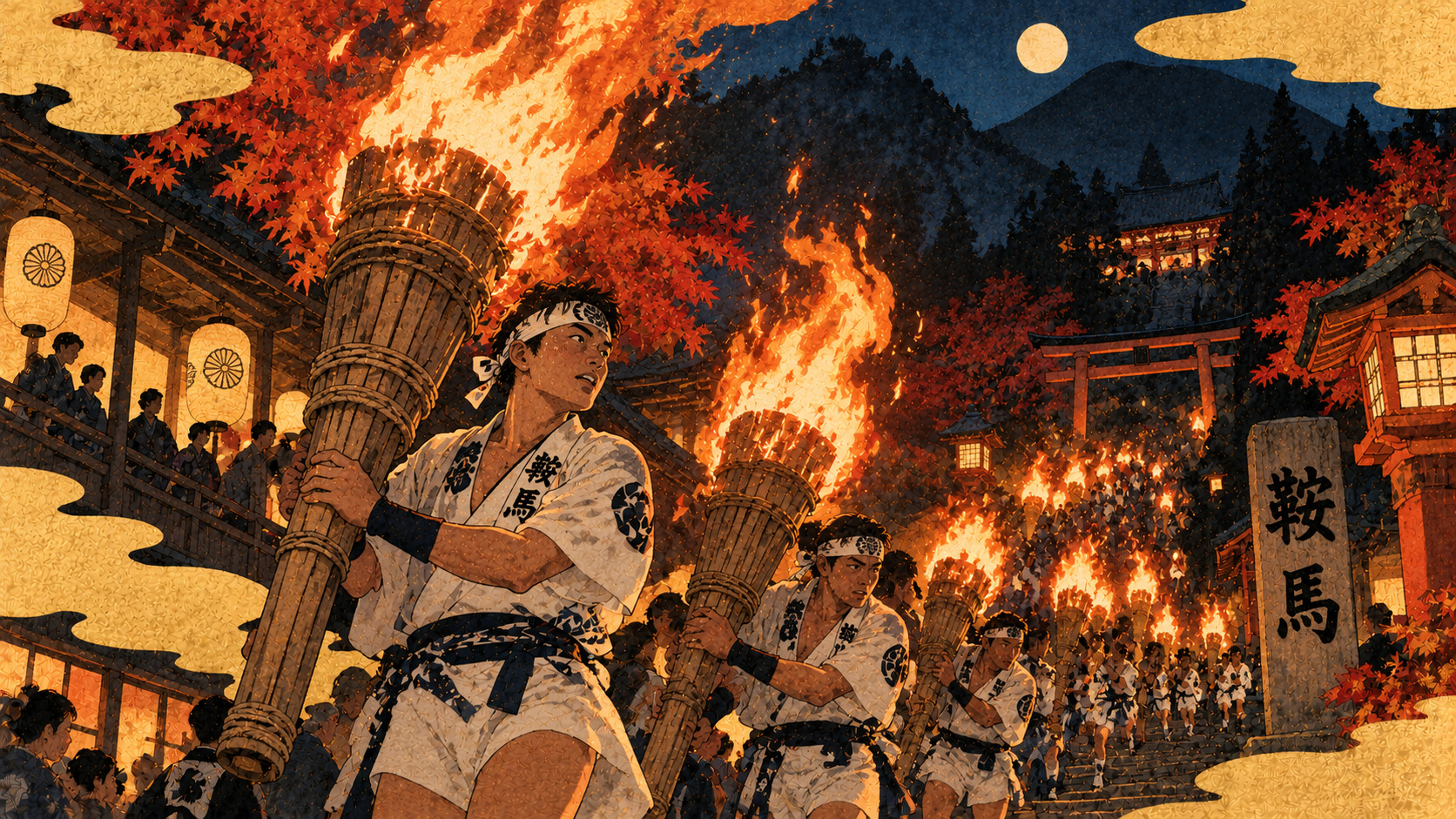
The fire is spectacular. The less visible achievement is a mountain community that keeps a difficult ceremony alive.
There is a difference between a fire show and a fire festival
On a narrow road in the mountains north of central Kyoto, the ritual begins not with a stage spotlight but with a call to the neighborhood. Household fires are lit. Children move through the streets with smaller torches, followed by older participants carrying much larger bundles of flame. Voices cry saireiya, sairyo. As darkness settles around the wooden buildings, the village seems to change scale.
It is one of Japan’s most arresting annual scenes. But to approach the Kurama Fire Festival as mere spectacle is to miss its reason for existing. It is the annual festival of Yuki Shrine, a Shinto sanctuary in Kyoto’s Sakyo Ward, and a religious rite carried by the people of Kurama. The official Kyoto city listing scheduled its 2026 observance for October 22, from 6 p.m. past midnight. This feature is based on documented ritual practices and official plans; it does not claim an eyewitness account or independently verified outcome for that evening.
Why 940 still matters
The ceremony’s traditional origin dates to 940, during Japan’s Heian period. According to Kyoto’s municipal accounts, the deity Yuki Myojin was brought from the imperial palace precincts to the northern mountain settlement. Villagers received the deity with torches and household fires, an event remembered in the ceremony performed today. This is an origin tradition, not proof that every movement of the current procession has remained unchanged for more than a millennium.
The political climate of the era matters. The Heian court faced upheaval and anxieties about disease, earthquakes and rebellion. Religious rites to protect the capital were inseparable from the political imagination of the day. A shrine on the route into Kyoto’s northern mountains could signify protection as well as worship. In the narrative preserved at Kurama, fire is simultaneously a practical escort and a ceremonial welcome.
The shrine within a temple mountain
Kurama is widely known for its Buddhist temple, Kurama-dera. Yet the Fire Festival belongs to Yuki Shrine, not to the temple as a single interchangeable institution. Kurama-dera’s own calendar calls it the autumn festival of the shrine located on the mountain. Maintaining that distinction is important: the two sites inhabit a shared landscape but have separate histories and religious functions.
Kyoto City identifies the shrine’s deities as Onamuchi-no-Mikoto (大己貴命) and Sukunahikona-no-Mikoto (少彦名命). The site also contains notable architecture. Its worship hall, listed as an Important Cultural Property, is associated with a reconstruction in 1610 under Toyotomi Hideyori. Its unusual divided arrangement accommodates the precipitous terrain, an architectural response to the mountain that gives the shrine meaning even on nights without fire.
The choreography of a village
The Sakyo Ward account starts the ceremony at approximately 6 p.m. with the announcement jinji ni mairasshare—a call that the sacred observances are commencing. Fires are lit outside homes. Young children carry small torches, older children larger ones, and adults shoulder immense burning structures. Processions move along the road and gather near the temple’s gate before the later portable-shrine rite.
Kyoto’s municipal description notes that some large torches weigh around 100 kilograms. That is an indication of the physical scale involved, not a uniform specification for every torch. The most revealing aspect may be the logistics: how to carry a fire of that size through a mountain village, how to coordinate movement and who knows when the lane must be cleared. In pictures, the ceremony can resemble controlled chaos. In practice, it depends on inherited roles, rehearsal and attention.
The shouted refrain is neither a soundtrack added for visitors nor a generic battle cry. It belongs to this procession and its community. So too does the participation of different age groups. The ceremony offers a literal way to see cultural transmission: the small torch comes before the larger torch, and the responsibilities of adulthood do not appear all at once.
The label “strange festival” tells only half the story
Tourism guides often place Kurama among Kyoto’s so-called three great unusual festivals. The label accurately signals that visitors will see something striking, but it risks turning religious life into novelty. For participants, the relevant questions are often less theatrical: whether the route is clear, whether the fire is managed safely, whether the community can continue the same obligations next year.
A Kyoto Fire Department account of the 2025 festival describes safety operations that ran from the afternoon road closure until around 1 a.m. the next day. That record is evidence of the infrastructure needed to hold such a ceremony; it is not a report of what happened in 2026. The shrine rite becomes possible through cooperation between residents, emergency personnel and transportation authorities, often invisible in the most widely shared photographs.
What happens when the world comes to watch?
The city’s 2026 festival listing warned of vehicle restrictions starting at 3 p.m. between Kibuneguchi and Kurama Onsen, with parking areas closed. Kyoto Bus announced a special outbound service from Kibuneguchi to Kokusaikaikan subway station and partial suspensions on regular routes. The company also cautioned that changes or cancellations could follow severe weather or a reduced-scale observance. None of those notices establishes the actual size or attendance of the October 22 procession.
Such restrictions reveal a tension affecting historic festivals well beyond Kyoto: greater international visibility can help sustain cultural interest while bringing pressure to spaces never designed for unlimited crowds. Kurama’s streets are residential routes and sacred ground, not simply a free-standing entertainment venue. The obligation to protect residents, participants and visitors should come ahead of the perfect photograph.
Not frozen in time, but carried forward
A living tradition is not an object sealed inside a museum case. The population of a village can change, the demands on volunteers can rise, safety expectations can evolve and travel can make local ceremonies global attractions. Continuity therefore requires adaptation as well as fidelity. Asking how Kurama’s residents carry that responsibility is more illuminating than merely counting centuries.
There is a reason the flames hold attention: the contrast of orange against a blue mountain night is unforgettable. But the true story is the chain of human choices behind that image. The fire is lit for a deity, carried by neighbors and passed between generations. What makes Kurama’s festival extraordinary is not simply that it has a thousand-year origin story. It is that people must decide, every October, how to make it live again.
Sources and reporting limits
No independently confirmed after-event account, attendance figure or incident tally for October 22, 2026 was available at the reporting cutoff. Origin claims are identified as tradition; historic operations and announced plans are kept separate. No on-site reporting or original interviews were conducted.
- Kyoto City Official Travel Guide: 2026 Kurama Fire Festival
- Kyoto City, Sakyo Ward: Kurama Fire Festival
- Kyoto City: Yuki Shrine and its architecture
- Kurama-dera: Annual rituals
- Kyoto Bus: 2026 service arrangements
- Kyoto Fire Department: 2025 operational record
- Kyoto Prefecture Tourism Federation: Festival listing