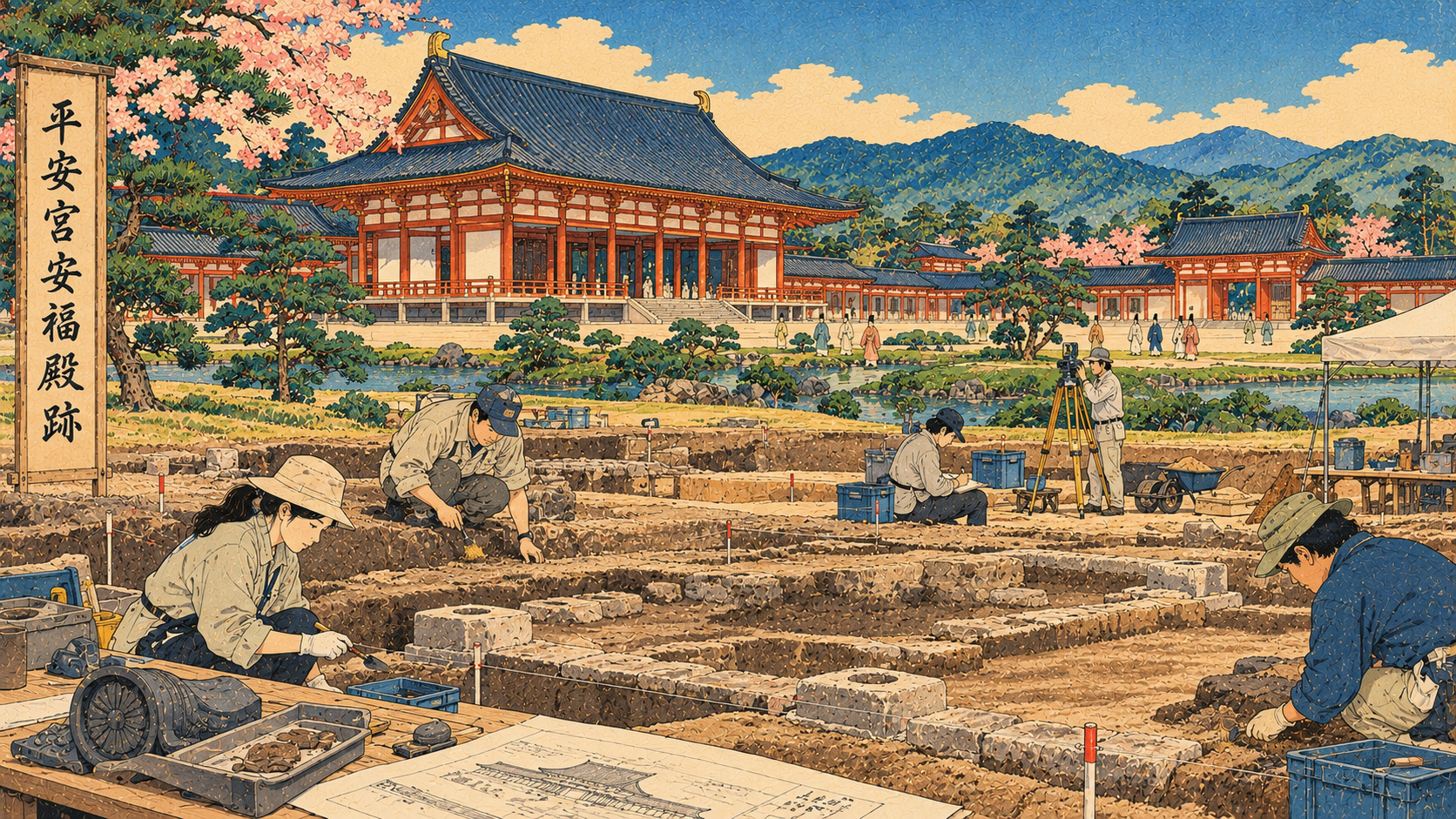
The find is not an intact palace. A channel that carried water from its eaves may help locate a building lost for centuries.
The palace beneath an ordinary Kyoto neighborhood
In a residential district of modern Kyoto, archaeologists have identified material traces of a palace complex once central to imperial life. On October 23, the city reported features associated with Anpukuden, an important building in the residential compound of the Heian Palace, as well as remains of the corridor enclosing its inner precinct. Excavation began in September. The surviving evidence is less theatrical than an intact royal hall: rainwater drainage channels and structural traces in the earth. Yet those marks matter precisely because most of the buildings themselves have disappeared.
A drainage channel can be a historical document
Kyoto City specifically identifies an amedamizo, a channel designed to collect water falling from a building’s eaves, associated with Anpukuden. It also identifies remains of the inner enclosing corridor and a corresponding drainage feature. Archaeologists can use their alignment, relationship to surrounding layers, and comparison with earlier excavation records to investigate where buildings stood. What has not been announced is the recovery of an intact palace, a complete architectural plan, or a fully dated reconstruction of Anpukuden. Treating a ditch as a clue, rather than as a complete building, is the beginning of responsible archaeological storytelling.
A city, a palace complex, and the emperor’s residence
Kyoto became the imperial capital in 794 under Emperor Kanmu. The purpose-built city of Heian-kyō included an extensive northern palace complex, Heian-gū, containing governmental and ceremonial facilities. Within that complex stood the Dairi, the imperial residential precinct. Anpukuden was an individual building inside the Dairi. The distinctions are essential: archaeologists have reported new evidence from a section of the residential compound, not the first discovery of the whole Heian Palace. The same modern name Kyoto can obscure how different the early capital’s planned layout was from the city visitors encounter today.
The architecture of separation
Historical diagrams and decades of excavation suggest that the imperial residential compound had an inner enclosed precinct and an outer boundary. Its southern areas were associated with major court ceremonies, while other sections served everyday imperial life and the residences of palace women. The inner corridor was part of a system for organizing movement, enclosure and access. A corridor foundation or its drainage line is therefore not merely an engineering remnant. It potentially gives scholars a fixed point for checking the position of other spaces described in plans and texts. Exact interpretations, however, depend on dating and the wider archaeological context.
Why a palace could vanish
The imperial compound was a wooden architectural environment repeatedly threatened by fire, repairs and changing patterns of political life. Kyoto’s archaeological records discuss a destructive palace fire in 960 and traces of burned building materials uncovered in earlier investigations. The Heian Palace was damaged and rebuilt repeatedly; following a major fire in 1227, the old Dairi was not restored. Land use changed, and districts once attached to the center of imperial government became part of an evolving city. The disappearance of the buildings does not mean that every trace vanished from the ground.
Literature is not an excavation plan
The Heian court survives vividly in literature, especially The Tale of Genji and The Pillow Book. Their enduring fascination can make it tempting to picture the excavation as an opening into a fully knowable literary world. That would go too far. Literature preserves observation, convention and invention; surviving diagrams can reflect later copying and revision. Archaeology adds a separate form of evidence: physical location, construction sequences, repairs and destruction. The strongest history emerges when those records inform one another without pretending that a story is a blueprint or that a reconstructed image is a photograph of the past.
Decades of careful work, not a discovery from nowhere
Research into the palace precinct did not begin in September 2026. Kyoto archaeologists conducted work in and near the Dairi long before the present announcement, identifying parts of the enclosing corridor, gates, foundations and fire-related deposits at different sites. One earlier excavation report documents corridor construction, repairs and material interpreted in connection with the 960 fire. The accumulation of relatively small trenches and observations has allowed maps of the former palace to be tested against the modern street grid. The newly reported Anpukuden-associated feature adds evidence to that work rather than replacing it.
What makes the location difficult
Unlike a remote ruin surrounded by open land, the Heian Palace site sits beneath a living urban neighborhood. Archaeologists work with limited plots, construction schedules, preservation requirements and the ordinary needs of residents. The result is a patchwork of evidence. Some remains survive well enough to map; others have been disturbed, rebuilt over or left unexamined. That makes modest discoveries unusually valuable. A short exposed length of drainage feature may help tie a new observation to a corridor found decades ago, refining the broader reconstruction without requiring an excavation of the entire district.
A chance to see archaeology at work on October 31
Kyoto City has scheduled a public site briefing for Saturday, October 31, 2026, from 10 a.m. to noon and 1 p.m. to 3 p.m. Admission is free and no reservation is required. Visitors must gather first at the designated Historic Site of the Heian Palace Dairi Ruins in Tanaka-chō, Kamigyō Ward, near number 435-1; the actual excavation near 450-1 is a separate location. The meeting point is about five minutes on foot from the Senbon-Marutamachi city-bus stop. There is no visitor parking. Sturdy footwear is advisable, and access may be managed in groups.
What could change the public viewing
The city says light rain will not automatically cancel the event. If a weather warning for southern Kyoto Prefecture is in effect as of 7 a.m. on October 31, the briefing will be cancelled. The field surface may be uneven and access is limited. These practical details matter because archaeology stories can generate travel interest beyond their intended audience. Readers should consult Kyoto City’s announcement before making the trip and should not go directly to the excavation entrance rather than the designated gathering point.
The unanswered archaeological questions
The newly identified traces raise questions about construction phases, exact chronology and how Anpukuden and neighboring buildings were arranged and used over time. Kyoto City’s short public announcement does not resolve all of them. Nor does it provide a basis to attach this particular excavated feature to a specific scene from court literature. Future reports, artifacts, stratigraphy and comparisons with historical palace diagrams will determine how much can be concluded. The published picture accompanying this article is an interpretive, AI-generated editorial illustration—not a documentary image or an authenticated reconstruction of the 2026 trench.
Kyoto’s history is larger than its surviving monuments
Kyoto is famous for temples, shrines and architectural treasures that can still be visited. The former imperial precinct offers a different kind of heritage: a city-sized absence made legible through careful measurement. A channel that once carried water off a roof can become evidence for a building whose timber vanished centuries ago. Archaeology gives the public a way to encounter the ancient capital without confusing certainty and imagination. Beneath ordinary streets, the vanished city still has things to say—if they are described with precision.
Sources and reporting method
Based on Kyoto City’s October 23 release and earlier archaeological records. The complete building plan and precise dating of the newest features are not established here. No independent site visit or interviews were conducted.
- Kyoto City: October 23 excavation announcement and site briefing
- Kyoto City: archaeological field-briefing archive
- Kyoto City: earlier excavations and fire evidence
- Kamigyo Ward: history of Heian-kyo and its palace
- Kyoto City Archaeological Research Institute: palace ruins guide
- Kyoto City Archaeological Research Institute: Dairi excavations overview
- Kyoto City Archaeological Research Institute: western corridor excavation