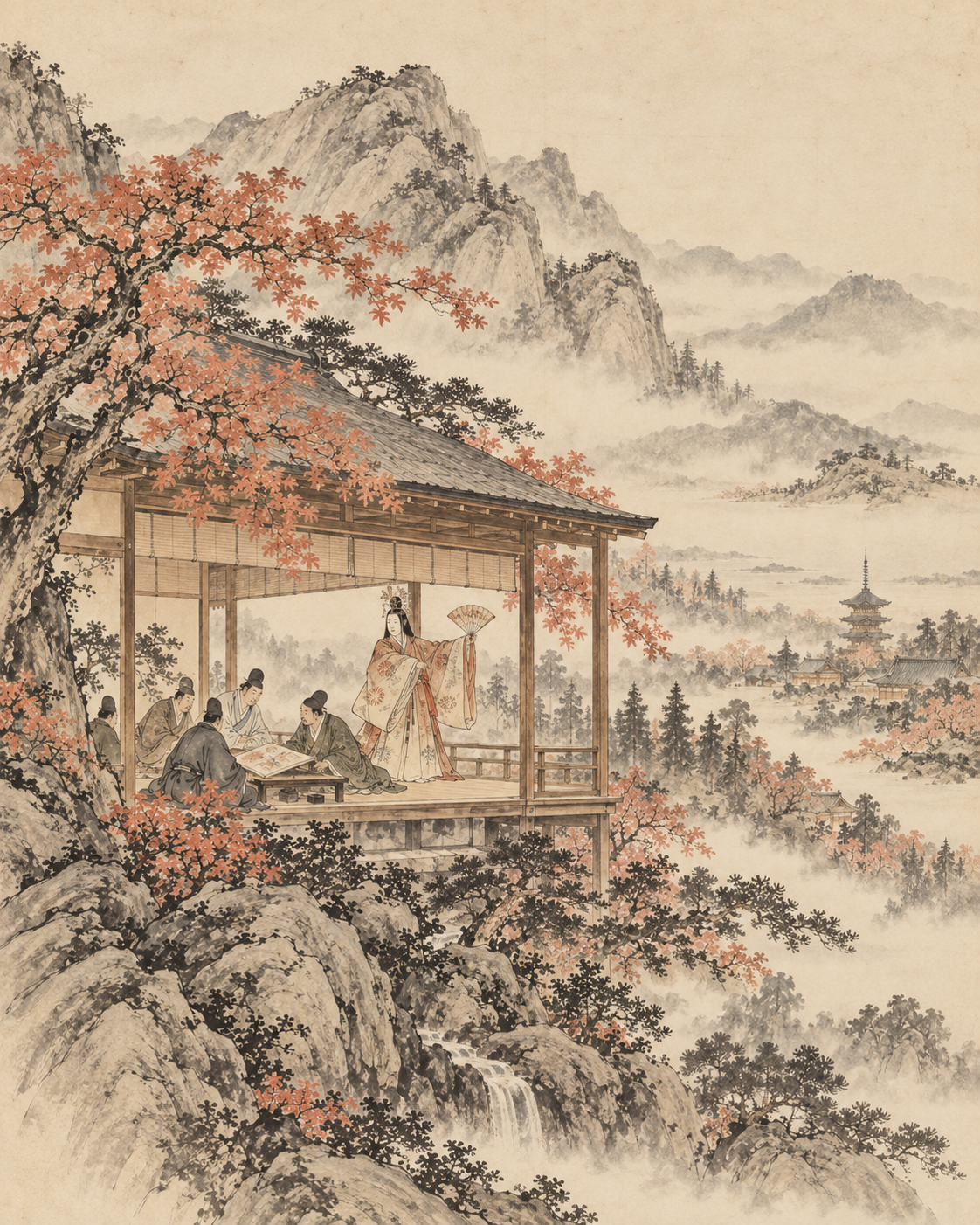
A thousand-year-old novel, a performance tradition more than six centuries old, and a British translator who helped reshape Western understanding of both will meet at Kyoto National Museum this autumn.
On October 25, the museum will hold an international symposium titled The Tale of Genji and Noh: New Narrative Interpretations through English Translation. The event runs from 1 p.m. to 5 p.m. in the Heisei Chishinkan Lecture Theater. Capacity is 200, attendance is in person only, and there will be no online stream. Admission to the symposium itself is free, but participants need a same-day ticket to the special exhibition The Tale of Genji: Radiant Culture of the Japanese Imperial Court. Advance registration opens October 6 and closes October 21 unless the event fills earlier.[1]
The subject is “Genji Noh”—Noh plays whose source material comes from The Tale of Genji. Kyoto National Museum points to works including Aoi no Ue, Nonomiya, Yūgao and Genji Kuyō as examples of how the Heian court novel was reinterpreted through medieval performance.[2]
A 250-object exhibition opens first
The symposium accompanies Kyoto National Museum’s autumn special exhibition, which runs from October 6 through November 29. The museum describes it as the largest exhibition of its kind to date, bringing together about 250 cultural properties across the Kyoto and later Tokyo presentations.[2]
Among its anchors is the National Treasure Genji Monogatari Emaki, the oldest surviving pictorial representation of the tale and one of Japan’s canonical picture-scroll masterpieces. Different scenes will rotate roughly every two weeks. The exhibition also includes manuscripts associated with Fujiwara no Teika’s textual tradition, the Kyoto museum’s Moriyasu-version Genji scroll, and Tawaraya Sōtatsu’s National Treasure screen paintings based on the Sekiya and Miotsukushi chapters.[2]
For Kyoto, one especially important section concerns Genji and Noh. The museum will recreate stage presentations using reconstructed Noh costumes for Aoi no Ue in the first half of the exhibition and Tama-kazura in the second, alongside masks and other performance material.[2]
How did Murasaki Shikibu’s novel become Noh?
The Tale of Genji was written in the Heian period by Murasaki Shikibu, who served Shōshi, daughter of the powerful Fujiwara no Michinaga. The work follows Hikaru Genji and a wide constellation of women and families through love, status, loss, aging and the politics of court life.[2]
By the medieval period, Genji had become more than a book to read. It became honsetsu—source narrative material—from which Noh playwrights could build new works.
The transformation was radical. Rather than dramatizing the enormous novel scene by scene, Noh often isolates a remembered emotion or unresolved attachment. In Aoi no Ue, the jealousy and spirit possession associated with Rokujō no Miyasudokoro become the center. Nonomiya reimagines memory and attachment around the shrine at Sagano. Yūgao revisits a woman whose life in Genji was brief. Genji Kuyō incorporates later legends about Murasaki Shikibu herself.
These plays are evidence not only of what Genji originally said, but of what medieval audiences thought the tale meant.
Arthur Waley is the bridge between the two
The symposium’s emphasis on English translation comes from a remarkable historical connection: Arthur Waley, the British scholar and translator who helped establish both Genji and Noh in English-language literary culture.
Kyoto National Museum notes that Waley, then working at the British Museum, was inspired to attempt a complete English translation of The Tale of Genji after encountering paintings based on the story. His multi-volume The Tale of Genji, published from 1925 to 1933, generated intense interest in Europe and North America.[1]
But immediately before that project, Waley had published The Nō Plays of Japan in 1921, translating Noh texts for English readers.[1]
That sequence matters. For many Western readers, Noh and Genji were not introduced by completely separate intellectual traditions. They passed through the interpretive choices of the same translator within a few years of one another.
Four speakers, four ways into the problem
The October 25 program is built around four presentations.
Maiko Yamanouchi, head of Kyoto National Museum’s Research and International Cooperation Office, will speak on “Noh and Art of The Tale of Genji,” connecting the exhibition’s masks, costumes and visual material with the performance tradition.[1]
Noh performer Noboru Yasuda of the Waki-kata Shimogakari Hōshō school will examine the power of “narration” through Noh, Arthur Waley’s translation and The Diary of Murasaki Shikibu.[1]
Monica Bethe, director of the Medieval Japanese Studies Institute, will address The Tale of Genji as source material for Noh. Richard Emmert—professor emeritus at Musashino University, founder of Theatre Nohgaku and a Kita-school shimai instructor—will discuss creating and performing Genji Noh in English.[1]
Kyoto National Museum senior specialist Marisa Rinne will moderate. Museum director Nobuyuki Matsumoto will open the event, and deputy director Tomoki Nishii will give closing remarks. A joint discussion follows the four papers.[1]
A translation meant to be read is not the same as one meant to be performed
Translating Genji into English requires decisions about court rank, honorifics, poems, omitted subjects, clothing, ritual and a narrative style that often leaves relationships implicit.
Translating Noh adds another layer. The text is sung and spoken inside a structure of music, timing and movement. A sentence can be elegant on the page and fail on stage because it is too long, rhythmically awkward or impossible to understand at performance speed.
That difference is one of the symposium’s most fertile themes. Waley’s literary English can reveal one set of interpretive choices. Performing Genji-derived Noh in English forces another: what belongs to semantic meaning, what belongs to sound, and what belongs to physical form?
Translation can create interpretation, not merely lose information
Classical translation is often judged by what it fails to preserve. The symposium’s subtitle takes a more productive position: translation can open new narrative interpretations.
Japanese may leave a relationship or subject unstated where English pressures a translator to specify it. Choosing a single English subject can clarify a passage for a new audience while simultaneously narrowing an ambiguity that existed in the Japanese.
Noh itself can be understood as another act of translation. It compresses a vast prose narrative into a short performance, turns characters into remembered or ghostly presences, and transfers emotion into chant, dance, masks and costume. The transformation tells us what medieval adapters considered worth preserving.
Art has been translating Genji for centuries too
The exhibition places this performance discussion inside a much larger history of cultural translation.
The National Treasure Genji scroll transformed prose into composition, color, line and decorated calligraphy. From the Momoyama period onward, Genji imagery expanded onto folding screens and sliding doors and became part of wedding furnishings. Edo-period audiences played Genji incense games, decoded Genji-pattern motifs and consumed ukiyo-e adaptations that relocated the classical tale into contemporary life. Ryūtei Tanehiko’s Nise Murasaki Inaka Genji became a publishing sensation.[2]
In that sense, the history of Genji is not simply the history of preserving an original text. It is also the history of repeatedly moving that text into a new medium.
Why Kyoto matters
The social world of The Tale of Genji is rooted in the Heian capital, and Murasaki Shikibu lived within Kyoto’s court culture. Holding the exhibition and symposium here gives the discussion a geographic resonance that a generic conference room cannot.
Kyoto National Museum is currently operating only its gardens and outdoor displays through October 4 while galleries prepare for the exhibition. The special exhibition opens October 6—the same morning registration for the symposium begins.[3]
The 200-seat symposium has no online stream and requires a same-day exhibition ticket. That structure effectively asks participants to encounter the objects—the scrolls, masks, costumes and manuscripts—before or around a discussion of how words and stories change when they cross media and languages.
Why a thousand-year-old work remains present tense
The Tale of Genji is not a classical object sealed in one historical moment.
Murasaki Shikibu wrote it in the Heian period. Medieval Noh reinterpreted it. Early modern painters and publishers visualized and popularized it. Waley carried it into 20th-century English. Contemporary performers now ask how Genji-derived Noh can live in another language on stage.
Each transformation can be described as a departure from an original. It can also be understood as another layer in the work’s reception history—a record of what another age found inside Genji.
The question Kyoto National Museum will pose on October 25 is therefore larger than how to preserve a millennium-old story.
When a story crosses into another language, another body and another century, what disappears—and what becomes visible for the first time? The durability of Genji may lie partly in the fact that every age has been allowed to answer that question again.
