A rare meeting of words and pictures
On November 3, Kyoto National Museum begins the second installation of The Tale of Genji: Radiant Culture of the Japanese Imperial Court. The date is more than an administrative change. For the first time, five surviving manuscript volumes associated with the textual tradition established by the poet Fujiwara no Teika will be displayed together. At the same time, the National Treasure Hashihime scene from the illustrated Genji handscrolls, on loan from the Tokugawa Art Museum, enters the galleries for a brief display ending November 15. These two types of survival—a written text and a painted interpretation—tell different parts of Japan’s literary history.
The novel was never just about a shining prince
Murasaki Shikibu composed The Tale of Genji in the early eleventh century, within the intellectual and social world of the Heian court. Its hero, Hikaru Genji, is memorable for his beauty, relationships and political fortunes, but the work is far more than a pageant of romance. It examines power, emotional dependence, reputation, grief, aging and the consequences of decisions that cannot easily be undone. The final Uji chapters shift away from the dazzling early life of Genji toward a subtler atmosphere of uncertainty. That movement matters particularly to the Hashihime scene newly on display in Kyoto.
Why Hashihime matters
Hashihime belongs to the Uji sequence, in which the story’s center of gravity moves to younger characters and a more secluded emotional world. The daughters of the Eighth Prince, their choices and the men drawn to them illuminate desire and restraint in a society where social position controls much of a person’s fate. In a handscroll, figures are not simply illustrations of a plot. Their placement within rooms and the spaces between them can suggest relationships that prose leaves unresolved. Visitors can read the painting as an interpretation of literature, not as a photograph of eleventh-century life.
The painting came later than the story
The surviving National Treasure Tale of Genji scrolls date to the twelfth century, later than Murasaki’s own lifetime. They are precious precisely because they record how early readers and painters understood the narrative. Yamato-e conventions such as the elevated, roofless view into interiors and the stylized depiction of aristocratic faces were artistic choices. They organize attention and imply emotion. A modern reader who expects cinematic realism might miss the fact that patterned screens, color and a character’s position in a room can carry as much meaning as facial expression.
An author’s original manuscript is lost
No autograph manuscript written by Murasaki Shikibu survives. Every modern edition depends on material copied, transmitted, compared and edited by generations of readers. Manuscripts can differ because scribes made mistakes, abbreviated passages or followed divergent models. These are not merely obstacles to recovering an ideal original; they are also evidence for the centuries in which the book was read. The museum’s first gallery examines that textual history, showing why a single printed version of Genji conceals a complicated chain of human decisions.
Five Teika-associated volumes together
Fujiwara no Teika, the celebrated poet and editor of the late twelfth and early thirteenth centuries, is central to the so-called Blue Cover manuscript tradition. Kyoto National Museum says all five surviving Teika-associated volumes are assembled together for the first time, specifically November 3–15. They are not Murasaki’s own pages, nor do five volumes amount to the entire 54-chapter work. Their rarity makes them important evidence of medieval literary editing, the authority certain textual traditions acquired and the sheer contingency of survival.
The women who made court literature
The Heian court gave highly educated women both opportunities and restrictions. Murasaki served Empress Shōshi, a daughter of the powerful statesman Fujiwara no Michinaga. Courtly literary life involved poetry, letters, storytelling and knowledge of Chinese texts, all embedded in social relationships that could be intensely political. The achievement of Genji cannot be understood without the women who composed, circulated and discussed writing in these spaces. At the same time, the historical details of Murasaki’s own life remain incomplete; portraits created later should not be mistaken for contemporary likenesses.
How a book became Japanese visual culture
Over the centuries, Genji became a reservoir of motifs for painting, lacquerware, textiles, screens and theatrical works. Noh plays such as Aoi no Ue, Nonomiya and Yūgao adapted its characters and anxieties into an art of presence and recollection. The Kyoto exhibition includes commentary traditions and later visual representations, alongside a reconstruction using Noh costumes. In its second installation, the museum identifies Tamakazura as the focus of a reconstructed stage display. These examples make the exhibition about more than one famous manuscript: they show literature becoming part of public cultural memory.
Kunisada and the reinvention of Genji
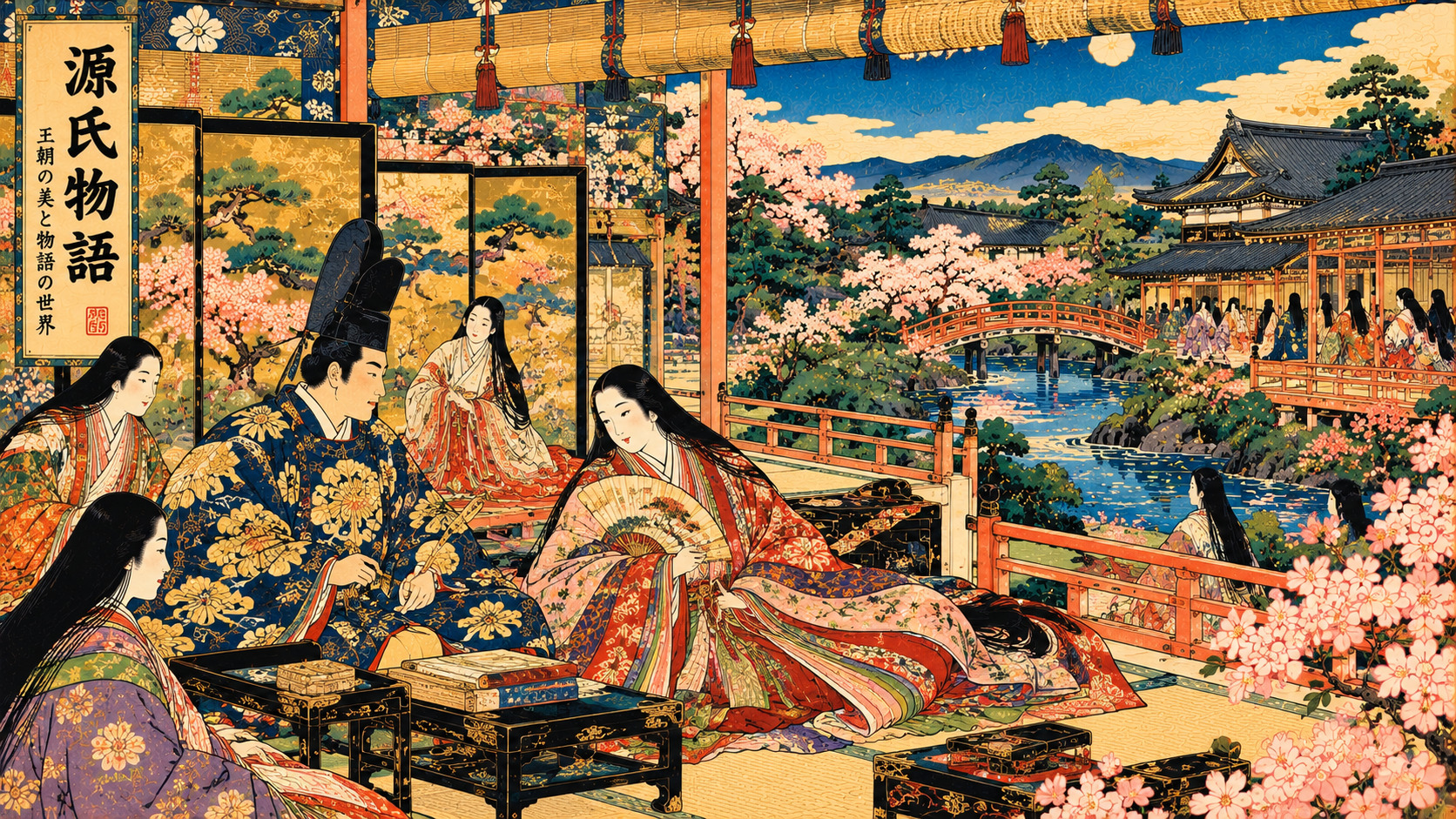
The story continued to change in the Edo period, when woodblock printing and popular theater brought Genji-related characters and imagery to wider audiences. Utagawa Kunisada, also known as Toyokuni III, created numerous prints connected to Genji fashions and adaptations. Such images do not necessarily reconstruct Heian life. Many translate classical themes into the dress, interiors and aesthetics of their own age. For this Japan.co.jp article, the accompanying Kunisada-inspired illustration is identified as a contemporary interpretation—not an exhibited masterpiece or a historical painting by Kunisada.
A world classic, without the simplistic superlative
Genji has become an international work through translations, literary scholarship and art-historical research. It is often promoted as the world’s first novel. That claim makes a useful conversational opening, but the label “novel” is historically contested, and older long narratives exist in other traditions. Genji’s lasting importance does not depend on winning a chronological competition. Its psychological complexity and the depth of its artistic reception give readers something more interesting: a record of how one narrative can remain recognizable through a thousand years of change.
Practical information for November visitors
The exhibition runs from October 6 to November 29 at Kyoto National Museum’s Heisei Chishinkan Wing. Part II begins November 3. Standard hours are 9:00 a.m. to 5:30 p.m., with admission ending at 5:00 p.m.; Friday opening extends to 8:00 p.m. with last admission at 7:30 p.m. Regular same-day admission is ¥2,200 for adults, ¥1,200 for university students and ¥700 for high-school students. Culture Day does not make this special exhibition free. Artworks rotate, so travelers should check the museum’s current exhibition list rather than assume any highlighted object remains on view throughout the run.
Another National Treasure arrives November 17
The Hashihime scene is scheduled for November 3–15; a different National Treasure scene, Yadorigi III, is scheduled for November 17–29. The five Teika-associated volumes appear together only November 3–15. These changes are not incidental marketing. Fragile works on paper and silk are vulnerable to light exposure, and limited display periods are a conservation necessity. A visitor arriving late in November will see a different exhibition from someone who visits on Culture Day. The precise dates matter as much as the exhibition’s overall title.
A classic survives through change
The most compelling lesson in Kyoto is not that a thousand-year-old text somehow reached modern readers untouched. It did not. Scribes copied it, medieval editors compared it, artists pictured it, performers transformed it, and translators wrestled with its language. The opportunity to see rare surviving pages beside a National Treasure painted scene makes that history material. Genji’s endurance rests partly in its ability to generate new interpretations, and partly in the patient conservation of objects that enable us to distinguish imagination from evidence.
Sources and reporting method
Based on published museum and exhibition-organizer documentation. No onsite viewing or original curator interview was conducted. Display dates and image permissions must be respected.