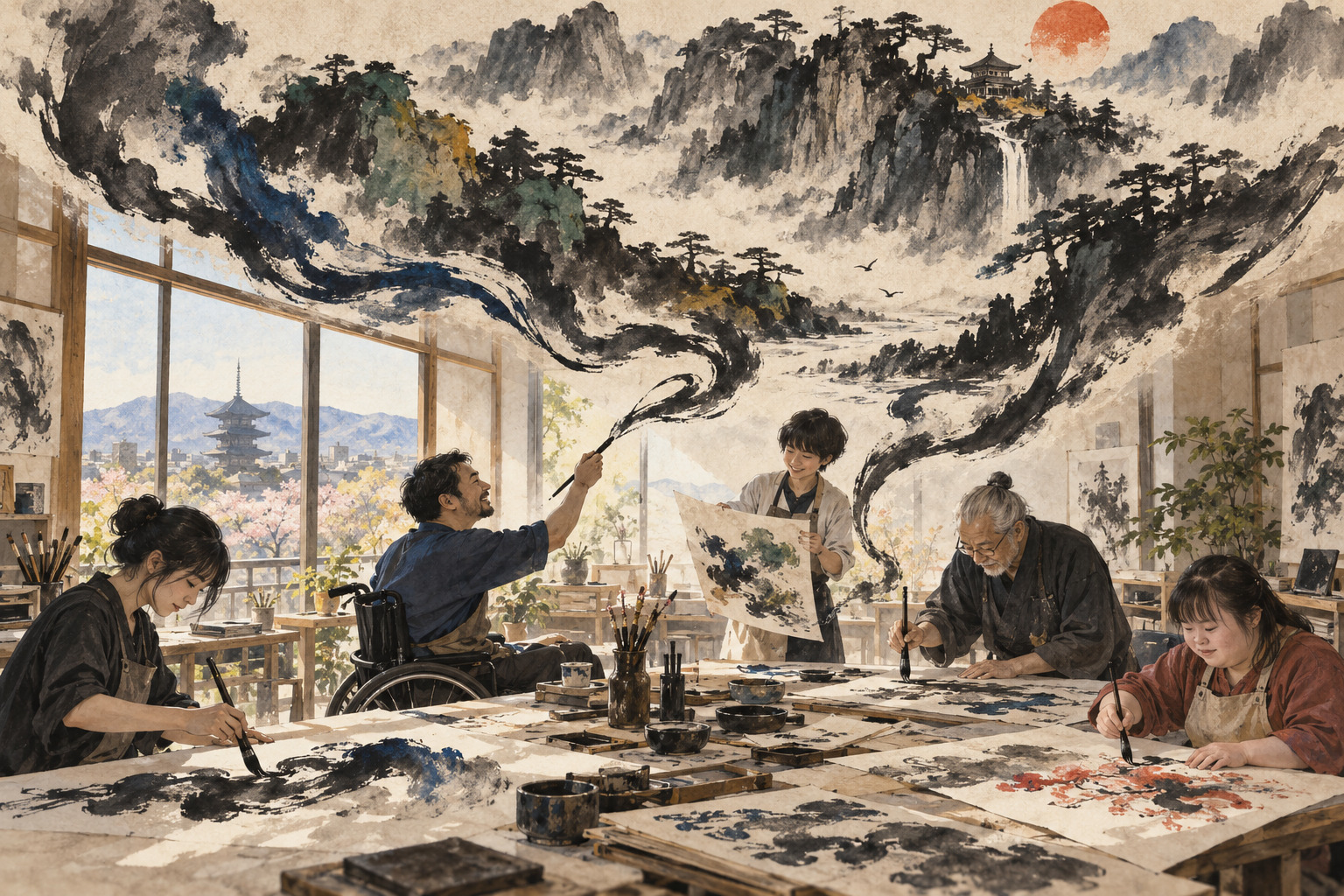
Artists need more than rooms in which to make art. They need somewhere to pay rent, store materials, find work, resolve a contract problem, cook dinner and meet people who understand the irregular rhythm of creative work. Kyoto’s policy compresses those needs into three words: housing, work and community. FLAT ArtSphere KYOTO, now taking shape in Misasagi in Yamashina Ward, is an attempt to connect all three inside one former dormitory.
The city opened the project’s website on September 8. A former university residence for international students is being renovated and will be operated by Flat Agency Co., Ltd. as a place for people working in arts and culture to live, create and interact. The plan contains 78 furnished rooms in three types. Shared facilities are to include a multipurpose hall, a café conceived as a social space, and a communal kitchen. Kyoto says the name “ArtSphere” imagines the residents tracing a single sphere together.[1]
The verb tense matters. What opened on September 8 was the website. The city says that facility information, recruitment details and videos introducing nearby cultural institutions will appear in stages. It has not yet disclosed who can live there, what they will pay or when the first residents will arrive. The project is concrete enough to examine, but not complete enough to describe as a thriving community.
From 80 dorm rooms to 78 artists’ rooms
The building already carries a history of communal life. When Kyoto sought an operator in November 2023, the property was identified simply as a former university international-student dormitory, eight minutes on foot from Misasagi Station on the Tozai subway line. The three-story, reinforced-concrete complex occupies a 3,778.50-square-meter site and has 2,050.89 square meters of floor space. It then contained 80 rooms. The main G building dates to 1965; the E and W wings date to 1994. Seismic reinforcement and large-scale repairs were carried out during fiscal 2014–16.[2]
The new plan lists 78 residential rooms. The released documents do not explain precisely how the other two former rooms will be used, so no conversion should be inferred. What is clear is the change from a collection of bedrooms to a mixed living and creative environment. The project website describes ateliers, a café, shared kitchen and hall: places to withdraw and work, encounter a neighbor, prepare food, show work and return to solitude.[3]
Kyoto selected Flat Agency as the prospective contracting party in December 2023 after a public proposal process; the company received 85.6 points out of 100. Flat Agency has a documented history in Kyoto’s student and international-student housing market and describes work with communal rental models. The resulting structure is a public-private one: the city sets the property and cultural-policy objective, while a private real-estate operator undertakes renovation and day-to-day management.[4][5]
The ambition is to stop separating the place where creative work is made from the place where a creative life is sustained. That is also where the project’s hardest questions begin.
More than a conventional artist-in-residence?
The official project site calls FLAT ArtSphere KYOTO an artist-in-residence. The term generally describes an arrangement in which artists spend a defined period in a place while making work, researching and meeting a host community. Kyoto Art Center has operated such a program since 2000, supporting emerging and younger artists and researchers who have a reason to create in Kyoto and can engage with local people.[6]
Judging from the language released so far, FLAT ArtSphere places greater weight on the ordinary conditions of living. Kyoto explicitly locates it within a settlement and migration initiative. “Housing, work and community” are not ancillary services but the factors the city says determine whether someone relocates. The policy object is therefore not only a completed artwork or a three-month exchange. It is the possibility that artists can establish lives in the city.
That shift responds to practical constraints. Creative work can involve sound, vibration, odors, large deliveries, specialist ventilation and long-term storage. Project-based incomes can fit poorly with ordinary rental screening. International artists may also confront language, guarantor and residency-status complications. Yet the current materials say nothing about soundproofing, chemicals or kilns, loading access, guarantor requirements, immigration support or whether all artistic disciplines can be accommodated. The significance of 78 rooms will depend on who is eligible and what kinds of work the building actually permits.
When cultural policy becomes migration policy
Kyoto began making the connection explicit in fiscal 2023, framing arts and culture as part of its response to a declining and aging population. In June of that year, the city placed a specialist settlement and relocation adviser inside KACCO, the Kyoto City Arts Support Center at Kyoto Art Center. The service covers not only homes but bases for production and cultural projects, invites property information from landlords and agents, and connects suitable cases to property matching by the nonprofit HAPS.[7]
In 2024, Kyoto fully launched Tadoritsuitara Kyoto, a website telling how artists, filmmakers, curators and performance professionals came to live in the city. A consultation desk, the search for suitable properties, narratives from people who moved, and now a 78-room residence form a developing chain—from the first thought of relocation to the community that might follow it.[8]
This is cultural development, but it is also population policy. City documents have associated a strong artist population with tolerance, openness, innovation and economic growth. That logic deserves scrutiny. Artists cannot be reduced to instruments for demographic repair or city branding. A serious evaluation will need more than the number of incoming residents and public events. It should ask whether residents obtain stable housing, usable production time, fair work, reciprocal local relationships and opportunities that survive after they leave.
Why Misasagi?
Misasagi lies apart from the celebrated visitor districts of central Kyoto. The Lake Biwa Canal passes through an area at the western edge of the Yamashina basin, close to the Higashiyama hills. The project’s own language emphasizes a slower everyday environment in which history is present without the spectacle of a major tourist site. Its access information places Misasagi Station about 15 minutes by train from Kyoto Station and about 45 minutes from Osaka Station.[3]
The location also connects the residence to a broader urban program. “meetus Yamashina-Daigo” aims to make the eastern districts a place where diverse people can live, learn and connect. Kyoto consolidated the direction and proposed actions in its March 2025 community plan. FLAT ArtSphere is intended to work alongside that initiative rather than function as an isolated artists’ dormitory. The project site anticipates exhibitions, workshops and talks connecting residents with local people, students, government and businesses.[9]
Genuine exchange cannot be measured by event totals alone. A neighborhood should not be treated merely as subject matter or as a ready-made audience. Residents must retain the freedom not to participate, while artists should not be expected to supply an endless stream of unpaid public programming in return for housing. Architecture can make encounters possible; it cannot manufacture trust.
| Confirmed in official material | Not yet confirmed |
|---|---|
| Former international-student dormitory; 78 rooms in three types; furniture and appliances; planned hall, café and shared kitchen; renovation and operation by Flat Agency | Eligibility; nationality, age or discipline rules; rent, fees and deposits; contract term; application and move-in dates; selection process; production restrictions; subsidies or reduced rents |
Seventy-eight private rooms, one “sphere”
The name carries two overlapping ideas. “FLAT” is the operator’s name, but the official concept also imagines people meeting on level terms, across status and occupation. “Sphere” refers to cultural workers drawing a shared surface through their relationships. The metaphor only works if the residence protects both halves of creative life: private time behind a closed door and voluntary exposure to other people in common space.
Renovation can produce rooms and corridors. It cannot by itself produce community. The decisive questions will sound mundane: Who participates in decisions? How are disputes handled? When is the hall open to neighbors? How are quiet residential hours reconciled with rehearsals and fabrication? Are residents customers, temporary guests or stakeholders? The rules governing kitchens, keys, noise and bookings may matter more than any launch event.
Kyoto has long sustained culture through a dispersed ecology of temples, workshops, schools, townhouses, universities, theaters and informal networks. The value of a new residence will not lie in using that history as décor. It will lie in translating cultural prestige into material conditions that allow today’s practitioners to continue living and working. The September 8 website launch was not a declaration of success. It was the entrance to a long experiment: whether 78 rooms can become more than inexpensive beds and more than a venue for occasional events.
- City of Kyoto, “FLAT ArtSphere KYOTO Website Opens”, September 8, 2026 — name, purpose, 78 rooms, planned facilities and operator.
- City of Kyoto, operator proposal for the former international-student dormitory, November 30, 2023 — structure, areas, original room count, construction dates, repairs and station distance.
- FLAT ArtSphere KYOTO official website — concept, creative and common spaces, Misasagi setting and transport estimates.
- City of Kyoto, operator-selection result, December 28, 2023 — prospective contractor and evaluation score.
- Flat Agency, “Work with Universities and Schools” — experience with student, international-student and communal rental housing.
- Kyoto Art Center, Artist-in-Residence Program — purpose and 2000 launch date.
- Kyoto Art Box, launch of the artist settlement and relocation consultation service, 2023 — specialist adviser, property information and HAPS coordination.
- City of Kyoto, launch of Tadoritsuitara Kyoto, July 31, 2024 — relocation narratives and consultation program.
- City of Kyoto, “meetus Yamashina-Daigo” — district-revitalization framework and 2025 community plan.
Editorial note: This report reflects primary materials available through September 10, 2026. It does not infer rents, opening dates, eligibility, selection procedures or operating rules that have not been published. Social-media claims that Kyoto University transferred the former dormitory to the city without charge were excluded because that detail was not verified in the formal city materials reviewed.