- Beyond the maple leaves: the art of imagining salvation
- A temple older than its familiar name
- The Buddha who looks back
- A painted welcome: Twenty-Five Bodhisattvas
- Ten realms, and an entire moral universe
- Taima Mandala Engi and the movement of an idea
- The faces of a lineage: Shōkū and Shandao
- The work behind a beautiful autumn
- Practical information: daytime treasures and separate night lights
- What the treasures keep asking
Beyond the maple leaves: the art of imagining salvation
The hillsides of eastern Kyoto draw visitors every autumn, but Eikandō offers a reason to look inward as well as outward. From November 11 to December 6, 2026, the temple’s autumn treasures exhibition brings Buddhist paintings and portraits into public view while its grounds, said to contain about 3,000 maples, enter the season for which they are famous. The most important story is not simply the color of the leaves. It is the way a religious community has pictured compassion, death and the possibility of liberation for centuries.
This year’s announced selection includes three designated Important Cultural Properties: The Descent of Twenty-Five Bodhisattvas, The Ten Realms and Taima Mandala Engi. It also includes portraits associated with Shōkū, an influential figure in the Seizan Pure Land tradition, and Shandao, a major Chinese Buddhist teacher. Together they trace the movement of beliefs between China, Nara and Kyoto and from scripture into image, ritual and memory.
This is a documented preview prepared for the November 11 edition. Exhibition plans are verified, but the report does not claim an opening-day visit, observe crowd sizes or predict exactly when leaves will reach their peak.
A temple older than its familiar name
The institution properly called Zenrin-ji traces its roots to the ninth century. Its own chronology says the monk Shinshō, a disciple of Kūkai, acquired the former residence of courtier Fujiwara no Sekio for a religious site in 853. In 863, the temple received imperial recognition and the name Zenrin-ji. Kyoto City’s tourist history gives 855 as its foundation year, a useful reminder that acquiring a site, establishing a temple and receiving an official title were not necessarily the same event.
For modern travelers it is easy to see a Buddhist temple as a single, uninterrupted tradition. Zenrin-ji’s history is more complicated. It began in a world closely associated with esoteric Buddhism and later developed into a major center of Pure Land practice. Its familiar name, Eikandō, comes from a monk who helped renew its religious life two centuries after its beginnings.
Buildings do not simply endure through time. The complex suffered destruction during the Ōnin War of the fifteenth century and was rebuilt in stages. Its survival is not proof that Kyoto escaped history; it shows how much labor is involved in carrying a religious institution through conflict, changing patronage and generations of repair.
Primary sources: 永観堂|歴史年表 · 京都市公式|永観堂・禅林寺の歴史
The Buddha who looks back
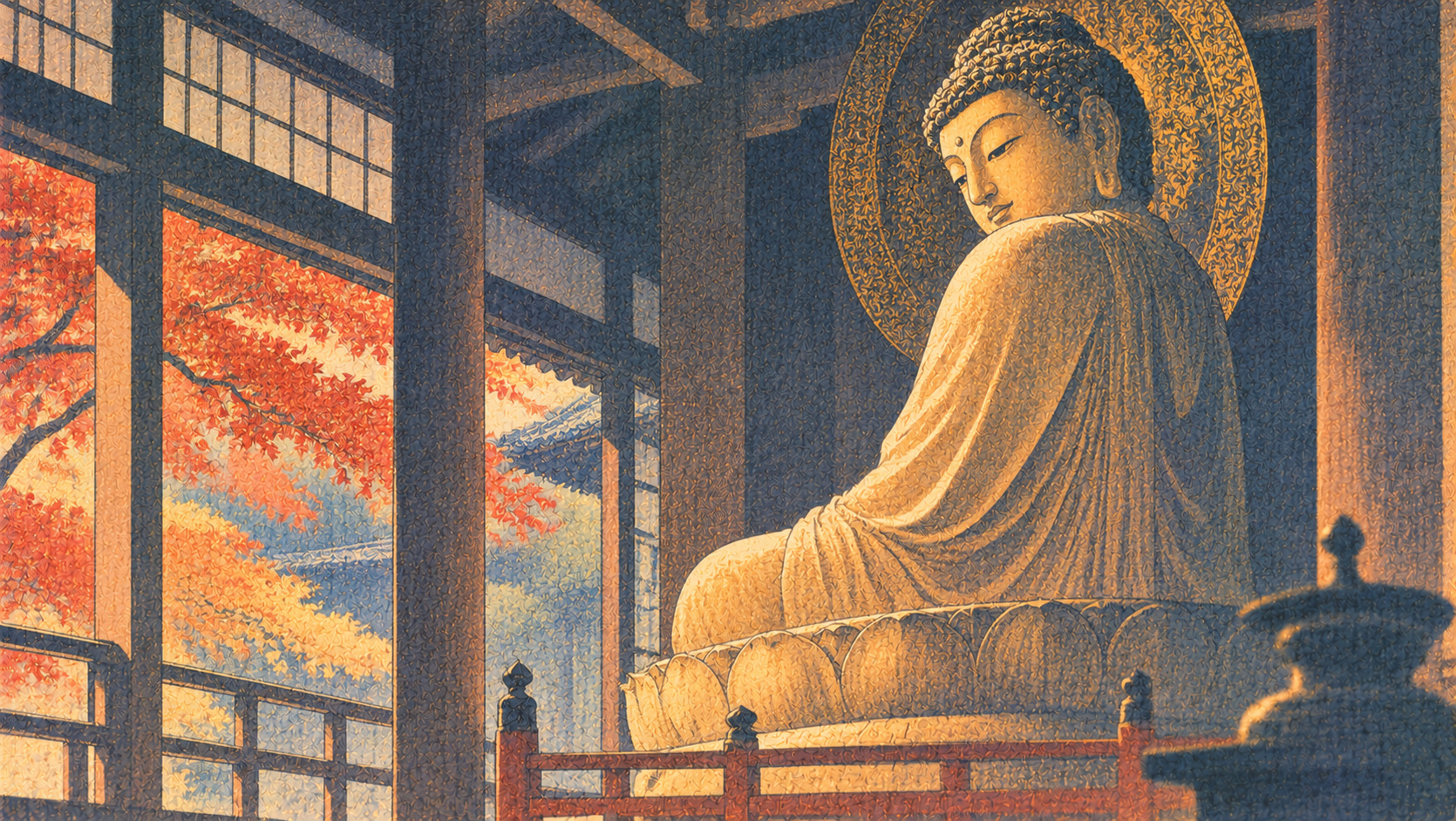
One of Eikandō’s best-known treasures is its principal standing image of Amida Buddha, famous for the unusual way its head turns to the left as though looking over a shoulder. Japanese visitors know it as Mikaeri Amida, the “Looking-Back Amida.” The pose has acquired meaning far beyond its technical qualities as sculpture.
Temple tradition connects the image to the monk Eikan (1033–1111). In an account dated to 1082, Eikan was walking around an Amida image while chanting the Buddha’s name when he experienced a vision: the figure stepped down and moved ahead of him, then turned back as the monk halted. The story belongs to religious tradition, not to independently demonstrable physical history. Yet it explains why an image of backward motion can signify attention to those who are slow or have fallen behind.
Eikan’s legacy was not limited to ritual. The temple chronology records his establishment of a treatment facility in 1097. Whether one approaches the Buddha as an object of devotion or of art history, this conjunction matters: the ideal of compassion was expressed in a sculpted form and also linked to an institution that cared for people.
A painted welcome: Twenty-Five Bodhisattvas
Among the announced Important Cultural Properties is a Kamakura-period painting known as The Descent of Twenty-Five Bodhisattvas. In Pure Land teaching, “descent” or raigō concerns the arrival of celestial figures to welcome the dying toward Amida’s Pure Land. The painting does not attempt a photographic rendering of the world. It gives form to a religious promise at one of life’s most vulnerable moments.
Eikandō’s exhibition commentary specifies that the depicted group excludes Kannon and Seishi and arranges the other twenty-five bodhisattvas densely across the surface. Because faces and bodies turn in varied directions, the temple suggests that the picture may once have hung behind a three-figure sculptural ensemble of Amida with attendants. That is a curatorial hypothesis, not a confirmed reconstruction of its original setting.
The work therefore asks readers to think about images differently. A painting could once have participated in worship with sculpture, chanting and architecture; it was not necessarily intended to hang alone on a neutral wall. A museum-style appreciation of composition is valuable, but the original religious use helps explain why that composition mattered.
Primary sources: 永観堂|2026年特別寺宝展・展示作品解説
Ten realms, and an entire moral universe
The Ten Realms, another Kamakura-period Important Cultural Property, organizes the possible conditions of existence within Buddhist cosmology. Six are conventionally described as hell, hungry ghosts, animals, fighting spirits, humans and heavenly beings; four further states relate to spiritual awakening. The temple describes a pair of hanging paintings, one centered on Amida and the other on Jizō.
Human existence and scenes of hell occupy a large portion of the imagery. Eikandō links their content to ideas familiar from Genshin’s Ōjōyōshū and the Jizō-jūō tradition. For a modern audience, the infernal details can appear sensational. But the painting also raises more difficult questions: how did religious teachers give visible form to suffering and ethical consequences in an era when many people encountered such ideas through ritual and images?
Placed conceptually alongside a welcoming raigō painting, The Ten Realms tells a richer story. One work imagines an arrival at liberation; another maps the moral conditions from which beings seek release. Their meaning does not depend on accepting that cosmology as literal fact.
Taima Mandala Engi and the movement of an idea
The exhibit also introduces Taima Mandala Engi, connected with a tradition surrounding the woven Taima Mandala at Taimadera in Nara. Eikandō dates its text to 1262 and attributes the writing, traditionally believed to be autograph, to Dōkan Shōe (1195–1264), a leading disciple in the lineage of Shōkū.
Its appearance in a Kyoto exhibition makes an important point about Buddhist art. Images moved together with narratives that explained their origins, authority and use. A mandala could become the subject of a written tradition, and a written tradition could help later audiences understand why an image deserved reverence and preservation.
The story also resists the notion that Japanese Buddhism developed in sealed regional compartments. The exhibition connects a Kyoto temple to religious traditions in Nara, teachers from China and doctrinal developments associated with the medieval Seizan movement.
Primary sources: 永観堂|2026年特別寺宝展・展示作品解説
The faces of a lineage: Shōkū and Shandao
The temple’s 2026 feature page describes a Muromachi-period portrait of Shōkū (1177–1247), also known as Seizan Kokushi, whose teachings shaped the Seizan tradition within Pure Land Buddhism. The same exhibition materials introduce a Muromachi-period representation of Shandao, the seventh-century Chinese monk whose writings profoundly influenced later Pure Land thought in East Asia.
These works are not snapshots of the men they depict. Religious portraiture records what later communities wanted to remember and transmit: the dignity of a teacher, the continuity of a lineage and the relationship between a person and doctrine. Clothing, gesture and attributes mattered because they helped place a figure within that inherited narrative.
Looking at the two portraits together can make the broader religious history more legible. Ideas cross boundaries, but they do not arrive unchanged. They acquire new institutions, languages, rituals and forms of artistic representation. Zenrin-ji is one place where those transformations became visible.
The work behind a beautiful autumn
Eikandō’s appeal to visitors rests partly on its landscape. Kyoto’s official tourism site describes approximately 3,000 maple trees across the grounds. Temple corridors, garden views and the multi-tiered pagoda create an unusually layered setting for autumn foliage. Yet the number is an approximate site description—not a certified count of red leaves on any particular November morning.
The visitor experience also depends on active preservation and crowd management. For the 2026 exhibition period the temple warns that the Garyūrō corridor will be closed, Senbutsu-dō will not be open, and the Tahōtō pagoda may close if weather or crowding makes access difficult. Particularly heavy attendance is anticipated later in November. A traveler following an older guide may therefore find a different route or a restricted building.
Eikandō explains that visitor fees support repairs to structures, care of the gardens and restoration of artworks, including designated cultural properties. Tourism and conservation are not automatically compatible, but this is one mechanism through which a season of intense attention may help keep a fragile heritage site functioning.
Primary sources: 永観堂|2026年秋の寺宝展・拝観案内 · 京都市公式|2026年秋の寺宝展
Practical information: daytime treasures and separate night lights
The autumn exhibition is scheduled for November 11 through December 6, 2026, with daytime entry from 9 a.m. to 4 p.m. and closing at 5 p.m. The temple’s main visitor guide and Kyoto City’s listing specify admission of ¥1,500 for adults, ¥1,000 for university and vocational students, and ¥800 for junior-high and high-school students. Visitors should recheck prices immediately before traveling because a promotional exhibition microsite still contains a conflicting adult figure.
The night illumination is a separate program running November 20 through December 6, with entry from 5:30 p.m. to 8:30 p.m. and closing at 9 p.m. Admission is separately charged; the temple lists ¥1,000 for junior-high students and older. Visitors cannot remain inside on a daytime ticket through the transition to the night program. The experience also differs: the nighttime opening includes the Amida hall and garden rather than the daytime exhibition as a whole.
No advance tickets are sold, according to the temple’s current guidance. Tickets are purchased for the day of the visit. Public transportation is strongly recommended, and the temple warns of vehicle-access restrictions. It can also close admissions early if crowds require it. The relevant details are practical rather than glamorous, but they prevent disappointment and help visitors respect a working religious site.
Primary sources: 永観堂|2026年秋の寺宝展・拝観案内 · 永観堂|English visitor guidance
What the treasures keep asking
The season will pass. The light through the maple leaves will change, and the garden will grow quieter. Eikandō’s art, however, has survived because generations of people saw more in these objects than decoration. The paintings and sculptures were ways of asking what compassion requires, how suffering might be understood and what it means to imagine help at the edge of death.
There is a productive tension between the temple’s two kinds of beauty. One is immediate: a red canopy over a path, an illuminated hall, a distant pagoda. The other demands time: reading a scroll’s figures, understanding why a monk was portrayed in a particular gesture, and recognizing that a painting once stood within a practice of chanting and worship.
To visit for the trees is natural. To leave having also encountered an argument about mercy, memory and the fragility of human life is to discover another Kyoto beneath the photographs. That is why the 2026 autumn exhibition deserves to be covered as cultural history, not simply as a seasonal attraction.
Sources and verification method
Temple and local-government records take precedence. Religious traditions, heritage designations and announced 2026 displays are distinguished from firsthand observations. Crowd counts and actual foliage conditions remain unverified.