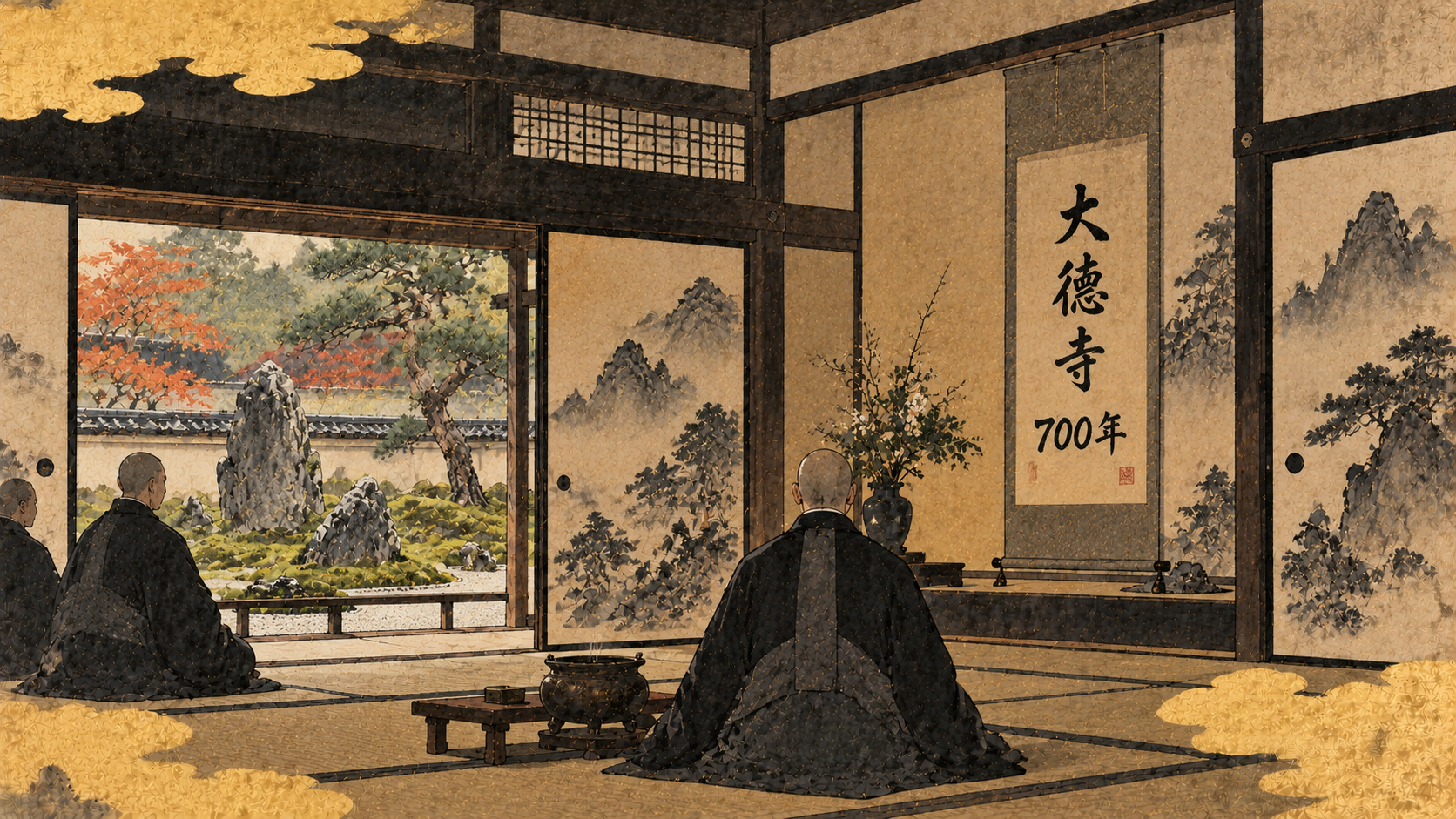
There is a restless monkey in an ink painting from medieval China, a Korean tea bowl that came to embody Japanese taste, a portrait of an unconventional Zen monk, and a statue of a tea master whose story is tangled with the power of a warlord. The objects in Tokyo's Daitokuji exhibition tell a surprisingly international and political history of an institution best known for religious discipline and quiet gardens.
At the Tokyo National Museum, the 700th-anniversary special exhibition Daitokuji: A Zen Temple Beyond Compare traces the Kyoto temple from its founding in 1326 to its entanglements with emperors, samurai and tea connoisseurs. The organizers list 14 National Treasures and 69 Important Cultural Properties. More revealing than the count is the journey linking them—and the fact that major exhibits change midway through the show.
A temple founded amid imperial conflict
Daitokuji grew from a Buddhist lecture hall established in Kyoto's Murasakino district by Shūhō Myōchō (1282–1337), the Zen master later honored as Daitō Kokushi. In 1326, he set the foundation for a religious institution that would gain the devotion of Retired Emperor Hanazono and Emperor Go-Daigo. Go-Daigo's praise of Daitokuji as a temple “beyond compare” supplies the anniversary exhibition's title.
These affiliations were not simply spiritual endorsements. A medieval Kyoto temple could be a center for scholarship, manuscripts, construction, patronage, travel and political prestige. Japan's Northern and Southern Courts clashed over legitimate rule; religious institutions survived and sometimes flourished through relationships with competing patrons. Daitokuji's art cannot be disentangled from that history.
The Chinese ink paintings that changed Japanese art
One of the exhibition's centerpieces is Guanyin, Monkey and Crane, a National Treasure by the Southern Song painter-monk Muqi, known in Japan as Mokkei. The work's brushwork, handling of animal forms and atmospheric space left a long afterlife in Japanese painting. Its status as Chinese art cherished in Japan also challenges any tidy notion that Japanese aesthetics emerged in isolation.
Crucially, the Muqi work is on view only in the first exhibition period, October 14–November 8. The latter half, November 10–December 6, features the turbulent Dragon and Tiger, an Important Cultural Property dated 1269 and attributed to Muqi. An attribution—indicated in Japanese by den—should not be confused with an independently established signature. Visitors who go in December expecting all the October highlights will be disappointed.
Ikkyū, beyond the children's stories
Ikkyū Sōjun (1394–1481) is famous in popular Japanese culture as a clever, irreverent monk. Yet his real life belonged to an era of war, doctrinal argument, literary experimentation and the fragile preservation of objects. An Important Cultural Property portrait of Ikkyū appears in the exhibition's first half. It invites a more complicated understanding than the familiar television and picture-book character.
The exhibition's historical essays retell how Ikkyū is said to have carried temple treasures while escaping conflict. Such traditions illuminate what later generations valued about him, though the details should not automatically be treated as independently verified eyewitness history. The survival of Daitokuji's treasures also depended on generations of less celebrated caretakers.
Nobunaga's funeral and Hideyoshi's public theater
In 1582, after Oda Nobunaga was killed in the Honnōji Incident, Hashiba Hideyoshi—the future Toyotomi Hideyoshi—staged an elaborate memorial ceremony at Daitokuji. The event had the weight of statecraft: it helped present Hideyoshi as a rightful inheritor of Nobunaga's political and military ambitions. The exhibition's own historical commentary encourages visitors to view the ceremony in this context.
Daitokuji also became a place where elite tea culture and the collection of paintings could signal authority. A portrait of Nobunaga, painted by Kanō Eitoku in 1584, is scheduled for the second exhibition period. A seventeenth-century portrait of Hideyoshi is displayed throughout. Distinguishing the date of a portrait from the lifetime of its subject matters: not every apparently contemporary face is a contemporary likeness.
Rikyū and a gate carrying a dangerous story
Sen no Rikyū (1522–1591) helped shape the ritualized aesthetics of Japanese tea. He also supported the construction of Daitokuji's monumental gate, with its upper story known as the Kinmōkaku. According to a well-known account, a statue of Rikyū placed there became part of the conflict that ended in his forced suicide under Hideyoshi. Historians must be cautious about reducing that political rupture to a single offending object.
The Tokyo exhibition recreates the space of the normally inaccessible gate and presents Buddhist images housed there, including a seated Shakyamuni, attendant figures of Kāśyapa and Ānanda, and a standing statue of Rikyū. One telling detail: the Rikyū statue's head dates to 1840 and its body to 1869. It is an object of later remembrance, not a sculpture made from life during the sixteenth century.
A Korean bowl at the center of Japanese tea taste
The National Treasure tea bowl Kizaemon Ido was made in Korea's South Gyeongsang region during the sixteenth-century Joseon dynasty. It later came to be prized in Japan, where tea masters found beauty in vessels whose makers had worked in a different cultural context. Understanding the bowl calls for attention both to Korean ceramic labor and to the Japanese institutions of collecting and connoisseurship that transformed its meaning.
Chinese works also figure prominently, including a fourteenth-century carved lacquer tray from the Yuan dynasty. These holdings resist a narrow vision of “Japanese tradition” as self-contained. From China came ink-painting languages and Zen texts; from the Korean peninsula came ceramic practices and vessels that Japanese collectors reinterpreted. Daitokuji helped preserve these cross-border inheritances.
What the classification labels cannot tell you
National Treasure and Important Cultural Property designations signal legal and historical significance, but they are not substitutes for interpretation. The exhibition links portraits, calligraphy, sculptures, paintings and tea utensils to a continuously changing institutional history. It is unusual to see the objects presented on that scale: organizers say a comparable assembly of Daitokuji treasures has not been mounted for 41 years, and never previously in Tokyo.
Many works are not continuously on view. The first period runs October 14–November 8; the second, November 10–December 6. The November 9 changeover is a closure day. Anyone traveling specifically to see Muqi or the Nobunaga portrait should consult the official object list rather than assume both will appear together.
Visiting—and looking beyond the quiet garden
The full Japanese title is Kaishō 700-nen kinen tokubetsuten: Daitokuji—Honchō musō no zen'en. It is staged in the Tokyo National Museum's Heiseikan in Ueno from October 14 to December 6, 2026. Standard hours are 9:30 a.m.–5 p.m., with evening openings on Fridays, Saturdays and designated dates. Adult admission is ¥2,300. The official exhibition website provides updated hours, closures and the full rotating list of works.
Perhaps the real surprise is not that a temple devoted to contemplation accumulated so much splendid art. It is that its treasures record a noisy, argumentative world: fractured imperial authority, battles for succession, foreign artists, Korean potters, the display of political power, and an uneasy relationship between spiritual ideals and worldly patronage. Daitokuji has held those contradictions for seven centuries. Seeing the works together makes them almost audible.
Primary sources and references
Based on museum and exhibition organizers’ documents. Works and viewing periods may change. No on-site reporting or original interviews were conducted.