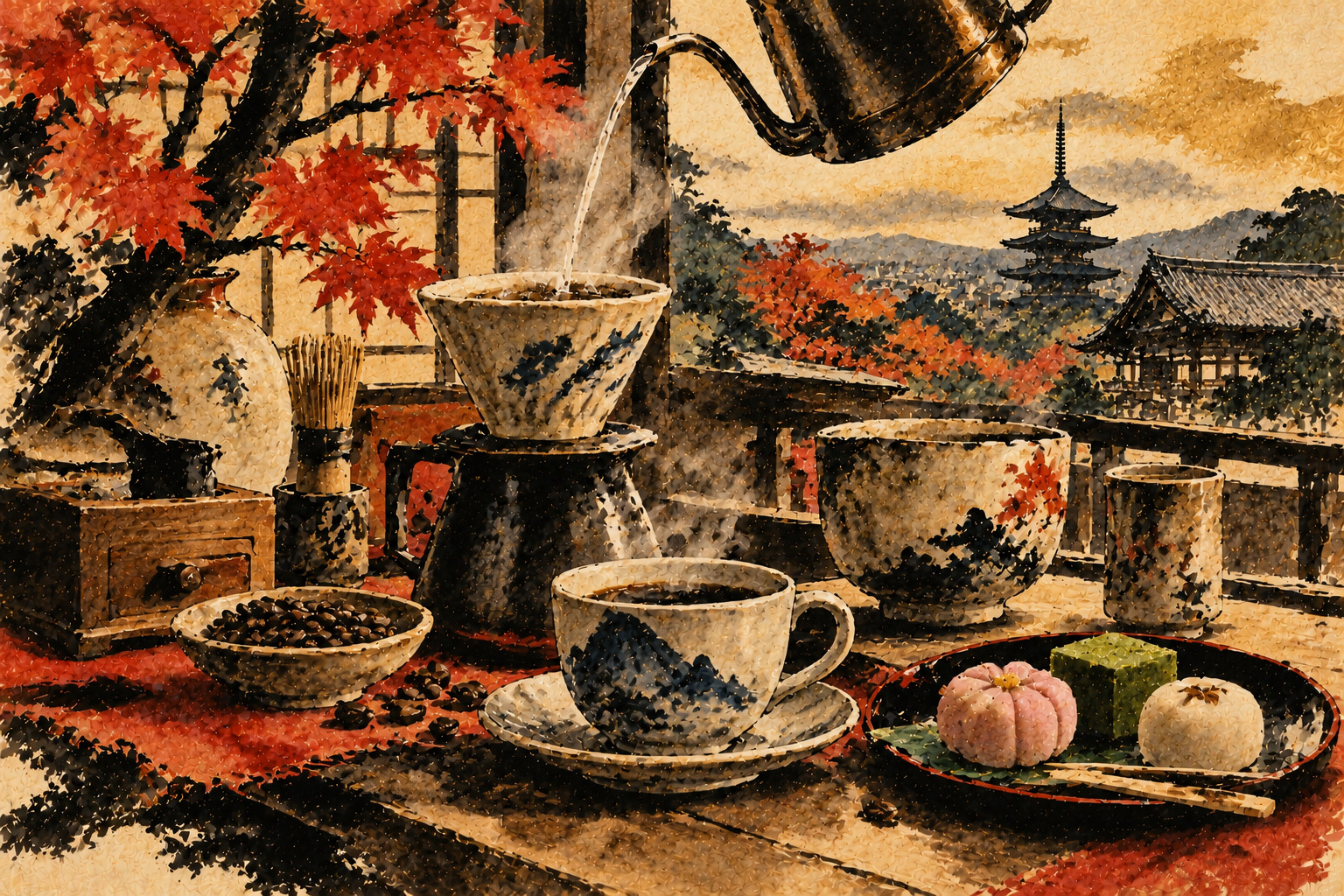
The future of a traditional craft may begin not on a museum pedestal, but under an ordinary slice of cake.
The plate steals the spotlight
In Kyoto, the most revealing object in a craft exhibition may be the plate beneath a slice of cake. The Kyoto Museum of Crafts and Design opened the sixth edition of its Coffee and Ceramics series on October 16, 2026, with a deliberately modest but consequential change: plates, not just coffee cups, are now the stars. Called “Coffee and Ceramics 6th — Spin-off: Plates Take Center Stage,” the sales exhibition brings together 23 participating makers and workshops, according to its organizer, the Kyoto Industrial Promotion Center. The organizer reported queues at opening; Japan.co.jp has not independently counted visitors.
It is easy to overlook this kind of event amid Kyoto’s high-profile temples and contemporary art shows. Yet it addresses a hard question for a city whose identity rests partly on skilled handwork: how do you bring objects associated with heritage and connoisseurship into the purchases people make for ordinary life? The answer being tested here is not an abstract lecture about tradition. It is coffee, a sweet and a plate someone can hold.
Why a plate changes the conversation
The series began in 2022, according to the museum, as an accessible introduction to handmade goods through the rituals of a coffee break. Cups have been the natural centerpiece: their handles, glazes and lip shapes invite personal judgments. This year the curators move the lens outward to plates for pastries, bread and cakes. A plate must accommodate food, provide room for presentation, feel stable on a table and survive ordinary use. The maker’s choice of rim, thickness, finish and surface texture becomes part of someone else’s daily routine.
There is a sophisticated design question hidden in that shift. A collector may buy a vessel because it looks exceptional on a shelf. A family might buy one because it makes breakfast more pleasurable without being awkward to wash or store. Those motivations overlap, but they are not identical. An exhibition that invites visitors to compare function as well as visual character could reach people who never thought of themselves as craft buyers.
Kyoto ceramics were never one unchanging tradition
Kyoto ware, generally called Kyo-yaki, encompasses pottery and porcelain associated with the city; Kiyomizu-yaki is an important part of that history. Accounts of its earliest kilns include traditions that cannot all be treated as established archaeological fact. More securely documented is the extraordinary flowering of ceramic innovation in the early modern period. Nonomura Ninsei developed richly decorated overglaze pottery. Ogata Kenzan extended the possibilities of painted surfaces. Later, Okuda Eisen and Aoki Mokubei contributed to Kyoto porcelain and scholarly tastes. The Kyoto Prefectural Government and the local ceramics trade association both describe a tradition shaped by changing methods, patrons and fashions.
The past matters here because Kyoto craft is sometimes sold as though its virtue were resistance to change. Its actual history is full of adaptation: tea ceremony culture, literary networks, changing dining customs and regional trade created different demands. A plate intended for coffeehouse sweets is not automatically a betrayal of heritage. Its significance lies in whether the design uses living knowledge and whether contemporary demand can sustain the people who possess that knowledge.
A museum that also has to think about markets
The institution now known as the Kyoto Museum of Crafts and Design traces its opening to 1976 and was renewed in 2020. Kyoto City describes the renovation as part of a move toward deeper exchange between contemporary makers and users. The museum presents 74 categories of Kyoto traditional industry, including Nishijin textiles, Kyo-yuzen dyeing, lacquerware and ceramics, along with production techniques and tools. This context makes a sales exhibition more than a temporary retail corner.
Conservation and economic survival are different tasks. An object can be beautifully displayed while the workshop that produced it struggles with material costs, electricity, training and access to buyers. The museum’s program makes the practical proposition that appreciating a handmade object and purchasing it need not be separate activities. Whether the current event materially raises orders, workshop incomes or repeat customers remains an open empirical question.
Twenty-three makers, not one generic “Kyoto style”
The October 16 organizer announcement names 23 participating artists and studios, including the workshops AIKA CRAFT and Utsuwa haku, and lists individual artists in Japanese. Their original Japanese names are preserved in the linked official record rather than assigning unverified English readings. The selection encompasses individual ceramic artists, workshops and makers of related handcrafted objects.
A fair that groups handwork under one familiar label can make its variety invisible. The real questions are more granular. Does a piece hold the weight its appearance promises? How does the glaze behave under different light? What decisions are made by a single artist, and which emerge from a workshop? Those differences help turn an anonymous souvenir into a relationship with a producer. They also caution against claiming that every exhibitor employs the same technique, uses the same local materials or belongs to an identical centuries-old lineage.
Coffee and sweets are part of the argument
The organizers enlisted Globe Mountain Coffee to serve hand-dripped coffee on designated days and Kyoto Murakami Kaishindo, the historic confectionery business, to supply baked treats. Globe Mountain Coffee is scheduled for October 16–19 and 22–25; the exhibition itself continues to October 30, apart from the October 26 closure. Conflating those dates would mislead a visitor expecting coffee service every day.
The combination is more persuasive than a gallery label because it demonstrates how a plate participates in a ritual. Size is easier to judge with food nearby. Color is easier to imagine against a pastry. A coffee cup invites the hand; a plate establishes the table. None of this proves that the food vendors jointly designed collections with all 23 makers, and the public materials do not establish such collaborations. The exhibition is best understood as a curated encounter among related, but distinct, businesses.
The internet opens another door—and another problem
A particularly consequential addition this year is an online sales page opened on October 16 for a selection of exhibited work. In principle, someone in Singapore, London or California can discover Kyoto craft without traveling to Okazaki. That broadens the possible market, but ceramics are challenging goods to sell at a distance. A screen cannot convey weight or the subtle roughness of clay. Photographs may obscure glaze variation. Shipping costs, protective packaging and damage claims can change the economics of a modestly priced piece.
For small workshops, successful e-commerce requires information as carefully made as the objects: accurate dimensions, care instructions, honest photographs, inventory management and clear policies. “Global reach” should not be confused with verified global sales. The organizers have not published overseas order totals, net revenue to makers or repeat-purchase figures for this edition. Those would be stronger indicators of durable market development than a launch announcement alone.
Not the same story as Kyoto’s big pottery fair
There is another ceramics story in Kyoto this October. The 50th edition of the former Kiyomizu-yaki village pottery fair has adopted the KYOPO identity, with a broader festival and international-exchange agenda. Coffee and Ceramics is different: it works through the intimate geography of a cup, a plate, a cake and a museum gallery. Both respond to the challenge of making Kyoto craftsmanship visible, but they address different parts of the market.
A healthy craft economy does not depend on a single sales channel. Large fairs can generate discovery; galleries can support interpretation; independent shops cultivate regular customers; online platforms reach distant buyers. Each channel brings distinct costs and power relationships. The important measure is not whether an event generates attractive photographs but whether producers retain enough income, control and public recognition to keep developing their work.
What a single plate can—and cannot—save
Handmade pottery will not solve the demographic or economic problems of Kyoto’s manufacturing districts by itself. Buyers have finite budgets. Workshops need space, apprentices and access to materials. Tourists may purchase once and never return. Celebrating the romance of the artisan while ignoring the conditions of work would turn the craft into a decorative symbol rather than a living industry.
Still, the exhibition points toward a plausible path. Cultural knowledge becomes easier to sustain when it has a recurring role in contemporary life. A plate acquired for Saturday cake may be used for years, reminding its owner of the maker and creating an invitation to seek more. This is modest compared with the ambitions of major cultural policy, but it may be closer to the way lasting markets grow: one object, one relationship and one household at a time.
Reporting note: This independent analysis uses institutional and organizer records available through October 17, 2026. There was no onsite reporting or independent verification of sales and attendance. Admission to this sales exhibition is free; the museum’s main permanent exhibition may carry separate admission fees.