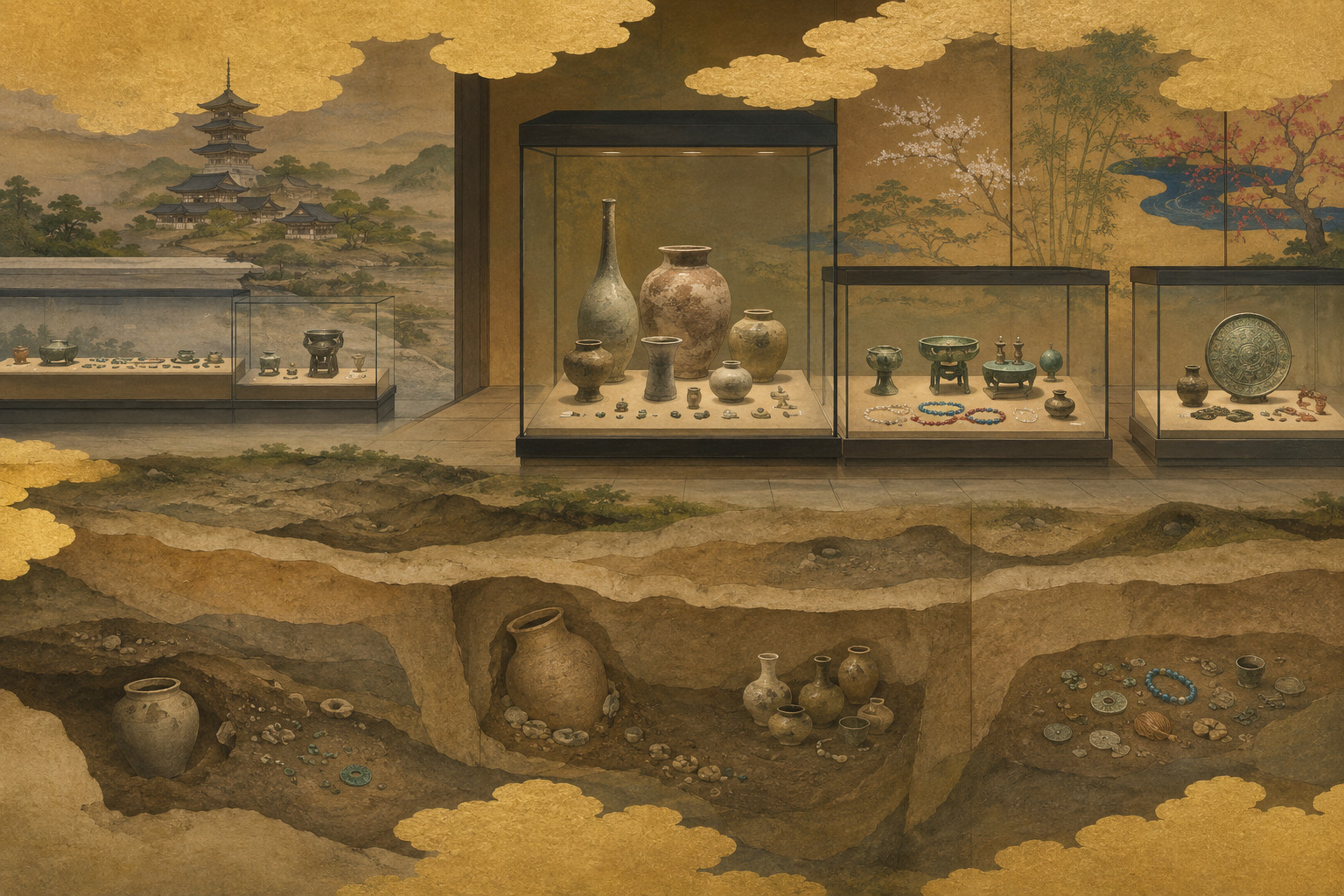
The ground beneath an old city is normally treated as a record: buildings collapse, refuse accumulates, streets rise and the traces of one life are sealed below another. Kyoto National Museum's closing exhibition begins with a more deliberate proposition. Sometimes the earth was not merely where history ended up. It was the intended recipient.
The feature exhibition Buried Prayers: Time Capsules of Faith—officially 特集展示 埋納(アンダーグラウンド)―地下に願いを―—ends September 6 after a run that began July 14. Its subject is mainō, the purposeful depositing of objects underground. The galleries follow that practice from Kofun-period pottery through Buddhist foundation rites, coin deposits and sutra mounds, then into the Muromachi and Edo periods and practices that remain recognizable in ceremonies for new buildings today.
That long view makes the show more than an assemblage of archaeological finds. A container beneath a pillar, a coin at a crossroads and a sutra sealed on a mountain were not versions of the same ritual. They addressed different fears, authorities and imagined futures. What connects them is a decision to remove something from ordinary circulation so that it might act unseen.
Buried on purpose, not simply lost
The exhibition's first distinction is methodological. Archaeologists recover countless things that entered the ground accidentally: broken roof tiles, discarded shells, burned timbers, flood deposits. Mainō applies when people placed something there for a purpose. Recognizing that purpose requires more than finding an intact pot.
Position matters. So do the relationship between a vessel and a foundation, the arrangement of contents, an inscription, evidence of a prepared pit and comparison with written ritual. A carefully nested group beneath a temple's central pillar offers a different argument from an isolated coin in disturbed soil. The object is evidence; its context is the grammar that may make the evidence readable.
The museum's own educational essay preserves a valuable uncertainty. Placenta jars from Nara-period Heijō-kyō have been found with brushes, ink and a small knife. The writing tools have been interpreted as a wish that the newborn child might rise in official life, but the museum stresses that the reason is not known conclusively. That restraint is central to responsible archaeology: an interpretation can be persuasive without becoming a recovered quotation.
Four histories under one floor
The four-part display moves chronologically without pretending that one practice simply replaced another. Chapter one begins with pottery deposits associated with fertility, settlement security and construction. As Buddhism took institutional form in Japan, temple foundations received relic containers and ornaments, while Nara-period rites for stabilizing a building site became increasingly systematized. Coins and placenta jars also connect deposition to urban life and household hopes.
The second chapter turns to maikyō, the burial of Buddhist scriptures, and to kyōzuka, the small mounds made for those deposits. The third follows the spread and regional variation of sutra-mound culture: mountain temples, sacred peaks, shrine and temple grounds, and even earlier burial mounds could become suitable sites. Containers and accompanying objects differ between the Kinai region and Kyushu, while Tango developed its own use of earthenware containers placed in small lateral cavities.
The final chapter refuses a neat medieval ending. Copper sutra tubes gradually gave way to forms such as texts written on pebbles, yet people continued to bury objects to quiet land, protect households and mark construction. The display includes inscribed Haji-ware dishes from Kyoto sites, ritual implements from Chishakuin and a ritual bottle with contents from the Kugechō site associated with the Yanagihara family.
| Chapter | Historical focus | What the deposit was asked to do |
|---|---|---|
| Origins of burial | Kofun through Heian periods | Support fertility, settle land, secure buildings and protect urban or domestic life. |
| Sutra burial and mounds | Especially from the 11th century | Preserve Buddhist teaching for a radically distant future. |
| Expansion of sutra mounds | Heian through medieval Japan | Adapt scripture deposits to regional landscapes, sacred sites and materials. |
| Practices inherited | Muromachi and Edo periods onward | Continue land-pacifying, household and construction rites in changing forms. |
A message meant to outlast civilization
The most extravagant time horizon in the exhibition belongs to the sutra mound. Late-Heian believers understood themselves to be approaching or living in mappō, an age in which the Buddha's teaching would decline. In the chronology then used in Japan, that era began in 1052. Maitreya—the future Buddha—was expected to descend 5.67 billion years after the historical Buddha's passing. Scriptures placed underground could be imagined as a transmission across that almost incomprehensible interval.
The task demanded material strategy. Paper was spiritually and textually suitable but vulnerable to damp and decay. Sutras were therefore sealed in bronze containers or copied onto copper plates, ceramic tiles, clay tablets, stone and other durable surfaces. Outer vessels and stone chambers added protection. The exhibition includes tile sutras, a copper-plate Lotus Sutra, incised tiles and a seated Maitreya excavated from a sutra mound on Iki Island.
There is a paradox here. The burial was meant to preserve a teaching, but excavation interrupts the intended wait. A museum display brings the object back into present circulation, where it becomes evidence, cultural property and art. The act saves the material for viewers while ending its isolation underground. The exhibition does not resolve that tension; it lets the promised future and the archaeological present occupy the same case.
Michinaga's golden cylinder and a dated act of faith
The exhibition's best-known object is the National Treasure gilt-bronze sutra cylinder of Fujiwara no Michinaga, excavated from the Kinpusen sutra mound and owned by Kinpu Shrine in Nara. Its importance comes not only from precious metal or elite ownership but from an unusually dense convergence of object, inscription and written record.
In 1007, the powerful courtier climbed the sacred mountain and buried the cylinder with 15 scrolls, including scriptures he had copied in gold on indigo-dyed paper. The Agency for Cultural Affairs' heritage database notes that ten had been copied in 998 and five in 1007. The cylinder's inscription records the purpose and date, while Michinaga's diary, Midō Kanpakuki, also records the journey and burial. Archaeological context and documentary history reinforce one another.
The cylinder precedes the conventional 1052 opening of mappō in Japan, a reminder that anxiety about preserving the Dharma did not begin on a single calendar page. It stands near the beginning of a form of sutra-mound practice that spread widely during the 11th and 12th centuries. A private act by the era's most powerful political figure became part of a national ritual geography.
Another late-rotation work deepens that family history: the Important Cultural Property fragment of the eighth scroll of the gold-letter Lotus Sutra commissioned by Fujiwara no Moromichi, Michinaga's great-grandson. The museum lists it for display from August 11 through the closing day. Its survival beside Michinaga's cylinder compresses elite devotion, family continuity and the physical attrition of buried manuscripts into one gallery.
Kyoto's map appears from below
Although the exhibition reaches from Shiga and Nara to Kyushu, its density of Kyoto material matters. Deposits came from the Heian Palace site, temple precincts at Ninnaji and Chishakuin, university excavations in Kitashirakawa and Yoshida, urban blocks of Heian-kyō, and northern Kyoto sites in Kurama, Hanase, Fukuchiyama, Miyazu and Kyōtango. The old capital is reconstructed not only through surviving temples and street plans but through acts meant never to be seen.
The Heian Palace deposits make that inversion especially clear. Excavation at the site of the Shōmeimon gate revealed a rainwater channel and land-pacifying deposits on the palace's central axis. Ritual objects beneath an imperial building were not decoration. Their work depended on location: they stabilized, purified and protected the ground on which visible authority would stand.
At Hanase Bessho, north of Kurama, sutra-mound objects were found along a ridge at roughly 700 meters above sea level. Kyoto National Museum's account places the group around the middle of the 12th century and describes a small bronze image of Bishamonten, ritual vessels, a mirror, a short sword and imported ceramics alongside a sutra container. The choice of a mountain ridge joined concealment to sacred geography; the earth was not merely a safe box but part of the religious address.
Why humble objects carry the argument
National Treasures command attention, yet the show's intellectual force also lies in ordinary-looking vessels, coins, dishes and fragments. A gilt cylinder can announce elite intention in hundreds of incised characters. A plain jar rarely speaks so directly. It forces the visitor to ask what combination of findspot, contents and comparison allows a museum label to move from description to meaning.
That question keeps the exhibition from turning belief into spectacle. “Prayer” is not used as a catchall for every unexplained object. Some motives are written down; some are supported by ritual texts; some remain hypotheses. The museum's list also marks objects whose find locations are traditional or unknown, preserving differences in evidentiary strength instead of smoothing them away.
This is also why the title's time-capsule metaphor works only up to a point. A modern time capsule expects future discovery on a chosen date. Many sutra deposits were intended to wait for Maitreya, while foundation offerings were meant to continue acting beneath a structure. Recovery was not necessarily the depositor's goal. What modern viewers call preservation could, for the person who buried the object, have been protection, consecration, withdrawal, transmission—or several of those at once.
The final day closes a temporary archaeology of intention
On September 6, this assembled view of underground acts comes to an end. The exhibition catalogue records 61 works or groups across 54 pages, but the most consequential achievement is the sequence between them. The visitor moves from land and building to body and household, from court and capital to remote ridge, then from medieval sutra preservation to rites that still accompany construction.
Visitors who bought the catalogue at the museum shop from July 14 through 17 should also note the museum's correction notice. Some copies were produced with pages 27–28 and 31–32 blank; the museum says affected copies can be exchanged after contacting the shop.
The objects were buried because people believed absence could perform work. Hidden things might guard a threshold, steady a building, carry a child's future or preserve words beyond the collapse of an age. Archaeology reverses that action, exposing what concealment was supposed to accomplish. The finest response is not to claim complete access to the original mind. It is to make the surviving evidence speak clearly—and to leave room for what the earth did not return.
Primary sources and references
- Kyoto National Museum, 特集展示 埋納(アンダーグラウンド)―地下に願いを― — Official dates, hours, admission, four-part interpretation and complete displayed-object list.
- Kyoto National Museum, Buried Prayers: Time Capsules of Faith — Official English title, terminology and exhibition description.
- Kyoto National Museum Dictionary No. 248, 「地下に願いを」 — Definition of intentional burial, placenta-jar interpretation, material durability and evidentiary cautions.
- Kyoto National Museum, 「花背別所経塚の遺物」 — Mappō, the 1052 chronology, Maitreya's future descent and the Hanase deposits.
- Kyoto National Museum, 「金色に輝く藤原道長の経筒」 — The 1007 inscription and relationship to Midō Kanpakuki.
- Agency for Cultural Affairs, Kinpusen sutra-mound indigo-paper gold-script scriptures — Michinaga and Moromichi manuscript history and documentary evidence.
- Kyoto City, Heian Palace Shōmeimon gate site — Official site name, reading, excavation and land-pacifying deposit.
- Kyoto National Museum catalogue information — Publication date, price, format and 61 listed works.
- Kyoto National Museum catalogue correction notice — Affected sales dates, missing pages and exchange instructions.
Reporting note: This article uses the museum's object-status labels and distinguishes explicit inscriptions or documented rites from archaeological interpretation. English translations follow the museum's official English page where available; Japanese titles and specialist terms were checked against the museum's Japanese materials. No visitor count or unrecorded curatorial quotation is asserted.
Image rights: © 2026 Japan.co.jp. AI-assisted editorial illustration. No unauthorized reproduction or reuse. For licensing, see the contact page.