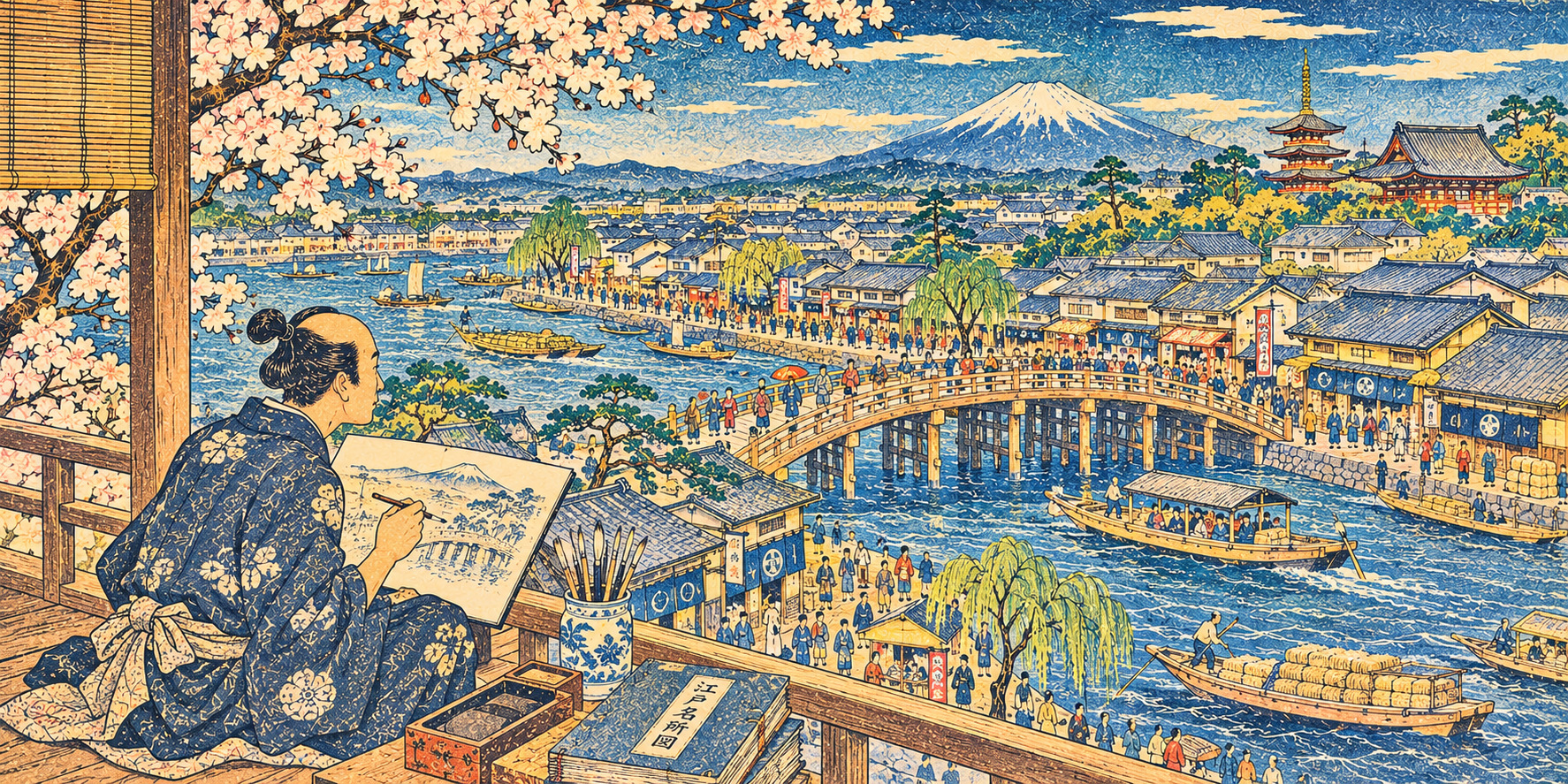
| Featured artist | Kuwagata Keisai (also known as Kitao Masayoshi) |
|---|---|
| Dates | 1764–1824 |
| Career shift | Entered service as a Tsuyama domain painter in 1794 |
| Key strengths | Panoramic city views, drawing manuals, depictions of workers and everyday life |
| Key works | Chōjū ryakugashiki, Craftsmen at Their Work, Sumida River Screen, Edo ichimoku-zu screen |
| Role in Nov. 4 edition | Visual inspiration for all 15 illustrated news stories |
Why Keisai became our featured artist
For the November 4, 2026 edition, Japan.co.jp wanted more than fifteen unrelated illustrations. We wanted a visual system: one artist’s way of seeing that could connect business, science, communities, sports and culture without flattening them into sameness. Kuwagata Keisai proved unusually suited to that task. His work can be panoramic without being heavy, observational without becoming cold, and simplified without losing specificity. That combination makes him an exceptional editorial reference for a day that moves from Hokkaido licorice fields to semiconductor research, from an ocean memorial in Shiretoko to public art in Shibuya.
An artist with more than one identity
Keisai is often introduced with a list of names, and that list matters. As a younger artist he worked as Kitao Masayoshi, a pupil of the ukiyo-e master Kitao Shigemasa. Later sources also record the name Kuwagata Shōshin or Tsuguzane. The National Diet Library authority record preserves these variants, and museum collection entries show why they matter: his career crossed publishing, popular prints, painterly handscrolls and large-scale urban views. He was not simply a specialist in one format. He was a flexible image-maker operating inside one of the richest visual cultures in early modern Japan.
From the print world to domain service
A major turning point came in 1794, when he entered service as a painter for the Tsuyama domain. The Tsuyama Local Museum describes this as a striking rise in status: a successful print artist becoming a samurai-affiliated official painter. That shift did not erase his earlier world. Instead, it expanded it. He absorbed Kano-school training while retaining the energy of commercial image-making. The result was an artist who could move between the quick wit of illustrated books and the structured breadth of folding screens. That unusual career arc helps explain why his work feels both immediate and composed.
The power of abbreviated drawing
Keisai’s greatest technical gift may be what Japanese art history calls ryakuga—abbreviated drawing. The word can sound reductive in English, but the achievement is the opposite of mere simplification. In the drawing manuals known as the Ryakugashiki series, Keisai distilled birds, animals, people and gestures into efficient marks that remained alive. Japan Search describes the early "Ryakugashiki" volumes as forerunners to Hokusai Manga. That is useful as a historical marker, but Keisai deserves to be understood on his own terms. He turned economy of line into a way of thinking: select the essential, preserve movement, and make a picture legible at a glance.
Why Chōjū ryakugashiki still matters
Among the most revealing books is Chōjū ryakugashiki, published in 1797 and preserved at the Metropolitan Museum of Art. The pages show birds, insects, fish and animals with a mixture of humor and structural intelligence. These are not crude cartoons, nor are they miniaturized natural-history plates. They are a training ground in attention. Keisai teaches the eye to ask what makes a fish read as a fish, or a bird feel airborne, once descriptive detail is stripped away. That discipline is precisely why his visual language adapts so well to modern editorial work. Scientific subjects, sports movement, coastal emptiness and urban density can all be clarified through the same underlying principle.
He looked at workers, not only beauties and celebrities
Another reason Keisai matters to a news publication is his commitment to ordinary life. The Tokyo National Museum’s Kinsei shokuninzukushi ekotoba, or Craftsmen at Their Work, presents tradespeople across three handscrolls. It is a magnificent reminder that Japanese pictorial culture did not only celebrate courtesans, actors or famous sights. It also documented labor. Keisai watched posture, tools and routines. He cared how a job looked in the hand. That observational quality makes him especially relevant to a publication interested in industry, technology and local economies. He brings dignity to work itself.
A city seen from above—but still full of people
Keisai’s panoramic screens are the opposite of empty cartography. In works such as the Sumida River Screen at the Suntory Museum of Art, the city is seen broadly but inhabited densely. Temple precincts, riverboats, seasonal crowds, distant mountains and local landmarks all join one continuous field of vision. The Tsuyama museum’s discussion of the Edo ichimoku-zu screen makes a similar point: Keisai fused viewpoints and distances into persuasive urban wholes. That ability to show a system without losing individual life is one reason we found him compelling for stories such as Waseda’s ekiden triumph and the Shibuya Art Festival.
Why he fits the November 4 package
Every major story in this edition found something useful in Keisai’s repertoire. The Ocean Phone memorial benefits from his ability to leave air and silence in a coastal composition. The Tohoku–Aisin chip story benefits from disciplined line and diagrammatic clarity. Oji’s licorice cultivation calls for his quasi-botanical attentiveness. Waseda’s ekiden requires the choreography of many small figures moving across connected space. Shibuya’s festival invites a contemporary echo of his urban panoramas. In other words, Keisai did not give us one look repeated fifteen times. He gave us a vocabulary.
What our AI images are—and are not
The illustrations published with the November 4 stories are not lost works by Keisai, facsimiles of Edo originals or documentary photographs. They are AI-generated editorial illustrations inspired by Kuwagata Keisai (1764–1824). That distinction matters. The project is not an attempt to fake an archive. It is an attempt to create a coherent visual conversation between contemporary reporting and Japanese art history. That is why attribution remains explicit and why each image is framed as interpretation. Editorial imagination is valuable only when readers can see clearly where history ends and present-day making begins.
A rediscovery, not an act of nostalgia
Keisai is sometimes mentioned as a precursor to better-known names, especially Hokusai. There is truth in that comparison, but it is not enough. His importance lies not simply in arriving earlier. It lies in the breadth of his achievement: illustrated books, handscrolls, panoramic city views, drawing manuals and studies of labor. He was able to compress and expand, to joke and to document, to teach and to enchant. For a modern newsroom, that versatility feels remarkably fresh. Choosing him as our featured artist was not a nostalgic gesture. It was a recognition that his way of organizing visual information still solves editorial problems in 2026.
The visual backbone of the edition
The November 4 edition ranges widely in subject matter, but Keisai provides a visual backbone strong enough to hold that range together. His lines encourage restraint. His panoramas encourage context. His figure studies encourage attention to human scale. His drawing manuals encourage clarity. That is why this featured-artist essay belongs alongside the news package itself. It explains not only who Keisai was, but also why a 200-year-old artist can still help a digital publication see the present more sharply.
Sources and reporting method
Based on museum, library and cultural-heritage sources in Japanese and English, with editorial interpretation by Japan.co.jp. No original archival photography or curatorial interview was conducted for this feature.
- Suntory Museum of Art: Sumida River Screen
- Japan Search: Ehon of Edo / Ryakugashiki entries
- The Metropolitan Museum of Art: Chōjū ryakuga shiki
- The Metropolitan Museum of Art: How to Draw Birds, Insects and Fish Simply
- Tokyo National Museum: Craftsmen at Their Work
- Cultural Heritage Online: Kinsei shokuninzukushi ekotoba
- Tsuyama Local Museum: Edo ichimoku-zu byōbu
- National Diet Library Authorities: Kitao Masayoshi
- Shimane Art Museum: artist record for Kitao Masayoshi
- Kitakyushu Municipal Museum of Art: artist data