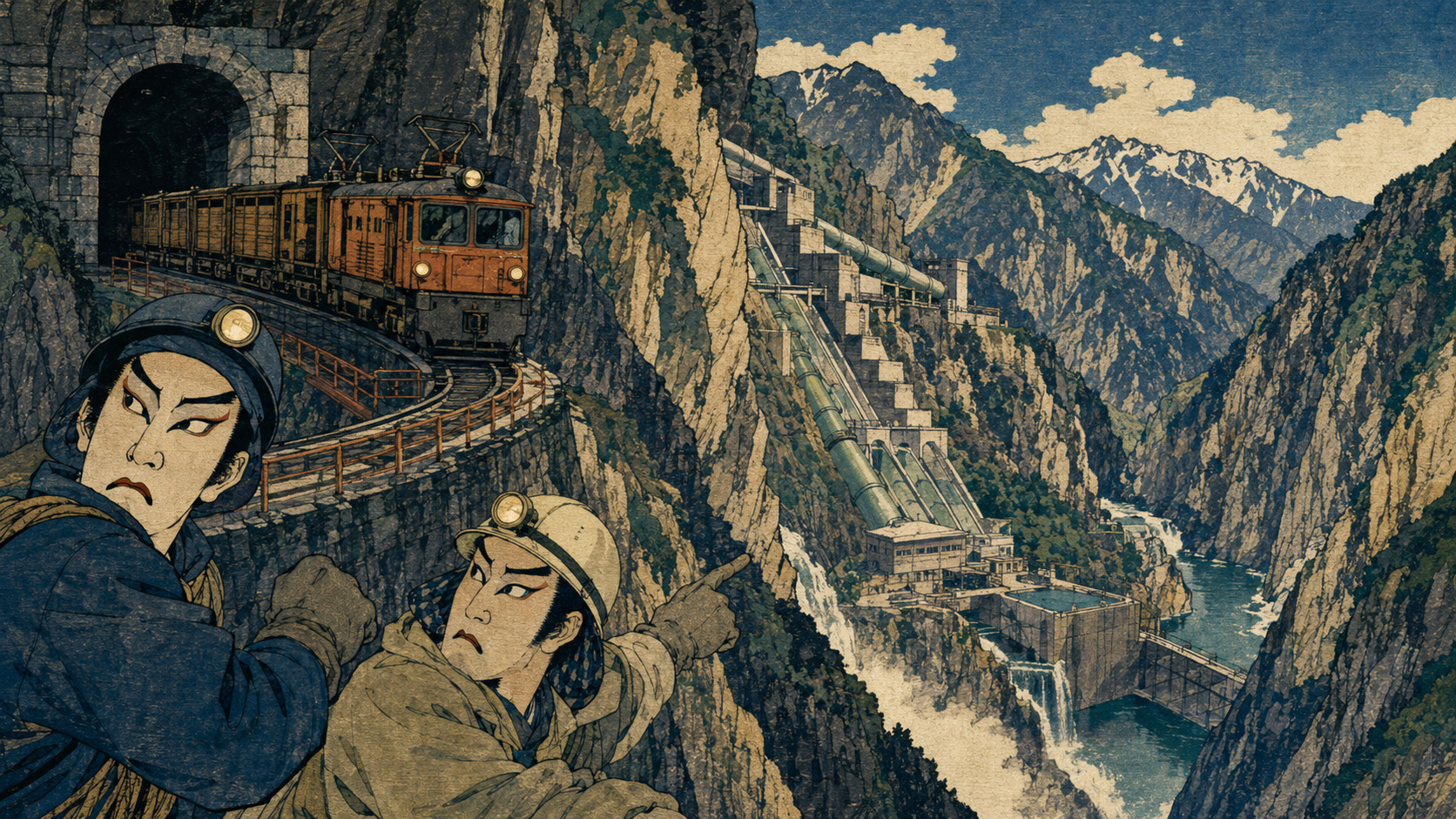
At Keyakidaira Station, the ordinary journey used to end. The trolley had traveled about 20 kilometers and 80 minutes from Unazuki. Visitors stepped toward the light of the gorge while a work train disappeared into a tunnel. Beyond the platform was the domain of Kansai Electric Power crews, freight, maintenance equipment and the fortunate few selected for a limited inspection program. On October 2, 2026, that boundary becomes a travel product for the first time.
The Kurobe–Unazuki Canyon Route is roughly 18 kilometers of industrial access between Keyakidaira and Kurobe Dam. It is not a new sightseeing railway. Nippon Electric Power and Kansai Electric Power built its components during the construction and operation of the Kurobe No. 3 and No. 4 hydroelectric projects. Visitors will transfer among a tiny work train, a 200-meter vertical-shaft elevator, a battery locomotive, an underground incline and a dedicated bus. The changes of vehicle are not theater. They are a physical record of terrain that no single transport system could master.
Travel packages went on sale July 23 through approximately 1,180 agencies across Japan. Only about 2,700 places are available in the inaugural October–November season. Officials call the change a “general opening,” but it does not mean that anyone can arrive and wander. Guests must buy a prearranged overnight tour, follow specialist guides and safety attendants, wear helmets and pass through facilities that remain part of KEPCO’s active maintenance network. Tourism is being admitted to the route; it is not replacing the route’s industrial purpose.
“Open to the public” does not mean open passage
The first essential distinction is between opening a tour and opening a path. This remains a KEPCO work facility, not a passenger line. Travelers cannot buy only the Keyakidaira–Kurobe Dam segment, make a day trip, join midway, leave the itinerary or ride out and back. Stops are permitted for guided inspection, but same-day admission without an advance package is not.
Four base itineraries move in both overall directions: from the Unazuki side through the mountain to Kurobe Dam, and from the Omachi or Tateyama side down toward Keyakidaira and Unazuki. Every itinerary includes a night before or after the crossing. The official FAQ estimated about ¥140,000 for the first departure from Unazuki. Toyama’s tourism site listed base packages from ¥127,600 to ¥182,500, depending on route, date, hotel and occupancy. Operators can add transport to Toyama, sightseeing and more hotel nights, producing higher prices.
| Industrial segment | Distance / rise | Approx. time | What the terrain required |
|---|---|---|---|
| Keyakidaira Station–lower level: work trolley | About 500 m | 3 minutes | A switchback through a constrained tunnel |
| Lower–upper Keyakidaira: shaft elevator | 200 m vertical | 2 minutes | A vertical link where a railway could not climb |
| Upper level–lower incline: battery locomotive | About 6.5 km | 35 minutes | The High-Temperature Tunnel and Sennindani |
| Lower–upper incline | 815 m / 456 m rise | 20 minutes | A 34-degree cable railway inside the mountain |
| Upper incline–Kurobe Dam: dedicated bus | About 10.3 km | 40 minutes | A larger tunnel bored to move heavy machinery |
The base price includes the designated hotel, relevant Tateyama Kurobe Alpine Route and Kurobe Gorge Railway fares, an advance lecture, a specialist guide, an industrial-facility safety attendant, and meals defined by the itinerary. This is controlled-access interpretation bundled with lodging, not a train ticket. The 2,700-place cap makes the first season scarce, but it also reflects the limited capacity of operating infrastructure and the need not to concentrate pressure in a severe mountain environment.
Before electricity, there was aluminum
Kurobe’s power-development story begins in 1917. Jokichi Takamine, the scientist known for developing Takadiastase, planned a Japanese-American aluminum enterprise and looked to the Kurobe River for the enormous quantity of electricity that smelting demanded. Aluminum has been called “congealed electricity.” The Kurobe, dropping roughly 3,000 meters from the Northern Alps to the Sea of Japan over a river length of about 86 kilometers, promised heavy precipitation and immense hydraulic head.
A useful drop on a survey map was not a road in the field. The Kurobe Gorge Railway describes an average basin slope of 36 degrees, with roughly 70 percent of the terrain between 30 and 45 degrees. Surveyors carried equipment along the Nichiden path, a ledge approximately 50 centimeters wide cut or hung against cliffs. To calculate the power of the water, people first had to reach it.
Nippon Electric Power took over the project in 1922 and began building a material railway upstream from Unazuki in 1923. Unazuki–Nekomata opened in 1926, Nekomata–Koyadaira in 1930 and Koyadaira–Keyakidaira in 1937. The line existed to carry cement, steel, machinery and workers, not sightseers.
From “no guarantee of safety” to a tourist railway
Public demand entered the industrial railway early. Residents rode with the freight, and paying visitors were admitted from 1929. The old tickets famously warned, in substance, that passenger safety could not be guaranteed. The pattern—tourism layered onto a hazardous working transport system—foreshadows the 2026 route.
The railway received a regular passenger license in 1953. Kurobe Gorge Railway Co. was established in 1971, shaping the trolley attraction known today. Yet behind its bright passenger carriages, KEPCO’s private industrial lines continued as arteries of maintenance. The public ride from Unazuki to Keyakidaira was only the visible first portion of a much longer network inside the mountain.
Kurobe No. 3: Superheated rock and lives that must not disappear
The most punishing section emerged from construction of the Kurobe No. 3 Power Station, which began in 1936. Between Asohara and Sennindani, tunneling entered rock hotter than 160°C. Workers injected cold water and forced air toward the face, but heat and sulfur surrounded them. Dynamite ignited spontaneously. The zone is still about 40°C, according to the route’s official history, and passengers can sense heat and sulfur from the battery train.
The “High-Temperature Tunnel” later gave Akira Yoshimura the title and setting of a celebrated documentary novel. But a triumphal engineering narrative alone dangerously flattens the past. On December 27, 1938, a massive avalanche at Shiai-dani tore away the upper floors of a four-story workers’ dormitory. A scientific history in the Journal of Glaciology records 84 dead or missing. Accidents and illness added further loss across the No. 3 project.
No. 3 began operating in 1940. A year earlier, engineers had installed the shaft elevator to bridge 200 vertical meters where the railway could not continue horizontally. The completion belongs in the history of Japanese engineering. It also belongs in the history of labor discipline, distributed risk and the people asked to enter extreme heat. If this route is presented as industrial heritage, it must restore the dead to the narrative rather than use danger merely as atmosphere.
Kuroyon: The power postwar Japan entrusted to a mountain
The second undertaking arose from postwar electricity shortages. Kansai Electric Power inherited the project after the 1951 reorganization of the industry and started building the Kurobe No. 4 Power Station and Kurobe Dam in 1956. KEPCO records seven years of work, a cost of ¥51.3 billion at the time, an aggregate 10 million worker-days and 171 deaths during surveying and construction. The arch dam stands 186 meters high and 492 meters long, holding roughly 200 million cubic meters. The underground No. 4 plant has maximum output of 337,000 kilowatts.
In 1957, a tunnel from the Omachi side hit an 80-meter crush zone. Water at about 4°C poured in at up to 660 liters per second; the crossing took seven months. From the Keyakidaira side, the Kurobe Route gained its 815-meter, 34-degree underground incline in 1959. It moved generators and other heavy equipment through the mountain while avoiding the avalanche-prone surface.
No. 4 began partial generation in 1961, and the dam project was completed in June 1963. “Kuroyon” became a symbol of the high-growth era, but its electricity was not abstract national power. It drove factory motors, city lights and household refrigerators. To travel the Canyon Route is to see how postwar consumption connected to remote water, rock and labor.
Did putting it underground protect nature?
Kurobe lies within Chubusangaku National Park, designated in 1934. Its 3,000-meter peaks, deep gorges, permanent snow, glacial landforms, alpine plants and rock ptarmigan form one of Japan’s defining mountain landscapes. KEPCO and Toyama present underground siting as an example of developing power while protecting grand scenery. Building below ground reduced large surface structures and also protected essential machinery from snow and avalanches.
“Underground” cannot mean “without impact.” Dams alter the movement of water and sediment. Tunnels, intakes, camps and transport converted a watershed into an industrial system. Nature and civil engineering are not two separate images here; they have occupied the same basin for a century. The tour becomes more valuable when it abandons the old script of technology conquering nature and explains the benefits of hydropower beside its transformations of rivers, landscapes and labor.
Small, guided groups may support that approach. A first season of 2,700 guests permits interpretation and limits crowding. Scarcity alone, however, is not conservation. Operators should eventually publish visitor numbers, waste, energy use, incidents, environmental monitoring and the share of spending retained locally. Stewardship of a national park and an operating power network should be measurable, not simply claimed.
The earthquake rewrote the opening date
Toyama Prefecture and KEPCO agreed in 2018 to convert the route into travel products, initially targeting 2024. The Noto Peninsula earthquake of January 1, 2024, sent rock onto the Kurobe Gorge Railway near Kanetsuri Bridge, damaging the bridge and slopes. Without service from Unazuki to Keyakidaira, the entrance to the new route did not function. The 2024 debut was postponed, and a full-line reopening remained impossible in 2025.
Recovery required removing and stabilizing rock, protecting slopes and repairing the bridge. Kurobe Gorge Railway now plans to restore full Unazuki–Keyakidaira operations on October 1, 2026. Canyon Route tours begin the next day. More than two years of delay carry an appropriate warning: after tunnels break through and dams are finished, geology, snow and water never become “completed work.”
Even after trains return, access around Keyakidaira beyond the station and visitor center is expected to remain restricted while walls and slopes are repaired, with capacity managed carefully. The 2026 opening is not one clean line between damage and recovery. It is a staged reconnection under continuing maintenance.
Do not erase the people who cannot enter
The participation rules are demanding. Guests must be at least 11, able to board vehicles and use stairs without difficulty, and willing to wear the supplied helmet. Because the itinerary includes dark tunnels, narrow interiors, frequent transfers and stairs, canes, wheelchairs and other walking aids are not permitted. Pregnant travelers, people prone to motion sickness, and those with severe claustrophobia or fear of heights are advised not to join. Clothing should be active, with trousers and athletic shoes; luggage is limited to approximately one backpack that fits on the lap.
Those conditions have a safety rationale inside narrow, active industrial works. Explaining the rationale is not the same as hiding the exclusion. The words “general opening” must sit beside a clear account of who cannot participate. VR, spatial film, full-size models, tactile and audio interpretation, and guided exhibits outside the tunnel could share the heritage with people unable to enter physically. Accessibility does not always require rebuilding a shaft; it also means designing more entrances to knowledge.
- Season: The first tours run only in October and November 2026. Confirm operations, availability and recovery conditions with the vendor.
- Format: Every base route includes a night before or after. There is no same-day, segment-only or walk-up admission.
- Physical access: Participants must independently manage stairs, dark passages, confined vehicles and multiple transfers.
- Clothing: Wear active trousers and athletic shoes. The tour provides the required helmet.
- Baggage: Bring roughly one small backpack that fits on your lap. Check the package for large-luggage forwarding.
- Direction: The trip passes through one way; it does not return. Drivers may need a separate paid vehicle-forwarding service.
- Price: Published base estimates range from ¥127,600 to ¥182,500; transport and extra nights change the total.
What remains in Unazuki
The route joins two famous tourism systems for the first time: Unazuki Onsen and the Kurobe Gorge Railway on the Sea of Japan side, and Kurobe Dam with the Tateyama Kurobe Alpine Route across the mountain. Turning the missing industrial link into an itinerary permits a one-way mountain crossing. The required hotel night supports safety and interpretation, but it is also a policy that can attach lodging, food, guides and baggage service to the regional economy.
A small, expensive tour will not transform a region by itself. At 2,700 first-season guests, this is a tiny market when averaged across days. The impact becomes deeper if travelers attend an evening lecture in Unazuki, study the power system at the Kurobe River Electricity Memorial Museum, use local hotels and restaurants, and support local preservation of construction records. If visitors are merely dispatched into the gorge, much of the value passes through.
From heroic epic to public memory
Industrial-heritage tourism has the power to select a story. The towering elevator, hot rock, 34-degree incline and dimensions of Kurobe Dam naturally form a heroic engineering epic. Their ingenuity and scale deserve wonder. But the 84 people dead or missing in the No. 3 avalanche and the 171 who died during Kuroyon surveying and construction belong to different projects; neither number should be buried behind the word “achievement.”
Under what corporate and labor arrangements did prewar power development proceed? What did the postwar electricity shortage make seem necessary? Who received the dam’s benefits, and who bore its risks? How far did underground construction reconcile development with conservation? If guides open those questions, this becomes public history rather than an infrastructure theme park.
KEPCO’s public inspection tours, which continued through 2023, provide a base of safety and interpretation. The transition from a limited application-and-lottery program to commercial package sales makes transparency more important. Accident history, workers’ origins, changes in construction methods, environmental monitoring and the continuing role of the live power facilities should appear in multiple languages and through sources beyond corporate promotion.
The mountain does not open; it lends an entrance
On October 2, guests will leave Keyakidaira aboard a work trolley, move through the ground, rise 200 meters in an elevator, cross a tunnel that retains the earth’s heat, climb an underground slope and emerge by bus at Kurobe Dam. This is not the inauguration of a new line. Travelers are being admitted temporarily into the circulation system of infrastructure that still produces electricity.
Preserving that distinction can keep the Canyon Route meaningful. Market Kurobe as wilderness no one knew and the people who surveyed, built, died and now maintain it vanish. Tell only a conquest story and the earthquake, avalanche, heat, water and sediment that still govern operations vanish instead.
The track continued into darkness at Keyakidaira not because a secret was being hidden. It continued because work supporting urban life occurred outside tourism’s field of view. The most important distance opened by the Canyon Route is not a tunnel. It is the gap in imagination between people who use electricity and the place where electricity begins.
Sources and references
Opening dates, capacity, price guidance and access rules reflect official information available July 23, 2026. Mountain transport may change with recovery work, weather and safety checks. Death counts for the No. 3 and No. 4 projects are kept separate.
- Toyama Prefecture: official Kurobe–Unazuki Canyon Route site and October 2 launch
- Official FAQ: sales, tour structure, participation rules and access limits
- Official route overview and the 2018 Toyama–KEPCO agreement
- Official history of Kurobe River power development
- Official technical highlights of the industrial route
- Toyama Tourism: transport modes, base itineraries and prices
- Yomiuri Travel: July 23, 2026 tour-sale announcement
- Kurobe Gorge Railway: geography and industrial-railway history
- Kurobe Gorge Railway: October 1, 2026 full-line reopening notice
- Travel Watch: Kanetsuri Bridge recovery and return to Keyakidaira
- Kansai Electric Power: early Kurobe development and High-Temperature Tunnel
- Kansai Electric Power: Kuroyon construction history
- Kansai Electric Power: Kurobe Dam project time, cost, labor and deaths
- Kansai Electric Power: Kurobe River generating-station capacity
- Journal of Glaciology: history of the 1938 Shiai-dani avalanche
- Ministry of the Environment: features of Chubusangaku National Park
- Ministry of the Environment: Chubusangaku National Park overview