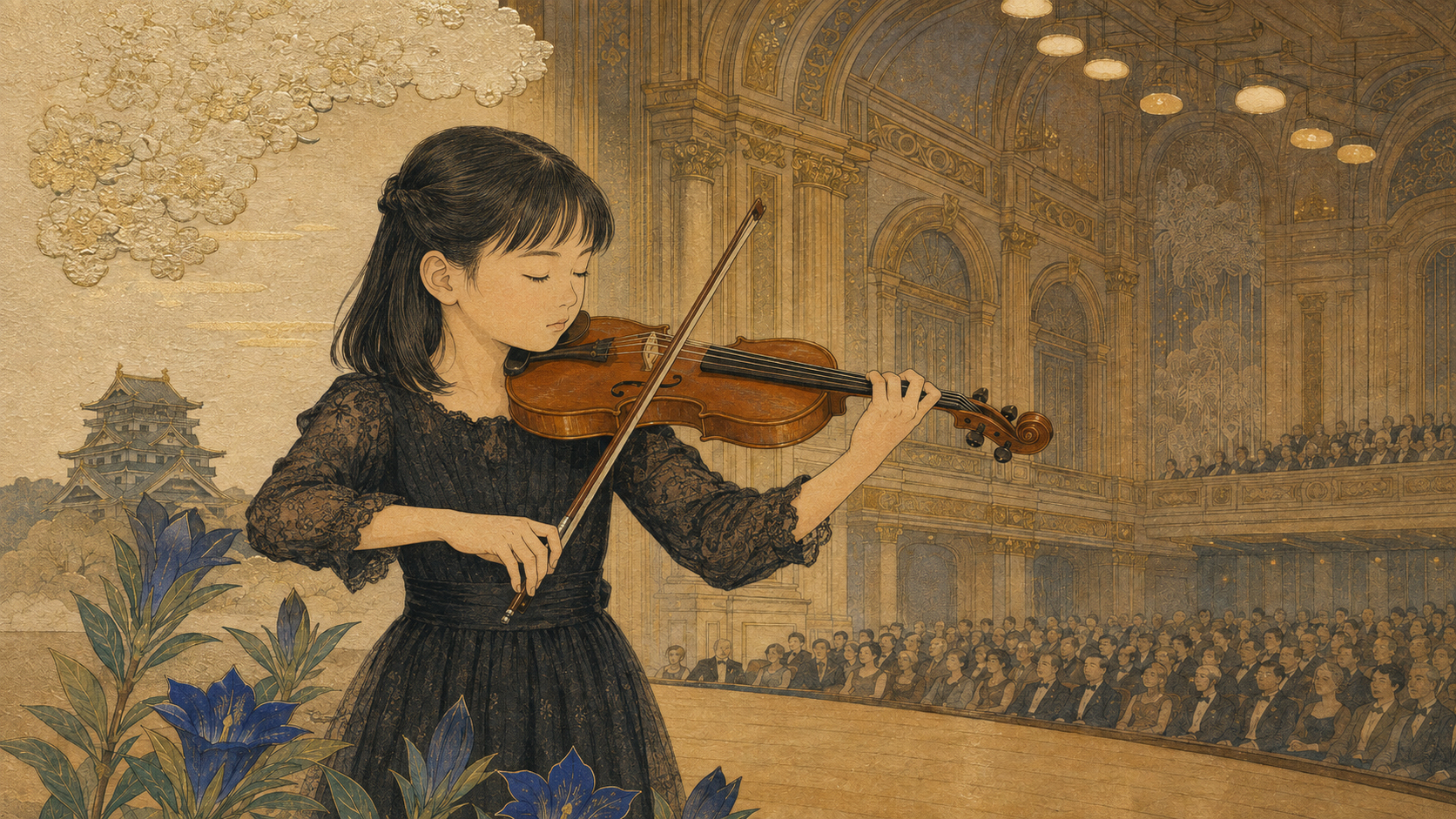
At 7:30 on the evening of August 1, a winners’ concert began behind the russet façade at 57th Street and Seventh Avenue in Manhattan. The public listing described a 90-minute gala featuring roughly ten international musicians. Among them was Sora Iwai, a 12-year-old sixth-grader at Sakuragi Higashi Elementary School in Kumamoto City.
Iwai had carried Franz Waxman’s Carmen Fantasie from Kumamoto to New York. It was the piece he submitted for the competition and performed on July 17 when he visited Kumamoto City Hall to report his award to Mayor Kazufumi Onishi. Local coverage said he planned to play it again at the gala. The competition’s results page places him alone under “First Grand Awards — Junior,” a category that combines instrumentalists and singers of every discipline up to age 17.
The words “Carnegie Hall” can finish a story before the music begins. They summon a famous marquee, celebrated debuts, and a century of mythology. But the deeper achievement was not merely entering an important building. It was moving from an audition that could be recorded, selected, and submitted to a performance that could not be taken back. A bow meets a string; the sound enters the room; the moment is gone. At 12, Iwai was given the chance to experience that irreversibility in front of a New York audience.
The ten years before New York
Iwai’s record is more revealing when read as accumulation rather than miracle. Both of his parents are string players. His father, double bassist Koji Iwai, leads the local performing organization Kumamoto Music Artist. Sora began violin at two, first learned from his parents, and moved into more formal lessons around age four. At five he began giving an annual solo performance at events held by Kumamoto’s Tsuruya Department Store.
Those modest appearances matter. A department-store event is not Carnegie Hall, but the performer’s work is recognizably the same: walk out, acknowledge the room, accept the audience’s silence, continue after a small mistake, and carry the piece to its final note. Long before an international results page recorded his name, a local audience helped turn performance into habit.
By seven, in 2021, Iwai was earning high placements in several Japanese competitions. In 2022 he won the first Yokohama International Violin Competition’s A division and a scholarship award, as well as the top prize and a junior special award at the Miyazaki Music Competition. In 2023 he placed first in the elementary third-grade division of the 45th All Japan Junior Classical Music Competition. He reported that result to the Kumamoto governor and appeared as a soloist in a prefecture-sponsored concert. Later that year, he placed second—with no first prize awarded—in the nine-and-under division of the Basel International Violin Competition.
He joined the Ishikawa Music Academy in 2024. A local corporate sponsorship and a donation from Tsuruya helped support overseas study, and Kumamoto reporting says he won a competition during a period of study in Austria in the summer of 2025. In May 2026 he submitted a video to the Manhattan competition. The top Junior result followed in July; the trip to New York followed in August.
Age 2 Begins violin, initially learning from his parents.
Age 5 Starts annual solo appearances at Tsuruya Department Store events.
2022, age 8 Wins the Yokohama competition’s A division and the top Miyazaki music prize, among other results.
2023 Places first in his grade at the All Japan Junior Classical Music Competition and performs as a soloist in a Kumamoto Prefecture program.
2024–25 Studies at a Japanese academy and in Europe with help from local donors and a sponsor.
May–July 2026 Submits a recorded performance and receives the Manhattan competition’s Junior First Grand Award.
August 1, 2026 Appears in the winners’ gala at Carnegie Hall.
What the “First Grand Award” actually selected
The 2026 event was the 10th Manhattan International Music Competition. It accepted piano, strings, voice, wind and other instruments, chamber music, and composition from applicants of all nationalities. The initial evaluation took place online. For the Junior category, all instrumentalists and singers age 17 or younger on August 1 were grouped together. The official results list Iwai as the sole First Grand Award winner in that category.
That is a broader comparison than “first among 12-year-old violinists.” It also differs from an older model of international competition built around live preliminary rounds, a semifinal, and a concerto final with orchestra. The 2026 regulations allowed one or more recording links, free repertoire, and a recommended total of 12 to 40 minutes. A professional studio recording was not required. Jury voting was confidential and the decisions final.
The format deserves neither exaggeration nor dismissal. Online selection reduces the cost of traveling simply to enter and lets a musician in Kumamoto reach an international jury. It also leaves unequal access to teachers, accompanists, recording spaces, equipment, and the cost of traveling after selection. The internet widens a gate; it does not level the entire road.
| Stage | Verified format | What it demands |
|---|---|---|
| Application | Recorded links submitted online; free repertoire; open internationally. | Fixing technique and interpretation in a performance that can be chosen for submission. |
| Junior award | One First Grand Award across instruments and voice for entrants through age 17. | Musical character capable of communicating across unlike disciplines. |
| Winners’ gala | A joint Carnegie Hall concert on August 1; the organizer described 10–15 minutes for each selected winner. | Adapting to an unfamiliar room, time zone, piano, accompanist, and unrepeatable live time. |
That two-step path—being discovered through media, then earning trust in person—is becoming normal for young musicians. The recording opened a door. The live concert asked a different question: could the promise heard through microphones become a complete experience in the room?
Carnegie Hall is a building, not a single stage
Carnegie Hall opened on May 5, 1891. Its five-day opening festival featured Pyotr Ilyich Tchaikovsky as a guest conductor. The name now carries worldwide prestige, but the building contains three distinct auditoriums: the 2,804-seat Stern Auditorium / Perelman Stage, the 599-seat Zankel Hall, and the more intimate Weill Recital Hall on the third floor.
The seating-chart link attached to the 2026 gala listing identifies Iwai’s venue as Weill Recital Hall. That room opened with the building in 1891 as Chamber Music Hall. It became Carnegie Recital Hall in 1947 and was renamed Weill Recital Hall in 1987. It is not the vast main auditorium familiar from orchestral broadcasts; it is a close room built for recitals and chamber music, where a player’s tone and phrasing are exposed at short range.
Precision about the room does not reduce the achievement. It makes it real. Iwai did not sell out Carnegie’s main hall or give a solo recital selected and presented by Carnegie Hall. He joined a competition-organized gala in the building’s historic recital room, alongside laureates of different ages, nationalities, and disciplines. His appearance was nevertheless listed on Carnegie Hall’s official calendar and completed before a live New York audience.
- Building: Carnegie Hall, opened in 1891.
- Room: Weill Recital Hall, separate from the main Stern Auditorium.
- Concert: A joint winners’ gala organized by the Manhattan International Music Competition.
- Time: August 1, 2026, scheduled from 7:30 to 9 PM.
- Meaning: A live international performance opportunity attached to the award—not a guarantee of representation, bookings, or a professional career.
Carmen Fantasie: a nine-minute theater born in Hollywood
The piece Iwai chose is more than a display of speed. German-born composer Franz Waxman created his Carmen Fantasie from themes in Bizet’s opera for the 1946 film Humoresque. The film follows a gifted young New York violinist, played by John Garfield. Isaac Stern supplied the recorded violin and served as musical adviser, allowing the fictional virtuoso to sound convincing on screen.
Jascha Heifetz saw the film and asked Waxman to enlarge the fantasy for concert use. According to the composer’s official history, Waxman revised the work between August and October 1946. It was presented on The Bell Telephone Hour on September 9, and Heifetz recorded it that November. Carnegie Hall’s work catalogue dates the concert composition to 1947.
The familiar melodies of Bizet’s opera arrive in quick succession, but the violin must make them cohere. Rapid passagework, double stops, chords, harmonics, leaps across registers, and abrupt changes of character make the work a formidable showpiece. Its deepest difficulty is narrative: the player has to become singer, dancer, and storyteller, turning a sequence of brilliant fragments into a drama lasting a little more than nine minutes.
Before leaving, Iwai said he wanted to play “emotionally” and “musically,” and to become a violinist who could move people around the world. That aspiration is exactly what the score tests. Accuracy lets the notes survive; character makes the fantasy sound like theater.
The work also draws a striking historical circle around this appearance. Humoresque told the story of a young New York violinist. Stern, whose playing gave that fictional musician a voice, later became the central figure in the campaign that saved Carnegie Hall from demolition and served as the institution’s president from 1960 to 2001. In 2026, a boy from Kumamoto played music born from that film inside the building Stern helped preserve. No one designed the symmetry, but the repertoire made it audible.
The 147-year Japanese road behind a two-year-old’s first lesson
Iwai could begin violin at two in Kumamoto because Western art music had long since become part of Japan’s educational infrastructure. The predecessor of Tokyo University of the Arts’ Faculty of Music was the Ministry of Education’s Music Investigation Committee, established in 1879. It taught performance while researching Japanese and Western music, history, and theory. In 1887 it became the Tokyo Music School, creating a durable system for specialist training.
This was not simply a project to erase Japanese sound with European music. The committee and the Tokyo Music School studied both traditions. Their work eventually supported a formal department of traditional Japanese music as well as Western performance. That double vision—learning an imported instrument while treating Japan’s own music as knowledge worthy of preservation—helped define the country’s modern conservatory culture.
After World War II, violinist and educator Shinichi Suzuki widened the instrument’s social reach through Talent Education. The movement took institutional shape in Matsumoto in 1946 and became an incorporated association in 1950. Suzuki argued that talent was not a fixed birthright: like language, musical ability could grow through listening, repetition, encouragement, and a rich home environment.
There is no public evidence that Iwai was trained in the Suzuki Method, and this article does not claim that he was. The relevant connection is historical rather than biographical. Starting at two, hearing string playing at home, learning first from parents, and accumulating small performances all belong to a Japanese musical world in which early childhood string education has been normalized. The line runs from a national music bureau in 1879, through a postwar movement in Matsumoto, to teachers, families, and studios throughout regional Japan—and, in 2026, to an audition link sent from Kumamoto.
1879 Japan’s Ministry of Education establishes the Music Investigation Committee.
1887 The Tokyo Music School opens, institutionalizing specialist music education.
1891 Carnegie Hall opens in New York.
1946 Suzuki’s Talent Education movement takes root in Matsumoto; Waxman expands Carmen Fantasie for Heifetz.
1950 The Talent Education Research Institute is incorporated and later carries its ideas worldwide.
2026 A 12-year-old trained in Kumamoto moves from an online audition to a live New York performance.
The local audience behind an individual prize
Competition results place one name in bold type. Young musicians, however, cannot travel, pay tuition, arrange accompaniment, maintain an instrument, or build a schedule alone. Iwai’s public record shows a surrounding structure: parents who were his first teachers, later instructors, Kumamoto Music Artist, the department store that offered a recurring stage, prefectural cultural programs, a company sponsor, and a local donation that supported European study.
His official profile names three current teachers and notes that he attended the Ishikawa Music Academy. The details resist the simplest prodigy myth. Development did not flow from a single master or a single breakthrough. One person watched daily fundamentals; another offered a different ear at a turning point; others accompanied, adjusted the instrument, booked a room, managed schoolwork, or paid a fare.
Kumamoto Asahi Broadcasting reported that Iwai sometimes practices more than eight hours on days off. The number conveys extraordinary concentration. It should not become a formula prescribed to every child. At 12, a musician is also growing physically, attending school, and forming a life beyond the instrument. Good teaching, rest, injury prevention, and room to enjoy music are not obstacles to achievement. They are what make a long career possible.
Why live performance matters more in the age of video
The 2026 competition illustrates how smartphones and fast networks have changed international access. A regional musician once had to cross countries for an early-round audition, with no assurance of advancing. A link can now carry sound from Kumamoto to judges elsewhere, allowing travel to be concentrated on the opportunity that follows selection.
Yet the spread of video has not made live performance obsolete. It has clarified what only live performance can test. A recording can be made with a chosen microphone position and a selected take. In a hall, the player must accept the air conditioning, lights, jet lag, an unfamiliar piano, a cough in the audience, the condition of the strings, and the acoustic of that particular room. The audience, in turn, shares time that has not been edited.
That difference may have been the most valuable part of the prize. A trophy remains on a shelf and an award stays in a biography. The wait in the wings, the placement of the first note, and the silence before lowering the bow after the last one remain only in the player. At the next unfamiliar hall, those memories may return as a steadiness that no ranking can measure.
An opening, not an arrival
Coverage of young musicians tends to reach quickly for “prodigy,” “gateway,” and “world stage.” A single award cannot predict a 12-year-old’s future. Competitions differ widely in format and standing. A performing career is shaped over years by schooling, teachers, repertoire, health, finances, collaborators, and chance.
There is no need to minimize this event in order to avoid prophecy. Iwai was selected for the highest award in a Junior category spanning instruments and voice. He traveled from Kumamoto to New York and performed for a live audience in the intimate recital room of a building with 135 years of musical history. He converted the promise heard in a recording into experience on a stage.
At Kumamoto City Hall, he said he hoped to become a violinist active around the world who could move his listeners. The next requirement is less grand than the dream: tune one interval, place one bow stroke, hear something today that went unheard yesterday. That repetition began in small rooms in Kumamoto and reached New York. New York, too, was one day that ended by returning him to practice.
Reporting notes and principal sources
This article uses public information checked through August 11, 2026 at 8:06 AM Japan Standard Time. The award, selection format, concert date, and invitation come from official competition materials; the room and building history come from Carnegie Hall sources and the event listing’s linked seating chart; Iwai’s record and remarks come from Kumamoto government, performing-organization, and local-news sources. No public source reviewed here provides the performance order, accompanist, jury scores, attendance, or a critical account of Iwai’s playing on August 1, so none is inferred. “Performed at Carnegie Hall” is kept distinct from a Carnegie Hall–presented concert or a performance in its main auditorium.
- Manhattan International Music Competition: 2026 winners, including Sora Iwai’s Junior First Grand Award
- Manhattan International Music Competition: 2026 rules, recording-based selection, age categories, and gala terms
- Carnegie Hall: official August 1 winners’ gala event page
- Carnegie Hall: Weill Recital Hall seating chart linked from the event listing
- Carnegie Hall Digital Collections: the 1891 opening
- Carnegie Hall Data: the room’s history from Chamber Music Hall to Weill Recital Hall
- Carnegie Hall Data: Waxman’s Carmen Fantasie, dated 1947
- Official Franz Waxman site: the work’s origin in Humoresque, Heifetz, and its concert history
- Kumamoto Asahi Broadcasting: the award, repertoire, practice, and Iwai’s ambitions, July 20, 2026
- Kumamoto Nichinichi Shimbun: City Hall report, musical parents, and recorded selection, July 17, 2026
- Kumamoto Prefecture: Iwai’s 2023 All Japan Junior Classical Music Competition result
- Kumamoto Music Artist: Sora Iwai’s performing, award, and study history
- Kumamoto Kenmin Television: his early training, musical family, and local performances
- Tokyo University of the Arts: the 1879 Music Investigation Committee and 1887 Tokyo Music School
- Talent Education Research Institute: Shinichi Suzuki and the movement’s institutional history