- The distance between having a hospital and reaching it
- What the two selected projects actually do
- A second Kumamoto earthquake, a familiar vulnerability
- Yatsushiro: a service exists, but can people use it?
- Uki: measure demand before choosing technology
- Kumamoto’s larger ambition: twice the public transport, no transport gaps
- How Japan reached this crossroads
- What disaster-access modeling reveals—and what it does not
- A minibus, a shared taxi or ride-sharing? The trade-offs
- The test: measure journeys restored, not press releases issued
- Reconstruction means being able to go somewhere
The distance between having a hospital and reaching it
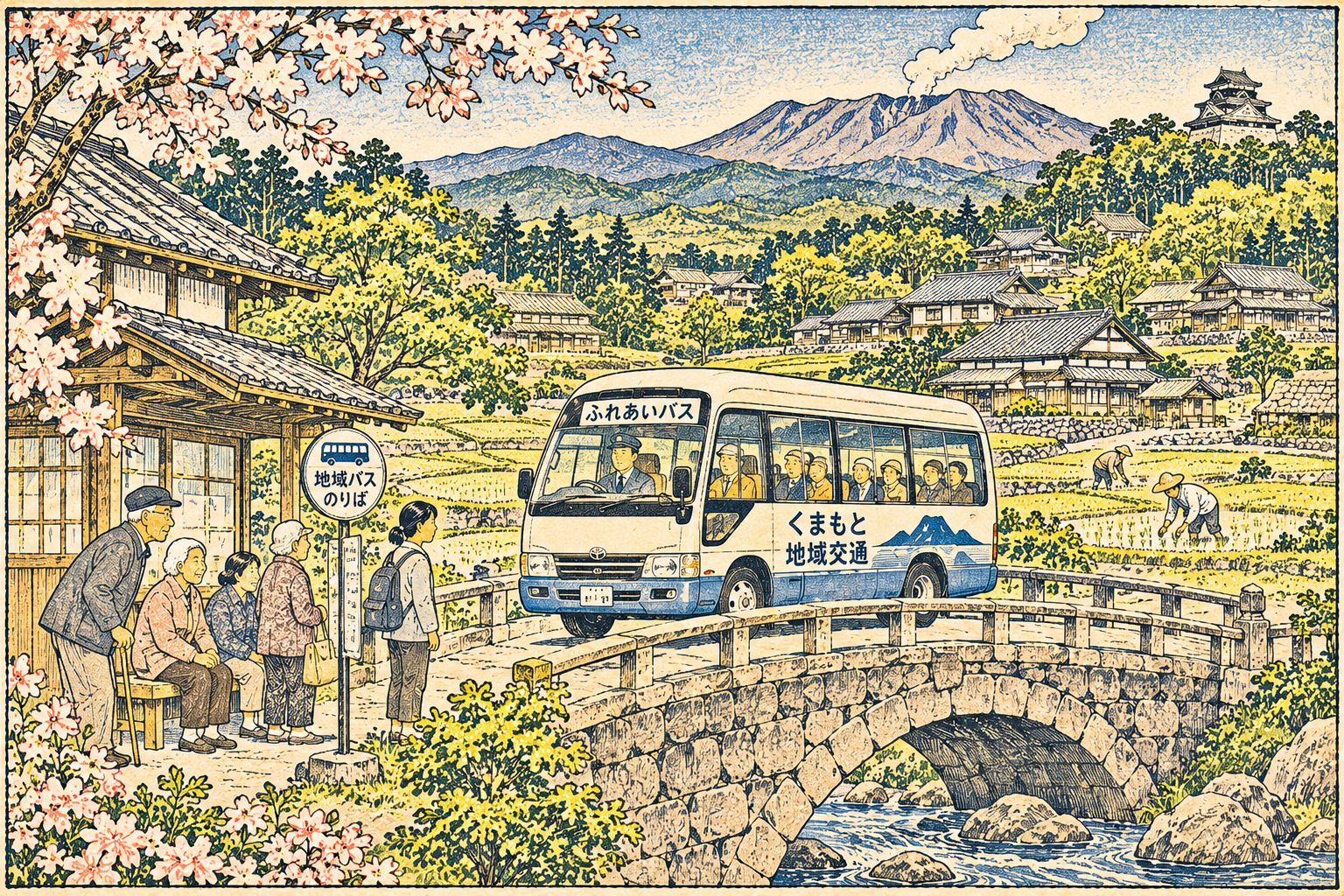
A hospital can remain open, a grocery store can be fully stocked and a railway line can have resumed service, yet a resident may still have no practical way to reach any of them. A bus stop may be too far to walk; the only bus may leave before a medical appointment ends. For an older person who no longer drives, or a child whose family cannot provide a lift, this is not a technical debate about transport capacity. It is the difference between participating in ordinary life and being shut out of it.
Japan’s transport ministry announced on November 2, 2026, that two Kumamoto municipalities had been selected for a special round of support under its program to eliminate transport gaps. Yatsushiro City will study how to prepare a demonstration service in earthquake-affected areas. Uki City will analyze local transport gaps and possible responses. The applications were linked to the July 28 Kumamoto earthquake and the government’s subsequent reconstruction-support package.
The crucial distinction is that these are research and planning selections. The ministry did not announce that two new bus routes are operating, that a ride-sharing fleet has been purchased or that either city has a final timetable. Understanding that difference is the first step toward judging what the new support might achieve.
What the two selected projects actually do
The ministry’s two-page notice names the applicants and project titles precisely. Yatsushiro’s project concerns a survey in preparation for trial operation of a transport service in an affected area. Uki’s is an analytical study directed at eliminating transport gaps. Both municipalities are applicants under the fourth recruitment round of the fiscal 2026 transport redesign program.
Yatsushiro’s own procurement notice describes residents who live far from railway stations and bus stops, as well as children who cannot conveniently attend lessons or activities because service frequencies are too limited at certain times. Uki is seeking a contractor to examine existing public transport, available mobility resources, residents’ patterns of travel and likely future demand, then identify possible policy responses.
Neither description should be transformed into a promise of a specific new service. They signal a prior problem: local governments need to understand the mobility journeys that are failing before committing scarce drivers, vehicles and public money to a solution.
A second Kumamoto earthquake, a familiar vulnerability
The new funding round explicitly addresses disruption from the Kumamoto earthquake of July 28, 2026. Japan’s transport ministry documented transport interruptions including suspension of passenger services on the JR Kyushu Kagoshima Main Line between Uto and Yatsushiro and on the Hisatsu Orange Railway between Yatsushiro and Higo-Tanoura. Replacement transport was arranged while the railway lines were unavailable; railway operations resumed in October and the substitute buses ceased.
The restoration of railway operations is real progress. But a reopened railway cannot automatically restore every connection between a home and the nearest station, or between temporary accommodation and a clinic. Damage to roads, shifts in where people live and changes in daily errands can leave lasting problems even as the principal network returns.
The region also carries the memory of the destructive 2016 Kumamoto earthquakes. Those events offer historical context, but the 2026 funding announcement is expressly about transport issues newly arising from the 2026 earthquake. The two disasters and their consequences must not be conflated.
Yatsushiro: a service exists, but can people use it?
Yatsushiro already had a transport restructuring agenda before the latest earthquake. Its second regional public transport plan describes declining ridership, shortages of drivers and increasing operating costs. It considers a network linking the city center with areas including Hinagu, Sakamoto, Kagami and Sencho, and Toyo and Izumi, with a possible move toward more demand-responsive shared-taxi services on lightly used routes.
At a June 2026 public transport meeting, the city had discussed trials involving shared taxis and AI-assisted on-demand transport. The November selection is therefore not the sudden invention of a mobility strategy. It is an additional step in a longer effort that now must also respond to changed conditions after a major disaster.
The distinction between nominal access and usable access is especially clear in the city’s mention of children trying to reach extracurricular activities. A service that runs at the wrong hour is not a usable service, even when the stop is nearby. The same applies to older passengers juggling appointments, shopping bags, connections and limited mobility.
Uki: measure demand before choosing technology
Uki’s regional public transport plan covers fiscal 2025 through 2029 and is built around a simple principle: connect different transport modes rather than treat each as a separate system. Its priorities include adjusting service levels to actual use, maintaining a sustainable network and improving interchange functions at Matsubase, Ogawa and Misumi stations.
The city’s newly announced research contract follows that logic. It calls for an examination of the local geography, existing transport services, travel behavior, gaps in provision and future options. This is not the same as awarding a contract for the operation of a bus, much less proving that ride-sharing will outperform conventional taxi or scheduled services.
An effective plan might use existing operators more efficiently, change transfer arrangements or create a narrowly targeted demand-responsive link. Which option is best depends on residents’ journeys, operator capacity and the costs of delivering the service reliably—not merely on whether an app can schedule a vehicle.
Kumamoto’s larger ambition: twice the public transport, no transport gaps
In March 2026, Kumamoto Prefecture adopted a new regional public transport plan. It sets long-term goals the prefecture describes as doubling public transport and eliminating transport-gap areas designated by municipalities. This was a policy commitment months before the July earthquake tested the network’s resilience.
A transport gap is not necessarily an empty space between dots on a route map. A municipality may identify a place as underserved because residents find it difficult to use services that technically exist. A journey can fail because of schedules, transfers, cost, booking requirements or physical barriers as well as distance.
The two selected studies will not, by themselves, achieve the prefecture-wide ambition. Their value lies in demonstrating how one local government diagnoses a problem accurately enough to decide where investment should go—and what it must measure after a new service is introduced.
How Japan reached this crossroads
Postwar motorization transformed Japan’s regional economies. Widespread car ownership made dispersed housing, retail and workplaces practical for many households. Yet those arrangements can become fragile when the population ages, younger residents move away and bus operators face shrinking demand and rising labor costs. A system designed around car access creates a particular hardship for people who cannot or choose not to drive.
The national government has responded with an effort to eliminate what it calls kōtsū kūhaku, or transport gaps. Its transport policy framework places fiscal 2025–2027 in an intensive countermeasure period and considers options including shared taxis, public ride-sharing and demand-responsive transport. Coordination with healthcare, welfare and educational institutions is also eligible for support.
The economic challenge is not simply choosing the newest vehicle technology. Sparse journeys can be expensive to serve. Drivers must be recruited and retained; safety and insurance responsibilities must be clear; and booking systems must work for residents who do not own smartphones. Public subsidy can make a trial possible, but lasting service requires an operational model that survives beyond the grant.
What disaster-access modeling reveals—and what it does not
An analysis discussed by the Research Institute of Economy, Trade and Industry, drawing on work by researcher Shunsuke Managi and collaborators, gives the issue a sharper geographic dimension. The team modeled roughly 340,000 road segments across Kumamoto Prefecture. Under a scenario in which 3% of road segments became unusable, an estimated 22,381 residents would lose the ability to reach emergency medical facilities within 30 minutes.
That number is not a verified count of people actually stranded after the earthquake. It is a modeled estimate under an explicitly stated road-closure scenario. The researchers also found that disruption of a small number of critical links could create outsized losses of accessibility, highlighting why protecting connections can matter more than increasing the number of facilities.
The same principle extends beyond emergency medicine. A timetable can show a route to a hospital while obscuring the fact that the return trip is impossible. Measuring real journeys, including the time and reliability of the connections, is therefore more useful than counting vehicles alone.
A minibus, a shared taxi or ride-sharing? The trade-offs
Demand-responsive vehicles may be attractive when homes are scattered and fixed-route buses run mostly empty. A shared taxi might connect households to a railway hub; a phone-booked service might serve medical appointments on particular days. Japan’s national program lists multiple eligible approaches rather than prescribing one technology for every community.
Each has costs and limitations. A booking-only service excludes people who cannot navigate the system unless telephone or assisted reservation options exist. Dynamic scheduling is less useful when demand peaks simultaneously. Driver availability, accessible vehicles, fare levels, trust in the operator and the continuity of public funding can determine whether an apparently efficient service becomes dependable.
It is therefore premature to claim either Yatsushiro or Uki has selected a particular ride-sharing provider, bought a fleet or launched a permanent service. Those decisions, if made, must be established through later municipal documentation.
The test: measure journeys restored, not press releases issued
If trial services follow, the first obvious metric will be riders. But the most important outcomes are subtler: whether a person reaches treatment they previously missed; whether a child can attend activities at the needed time; whether travelers can make the connection to a train; and whether the service can offer accessible, affordable transport without unreasonable waiting.
Municipalities should also be able to report operating cost per completed trip, unsuccessful bookings, service coverage, labor requirements and the stability of demand as households rebuild. Earthquake recovery can change residential patterns quickly. A network based entirely on one month’s temporary travel needs may become obsolete as people return home or move elsewhere.
The official announcements reviewed do not settle the eventual route maps, fare schedules, target neighborhoods, contracts or outcome evaluations. Those are not trivial omissions; they are the information against which success should ultimately be judged.
Reconstruction means being able to go somewhere
A repaired road and a reopened railway are essential parts of recovery. Yet people judge recovery through what they can do again: visit a doctor, buy food, see friends, take part in local life. The freedom to make those journeys can be lost long before a community is visibly abandoned.
Yatsushiro and Uki are starting with surveys, not victory announcements. That is less dramatic than inaugurating a bright new bus. It may prove more consequential if the research identifies the particular trips residents cannot complete and helps the cities sustain a better service afterward.
Japan’s aging, shrinking communities will keep encountering this problem, with or without another earthquake. Kumamoto’s November decision offers a modest but revealing question for the country: will public transport be planned as lines on a map, or as a practical ability to reach the people and places that make daily life possible?
Sources and reporting method
Document-based reporting using MLIT, Kumamoto Prefecture, Yatsushiro City and Uki City primary records, transport restoration notices and public research on disaster accessibility. No independent resident or official interviews were conducted.