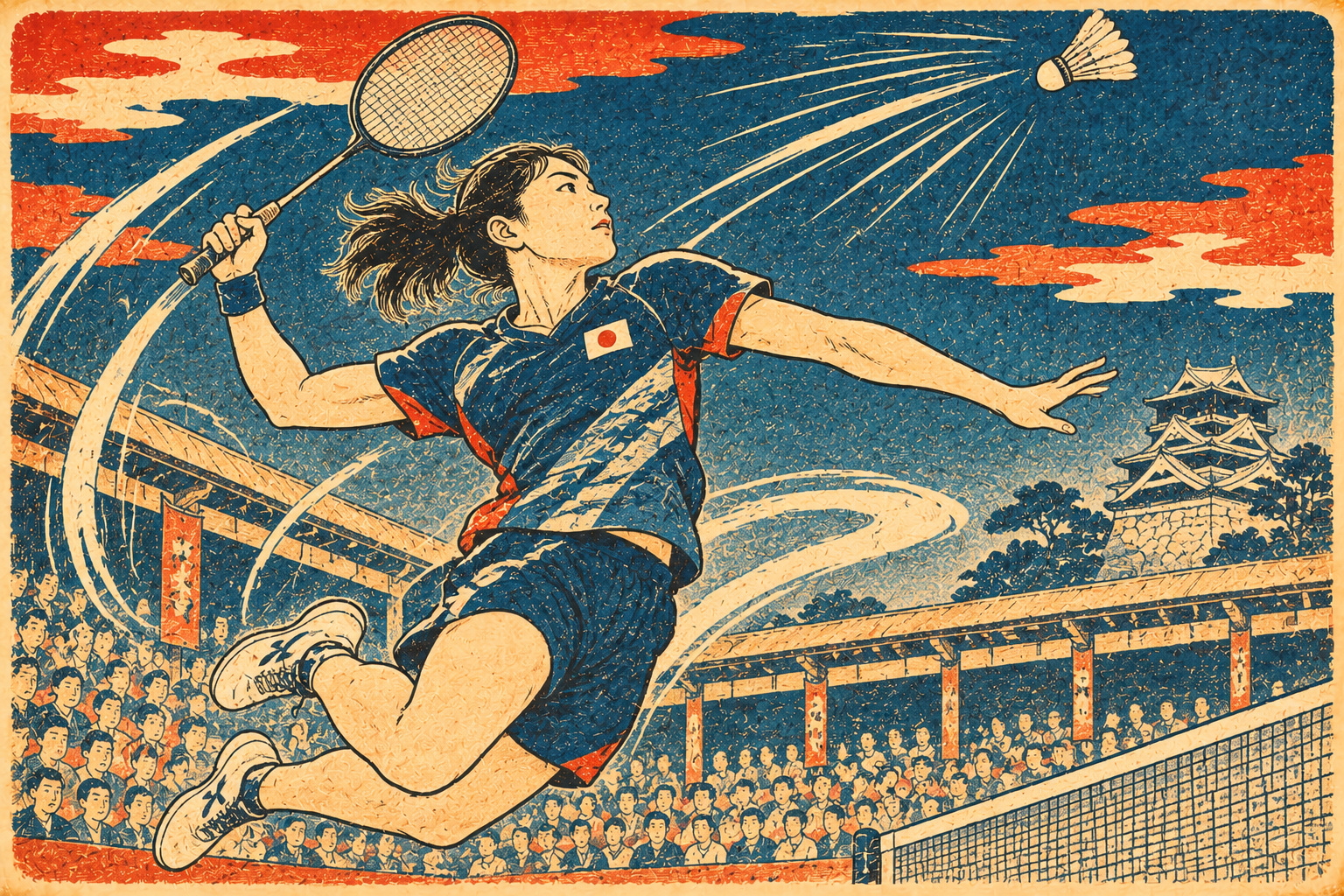
- A scoreline that refuses to end
- The men’s singles test: losing a game, finding a response
- Women’s singles: experience meets the next wave
- Doubles upsets are about partnership, not just power
- Women’s doubles show how rapidly a pair can change a contest
- Mixed doubles: four Japanese pairs progress
- Why Kumamoto matters beyond the scoreboard
- A Japanese badminton century, from YMCA halls to Olympic gold
- What Super 500 actually means
- What the quarterfinals could reveal—and what is not yet known
A scoreline that refuses to end
The deciding game reached 29–27. Japan’s Kyohei Yamashita and Hiroki Okamura had survived an extraordinary men’s doubles first-round battle against Indonesia’s second seeds Fajar Alfian and Muhammad Shohibul Fikri, taking the match 21–14, 11–21, 29–27. It is the kind of contest that can pull an entire tournament into focus: not simply who was seeded to win, but which pairing made the final adjustment under pressure.
The result was among the early highlights reported by the Badminton Association of Japan on November 12. The same official recap documented Japanese victories across all five disciplines, alongside defeats that showed just how unforgiving a Super 500 draw can be.
Kumamoto Masters Japan runs November 10–15 at Kumamoto Prefectural Gymnasium. The round of 16 is scheduled for November 12, quarterfinals for November 13, semifinals for November 14 and finals for November 15. This feature reports confirmed first-round outcomes; later match results were not independently verified at the research cutoff.
The men’s singles test: losing a game, finding a response
Kodai Naraoka recovered from a game down against Thailand’s Panitchaphon Teeraratsakul, winning 17–21, 21–17, 21–17. Kenta Nishimoto staged his own comeback against Ireland’s Nhat Nguyen, 15–21, 21–7, 21–18. Neither player cruised through a comfortable opening round, and that matters more than a simple list of winners.
Yuji Tanaka defeated China’s Zhu Xuan Chen 21–14, 21–17, while Koki Watanabe beat South Korea’s Jeon Hyeok Jin 21–10, 21–18, according to the Japanese association. These are verified first-round scores, not claims that the four players all reached the quarterfinals.
Other Japanese entrants, including Minoru Koga, Yudai Okimoto and Riki Takei, were eliminated at the first hurdle. A serious assessment must include those results too. Adaptability, rally management and recovery after losing momentum cannot be measured by nationality or pre-tournament reputation.
Women’s singles: experience meets the next wave
Akane Yamaguchi defeated fellow Japanese player Hina Akechi 22–20, 21–10. The first game was tight; the second decisively less so. Riko Gunji also advanced, beating Indonesia’s Putri Kusuma Wardani 21–13, 22–20, while Tomoka Miyazaki won an all-Japan meeting with Manami Suizu 21–18, 21–11.
Nozomi Okuhara and Natsuki Nidaira likewise progressed, the association reported. For younger players, facing established names offers a direct benchmark. For experienced players, a first round demands immediate sharpness, particularly when there is little time to recover from a poor start.
Not every Japanese contender advanced. Kaoru Sugiyama lost to China’s Chen Yufei, and Nodoka Sunakawa fell to Thailand’s Ratchanok Intanon. Asia’s depth in women’s singles means a difficult opponent can appear before the later rounds even begin.
Doubles upsets are about partnership, not just power
Yamashita and Okamura’s win over the second seeds was not the only Japanese men’s doubles success. Takuro Hoki and Yugo Kobayashi defeated a Hong Kong pair 21–13, 21–17. Other combinations lost in the opening round, underscoring the difference between one team’s breakthrough and an overall national sweep.
The third game of the upset ended 29–27 because badminton requires a two-point margin after 20-all, subject to a 30-point ceiling. A sequence of points near that limit tests serve reception, net control, shot selection and nerve. The drama is genuine without requiring an invented quotation from the court.
A single victory over highly ranked opponents does not establish that a pair has become the strongest in the draw. Sustained tournament performance depends on recovery, opponents’ tactical responses and the cumulative demands of multiple matches in consecutive days.
Women’s doubles show how rapidly a pair can change a contest
Chiharu Shida and Ririna Hiramoto recovered to beat Malaysia’s second seeds Pearly Tan and Thinaah Muralitharan 18–21, 21–13, 21–14. It was one of the opening round’s most striking reversals and a useful reminder that doubles performance depends on the combination, not merely on the reputations of two individuals.
Other Japanese pairs to advance included Yuki Fukushima and Mayu Matsumoto; Kie Nakanishi and Rin Iwanaga; Miyu Takahashi and Sumire Nakade; and Ayaka Hirota with Ayako Sakuramoto. Their shared task is to defend court space together, exchange front- and back-court responsibilities and coordinate under speed.
At the same time, Ayaka Hobara and Rui Hirokami lost to an Indonesian pairing despite their recent success at another tournament, according to the national association. Form transfers imperfectly from one competition to the next; court conditions and opposition change.
Mixed doubles: four Japanese pairs progress
Japan entered five mixed doubles combinations and four won their first matches. Yuta Watanabe and Maya Taguchi advanced, as did Yuichi Shimogami and Ayaka Hobara. Hikaru Koga and Natsu Saito defeated a Hong Kong pair 21–19, 21–14; Haruki Kawabe and Kokona Ishikawa fought back against a pair from Chinese Taipei 15–21, 21–14, 21–19.
Mixed doubles is not a simple contest of a powerful smash from one player and defense from the other. The opening exchanges, the speed of the front court, rotations, deceptive placement and communication determine whether a partnership can control a rally.
Hiroki Midorikawa and Mao Yamakita lost in three games to opponents from Chinese Taipei. Including that result keeps the assessment proportional: four opening wins show depth in the draw, not a guarantee of medals or semifinal appearances.
Why Kumamoto matters beyond the scoreboard
The tournament began in 2023. The Japanese association’s annual report records 354 participating athletes in that inaugural edition, bringing an international field to Kumamoto rather than concentrating every major event in Tokyo or Osaka.
In February 2026, the association confirmed that Kumamoto would continue to host Japan’s BWF Super 500 event from 2027 through 2030, while Tokyo would host the Super 750 Japan Open. That longer horizon matters for organizing capacity, continuity and the possibility of an enduring local sporting identity.
Visitors, officials, broadcasters and young spectators may all benefit from a world-class competition outside the capital. Yet a particular economic return cannot responsibly be estimated from tournament status alone; credible impact numbers would require independent evidence.
A Japanese badminton century, from YMCA halls to Olympic gold
Japan’s badminton history reaches back to early twentieth-century YMCA activity. Its national association was established in 1946 and joined the international federation in 1952. Postwar sports clubs, corporate teams and disciplined coaching contributed to an enduring competitive structure.
Japan won the women’s Uber Cup for the first time in 1966 and the men’s Thomas Cup in 2014. Its first Olympic badminton medal came at London 2012. At Rio 2016, Ayaka Takahashi and Misaki Matsutomo won women’s doubles gold—the culmination of years of institutional development, not an isolated accident.
World titles for Nozomi Okuhara in 2017 and Kento Momota in 2018 and 2019 helped make Japan one of the sport’s established powers. But the past can illuminate the present without predicting it. Kumamoto is a test of current partnerships, emerging talents and the ability to compete repeatedly.
What Super 500 actually means
The BWF World Tour divides its premier regular-season events into categories including Super 1000, Super 750, Super 500 and Super 300. These levels reflect relative standing, ranking points, prize structures and the caliber of fields—not a requirement that exactly 500 athletes enter or that the winner receives $500.
Five disciplines are contested: men’s and women’s singles, men’s and women’s doubles, and mixed doubles. A match is normally best of three games to 21 points, with a two-point margin required at 20-all and a cap at 30. The dramatic 29–27 decider in men’s doubles illustrates why understanding the rules matters when reading a result.
An upset can alter an individual’s tournament outlook, but not, by itself, establish a permanent change in the world order. Ranking movement depends on the full competition and the BWF points framework.
What the quarterfinals could reveal—and what is not yet known
The timetable takes the tournament into quarterfinals on Friday, November 13, semifinals on Saturday and finals on Sunday. Those are scheduled rounds, not verified results. At the time of this reporting, official quarterfinal scorecards and a confirmed semifinal lineup were unavailable for independent checking.
A publication-day update should identify exactly which Japanese entrants survived Thursday’s second round, list Friday’s confirmed winners and scores, check withdrawals or injuries, and match each Saturday semifinal pairing to a BWF draw record. It should not merely promote early-round winners into later rounds.
Kumamoto’s value is in the combination of world-class opposition and local visibility. The outcome can be dramatic, but trust depends on something less theatrical: telling readers what the federation has actually verified, and being equally clear about what it has not.
Sources and verification
Based on published organizer, municipality and government sources. We have not independently verified November 13 quarterfinal scores or the Saturday semifinal draw.