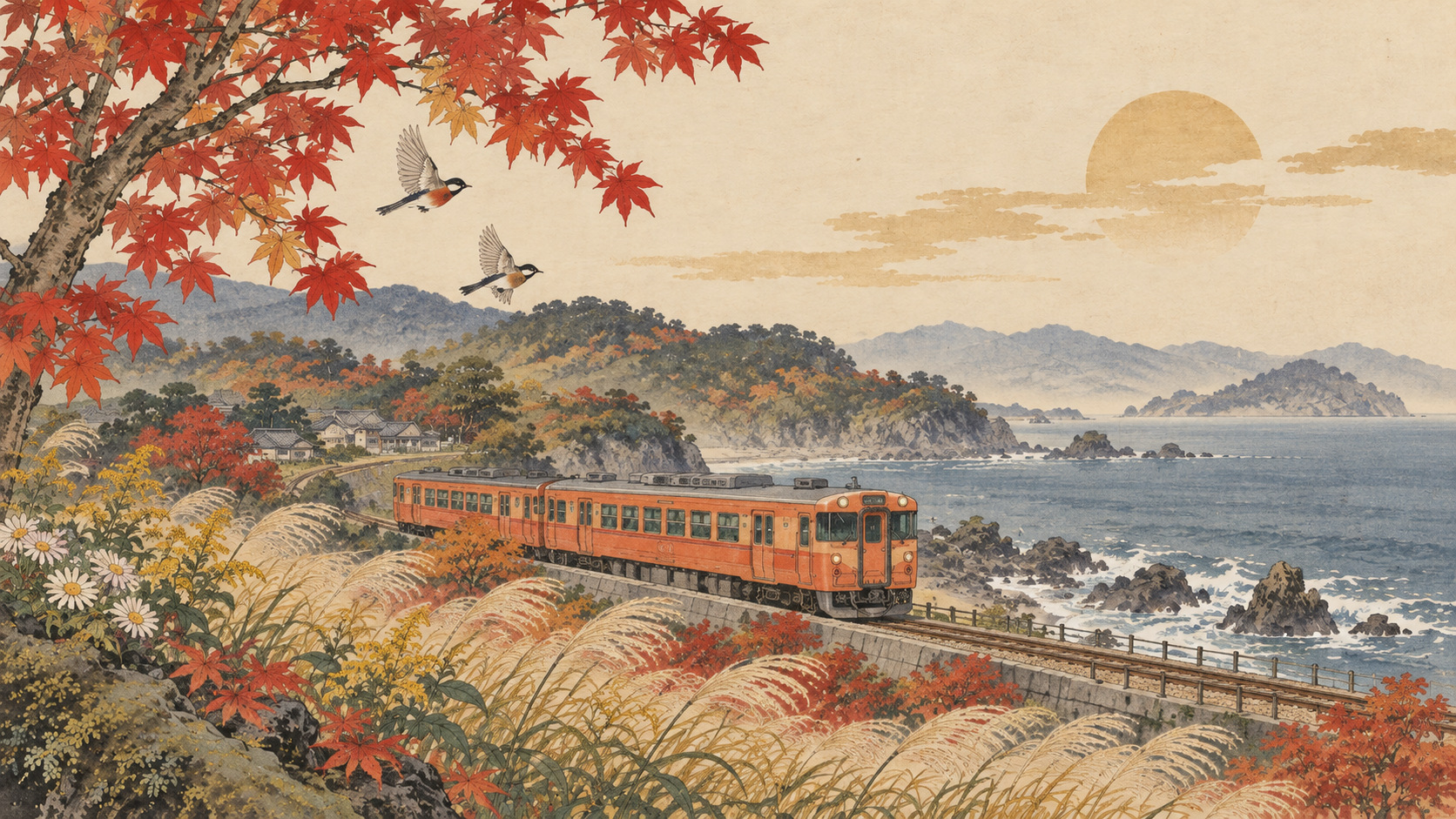
The first train carries more than passengers
On October 13, the first scheduled trains returned to a 23.6-kilometer stretch of railway between Yatsushiro and Higo-Tanoura in Kumamoto Prefecture. It had been closed since the July 28 earthquake. With that final section reopened, Hisatsu Orange Railway could once again operate over its 116.9-kilometer corridor to Sendai in Kagoshima Prefecture, 77 days after the disaster. For those who rely on the line to reach school, shops, medical appointments and work, the restoration means considerably more than a line on a network diagram turning green.
The operator announced on October 6 that it intended to restart the section with the October 13 first departures. Local broadcasters subsequently confirmed that trains had returned. Substitute buses ended on October 12. But an important distinction survives the celebration: full-line infrastructure restoration does not mean every train has returned. The railway says some services have been suspended since August 2025 because of a driver shortage.
An earthquake does not damage just one rail
The operator identified deformed track near Yatsushiro and Higo-Koda, a broken overhead electrical feeder wire between Hinaguonsen and Higo-Futami, and damaged platforms or boarding areas at Yatsushiro and Kami-Tanoura, among other defects. Services were initially halted across the system and restored section by section after safety checks. The final gap, closest to serious damage, demanded more work.
Japanese reporting counted damage at roughly 100 locations and cited approximately ¥550 million in projected restoration and substitute-transport costs. That estimate should not be confused with an audited final bill. Rails, ballast, station platforms, electrical systems, inspections, rolling stock and crew schedules all have to come together before a safe timetable can resume. The conspicuous moment is the first train; the less visible achievement is the sequence of repairs and tests behind it.
How one lost connection reshaped a school day
The human cost of a closed local railway can be counted in missed hours, changes of vehicle and dependence on other people. Mainichi Shimbun reported on a high-school student from Ashikita whose commute to Yatsushiro had taken almost two hours using replacement transport and would return to about one hour by train. Other passengers described relief at no longer having to transfer from rail to buses.
These experiences illustrate why seemingly modest rail links can be indispensable in communities where younger people and some older residents cannot simply drive. A dependable trip to a clinic or an education campus creates choices that are not obvious from revenue statistics. They do not, however, establish an average time saving for every passenger; no comprehensive survey of such changes was verified for this report.
Why a railway founded in 2004 matters
Hisatsu Orange Railway emerged from one of the defining infrastructure decisions in modern Japan. The Kyushu Shinkansen brought higher-speed links to southern Kyushu, and on March 13, 2004, the original JR Kyushu Kagoshima Main Line section between Yatsushiro and Sendai transferred to a third-sector company supported by Kumamoto Prefecture, Kagoshima Prefecture and municipalities along the route. The Ministry of Land, Infrastructure, Transport and Tourism had granted railway-business authorization in June 2003.
It is a familiar exchange across Japan: communities gain rapid intercity service, while responsibility for parallel conventional lines shifts to regional operators. Those trains are slower, but they stop where local lives are lived. The name Hisatsu combines Higo and Satsuma, the historic names of the regions; Orange evokes the citrus-growing districts along the route. The official network lists 28 stations. Its tracks follow stretches of the Yatsushiro Sea and the East China Sea, making the line a working transport service and a landscape experience at once.
The experiment with travel as a destination
Since 2013, the sightseeing train Orange Restaurant, or Orenji Shokudo, has connected coastal views with meals drawing on regional ingredients. It is an attempt to make a local railway part of a region’s visitor economy, encouraging travelers to experience the food, towns and waterfront rather than simply pass through.
Yet tourism cannot make a driver shortage disappear. The Kagoshima tourism authority has warned of the sightseeing train’s suspension from April 2025 amid staffing constraints. In October 2026 the operator announced campaigns and plans to revive a special tourist course. These programs should not be mistaken for confirmation that the historic sightseeing timetable is fully back. Visitors need to consult the operator directly before making plans.
The final link in a wider recovery
Other rail corridors struck by the July earthquake had come back earlier. The damaged Kumamoto–Shin-Minamata segment of the Kyushu Shinkansen reopened on September 18, followed by the Uto–Yatsushiro section of JR Kyushu’s Kagoshima Line on October 10. The Hisatsu Orange Railway’s October 13 resumption closed the last rail suspension directly attributed to that earthquake, according to contemporary Japanese reporting.
The distinction is important: it does not mean that every unrelated railway closure in Kumamoto or elsewhere in Kyushu has been resolved. Older disasters have damaged other lines, and service changes can continue even where tracks are usable. For passenger information, the relevant operator’s current notices are authoritative.
The economic arithmetic after repair crews leave
Running a regional railway requires more than repairing earthquake damage. Track renewal, bridge inspection, drainage, weather resilience and ongoing station maintenance must be financed year after year. Fuel, staffing and recruitment pressures affect the frequency of service. With the company partly owned by the prefectures and local authorities, the question is not simply whether the trains make a profit in isolation. It is what the route contributes to access to education, health care, tourism and the wider regional economy.
That contribution is difficult to compress into a single financial figure. The ¥550 million figure reported for this restoration is a projected cost including replacement transport, not proof of a final funding split. Precise national subsidies, engineering outcomes and inspection findings require further documentation before any firm claims about the full financing can be made.
The real test begins after reopening
There is a tempting ending to disaster reporting: the train glides into a station, a crowd celebrates and the story is complete. But a railway’s success has to be measured over time. Will suspended services return when staff can be recruited? Will students regain predictable daily schedules? Will visitors come back and spend money in the towns along the tracks? What new protection against future shocks will be affordable?
The 77-day interruption revealed both the vulnerability and the value of the route. Between Yatsushiro and Sendai, the line is not merely a nostalgic alternative to a bullet train. It is a public connection that turns geography into ordinary possibility. Restoring the steel was one achievement; sustaining the community it serves will be the longer one.
Sources and documentation
- Operator’s October 6 reopening announcement
- Hisatsu Orange Railway corporate profile
- MLIT: 2003 railway-business authorization
- Association of third-sector railways: company and line history
- KAB: October 13 local reopening report
- Mainichi: Repair work, costs and students’ journeys
- Kagoshima tourism office: Orange Restaurant train
- Kagoshima Prefecture: Parallel conventional-line policy
- Jiji Press via Nippon.com: October 13 reopening
Sources checked October 13, 2026. Operator notices, official documents and same-day reporting were cross-checked.