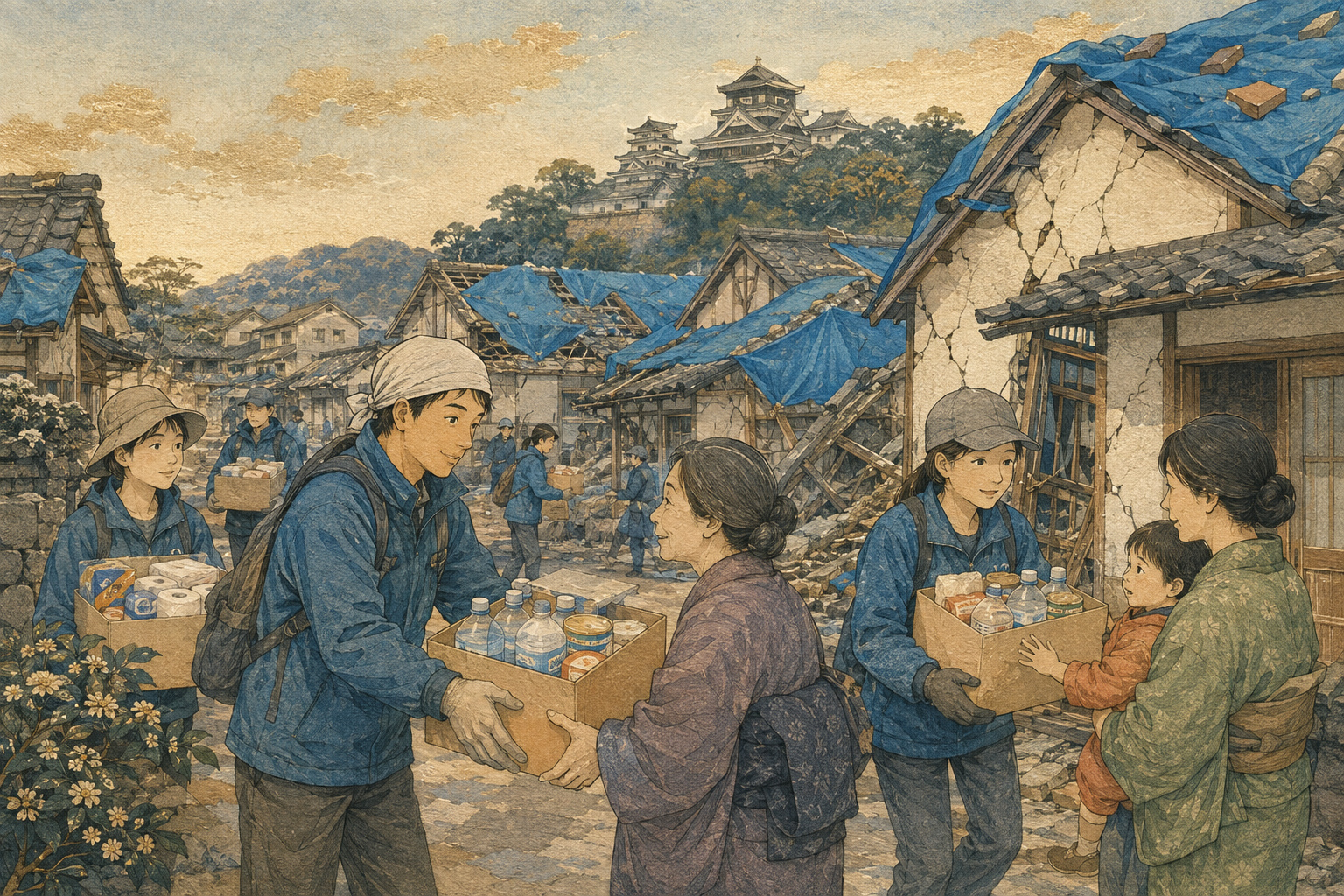
A cardboard box is not the finished form of generosity. Fill it with water, clothes, toothbrushes or nutrition bars and it may still become an obstacle in a shelter corridor if it reaches the wrong place at the wrong hour. A single bottle of water, by contrast, becomes relief when it reaches an older resident who needs it to take medicine in a home without running water.
Fourteen days after the July 28 shaking, the vocabulary of the response is changing. The first 72 hours give priority to rescue and survival. The work that follows reconnects a life: lifting damaged furniture, sorting disaster waste, finding transportation for a household that lost its car, improving monotonous meals, making room for children, and locating people who never entered a shelter.
These tasks lack the drama of a search-and-rescue scene. Together, they determine whether a survivor can resume treatment, work, school, shopping and sleep. The second week is when aid stops being measured only in tons and starts being judged by fit.
The first helpful choice was to wait
Immediately after the earthquake, traveling to the disaster zone was not necessarily the best way to help. On July 30, the Saga Prefecture Council of Social Welfare said councils in Kumamoto were gathering damage information and preparing disaster volunteer centers. Activity had not begun at that point because aftershocks, power and water outages, communications failures, damaged roads and congestion made deployment unsafe. Other councils relayed that the prefectural center had opened but was not yet recruiting members of the public.
That did not mean volunteers would not be needed. It meant ambulances, fire engines, rescue teams, utility crews and emergency deliveries required the roads first. A person who arrived without fuel, food, a bed or a toilet could consume resources intended for residents. Someone entering an unstable house without authorization could become another person to rescue.
Modern disaster volunteering therefore begins with an apparent contradiction: the discipline not to go until the receiving community says where, when and how many people it can accept. Municipalities may recruit only local residents at first; requirements can change by day. Useful urgency includes the courage to leave space.
Connecting boxes to people: a relief chain measured in Kitakyushu
The clearest public ledger of the second-week response comes from Kitakyushu, across the prefectural border in Fukuoka. Its “Kumamoto Support Station” was designed to bring residents, local companies, the municipal government and transport specialists into one demand-led operation for Yatsushiro, Hikawa and surrounding communities.
Members of the public could contribute over three days, from July 31 through August 2. In an official update dated August 10, the city counted 814 recorded contributions containing 34,839 items. It noted that this subtotal included one advance corporate contribution of 870 items in 65 boxes that was also listed in the corporate record. Seventy-six companies supplied 2,398 boxes—approximately four 10-ton truckloads. The Kitakyushu branch of the Fukuoka Trucking Association supported receipt, storage and transportation, while business associations helped circulate the request.
The chain extended far beyond the donor. Someone in Kumamoto had to report the needed items. Someone in Kitakyushu set specifications and dates. Staff received forms, counted goods and separated streams. Warehouse workers moved boxes; dispatchers assigned vehicles; drivers followed passable routes; receiving teams prepared unloading space; local workers decided where the contents would go next. Each link protected the next one from disorder.
Kumamoto City made a different decision. On July 29 it said reserves and supplies from the government and partner companies were expected to meet its requirements, so it was not accepting relief goods from individuals. Kitakyushu collected while Kumamoto City did not. The policies are not contradictory: inventories, warehouse space, damage and destinations differ. Demand-led aid asks the recipient to define the opening rather than allowing the sender to define the gift.
| Stage | Visible work | Work that is easy to miss |
|---|---|---|
| Collect | Bring water, food, hygiene products and clothing | Confirm exact items, sizes, quantities and expiry requirements |
| Prepare | Pack, label and load boxes | Track inventory, dates, destinations and responsible parties |
| Transport | Move goods by truck or van | Verify routes, arrival windows, unloading space and local capacity |
| Deliver | Hand supplies to shelters or households | Find people outside shelters and feed new needs back into the system |
From bulk supply to “what this person needs today”
Large-scale supply was indispensable in the opening days. The national government sent food, water, toilet paper and power vehicles through “push” assistance that does not wait for a detailed municipal request. Lawson, responding as a designated public institution, said it would deliver roughly 10,000 body-cooling sheets to the Grandmesse Kumamoto logistics point. Under a separate agreement with Kyushu Electric Power, it listed 600 nutrition products, 900 instant-food items, 2,400 bottles of barley tea, toothbrushes, toothpaste and clothing for a designated location in Yatsushiro.
Asahi Group announced 30,240 bottles of 600-milliliter water and 18,468 two-liter bottles, along with baby food, food for older people requiring care, freeze-dried miso soup and health products. The quantities convey the scale of the emergency. The range conveys something equally important: “evacuee” is not a standard body.
An infant cannot eat an ordinary boxed meal. A person with difficulty chewing or swallowing may need modified food. Medication, allergies, disability, pregnancy, religion and culture shape what can be consumed. A household evacuating with a dog or cat may require pet food or temporary boarding before its human members can use a shelter at all.
On August 1, food-service company Plenus began using a kitchen truck at shelters in Yatsushiro. Its first offering was rice cooked in the vehicle, hot curry and tea. A hot meal does more than deliver calories: steam, aroma and the brief conversation in a queue can restore a boundary between one emergency day and the next.
A peer-reviewed study of meals after the 2016 Kumamoto earthquakes illustrates how the diet of a disaster evolves. Rice balls and processed rice appeared on day two, hot meals on day four, long-life milk around two weeks and boxed meals around a month and a half. Availability is only the first test. After that come nutritional balance, suitability, variety and the endurance of the supply chain.
A volunteer center is not a labor counter; it is a community’s ear
Disaster volunteer centers, generally operated by local councils of social welfare, do more than register willing hands. They receive requests from residents, assess danger and urgency, assemble teams with suitable numbers and skills, and turn the report after each visit into the next assignment. Japan’s Central Community Chest opened support for center operations because coordination requires experienced people, communications, tools and materials of its own.
Japan.co.jp could not verify a single, current prefecture-wide total of volunteer participants in the public documents checked through August 10. This article does not manufacture one. Another number nonetheless shows that centers are operating: on July 31, the Japan Car Sharing Association said councils of social welfare running centers had asked it for a combined 30 vehicles. It planned to place about 150 vehicles in Kumamoto for survivors and relief organizations through December 25.
In much of Kumamoto, a car is not a luxury. It connects medical appointments, groceries, work, school, public offices, family checks and the transport of supplies. A free loan requires more than a donated automobile. The vehicle must be inspected, repaired, transported and insured; a staffed lending base must be maintained. The association’s funding project even converts the recycling value of unwanted vehicles elsewhere in Japan into money for the Kumamoto fleet. Aid is often less about possessing an object than constructing a safe way to use it.
- Residents sleeping in damaged homes, relatives’ homes or vehicles rather than registered shelters
- Households unable to visit an aid desk because of age, disability, illness, pregnancy or infant care
- Foreign residents who cannot act on Japanese-only information
- Families unable to enter a general shelter with an animal
- People who lost a shop, farm, workplace or car and need more than housing assistance
Absence from a shelter list does not indicate absence of need. Outreach has to combine home visits and calls with fragments known to welfare commissioners, neighborhood associations, care providers, schools and organizations serving foreign residents. Moving a wardrobe takes arms. Hearing the answer to “what is keeping you from managing today?” takes time, trust and an accurate handoff.
From 1995 to 2016: how mutual aid acquired a structure
The 1995 Great Hanshin-Awaji Earthquake is remembered as Japan’s “first year of volunteerism.” The national response by ordinary citizens led to the designation of January 17 as Disaster Preparedness and Volunteer Day. Building systems around goodwill was not intended to drain it of spontaneity. It was an attempt to reduce chaos, protect recipients and keep help available after attention moved on.
The 2011 Great East Japan Earthquake deepened the need for coordination among nonprofits, businesses, public agencies and social-welfare councils. Then, in 2016, Kumamoto experienced the top intensity of 7 twice. According to the Kumamoto Prefecture Council of Social Welfare, volunteer centers had recorded 112,546 participant-days by the end of that August. The total did not capture every nonprofit, neighborhood group or act of mutual help, but it demonstrated that recovery could not be completed in one crowded weekend.
The 2016 disaster also showed that a life can remain in danger after surviving the collapse itself. The Japanese Red Cross says it deployed roughly 2,300 personnel over three months and emphasizes the prevention of disaster-related deaths during prolonged evacuation. Blood clots associated with sleeping in cars, worsening chronic disease, poor oral health, sleeplessness and isolation continue beyond the rescue window.
Kumamoto later faced the July 2020 floods and the August 2025 rains. More than 11,000 participant-days were recorded at volunteer centers for the 2025 disaster before those centers closed at the end of November. Last year’s network cannot stop this year’s earthquake. It can mean that people already know one another, know who holds the warehouse key, and share procedures for volunteer insurance, transport and welfare referrals.
1995 The Great Hanshin-Awaji Earthquake gives rise to Japan’s “first year of volunteerism.”
2011 The Great East Japan Earthquake exposes the scale and duration of multi-organization coordination.
2016 Kumamoto records intensity 7 twice; volunteer centers pass 112,000 participant-days by August 31.
2020 July floods devastate communities including Hitoyoshi and the Kuma region.
2025 August rains draw more than 11,000 participant-days to centers across the prefecture.
2026 Another intensity-7 disaster turns accumulated relationships toward a new pattern of need.
From “doing for” to “restoring with”
Cleanup is not a contest for speed. Broken glass and dirt may be mixed with family photographs, a memorial tablet, business records or a child’s drawings. Throwing everything out without the owner’s decision may clear a room while stripping it of memory. When exhaustion makes a decision impossible, a hold box and the option to decide later can be more helpful than another full trash bag.
The same principle governs photography. A collapsed home is not generic disaster scenery. It is a private life opened to the street when its walls failed. Even when an organization needs pictures to document work or account for donations, consent, faces, nameplates, location data and medical information come first. Entry into a damaged property is not a license to narrate its owner’s life.
Needs become more specialized after the second week: damage certificates, emergency repairs, insurance, temporary housing, business continuity and mental and physical care. Strength alone cannot solve them. Lawyers, architects, nurses, interpreters, technology workers, childcare providers, animal-welfare groups and trained listeners all belong inside the broad word “volunteer.” Recovery does not mean reproducing the old town exactly. It means restoring a survivor’s ability to make the next decision.
How to help Kumamoto without adding to its burden
National Council of Social Welfare and government guidance produce a practical sequence. First, check the latest page of the council or disaster volunteer center for the municipality where you hope to work. Eligibility, registration, dates, age limits and equipment differ even within one prefecture. Do not overwhelm a damaged local office with a phone call before reading its published information.
Second, obtain volunteer-activity insurance through the council where you live before departure, and verify that the plan covers injury caused by earthquakes. Bring your own food, water, work clothes, gloves, footwear, mask, heat protection, transportation and lodging unless the center says otherwise. Illness or exhaustion is a reason to stop. In August, taking a cooling break is part of competent fieldwork.
Third, do not ship unsolicited goods directly. Kumamoto City is not accepting individual relief goods, and Kitakyushu’s collection has ended. Needs change faster than a distant donor can see. Send specified items only while an official list is open. Otherwise, choose a verified donation according to its purpose: money distributed to survivors and funds supporting nonprofit or volunteer operations perform different jobs. Neither is inherently better.
- Has an official center opened recruitment, and are you within its geographic eligibility?
- Have you confirmed registration, meeting point, parking and required tools?
- Did you obtain appropriate volunteer insurance before entering the disaster area?
- Can you supply your own water, food, transport, lodging, fuel and heat protection?
- Will you let residents decide about photographs, belongings and disposal?
- Can you report progress, remaining work and changes in a resident’s condition afterward?
Two weeks is a marker, not a finish line
The dust and sirens of the first news images gradually recede. A survivor’s workload may grow. Forms arrive; repair estimates are needed; treatment and school resume; isolation can begin after a shelter closes. Just as the number of helpers settles, rebuilding a life becomes more complicated.
Kitakyushu’s 34,839 items are not merely the contents of boxes. The total records a chain: Kumamoto described a need; officials set the collection; residents carried goods; staff counted them; companies consolidated loads; trucking specialists prepared vehicles; drivers took the road; receiving teams accepted the handoff. Only after that sequence could an item become relief.
No single hero is holding Kumamoto together at the two-week mark. The work belongs to the person who waited rather than blocking a rescue route, the person who maintained the list, the person who cooked hot rice, the mechanic who checked a loan car, the organizer who remembered pet food, and the volunteer who paused in a damaged room to ask, “May I throw this away?”
That question is the ethic of recovery. A community returns not through the number of hands alone, but through the strength of the relationships that connect each hand to an actual need.
Reporting notes and principal sources
This article uses public information checked through August 11, 2026 at 8:06 AM Japan Standard Time. Seismic data come from the Japan Meteorological Agency; the initial evacuation snapshot comes from a nonprofit release citing Kumamoto Prefecture’s emergency-headquarters material; current supply results come from official municipal and company notices; historical comparisons draw on councils of social welfare, Kumamoto Prefecture, the Japanese Red Cross, government material and peer-reviewed research. No unified, current prefecture-wide volunteer count was located in the public material reviewed through August 10, so none is estimated. Recruitment, supply intake, displacement and damage figures change; prospective volunteers should verify the latest local council and municipal pages before acting.
- Japan Meteorological Agency: July 28 earthquake and early-warning record
- Kumamoto Prefecture: 2026 earthquake information and emergency-headquarters documents
- Katariba: next-morning shelter snapshot and child-and-family assessment
- Saga Prefecture Council of Social Welfare: early access and safety constraints
- City of Kitakyushu: August 10 Kumamoto Support Station results
- Kumamoto City: notice declining individual relief goods
- Lawson: official supply and employee-response announcement
- Asahi Group: water and foods for infants and older people
- Plenus: hot-meal kitchen truck at Yatsushiro shelters
- Peer-reviewed study: timing and content of shelter meals after the 2016 earthquakes
- Central Community Chest of Japan: support for disaster volunteer center operations
- Japan Car Sharing Association: center vehicle requests and planned free fleet
- Kumamoto Prefecture Council of Social Welfare: 2016 volunteer participation
- Japanese Red Cross: ten-year lessons from the 2016 Kumamoto earthquakes
- Kumamoto Prefecture: closure and participation for 2025 rain-disaster centers
- Government of Japan: Hanshin-Awaji and Disaster Preparedness and Volunteer Day
- Government of Japan: preparing for and sustaining disaster volunteer work
- National Council of Social Welfare: volunteer information, preparation and insurance