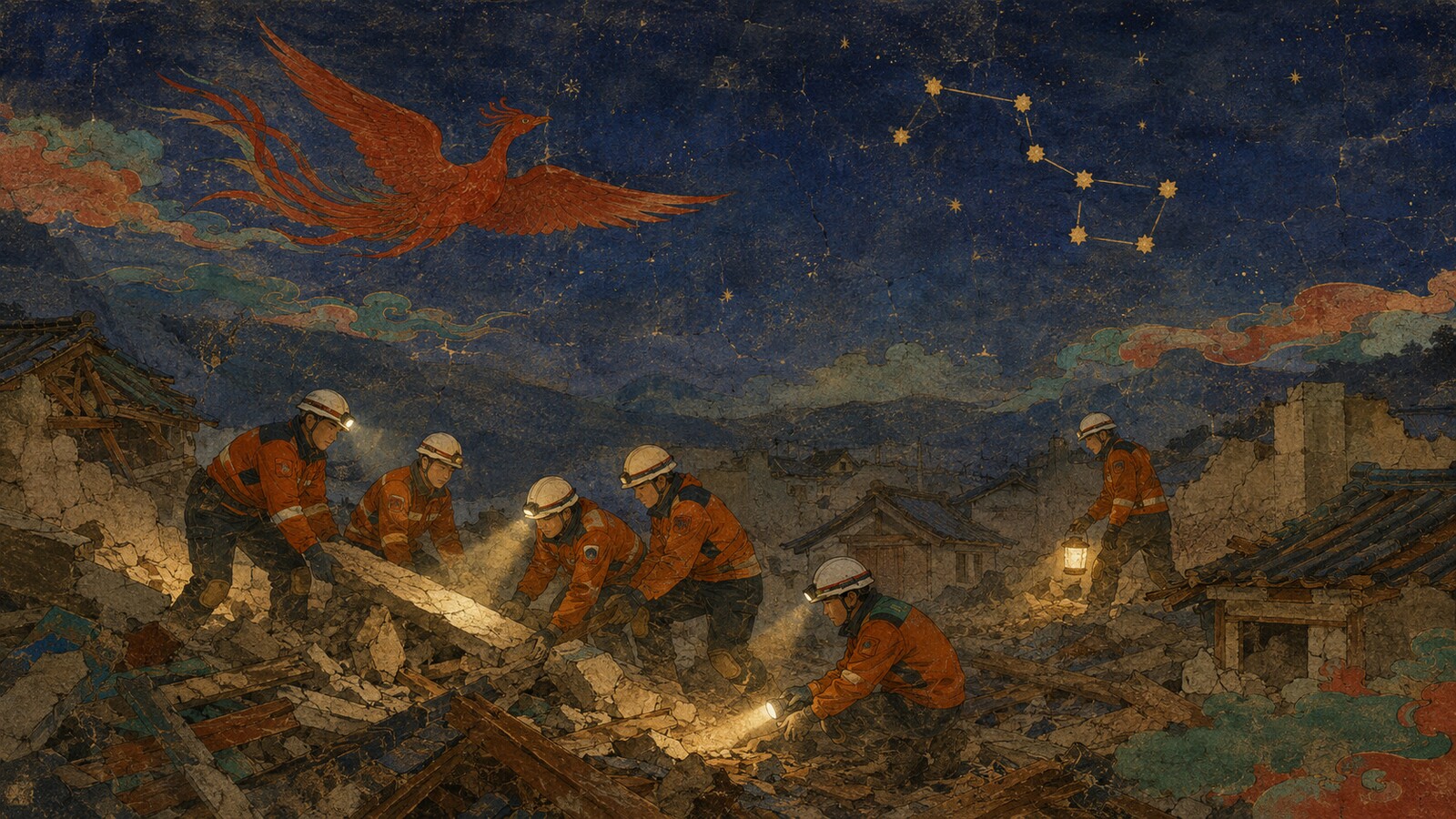
The most important sound at a rescue site can be silence. Engines are cut. Hydraulic cutters stop biting through steel. Boots settle on broken concrete. Beneath floodlights in Kumamoto’s second night, teams listen for a tap, a voice, a phone—or the smaller sounds of a building that may be preparing to move again.
Then comes another tremor. A safety officer orders people back. Engineers check walls, slabs and the improvised path into the wreckage. The retreat costs minutes, but it protects the only people capable of reaching those still inside. When the structure is judged stable enough, the lights and tools return. Dig, listen, withdraw, reassess: this is how a search continues when the disaster itself has not stopped.
The magnitude-7.1 earthquake struck at 4:27 p.m. on July 28, at a depth of 16 kilometers. The Japan Meteorological Agency recorded the maximum intensity of 7 in Uki City and Hikawa Town. A tsunami advisory for the Ariake and Yatsushiro seas was issued two minutes later and lifted at 6:10 p.m. But the seismic emergency moved inland. By 2:00 p.m. Wednesday, the agency had recorded 195 earthquakes with intensity 1 or stronger, including the main shock. Three reached lower 5 after the initial event.
As Thursday began, the operation had entered a new phase. The Fire and Disaster Management Agency had logged 59 rescue incidents; 56 had been handled and three were still active. Across the deployment, 347 emergency fire teams, 1,147 personnel and four aircraft from nine prefectures had been mobilized. Together with local and in-prefecture support, roughly 1,200 responders were operating by early morning. Cumulative figures recorded 85 rescues and 539 ambulance transports.
What changed in the second night
During the first night, the geography of the rescue was uncertain. Reports arrived from collapsed houses, a shopping complex and the Nippon Paper Industries mill in Yatsushiro. By the second, the largest sites had become more legible—and more painful.
At the Yatsushiro mill, a fallen chimney trapped 11 people. The prefecture’s morning account said ten had been recovered: eight died and two suffered moderate injuries. One person remained unaccounted for. Industrial rescue is a problem of weight and hidden energy. Steel, piping, suspended equipment and damaged electrical systems create hazards unlike those in a house. A crane can remove an obstruction quickly, but the wrong lift can transfer a load onto a survivable pocket. Progress is measured not by how much rubble moves, but by whether it moves without closing the space beneath it.
At Aeon Mall Kumamoto in Kashima, an explosion after the earthquake turned an evacuation into a second disaster. Reuters reported that about 3,000 shoppers were moved out within roughly half an hour; the blast followed about 50 minutes after the quake. Gas was suspected, but investigators had not established the cause, and an on-site liquefied-petroleum-gas tank was reported intact. The prefecture said 11 people had been brought out or located: five were confirmed dead, one was in cardiopulmonary arrest, four had moderate injuries and one had a minor injury. Another person was still the subject of rescue work.
The distinction in that sentence matters. Japanese emergency services use “cardiopulmonary arrest” when breathing and heartbeat have stopped but a physician has not yet formally confirmed death. “Unaccounted for” may describe someone whose location has not been reconciled. “Trapped” means authorities have evidence a person is inside a dangerous space. None should be silently converted into another category for a cleaner headline.
Why rescuers stop when the ground moves
From a distance, a pause can look like hesitation. Inside the perimeter, it is part of the rescue. The main shock was a shallow strike-slip earthquake in a landscape crossed by the Futagawa and Hinagu fault zones. Preliminary analysis placed the source near those active structures, but scientists still needed detailed mapping before assigning the rupture to a precise segment.
The JMA warned that shaking as strong as intensity 7 could occur for about a week, with the greatest need for caution in the first two or three days. It also noted that activity stretched over a broad area, meaning a later strong earthquake might occur somewhere other than the point that dominated the first evening’s maps. The warning does not predict that another intensity 7 event will occur. It describes a period in which the probability is elevated and complacency is dangerous.
Rescuers manage that uncertainty with redundant exits, observers assigned only to safety, structural monitoring, disciplined head counts and rapid withdrawal thresholds. A damaged building is not static. Removing a wall changes the load carried by the floor above it. Rain can weaken soil. Heat can alter the condition of workers and victims. An aftershock can turn a narrow passage into a trap. The operation therefore advances through repeated, reversible decisions rather than one heroic rush.
The familiar “72-hour window” is useful shorthand for urgency, not a switch that ends hope. Survival depends on injury, air, water, temperature and the shape of a void. People have survived beyond three days; others with catastrophic trauma have far less time. Search leaders use testimony, phone data, plans, cameras, acoustic devices and dogs to prioritize spaces. The ethical rule is simpler than the slogan: act with maximum urgency, and do not confuse a statistical decline with a deadline for an individual life.
A count moving on different clocks
Kumamoto Prefecture’s 7:30 a.m. summary listed 86 casualties, including 17 confirmed dead, six in cardiopulmonary arrest and five seriously injured. Thirty minutes earlier, the national fire agency’s 18th situation report listed 12 deaths. That gap does not show that one authority had misplaced five people. Prefectural, police, hospital and national systems close their tables at different moments, apply formal confirmation steps and then publish after review.
The most responsible way to report a fast-changing disaster is to state the authority and cutoff beside every number. This article uses the later prefectural casualty snapshot while using the 6:30 a.m. national report for rescue incidents and deployment. It does not add categories from separate documents to manufacture a newer total.
| Measure | Latest source used here | What it means |
|---|---|---|
| 17 confirmed deaths; six in cardiopulmonary arrest | Kumamoto Prefecture, 7:30 a.m. | Separate legal and medical statuses. They should not be combined as “23 dead.” |
| 59 rescue incidents; three continuing | FDMA, 6:30 a.m. | Incidents known to the fire-service reporting system, not a count of every damaged property. |
| 85 people rescued; 539 ambulance transports | FDMA cumulative figures, 6:30 a.m. | Operational totals; a transported person is not necessarily seriously injured. |
| 10,467 evacuees in 415 shelters | Kumamoto Prefecture, morning update | People registered at official shelters; those in cars or private homes may not appear. |
Heat has joined the rescue
By Thursday morning, the emergency was no longer only beneath debris. The Environment Ministry’s heat-risk system put Kumamoto under a heatstroke alert. At the Kumamoto observation point, the heat-stress index reached 30.3 at 9:00 a.m.—the “severe warning” range—and was forecast to reach 31 at noon and 32 by 3:00 p.m., both in the “danger” range. The JMA expected highs of 35°C or more through August 5 and said 40°C was possible on August 2.
For a rescue crew in helmets, gloves and protective clothing, heat reduces concentration and grip strength. For someone trapped, it accelerates dehydration. For an older evacuee in a powerless building, it can turn a manageable chronic condition into an emergency. Rotating crews, cooling stations, water and electrolyte supplies are therefore rescue equipment, not comforts.
The prefecture reported 22,950 homes without electricity. Its water figure was broader and must be read carefully: 74,800 households were affected by some combination of outages, cloudy water and leaks, not necessarily complete loss of service in every home. Water stations had been established in 16 municipalities. Ten thousand servings of bread, spot coolers and mobile power vehicles were among the supplies sent by the national government.
Medical institutions were dealing with both building damage and lost utilities. Reports covered 88 medical facilities and 62 pharmacies, along with hundreds of elderly-care, child-welfare and disability-support facilities. Kumamoto Minami Hospital moved all 127 inpatients; Kibogaoka Hospital moved 119. Evacuation is not complete when a patient reaches a bus. Medication lists, oxygen, dialysis schedules, infection control and the destination’s staffing all have to move with them.
A prefecture running on broken systems
Earthquakes damage networks as much as structures. The prefecture recorded 1,656 emergency calls and 717 dispatch requests. Each call enters a system whose radio sites, roads and control rooms may also be impaired. The Kyushu Shinkansen, a symbol of regional connectivity, suffered a broken overhead line and seven rail distortions between Chikugo-Funagoya and Kumamoto. South of Kumamoto, inspections found more than 200 damaged sound-wall locations, two rail breaks and movement at a bridge pier. Major sections remained suspended Thursday.
Those transport failures complicate everything: moving specialist crews, bringing replacement equipment, reuniting families and maintaining commercial supply. Ports reported liquefaction and other damage. Power crews needed access to substations and lines. Water repairs could not proceed until buried-pipe breaks were mapped and roads made passable. A city can look intact from the air while the systems that make daily life possible have fractured underground.
That is why the second night matters as a transition. The first hours concentrate on fires, entrapments and tsunami risk. The following days require a wider field of care: shelters that can cool people, toilets that function, pharmacies that know where patients have gone, and accurate lists of people sleeping outside official facilities. The response becomes less cinematic at exactly the moment it becomes more complex.
2016: the warning embedded in Kumamoto’s memory
Kumamoto does not have the luxury of treating “aftershock” as a reassuring word. On April 14, 2016, a magnitude-6.5 earthquake produced intensity 7. Twenty-eight hours later, a magnitude-7.3 event struck and produced intensity 7 again. What had seemed to be the central event became the opening of a larger sequence. In the two years that followed, more than 4,400 earthquakes of intensity 1 or greater were recorded.
The experience changed national communication. Authorities now avoid language that implies the first large event must be the largest. The lesson is not that history will repeat on the same timetable. It is that an earthquake sequence can only be understood after it unfolds, while public safety decisions must be made in real time.
The longer lesson is about deaths that occur after buildings stop moving. Kumamoto Prefecture’s ten-year accounting for the 2016 disaster records 275 deaths: 50 direct and 225 classified as disaster-related. It also records 2,739 injuries and damage to 198,385 homes, including 8,657 destroyed and 34,489 half-destroyed. At the peak, 183,882 people were evacuated.
Those figures reverse the usual picture of an earthquake. Most deaths in the final official record were not caused directly by collapse. They came through deteriorating health and the burdens of evacuation: interrupted treatment, immobility, stress and harsh living conditions. Car sleeping protected some people from buildings they feared, but cramped immobility increased the danger of blood clots. Others limited drinking because toilets were difficult, raising dehydration risk. The disaster’s deadliest phase stretched into the weeks and months that followed.
Same landscape, different sequence
The preliminary mechanism of the July 2026 earthquake was strike-slip, and its source lies near the Futagawa and Hinagu fault zones that shaped the 2016 disaster. That proximity makes comparison inevitable, but it does not make the events identical. Scientists must examine aftershock locations, ground deformation and any surface rupture before saying exactly which segment moved.
Long-term fault probabilities are sometimes misunderstood as failed appointments. Before 2026, estimates for portions of the Hinagu fault zone described a measurable chance of a magnitude-7-class earthquake over 30 years. Such numbers cannot identify a Tuesday afternoon. Their purpose is to guide the quieter decisions made years earlier: how a hospital anchors equipment, how a town protects water mains, whether a family secures a cabinet and where a company keeps its staff roster.
Resilience also resists simple verdicts. Aeon Mall Kumamoto had been damaged in 2016, rebuilt and recently renewed. Its new destruction demands a rigorous investigation into the explosion, building systems and evacuation. But the rapid removal of thousands of shoppers before the blast is part of the evidence, too. A disaster can reveal a grave failure and a successful protective action in the same place. Honest analysis must hold both facts.
What residents can do during the next days
- Do not enter a leaning, deeply cracked or officially restricted building to retrieve belongings. Reassess after every strong tremor.
- Keep emergency routes and rescue perimeters clear. Do not fly unauthorized drones or visit a site for photographs.
- Drink regularly and use cooling spaces before symptoms become severe. Check infants, older adults, pregnant people and anyone taking medicines that affect temperature or hydration.
- Never use a generator, charcoal burner or vehicle engine in an enclosed space. Carbon monoxide cannot be seen or smelled.
- Keep medicines, identification and charging equipment together. Tell shelter staff if electricity, refrigeration, oxygen or dialysis is medically necessary.
- Use time-stamped updates from municipalities, the JMA and the fire service. An old map or screenshot can become dangerous when shared as current.
People outside official shelters can be hard to see. Some sleep in cars, stay with relatives or remain near a damaged home to protect animals and belongings. Municipal outreach must find them, especially those who need powered medical equipment or cannot stand in a water-distribution line. Translating an alert is not enough; foreign residents and visitors need to know what has changed, where to go and which action is safest now.
Morning after the second night
At daylight, floodlights lose their power to isolate the rescue site from the rest of the city. The wreckage becomes part of a larger landscape: halted trains, water stations, hospital transfers, rows of shelter bedding and families waiting for a name. The work beneath a chimney or floor slab remains intensely local. Its support system now spans nine prefectures.
Kumamoto’s second night did not produce a neat ending. It produced recoveries, confirmed deaths and searches that continued. It also exposed the discipline behind rescue—the retreat before a tremor, the status that is not prematurely changed, the crew relieved before heat clouds judgment. These can appear like pauses. They are how the work endures.
At 10:12 a.m. JST on July 30, one person remained unaccounted for at the paper mill and another rescue continued at the mall in the prefecture’s latest account. The earth was still active, the afternoon heat was building and official totals were still being reconciled. The second night was over. The emergency was not.
Reporting Notes and Sources
Information was checked through 10:12 a.m. JST on July 30, 2026. The later 7:30 a.m. Kumamoto Prefecture briefing is used for the casualty baseline; the FDMA’s 6:30 a.m. report is used for rescue incidents and national deployment. Confirmed death, cardiopulmonary arrest, unaccounted for and trapped are kept distinct. Figures remain provisional.
- Kumamoto Prefecture: Fifth disaster-response meeting materials, July 30
- Kumamoto Prefecture: Casualty and damage summary, July 30
- Fire and Disaster Management Agency: 18th damage and response report
- Japan Meteorological Agency: Main-shock characteristics and tsunami advisory
- Japan Meteorological Agency: Fourth explanatory report and aftershock outlook
- Earthquake Research Committee: Preliminary evaluation of the July 28 earthquake
- Reuters: Evacuation, explosion and investigation at Aeon Mall Kumamoto
- Environment Ministry heat-risk information for Kumamoto
- Kumamoto Prefecture: Ten-year record of the 2016 Kumamoto earthquakes