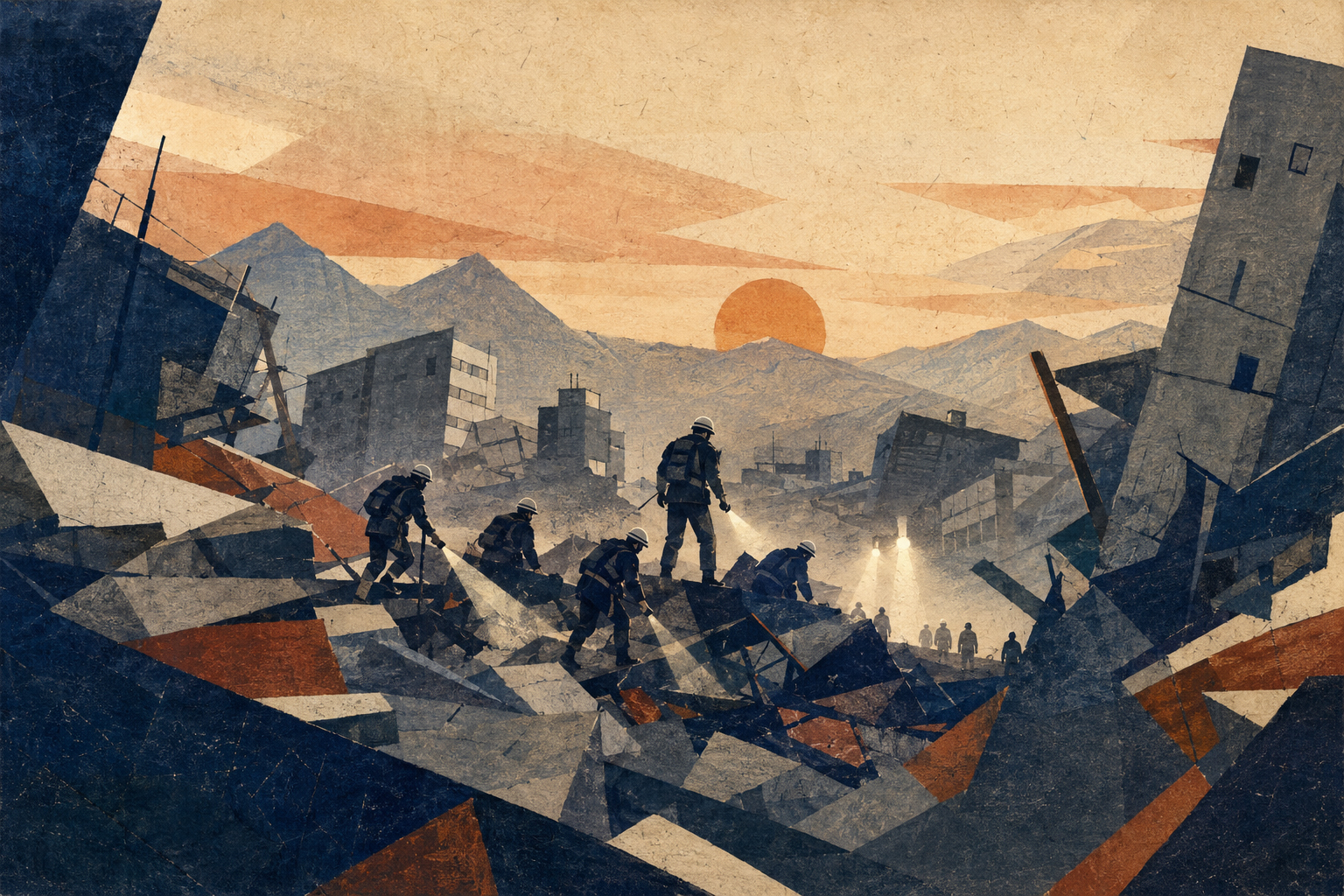
Daybreak does not bring only hope to an earthquake zone. As daylight spreads beyond the narrow islands lit overnight by floodlights, it reveals the full length of fractured walls, leaning columns, blocked roads and spaces that could not be checked in darkness. On Wednesday morning in Kumamoto, dawn was not the end of the first night. It was the moment search teams had to redraw the map.
The earthquake struck at 4:27 p.m. Tuesday in the Kumamoto region of Kyushu. The Japan Meteorological Agency measured it at magnitude 7.1, with the maximum level of 7 on Japan’s seismic intensity scale recorded in Uki City and Hikawa Town. A tsunami advisory for the Ariake and Yatsushiro seas was issued at 4:29 p.m. and lifted at 6:10 p.m. Even as that coastal danger receded, the ground kept moving: a 5-lower was recorded across parts of Yatsushiro, Kamiamakusa, Amakusa, Misato and Ashikita at 5:08 p.m., followed by another 5-lower in Uki at 7:03 p.m.
By 7:00 a.m., the Fire and Disaster Management Agency had identified three major operations among 47 rescue incidents: the collapse of the second floor of a shopping complex in Kashima, a collapsed factory chimney in Yatsushiro and two buckled homes in Hikawa. Eight reported fires had been extinguished. Yet the absence of flames did not mean the sites were safe. Damaged floors, gas lines, suspended machinery and aftershocks threatened both the people trapped inside and the teams trying to reach them.
Three clocks are running
At a collapse site, three clocks run at once. The first is the human clock. Disaster coverage often invokes a “72-hour window,” but survival does not end at a fixed hour. It depends on air pockets, injuries, temperature, water, body position and chance. Rescue teams do not abandon a person because a slogan’s deadline has passed. They combine emergency calls, floor plans, phone location data, accounts from relatives and co-workers, search dogs, listening devices and cameras to identify voids where life may remain.
The second is the earthquake clock. The JMA says powerful earthquakes are more likely during roughly the first week after a major event, especially in the first two or three days. On a rescue site, that is not a paragraph in a safety manual. Every entry into a damaged structure requires a route out. Engineers watch for changes in tilt and cracking. After strong shaking, spaces that were judged passable may have to be assessed again. A temporary withdrawal can look like lost time, but if rescuers themselves become trapped, the entire operation can fail.
The third is the summer clock. Forecasts put daytime highs around 33 degrees Celsius in Kumamoto and Yatsushiro, with dangerous heat of 35 degrees or more expected in parts of the wider region. A powerless house, a crowded shelter, an unshaded waiting area or a broken refrigerator holding temperature-sensitive medicine can become a second emergency. In late July, disaster response means making sure people who survived the shaking do not die the next day from heatstroke, dehydration or an interrupted treatment.
The mall: a recovery symbol becomes a rescue site
The most visible operation is at Aeon Mall Kumamoto in Kashima. After the earthquake, employees helped guide roughly 200 visitors outside. About an hour later, an explosion tore walls from part of the complex and left sections reduced to a skeletal frame and rubble. Witnesses reported the smell of gas, but the cause remains under investigation. It is too early to state exactly how earthquake damage, an apparent leak, the explosion and the structural collapse were connected.
Eight people were brought out during the night. Two women in their twenties were confirmed dead, one person was reported in cardiopulmonary arrest and the other five had injuries that were not believed to be life-threatening. Teams continued to search around places where calls for help had been heard. Early counts of people who could not be contacted were fluid: attendance lists can include staff who were not on site, while some evacuees may go home or be taken to different hospitals before authorities reconcile names. “Unaccounted for” is not a synonym for “under the rubble,” and neither term is a death count.
The site carries painful historical weight. The mall was badly damaged in the 2016 Kumamoto earthquakes and was rebuilt and expanded in stages. On June 13, 2026—little more than six weeks before Tuesday’s disaster—it completed a major renewal presented as a fresh start. The regional center contained about 200 shops and businesses, a cinema and parking for 5,000 vehicles. Its destruction so soon after reopening makes for a searing image, but not a simple verdict that seismic reinforcement was pointless. The evacuation of around 200 people before the explosion also matters. Large commercial buildings contain many connected systems—ceilings, gas, power, kitchens, retail fixtures and parking structures—and failure can cascade. A rigorous investigation will have to establish what worked, what failed and why.
The paper mill: searching beneath industrial weight
In Yatsushiro, the collapse of a chimney at a Nippon Paper Industries mill created a very different rescue problem. TV Asahi reported at 7:10 a.m. that 11 people had been described as trapped. Two had been recovered in cardiopulmonary arrest, while the whereabouts of nine were still being checked. Industrial sites bring hazards rarely present in a home: immense steel components, pipes, chemicals, heat sources and energized machinery. Heavy equipment can accelerate removal, yet its vibration can also crush a survivable void or disturb material above a victim.
The national response was built in layers. Local firefighters were joined in Yatsushiro by a Kagoshima emergency contingent; teams from Fukuoka and Saga worked at the Kashima commercial site; an Oita contingent was assigned to the buckled homes in Hikawa. At 6:00 a.m., the emergency fire response comprised 340 teams and 1,129 personnel from eight prefectures, supported by three aircraft. The size does not describe a wall of people digging at once. It includes command, engineering, medical care, communications, logistics, safety and relief shifts—the structure needed to keep a precise operation working without interruption.
Even the system that sends help was damaged. The FDMA reported a failure in the Yatsushiro regional fire command system. In a major disaster, the challenge is not merely a surge in calls. The machinery that receives a call, locates it and dispatches a crew may itself be impaired. The total of 47 rescue incidents was therefore not a final count of every dangerous location. It was the set of incidents authorities had been able to identify through a damaged information network by 7:00 a.m.
Between an official count and a live scene
One of the hardest jobs in disaster reporting is placing a slower, standardized government count beside rapid, fragmentary information from a rescue site. The FDMA’s 7:00 a.m. baseline recorded three deaths, six serious injuries and 22 minor injuries in Kumamoto, plus one minor injury in Kagoshima. Hospital admissions, police lists of missing people and news reports of those brought out of buildings run on different clocks and can overlap.
Japanese authorities commonly use “cardiopulmonary arrest” before a doctor has formally pronounced death. A report should not silently convert that status into “dead.” “Missing,” “unable to contact” and “possibly trapped” are also different categories. Precision is not coldness. The numbers may be read by families waiting for a name, which is exactly why the steps of confirmation cannot be skipped.
| Confirmed by the 7:00 a.m. baseline | Still changing or under investigation |
|---|---|
| Three dead, six seriously injured and 22 lightly injured in Kumamoto; one light injury in Kagoshima. | The fate of every person sought at the shopping center, paper mill and damaged homes, and the final casualty count. |
| Forty-seven rescue incidents; major operations continued at the mall, factory chimney and two Hikawa houses. | The cause and sequence of the explosion and collapses, the full structural record and any allocation of responsibility. |
| All eight reported fires extinguished; tsunami advisory lifted at 6:10 p.m. Tuesday. | Neighborhood-by-neighborhood restoration of gas, electricity, water, roads and rail. |
| Emergency safety orders or evacuation instructions covered 125,325 households and 261,541 people. | How many people were actually in shelters, cars, relatives’ homes or other informal places of refuge. |
How 2016 changed the language of aftershocks
In Kumamoto, the words used after an earthquake carry unusual weight. On April 14, 2016, a magnitude-6.5 earthquake produced intensity 7. It was widely treated as the largest event in the sequence. Roughly 28 hours later, a magnitude-7.3 earthquake struck and produced intensity 7 again. Seismic activity then expanded into the Aso region and central Oita.
The experience changed how Japan communicates. Quickly calling the first earthquake the “main shock” and later events “aftershocks” can sound reassuring, as though nothing stronger will follow. But the pattern of an earthquake sequence cannot be known until it has unfolded. Modern JMA guidance therefore emphasizes action: be ready for strong shaking for about a week, with particular caution during the first two or three days, and recognize that an event as large as—or larger than—the first is possible.
History is not a prediction, however. The 2016 sequence does not mean a larger earthquake is scheduled exactly 28 hours after the 2026 shock. Overlaying the clocks to frighten people would not be science. The useful lesson is to resist assuming the first major earthquake was necessarily the largest, and to reassess buildings, slopes and evacuation routes after every significant shake.
The danger after the extraction
The two intensity-7 earthquakes in April 2016 sent as many as 180,000 people into evacuation in Kumamoto Prefecture alone. Later official totals, including disaster-related deaths from deteriorating health and the strain of displacement, reached 275 dead and 2,739 injured. The disaster did not end at the instant a house stopped moving.
People slept in cars because shelters were damaged or overcrowded. Some lost medicines. Others restricted water to avoid toilets. Care arrangements collapsed. Those experiences established a hard principle: escaping a building is only the first stage of survival. The 2026 earthquake adds the severe heat of late July. High temperatures, power loss, disrupted water and crowded shelters accelerate dehydration, heatstroke and medical complications. Nurses, pharmacists, water crews and shelter staff are working against the same survival clock as the specialists at the rubble.
Interrupted delivery networks make the clock run faster. Sagawa Express and Yamato Transport halted pickup and delivery across Kumamoto, while Japan Post stopped parcel services and closed post-office counters throughout the prefecture on Wednesday. That is more than inconvenience. Medicines, hygiene products, replacement parts and shop inventory may not arrive. The approximately 48,000 homes that lost electricity shortly after the quake also lost access to air conditioning, phone charging, some medical devices and reliable refrigeration for medicines.
The fault’s memory—and the castle walls
The 2026 source region lies near the Futagawa and Hinagu fault zones involved in the 2016 sequence. Japan’s long-term earthquake assessments had placed the Hinagu section at up to a 6 percent chance of producing an earthquake around magnitude 7.5 within 30 years, and the Yatsushiro Sea section at up to 16 percent for an event around magnitude 7.3. Both sit in the comparatively high group among Japan’s active faults. A percentage that looks small takes on a different meaning over the length of a mortgage or a child’s years in school.
Multiple stone-wall collapses were also observed at Kumamoto Castle, where repairs from 2016 were still under way. The image is a reminder that recovery is not a straight line. Castle stones are numbered, mapped and returned cautiously to their places. Disaster reporting demands something similar: speed matters, but if the origin and definition of every number are lost, the resulting structure will not hold.
Long-term fault probability does not mean the July 28 earthquake was predicted. Science cannot name the day and hour, and field work is still needed to establish which fault segments moved and how far. The point of a 30-year probability is not to declare a forecast a “hit.” It is to justify, in ordinary times, investment in reinforced buildings, secured furniture, evacuation routes, continuity of medical care and mutual aid.
How to support the rescue without obstructing it
- Do not re-enter a leaning, collapsed or deeply cracked structure to retrieve belongings. Reassess safety after every strong tremor.
- Keep emergency routes clear. Avoid sightseeing at rescue sites, unauthorized drone flights and sharing images that expose victim locations or rescue tactics.
- Take water and electrolytes in small, regular amounts. Check infants, older people, pregnant people, those with chronic illness and anyone dependent on refrigerated medicine or powered equipment.
- Never run generators, charcoal burners or vehicle engines indoors or in an enclosed garage. Carbon monoxide has no color or smell.
- Check time-stamped information from municipalities, the fire service, the JMA and public broadcasters. Do not recirculate an old screenshot as a current alert.
- Confirm official channels before sending goods or donations. Unrequested individual deliveries can congest roads and warehouses.
The official orders covered 125,325 households and 261,541 people across Kumamoto and Nagasaki, but the number subject to an order is not the number physically inside shelters. People sleeping in vehicles, staying with relatives or camping outside a damaged home are less visible to government systems. Those most likely to miss aid are not only people without information, but people who do not appear on the expected lists.
Foreign residents and travelers need more than translated place names. Clear messages should explain that the lifting of a tsunami advisory does not certify a damaged building as safe; that safety must be checked again after strong shaking; and that conserving water must not mean dangerously restricting drinking. Emergency communication succeeds only when people understand what to do, when to do it and why.
Beyond daybreak
Two kinds of time meet in Kumamoto’s morning. One is measured in seconds as a rescue team listens into a void. The other is the decade of reconstruction since 2016: a renewed mall, a castle still being repaired, strengthened homes and emergency crews trained by painful experience. Each has now been tested in a different way.
The destruction of a recovery symbol does not erase ten years of work. Around 200 people were guided out before the mall explosion. More than a thousand emergency firefighters crossed prefectural lines overnight. Officials reconciled names and numbers. Shelter staff distributed water and medicine. Those are also the products of the past decade. But lives were lost, so a story of competence alone would be false. After the rescue, investigators must ask why structures failed, whether warnings reached workers, how people on shift were counted and who could not be protected from heat and disruption.
At 10:06 a.m. JST, the ending could not yet be written. What could be said was that the rescue had continued through the night; three deaths were officially confirmed; people were still being sought at major sites; and both seismic activity and extreme heat were creating the next dangers. Kumamoto’s survival clock is not only ticking beneath rubble. It is running in rescue-team safety, shelter water, uninterrupted medicine and trustworthy information—all at the same time.
Reporting Notes and Sources
Casualty, rescue, deployment and evacuation-order figures use the Fire and Disaster Management Agency’s 14th report, issued at 7:00 a.m. JST on July 29, 2026, as the official baseline. Site reporting is time-stamped, and cardiopulmonary arrest, unaccounted for and confirmed death are kept distinct. The full article was checked through 10:06 a.m. JST.
- Fire and Disaster Management Agency: 14th damage and response report
- JMA Fukuoka Regional Headquarters: 2026 Kumamoto earthquake portal
- Japan Meteorological Agency: Earthquake activity after a major earthquake
- TV Asahi: Morning rescue status at the mall and paper mill
- Reuters: Casualties, rescue, evacuation, power and transport disruption
- Reuters: Aeon Mall evacuation and June 2026 reopening
- Cabinet Office: Recovery and evacuation after the 2016 Kumamoto earthquakes
- JMA: Changes to post-earthquake public communication after 2016
- TV Asahi: Hinagu fault zone and the outlook for further seismic activity
- TV Asahi: Heat forecasts and heatstroke risk in the disaster zone