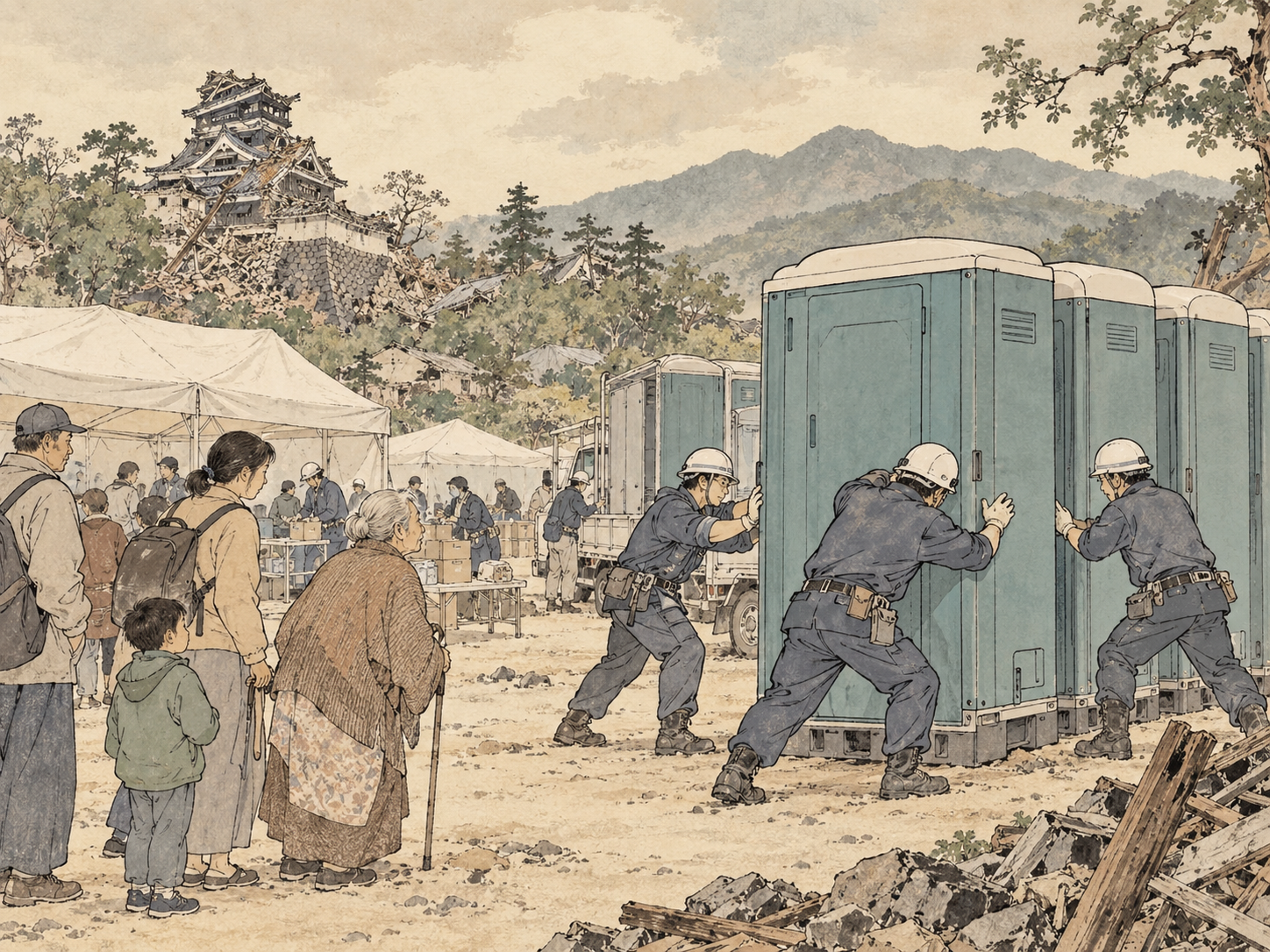
One of the first pieces of ordinary life to fail after a major earthquake is the toilet. Water stops. Sewer systems may be unusable. Temporary toilets take time to arrive. People drink less, avoid leaving shelter, and the burden falls particularly hard on older people, women and people with disabilities.
At 4:27 p.m. on July 28, 2026, a magnitude-7.1 earthquake struck the Kumamoto region and produced a maximum seismic intensity of 7 on Japan’s scale. By 7 a.m. the next morning, the government reported 9,186 evacuees in 506 shelters across five prefectures, about 84,000 households without water and roughly 36,900 households without electricity in Kumamoto.
Two days later, Japan’s Ministry of Land, Infrastructure, Transport and Tourism began moving container toilets that had already been positioned at roadside stations around the country into the disaster area. Nine of the 11 NTN “N³” restroom units installed nationally before the earthquake were ultimately transferred to seven locations in Kumamoto Prefecture and put into use.
A roadside-station toilet that can become disaster infrastructure
NTN’s N³ restroom model combines a containerized flushing toilet with wastewater treatment, a vertical-axis wind turbine, solar panels and battery storage. NTN says the system can operate independently of the grid and can circulate flushing water after an initial water supply, reducing dependence on continuous mains water.
In ordinary times the units can serve roadside-station users. In an emergency they can be transported by truck, ship or other means and installed where power and water infrastructure have failed. NTN announced in May 2026 that 11 such units had been installed at disaster-response roadside stations and related locations across Japan. Roughly two months later, the network faced a real deployment.
From Fukui, Kyoto and Hyogo to Kumamoto
NTN’s final September deployment list makes the logistics visible. A unit from Tarumizu, Kagoshima went to Uki City. Units from Takahama in Fukui and Kyotamba in Kyoto went to Michi-no-Eki Ryuhoku in Hikawa. A unit from Asago, Hyogo went to Yatsushiro’s Kagami branch office. Another came from Nagahama, Shiga. Units were also dispatched from Nara, Wakayama, Oita and Miyazaki.
The distance is the point. If Kyushu’s local capacity is insufficient, the system can pull assets from Kansai or farther away. MLIT announced wider dispatches on July 31 and additional units from other regional bureaus on Aug. 6, describing the response as “push-type” support based on assessed municipal needs rather than waiting passively for every local request.
Japan learned repeatedly that toilets are health infrastructure
The problem has been documented for three decades. MLIT’s disaster-toilet guidance records how the 1995 Great Hanshin-Awaji Earthquake left flush toilets unusable across broad areas and caused severe sanitation problems. After the 2004 Niigata Chuetsu Earthquake, cases in which evacuees restricted fluid intake to avoid toilets became associated with fatal economy-class syndrome.
After the 2011 Great East Japan Earthquake, authorities again documented people reducing water intake because they feared unusable toilets, adding physical and psychological strain to shelter life. Disaster sanitation gradually came to be treated not as a comfort issue but as part of preventing dehydration, blood clots, infection and loss of dignity.
Kumamoto had already taught Japan this lesson in 2016
The 2026 earthquake revisited a lesson from the same prefecture. During the 2016 Kumamoto earthquakes, 20 manhole toilets were used at four shelters in Kumamoto City. Government records say users valued the fact that they were available immediately, used Western-style seats and had no step at the entrance, making them easier for older evacuees and women. Complaints highlighted nighttime lighting and protection from wind and rain.
Manhole toilets have a major advantage where sewer infrastructure remains usable: waste can be sent directly into prepared sewer lines. Mobile containers solve a different problem. They can be brought to places that do not already have dedicated manhole-toilet infrastructure. The two approaches are complementary rather than competing.
Disaster roadside stations grew from 39 to 79
MLIT first designated 39 “Disaster-Response Roadside Stations” in 2021 as regional hubs for supplies, evacuation support and emergency activity. Experience during the 2024 Noto Peninsula earthquake reinforced their value, and 40 more were added in 2025, taking the total to 79.
Japan’s roadside stations already have large parking areas, toilets, information functions and links to municipal communities. Unlike expressway service areas, they sit on ordinary roads and can become logistics nodes for surrounding towns. Prepositioning transportable infrastructure there effectively turns the roadside-station network into a distributed disaster warehouse that is also used in normal life.
Renewable power matters because fuel itself becomes logistics
The N³ system uses a vertical-axis wind turbine, solar generation and batteries. NTN describes the restroom as operating entirely on renewable energy. In a disaster, the operational value is not only lower carbon emissions. A diesel generator needs fuel deliveries, and fuel becomes one more scarce cargo competing for damaged roads and limited personnel.
Renewable power does not mean unlimited power under all weather and usage conditions. Actual performance depends on sun, wind, battery state, user volume and treatment load. Neither NTN nor MLIT has published site-by-site data for daily uses, generation, battery state or water-treatment throughput during the Kumamoto deployment.
Using the equipment in peacetime solves a storage problem
Emergency stockpiles have a familiar weakness: equipment can sit in a warehouse until the day it is needed, when operators discover degraded parts, dead batteries or missing know-how. A restroom used routinely at a roadside station is inspected, cleaned and repaired as part of normal operations.
That resembles Japan’s “phase-free” disaster-preparedness philosophy—designing products and systems that are useful in ordinary life and continue to be useful in emergencies, rather than maintaining two entirely separate sets of infrastructure.
Nine units do not mean the toilet problem was solved
The successful deployment of nine NTN units shows that the concept can move across regions and operate in the field. It does not show that nine toilets met Kumamoto’s overall sanitation demand. More than 9,000 people were in shelters on the morning after the quake. MLIT also dispatched other container toilets, while municipalities used existing facilities, temporary units, portable toilets and other measures.
The useful metric is therefore not the number of containers moved. It is how quickly the right mix of toilets reached the right shelters relative to evacuee numbers and utility damage.
- Travel time from each peacetime location to operational use in Kumamoto
- Daily users and utilization rates at each of the nine units
- Real electricity generation, battery and water-treatment performance
- Staffing required for cleaning, sludge handling and repairs
- Accessibility for older people, wheelchair users, women and children
- How many mobile toilets should ultimately be positioned across Japan’s 79 disaster-response roadside stations
From stockpiles to movable preparedness
Disaster planning traditionally asks each region to own enough supplies for its own emergency. But the geography of the next major disaster cannot be predicted precisely. For some expensive, reusable assets, it may be more efficient to distribute them nationally in peacetime and move them after impact toward the places of greatest need.
The Kumamoto toilet deployment is a small but concrete test of that model. A restroom in Fukui became sanitation infrastructure in Kumamoto. So did units in Kyoto, Hyogo and elsewhere. Ordinary regional infrastructure became emergency infrastructure hundreds of kilometers away.
Toilets rarely dominate disaster headlines. Yet whether people can remain safely in shelters depends on them almost as fundamentally as electricity and water. The 2016 Kumamoto earthquakes demonstrated the value of prepared manhole toilets. The 2026 earthquake tested a different idea: preparedness that can move. The next question is whether Japan can turn that successful improvisation into a repeatable national standard.
Sources & Reference Material
- NTN Corporation, nine disaster container toilets deployed after the 2026 Kumamoto earthquake, Sept. 30, 2026 (Japanese).
- Japan Ministry of Land, Infrastructure, Transport and Tourism, first dispatch of disaster container toilets, July 30, 2026.
- MLIT, second dispatch announcement, July 31, 2026.
- MLIT, third dispatch announcement, Aug. 6, 2026.
- Japan Meteorological Agency, 2026 Kumamoto earthquake portal.
- Prime Minister's Office, early impact information for the 2026 Kumamoto earthquake.
- NTN Corporation, nationwide installation of 11 N³ units, May 11, 2026.
- NTN, N³ product information and self-contained restroom system.
- MLIT, disaster toilet guidance and historical use of manhole toilets.
- MLIT, manhole-toilet use during the 2016 Kumamoto earthquakes.
- MLIT, expansion of Disaster-Response Roadside Stations to 79, May 14, 2025.
Reporting cutoff: Oct. 6, 2026, 1:21 PM JST. Public materials do not disclose site-by-site user counts, daily utilization, generation and battery performance, wastewater throughput, cleaning or sludge-handling costs, user satisfaction or any equipment failures.