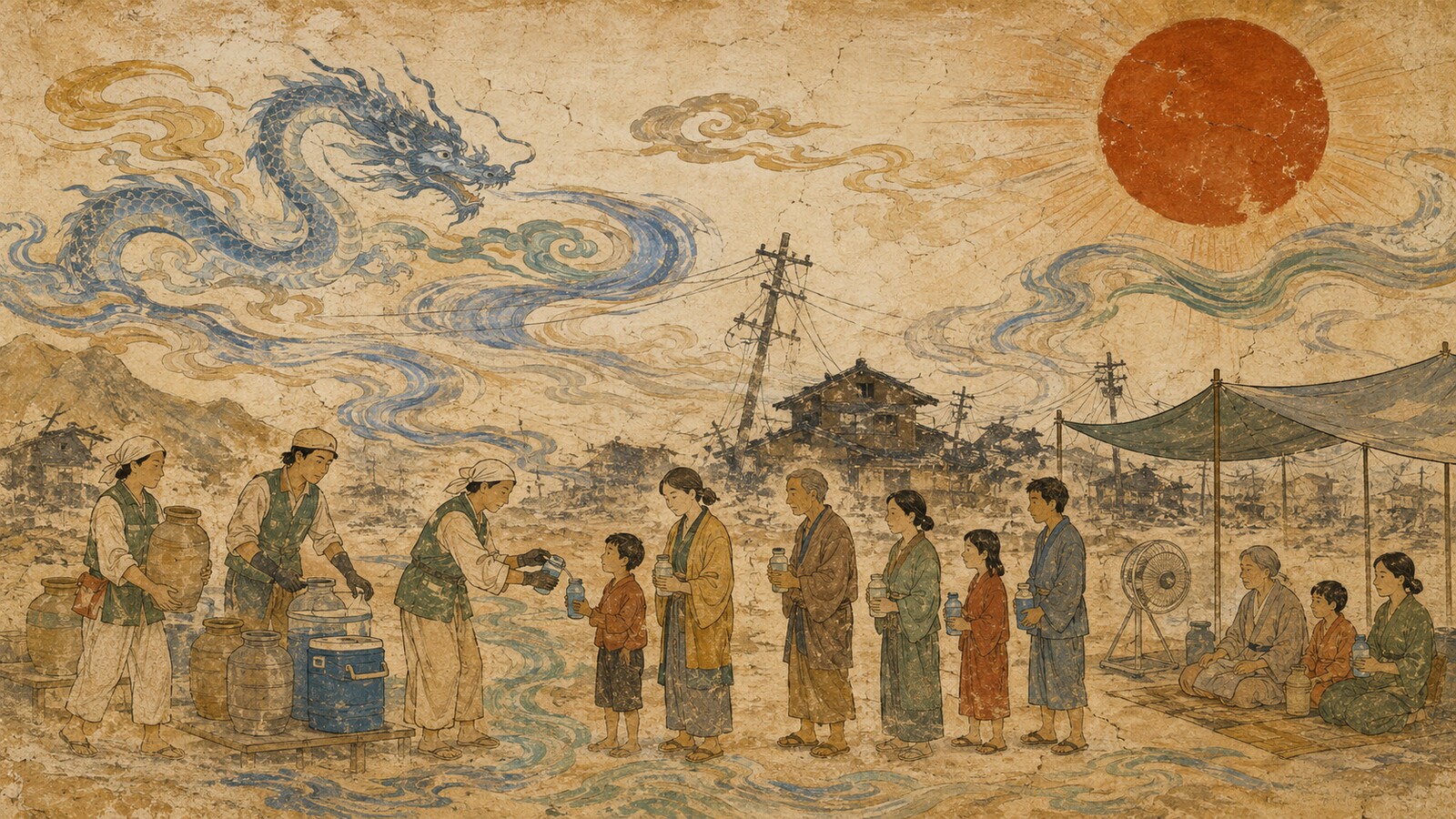
By seven in the morning, people were already forming a line for water in Hikawa. They had spent the night in cars parked outside the town office and on school grounds, not because a vehicle was comfortable, but because the buildings around them had endured intensity-7 shaking and the aftershocks had not stopped. Indoors offered walls and shade. Outdoors offered distance from those walls. Then the sun rose, and safety acquired a second meaning.
Hikawa had not opened indoor shelters while the stability of buildings remained a concern. Local reporting described outages across nearly the entire town. An emergency water truck arrived at about 11:00 a.m. Wednesday, after residents had waited for hours in hardening heat. More than 50 households collected water. One person who had also slept in a car during the 2016 Kumamoto earthquakes said movement through the night was part of avoiding blood clots. Ten years of disaster memory had become a bodily routine: keep the legs moving, keep drinking, keep watching the buildings.
On Thursday, the Environment Ministry’s system placed Kumamoto under a heatstroke alert. The measured wet-bulb globe temperature, or WBGT, was already 30.3 at 9:00 a.m. It was forecast to reach 31 at noon and 32 at 3:00 p.m.—both classified as “danger.” The Japan Meteorological Agency expected daily highs of at least 35°C through August 5 and warned that 40°C was possible on August 2.
This is the central fact of Kumamoto’s second emergency: heat, water and electricity are not three separate problems. Electricity powers cooling, pumps, communications and medical devices. Water allows the body to cool itself, toilets to function and hospitals to control infection. Heat increases demand for both at precisely the moment supply has been damaged.
The arithmetic of a water crisis
A broken water system resists a single headline number. The prefecture’s total of 74,800 affected households combined several conditions: complete interruption, cloudy water and leaks. A tap may run but produce water that authorities have not cleared for drinking. Pressure may be too low for an upper floor. A visible road leak can drain a reservoir faster than crews can refill it. A household counted as restored may lose service again when another break is isolated.
That is why “affected” should not be rewritten as “without water.” It is also why restoration maps change. Water operators must inspect sources, treatment plants, reservoirs, transmission mains and neighborhood pipes in sequence. Restoring pressure too quickly can worsen a rupture. Repairs require excavation, but roads may be buckled or needed by rescue vehicles. Aftershocks can reopen a joint that passed an earlier check.
By Thursday morning, water-distribution points had been established in 16 municipalities. The queues were not only for drinking water. Water is needed to take medicine, prepare infant formula, clean wounds, wash hands, cool the body and flush toilets. When supplies are limited, people often conserve the easiest water to see—the glass they would have drunk. In hot weather, that choice can turn prudent rationing into dehydration.
Emergency guidance commonly starts with drinking water because the need is immediate. But a functioning shelter consumes far more for sanitation. Toilets that cannot flush become a health hazard; handwashing declines; kitchens and clinical areas are harder to keep clean. The crisis therefore changes character over time. On the first day, the question is whether water can be delivered. On the third, it is whether enough clean water can sustain a crowded community without creating new illness.
Electricity has become life support
For 22,950 homes reported without power, the most visible loss was air conditioning. The less visible losses spread through every part of the response. Phones could not be charged. Refrigerators warmed. Traffic signals went dark. Elevators stopped. Electric pumps could not move water into some buildings. Pharmacies had to protect temperature-sensitive medicines. People dependent on oxygen concentrators, suction machines or powered beds had to find another source immediately.
A mobile generator can restore a critical circuit, but it is not the same as restoring a grid. Fuel must arrive over damaged roads. Machines need ventilation, grounding, operators and maintenance. A cable may cool one shelter room while homes nearby remain dark. The national government sent mobile power vehicles and spot coolers, among other supplies, but allocation is a form of triage: hospitals, water plants, communications, shelters and rescue sites may all need the same limited equipment.
Generators introduce their own lethal hazard. Carbon monoxide has no color or smell. Running a generator, charcoal grill or engine inside a home, garage, tent or partly enclosed entry can kill people who were trying to create power or cool air. The cable should enter the building; the engine and exhaust must stay fully outdoors and away from openings.
Vehicle refuge poses a different tradeoff. Air conditioning can turn a car into a temporary cooling room, but it consumes fuel that may be hard to replace. Idling in an enclosed or debris-blocked area risks exhaust exposure. A stationary seated position raises the danger of deep-vein thrombosis. The safest short-term refuge can become dangerous if it is treated as a complete shelter system.
A hospital evacuation in the dark
Kumamoto Minami Hospital in Uki shows how quickly utility failure becomes a clinical emergency. Intensity-7 shaking damaged walls and ceilings, jammed doors and disabled elevators. The entire building lost power. Backup generation kept essential equipment running, but hospital leaders estimated the fuel or system could sustain them for only one or two days. Many patients had chronic conditions; some depended on ventilators continuously.
The hospital decided to move all 127 inpatients during the night. Staff contacted other hospitals directly, wrote available beds and capabilities on a whiteboard, set priorities and moved patients in repeated trips using welfare taxis, receiving hospitals’ vehicles and, later, DMAT and out-of-prefecture ambulances. By 7:45 a.m., all 127 had been transferred without injury.
That success was not improvised from nothing. Hospital leaders pointed to the 2016 evacuation of Kumamoto City Hospital as the experience that shaped the network and the decision-making. The transfer illustrates what resilience really looks like: not a building that never fails, but a prepared system capable of preserving life when the building can no longer do so.
The broader medical picture remained severe. A Health Ministry snapshot at 1:00 p.m. Wednesday had reports from 54 damaged medical institutions; 40 still lacked water, nine lacked electricity and eight had disruptions to medical oxygen or related supplies. Later prefectural materials referred to impacts reported by 88 medical institutions and 62 pharmacies. These are not directly comparable totals: they reflect different reporting windows and definitions. What matters is the pattern—clinical capacity was being damaged at the same time demand was rising.
Thirty DMAT teams, about 120 personnel from across Kyushu, had entered the area by Wednesday afternoon, along with ten disaster psychiatric teams. Their job extended beyond treating visible injuries. They had to identify which facility was near failure, which patients could be moved safely, where medicines were available and which receiving hospital still had water, power, oxygen and staff.
The cascade no map can show
A utility map usually colors electricity and water separately. A disaster does not. A power outage can halt a well pump or building booster, creating a water failure without a broken pipe. A water outage can force a hospital evacuation even when electricity is available. A damaged road delays the fuel truck for a generator and the repair crew for a main. A failed cellular site leaves residents unable to learn which water station is open.
The Kyushu Shinkansen suffered a broken overhead line, rail distortions, two rail breaks, movement at a bridge pier and damage at more than 200 sound-wall locations. Ports reported liquefaction and other damage. These transport failures matter to a heat story because coolers, bottled water, repair parts, fuel and medical teams are physical objects. They have to cross the same damaged landscape as everyone else.
Food is part of the cascade. The government sent 10,000 servings of bread, a useful rapid supply that requires little preparation. But shelter nutrition cannot remain bread and packaged carbohydrates indefinitely, especially for people with diabetes, kidney disease, swallowing difficulties or allergies. Refrigeration, clean preparation water, diet records and trained staff become increasingly important with every day of displacement.
The official shelter count—10,467 people at 415 locations—also leaves blind spots. People in cars, relatives’ homes, workplaces or beside damaged houses may not be registered. A cooler or water truck sent according to shelter numbers alone may miss the very people who chose outdoor refuge because they distrusted the building.
2016: when lifeline failure lasted beyond the shaking
The historical scale is sobering. In 2016, the two intensity-7 earthquakes contributed to water interruptions across 445,857 households in seven prefectures; 432,457 were in Kumamoto. Up to 100 emergency water trucks and as many as 1,000 water-sector staff and contractors took part. Kumamoto City regained the ability to supply water across the city by April 30, two weeks after the second major shock. By May 20, the wider restoration rate had reached 99.9 percent, excluding areas where destroyed housing required longer reconstruction.
Electricity failed on a comparable scale. The 2016 sequence caused outages to a cumulative 610,000 homes and a peak of 476,600. Kyushu Electric mobilized thousands of its own workers and hundreds from other utilities; service was restored by April 20 except in areas where access or damage made restoration difficult.
Those numbers show what infrastructure recovery can achieve. They also show that “nearly restored” is not the same as safe for every person. A percentage can approach 100 while a ventilator user remains in the last dark house, a mountain community waits behind a broken road or a hospital cannot trust its water quality.
Kumamoto Prefecture’s ten-year record lists 275 deaths from the 2016 earthquakes: 50 direct deaths and 225 disaster-related deaths. The largest share of the final toll came not from the immediate collapse, but from worsening health and the strains of evacuation. The prefecture later documented 54 patients hospitalized with deep-vein thrombosis, commonly called economy-class syndrome, through March 2017 amid widespread vehicle evacuation.
That history explains Thursday’s urgency. The weather in April 2016 was not the late-July heat of 2026. Today’s combination compresses the timeline. Dehydration, heat illness and medication failure can develop in hours. Preventing disaster-related death must begin while the dramatic rescues are still under way.
What ten years of preparation changed
There is evidence that institutional memory is working. The hospital transfer network moved 127 medically complex patients overnight. DMAT and psychiatric teams arrived. Water trucks, mobile power vehicles and spot coolers were deployed. Water stations opened in 16 municipalities. Health guidance now explicitly tells response teams to find people outside designated shelters and to treat vehicle evacuation, thrombosis and heat as linked risks.
Kumamoto’s health planning also carries a specific lesson from 2016. The prefecture developed early warnings, a three-minute exercise supervised by Kumamoto University, leg-ultrasound screening and distribution of compression stockings. After the 2020 Kyushu floods, similar early intervention identified people at risk without producing the same number of severe cases requiring hospitalization. Preparedness here is not an abstract plan; it is a set of actions learned through earlier harm.
Yet preparedness cannot eliminate geography or physics. A backup generator still needs fuel. A cooler still needs electricity. A water truck serves only the people who can reach it. The hardest test is equity: whether aid reaches older residents living alone, people with disabilities, those who do not speak Japanese, households without cars and patients whose needs are not visible in an ordinary shelter roster.
A practical hierarchy for the next hot hours
- Cool first: Move to an air-conditioned, structurally cleared location before dizziness or confusion begins. Fans alone may be inadequate in extreme indoor heat.
- Drink regularly: Do not wait for thirst. Follow medical advice if fluid intake is restricted for heart or kidney disease; ask shelter medical staff rather than guessing.
- Protect water quality: Follow municipal boil or non-drinking notices. Clear-looking water is not automatically safe after pressure loss or pipe damage.
- Move the legs: During car or floor sleeping, flex ankles, stand and walk when safe. Seek urgent care for sudden shortness of breath, chest pain or one-sided leg swelling.
- Prevent carbon monoxide poisoning: Keep generators and combustion devices fully outdoors, away from windows, doors and vents.
- Register critical needs: Tell staff about ventilators, oxygen, dialysis, refrigerated medicine, pregnancy, infants or inability to stand in a distribution line.
- Check the timestamp: Water points, outage zones and shelter capacity change. Use current municipal and utility information rather than forwarded screenshots.
Heatstroke can present as headache, nausea, unusual fatigue, poor coordination or confusion. Confusion, collapse, seizure or inability to drink is an emergency: call for medical help and cool the person immediately. Do not force fluids into someone who is not fully alert.
Restoration numbers should also be read as operations data, not permission to return. The reappearance of electricity does not certify a cracked building. Running water does not prove the supply is cleared for drinking. A lifted evacuation order does not mean a medically vulnerable person can manage without support. Each system has its own safety check.
The disaster after survival
In Hikawa, the morning water line captured the whole crisis in one scene. People stood outside because they feared the next shake. They needed the sun for visibility and the open ground for safety, but the same exposure raised their heat risk. They waited for water while knowing that drinking it would create another need—a working toilet. Some used cars for cooling, spending fuel that might later be needed to move.
This is not a failure of individual judgment. It is what happens when every available choice carries a cost. The task of public response is to reduce those costs: certify safe indoor spaces, deliver clean water, restore power, bring cooling to people who cannot travel and keep medical care continuous.
At 10:12 a.m. JST Thursday, the heat was still climbing toward the most dangerous part of the day. Thousands of homes remained without electricity, tens of thousands had some form of water-system disruption and more than ten thousand people were recorded in shelters. The earthquake began in seconds. The effort to prevent its next deaths will be measured in cool rooms, safe water, charged medical devices and the people no official count has yet found.
Reporting Notes and Sources
Information was checked through 10:12 a.m. JST on July 30, 2026. Lifeline and shelter figures use Kumamoto Prefecture’s morning disaster-response materials. “Water affected” combines outages, cloudy water and leaks and is not presented as complete interruption in every household. Heat observations and forecasts use the Environment Ministry’s WBGT system.
- Kumamoto Prefecture: Fifth disaster-response meeting materials, July 30
- Fire and Disaster Management Agency: 18th damage and response report
- Japan Meteorological Agency: Earthquake activity and extreme-heat outlook
- Environment Ministry: Kumamoto WBGT observations and forecast
- Kumamoto Asahi Broadcasting: Outdoor evacuation and water distribution in Hikawa
- Kumamoto Asahi Broadcasting: Water, power and oxygen disruption at medical facilities
- Kumamoto Asahi Broadcasting: Evacuation of 127 patients from Kumamoto Minami Hospital
- Health Ministry: Water-system damage and restoration after the 2016 Kumamoto earthquakes
- Economy Ministry: 2016 power outages and restoration
- Kumamoto Prefecture: Ten-year record of the 2016 Kumamoto earthquakes
- Kumamoto Prefecture: Disaster health and deep-vein-thrombosis lessons