- Two Tokyo gardens, one message from Kumamoto
- What visitors can see—and when
- A piece of Higo inside the former Edo capital
- What the Hosokawa connection can—and cannot—mean
- Why Soseki belongs in a Kumamoto story
- A cat, a lantern and a literary invitation
- The art of bamboo illumination
- From the 2016 earthquakes to a decade of solidarity
- A quieter form of cultural diplomacy
- What remains after the lights go out
Two Tokyo gardens, one message from Kumamoto
The light is still a week away, but its meaning is already visible. From November 20, bamboo lanterns from Kumamoto are scheduled to illuminate the historic Higo Hosokawa Garden in Tokyo’s Bunkyo ward. Another installation will begin December 2 outside Shinjuku’s Soseki Sanbo Memorial Museum. These are two separate engagements, not a continuous month-long light show. Their common subject is a relationship between places that history had connected long before either venue existed as a public institution.
Kumamoto Prefecture announced the 2026 program on November 12. It describes the lanterns as thanks to Bunkyo and Shinjuku for assistance after the 2016 Kumamoto earthquakes and as a way to convey the prefecture’s continuing recovery. That is a civic purpose, not an independently measured assessment of how far recovery has progressed. The dates and participation details were future plans at the time of this November 14 report.
At first glance, the idea is almost disarmingly modest: light seen through openings in bamboo. Its power lies in where the bamboo is placed—inside the landscape of an old domain family and near the final home of a novelist whose imagination was shaped, in part, by years spent in Kumamoto.
What visitors can see—and when
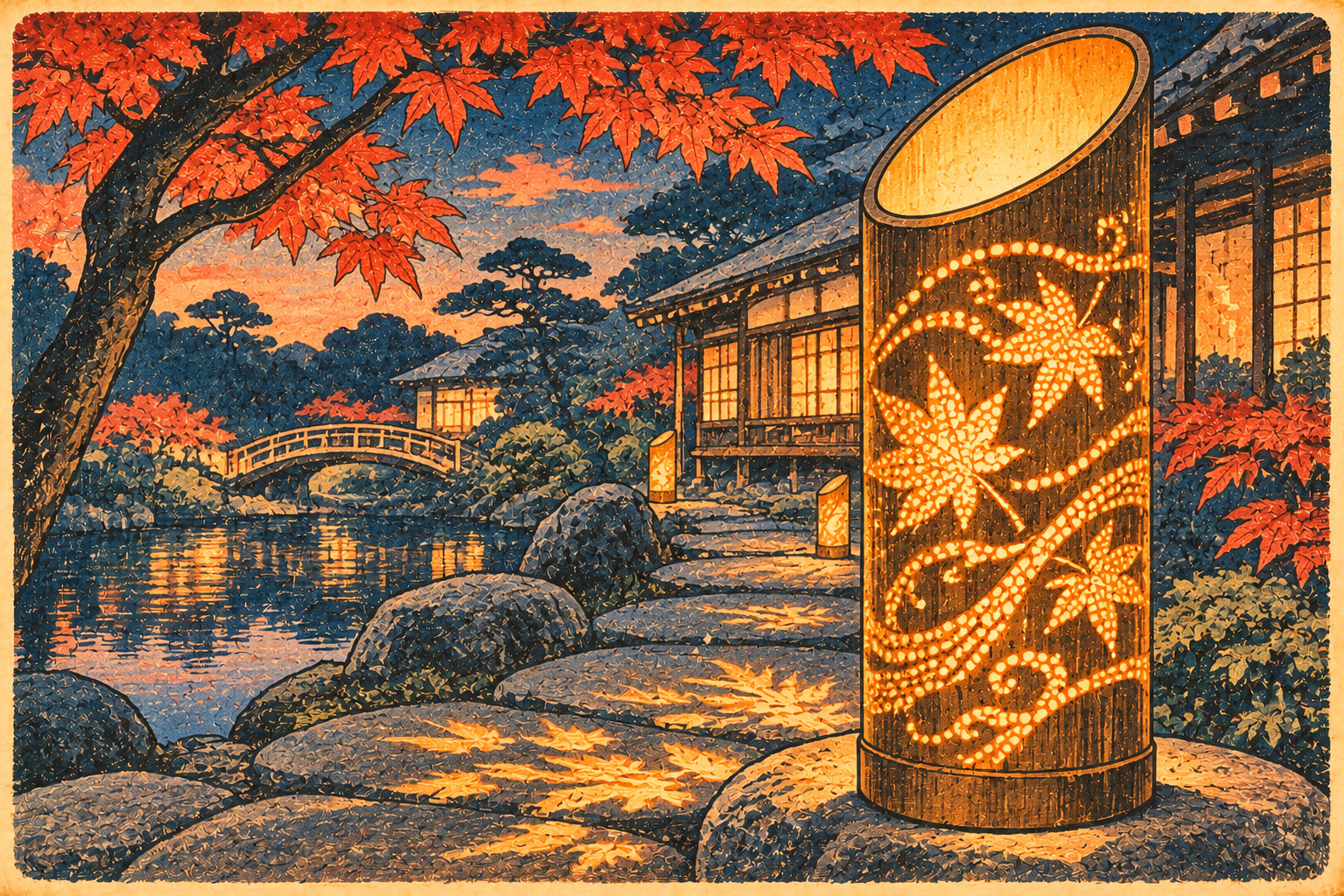
At the Bunkyo City Higo Hosokawa Garden, the autumn foliage illumination “Higo Akari” is scheduled for November 20–29, 5:30–8 p.m., with last admission at 7:30 p.m. The special evening admission costs ¥500; preschool children enter free. The announced attractions include bamboo illuminations with Kumamon motifs, tourism displays, and lighting that picks up the contours of the garden, its pond and autumn leaves. The program also lists Yamaga lantern dancing at 6 and 7 p.m. Visitors should consult the operator’s current notices for any changes.
The second location is the forecourt of the Soseki Sanbo Memorial Museum at 7 Wasedaminamicho, Shinjuku. The planned dates are December 2–25 and the exterior illumination hours are 4:30–8 p.m. Indoor museum admission closes earlier, at 5:30 p.m.; the institution also lists closure days that need checking before travel. The bamboo objects evoke Soseki’s literary world, including cats, paw prints, whiskers and a hat, as well as Kumamon.
The first garden ordinarily admits visitors without charge, but the ¥500 ticket applies to this special evening event. Kumamoto’s official notice also says there is no reservation requirement for Higo Akari, advises using public transportation, and warns of steps, one-way movement and possible visitor limits. Those practical details make the difference between a romantic photograph and a useful cultural guide.
A piece of Higo inside the former Edo capital
Higo Hosokawa Garden’s name is not a marketing coincidence. The site was associated with residences of the Hosokawa family, rulers of the Higo domain, which had its center in what is now Kumamoto Prefecture. Bunkyo’s account traces the land through flag-bearer estates and residences linked to the Shimizu and Hitotsubashi branches of the Tokugawa before it became connected with the Hosokawa household late in the Edo period.
After the Meiji Restoration, the property became a principal Hosokawa residence. Its surviving landscape uses a pond and the changes in elevation at Mejirodai to achieve the sense of a much larger natural scene. The wooden Shoseikaku building is associated with the family’s educational and residential life; the garden later became a Tokyo metropolitan park in 1961 and was transferred to Bunkyo in 1975.
The pond’s reflections and sloping paths are therefore not generic scenic backdrops. They are physical evidence that Japanese political geography had two scales: domains far from Edo, and the land those domains’ governing families occupied in the capital. This year the lanterns briefly reverse that old direction of movement. A contemporary craft from Kumamoto comes back to a Tokyo place bearing the history of Higo.
What the Hosokawa connection can—and cannot—mean
The Hosokawa are associated with centuries of Japanese political and cultural history, but it would be misleading to treat every object in the garden as a survival unchanged from the seventeenth century. The land changed owners; buildings and paths were altered; the Shoseikaku structure underwent restoration and seismic upgrading before reopening in 2016. The official garden history is unusually useful precisely because it records these layers rather than presenting a frozen Edo tableau.
The garden is a place to read historical continuity alongside reconstruction. A pond can be old in origin, a building can have later modifications, and a contemporary light installation can still speak authentically to the site. The question is not whether the bamboo lantern was once part of a daimyo household—it was not—but how modern public programming makes a layered historical place legible to visitors.
Nearby Eisei Bunko, the museum associated with the Hosokawa cultural holdings, is another reminder that the family’s legacy includes collecting, scholarship and the arts as well as political power. That broader history gives the autumn event a more interesting frame than the familiar formula of illuminated red leaves.
Why Soseki belongs in a Kumamoto story
Natsume Soseki was born in Edo in 1867, but his career carried him west. In April 1896 he began teaching English at the Fifth Higher School in Kumamoto, an institution whose history leads to modern Kumamoto University. He spent roughly four years there before leaving for Britain in 1900. The years preceded his emergence as the celebrated novelist, but they became part of his imaginative geography.
Kumamoto Prefecture identifies landscapes he visited during that period as later sources for settings in “Kusamakura” (The Three-Cornered World) and “Nihyakutoka” (The 210th Day). These are connections in the writer’s life and work, not proof that either novel simply transcribes a particular journey. Soseki would later write “I Am a Cat” after his British experience, and his literary career developed largely around Tokyo.
The Soseki Sanbo site in Shinjuku is where he lived for the final nine years of his life, from 1907 until his death in 1916. The museum stands at that literary address. To place a lantern from Kumamoto by its forecourt is to connect the young teacher in a provincial city with the mature writer who helped shape modern Japanese prose.
A cat, a lantern and a literary invitation
The Shinjuku installation turns that history into imagery accessible without a lecture. The outlines of cats and their paw prints refer to the literary universe of “I Am a Cat,” while the small apertures of bamboo allow a modest amount of light to become a line, a silhouette or a moving pattern as the viewer changes position.
This is interpretation rather than an original illustration drawn by Soseki. Neither the cat shapes nor Kumamon are historical artifacts from his residence. The point is instead public participation: a familiar animal gives children a way into an author whose novels can be demanding, while a brightly recognizable Kumamoto character links the two cities.
Such an installation carries an obvious risk of reducing literature to an attractive photograph. The museum setting can counter that, if visitors go on to learn about Soseki’s work, his Kumamoto teaching years and the tensions of early modern Japan that made his fiction enduring.
The art of bamboo illumination
Bamboo lanterns occupy an interesting meeting point of regional craft and contemporary event design. A section of bamboo can be drilled or cut with a pattern, then illuminated so that its openings draw marks in light. That simple explanation hides the skills of preparing a material that can split, arranging stable structures outdoors, and controlling illumination in a public landscape.
Kumamoto-based CHIKAKEN traces its work to 2004, when founders Ikeda Chikao and Mikishiro Kenji encountered the Usuki Takeyoi bamboo-lantern festival and participated in Kumamoto’s Mizu Akari festival. The team describes “lighting our own town” as a form of community making. CHIKAKEN is also named by the Hosokawa Garden as the producer behind a November 21 workshop, an identifiable link between the movement and this venue.
The bamboo used in a given installation, how it is harvested, whether it is reused, what electrical equipment is employed and how it is recycled would all matter to a serious environmental accounting. The public November announcement does not supply a full materials inventory or lifecycle assessment. Calling every bamboo lantern automatically sustainable would overstate what is documented.
From the 2016 earthquakes to a decade of solidarity
On April 14 and April 16, 2016, the Kumamoto region suffered devastating earthquakes, with both major shocks reaching the highest intensity of seven on Japan’s seismic scale. The Japan Meteorological Agency records the events at magnitude 6.5 and 7.3 respectively. Their impact extended far beyond the immediate physical damage, affecting homes, infrastructure, heritage and daily life.
The relationship behind the Tokyo lighting actually predates those earthquakes. In October 2015, Kumamoto Prefecture and Kumamoto City signed a four-party memorandum with Tokyo’s Bunkyo and Shinjuku wards, linking their shared histories through the Hosokawa family, Soseki and Lafcadio Hearn (Koizumi Yakumo). The prefecture says bamboo displays have continued since 2016 as an expression of gratitude for support.
That chronology matters. The disaster did not invent the relationship; it gave the existing civic connection a new task. In 2026 the lanterns are part of a continuing exchange rather than a first-time donation or evidence that earthquake reconstruction is complete.
A quieter form of cultural diplomacy
Regional diplomacy is often imagined in the language of export promotion and large-scale tourism campaigns. This program is smaller and more local: one prefecture works with two Tokyo wards, a historical garden and a literary museum. The public goods involved are recognition, shared historical knowledge and opportunities for residents to encounter a different part of the country.
The 2015 memorandum also drew attention to Koizumi Yakumo, the foreign-born writer and educator who worked in Kumamoto. He does not appear as a central character in this particular lantern program, but he helps explain why the four governments viewed their pasts as intertwined. The historical network is richer than a single famous family or author.
No visitor-count target, measured economic impact or survey of participants is established by the November 12 announcement. The plausible benefit is cultural exchange; whether the event measurably changes tourism or perceptions will require evidence after the installations open.
What remains after the lights go out
It is tempting to describe any public illumination as an ancient tradition. Bamboo has long appeared in Japanese craft, but these specific illuminated installations are contemporary works and should be described as such. Their value is not manufactured antiquity. It is the deliberate use of an ordinary material to make a public memory visible.
By November 14 neither of the two 2026 displays has opened. The announced evening hours are therefore plans, not eyewitness descriptions of this season’s crowds, colors or weather. The original illustration accompanying this feature is an artistic interpretation, not a photograph of the forthcoming events.
If the lanterns succeed, it will not be because they make Tokyo look like Kumamoto for a few evenings. It will be because a visitor sees a garden or a novelist’s house differently—and comes away understanding why a prefecture hundreds of kilometers away considers those places part of its own story.
Visitor information (announced November 12, 2026)
| 会場/Venue | Higo Hosokawa Garden · Bunkyo |
|---|---|
| 日時/Dates | 2026-11-20 — 2026-11-29, 17:30–20:00 |
| 料金/Entry | ¥500 (preschool children free) |
| 会場/Venue | Soseki Sanbo Memorial Museum forecourt · Shinjuku |
| 日時/Dates | 2026-12-02 — 2026-12-25, 16:30–20:00 |
| 注意/Note | Museum indoor admission ends at 17:30; check closure dates. |
Sources and verification
Primary institutional and official sources were prioritized. Dates describe a forthcoming program; schedules, restrictions and access should be checked with venues before visiting.
- Kumamoto Prefecture: Tokyo bamboo illumination, November 12, 2026
- Kumamoto Prefecture: original event announcement
- Higo Hosokawa Garden: official history
- Bunkyo City: Higo Hosokawa Garden
- Shinjuku Soseki Sanbo Memorial Museum: Soseki biography
- CHIKAKEN: history of bamboo illumination
- Japan Meteorological Agency: the 2016 Kumamoto earthquakes
- Kumamoto Prefecture: ten-year cultural memorandum symposium
- Higo Hosokawa Garden: workshops and visitor updates
- Kumamoto City: the Hosokawa estate in Tokyo