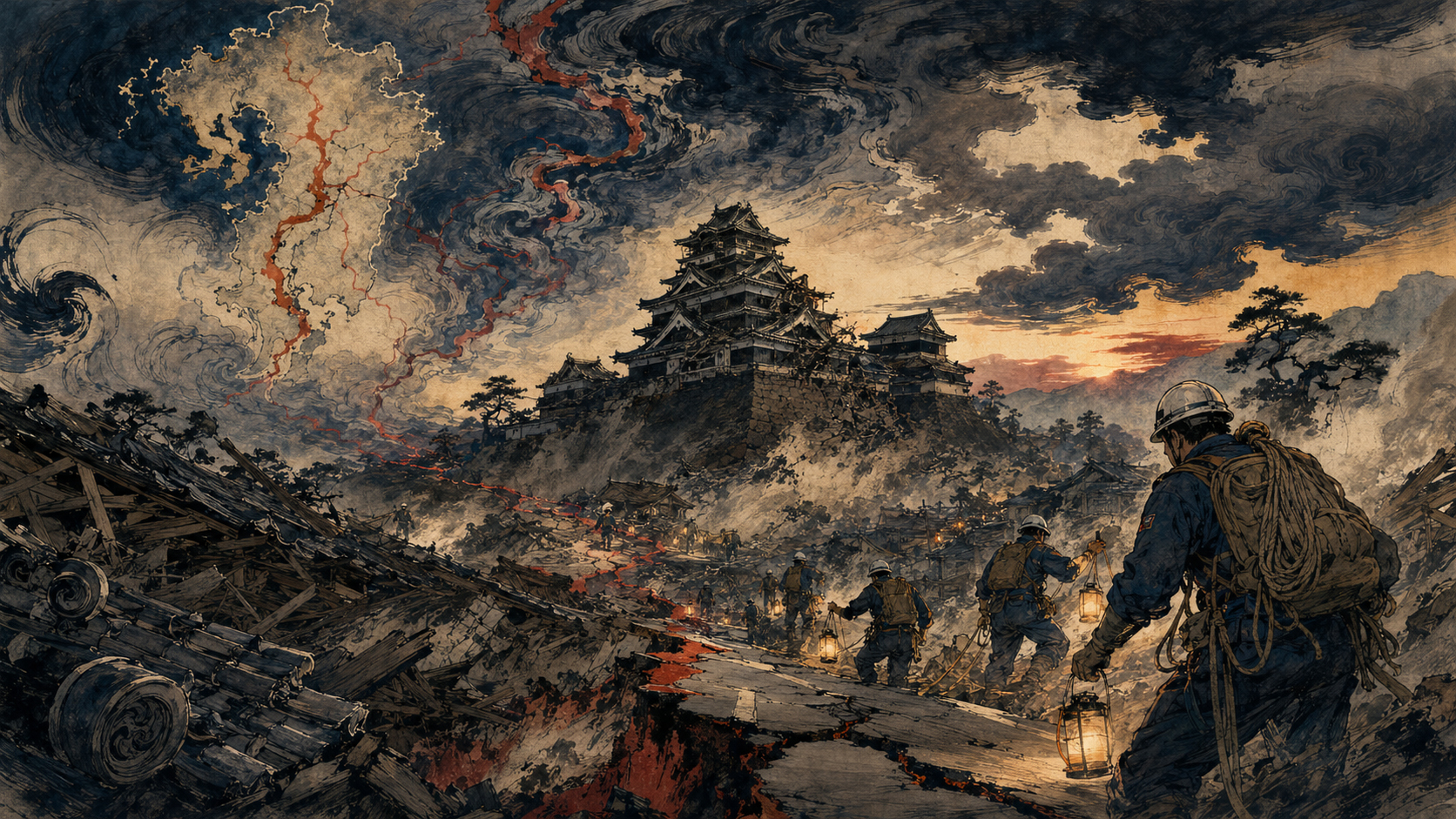
At 4:27 p.m. on Tuesday, the ground beneath central Kumamoto moved with the kind of force that turns an ordinary afternoon into a dividing line. The Japan Meteorological Agency placed the shallow hypocenter in the Kumamoto region at about 10 kilometers deep and issued a preliminary magnitude of 7.1. Uki City and Hikawa Town recorded shindo 7—the maximum on Japan’s intensity scale. Kumamoto’s Minami Ward, Yatsushiro, Uto, Misato and Mashiki recorded shindo 6-upper.
The earthquake’s violence was intensely local but its consequences spread across Kyushu. Emergency alerts reached seven prefectures. Railways stopped. Flights were grounded or diverted. Electricity failed across roughly 48,000 Kumamoto households in the first hour. Fires and building collapses were reported, roads split and bridges were damaged. By evening, hospitals had treated scores of injured people, while rescue teams searched damaged structures.
The gravest operation centered on Aeon Mall Kumamoto in Kashima, where part of the second floor collapsed after reports of an explosion and many people were believed trapped. Workers were also reported missing after a factory chimney collapsed. Reuters reported at least 90 injured, including 10 seriously, while authorities stressed that the full toll had not been established. This report does not convert missing-person reports or media descriptions into confirmed deaths.
The first six hours
4:27 p.m. — Main shock in the Kumamoto region. JMA’s emergency warning system activates across much of Kyushu.
Minutes later — A tsunami advisory is issued for the enclosed Ariake and Yatsushiro seas, with possible waves of up to one meter. Coastal residents are told to move away from shorelines and river mouths.
5:08 p.m. — A strong aftershock produces shindo 5-lower in parts of Kumamoto. Repeated aftershocks continue.
5:15 p.m. — Kyushu Electric reports about 48,000 households without power, including roughly 12,000 in Uki and 14,000 in Yatsushiro.
6:10 p.m. — The tsunami advisory is lifted. No damaging tsunami is observed, but the emergency shifts from coastal evacuation to rescue, fire control, shelter and infrastructure inspection.
Evening — A reported explosion and partial collapse at Aeon Mall Kumamoto becomes the largest rescue site. National and regional teams mobilize as night, heat and aftershocks complicate operations.
Magnitude is not shindo
International headlines naturally lead with “7.1,” but Japanese residents experience earthquakes through two different numbers. Magnitude describes the total energy released at the source. Shindo describes the strength of shaking at a particular place. One earthquake has one magnitude estimate but many local intensity readings.
JMA’s preliminary local-magnitude value is 7.1. Its moment-tensor analysis gives a moment magnitude around 6.8, broadly consistent with the U.S. Geological Survey’s revision to 6.8. That is not a contradiction and it does not mean the shaking “was downgraded.” Different methods measure different aspects of rupture. The shindo 7 observations in Uki and Hikawa remain the essential fact for damage: unsecured furniture can be thrown, reinforced-concrete structures may be damaged and ordinary movement becomes extremely difficult.
Depth matters too. A shallow inland rupture has less rock through which to dissipate energy before waves reach communities. Here, the epicentral area was close to population centers, transport corridors, factories and structures already carrying the memory—and in some cases the unfinished repairs—of 2016.
An active-fault earthquake, not a Nankai Trough event
JMA’s initial mechanism indicates predominantly strike-slip faulting under east-northeast–west-southwest compression. The location overlaps the inland active-fault system associated with the 2016 Kumamoto sequence, near the Hinagu fault zone. Detailed surveys will be required before scientists assign the rupture to a particular mapped segment.
That distinction matters. This was not reported as a subduction-zone rupture on the Nankai Trough, and the available official mechanism is characteristic of an inland crustal earthquake. It should not be described as “the Nankai earthquake.” Nor does one large earthquake allow a responsible prediction of another. What it does justify is JMA’s warning that a quake of similar intensity can occur in the strongly shaken area, especially during the next two or three days, and that heightened caution should continue for about a week.
The unbearable memory of April 2016
Kumamoto has lived this uncertainty before. On April 14, 2016, a magnitude 6.5 earthquake struck near Mashiki and produced shindo 7. It was initially treated as the main event. Twenty-eight hours later, on April 16, a magnitude 7.3 rupture spread through the Futagawa–Hinagu fault system and again produced shindo 7. The larger second shock transformed the disaster.
The full sequence killed more than 270 people when disaster-related deaths are included, injured roughly 2,800 and damaged about 160,000 homes. More than 180,000 people evacuated at the peak. Landslides severed roads and railways near Aso. Kumamoto Castle’s stone walls and historic buildings failed on a scale that turned cultural restoration into a multigenerational project; full restoration is not expected until 2052.
Ten years of reconstruction changed the region. Houses were strengthened, slopes monitored, utilities hardened, evacuation plans rewritten and the broken castle made into a public lesson in structural history. Yet resilience does not mean invulnerability. A repaired road may lead to an older house. A modern shopping center can become a mass-casualty site if fire, gas, ceilings or internal systems fail after the shaking. A community with excellent drills still has elderly residents, hospital patients and visitors who cannot move quickly.
Why the tsunami alert was real even for an inland quake
The epicenter was inland, but the rupture sat close to two shallow, enclosed seas. JMA issued an advisory for the Ariake and Yatsushiro seas, where local deformation, landslides or complex basin effects required immediate caution. The advisory was lifted within two hours and no damaging tsunami was detected.
The correct lesson is not that the alert was excessive. Tsunami decisions must be made before perfect information exists. In enclosed waters, a modest wave can produce dangerous currents at harbors, river mouths and seawalls. Leaving the coast when told, then returning only after the advisory is lifted, is the system working as intended.
Kyushu’s industrial exposure
Modern Kumamoto is not only an agricultural and cultural center. It is a strategic node in Japan’s semiconductor revival. TSMC’s Japan Advanced Semiconductor Manufacturing plants, Sony’s image-sensor operations and a dense network of tool, materials and precision-parts suppliers make central Kyushu one of Asia’s most important chip clusters.
TSMC, Sony and Fujifilm evacuated workers to conduct checks. Tokyo Electron said it would suspend operations at two Kumamoto factories through Wednesday, and Honda temporarily idled its local motorcycle plant. The immediate priority is human safety, not output estimates. Even where a building remains intact, advanced factories must inspect clean rooms, gas lines, water, power quality and nanometer-precision equipment before restarting.
The economic risk therefore travels in layers: direct facility damage; power, water and road interruptions; employee displacement; supplier delays; and precautionary shutdowns. The July 28 Tokyo stock market had already closed before the earthquake. Any financial-market reaction belongs to the next trading session and should not be backfilled into Tuesday’s close.
Infrastructure, nuclear plants and the overnight test
JR Kyushu suspended the Kyushu Shinkansen and local services while crews inspected tracks, bridges, overhead power and stations. Kumamoto Airport closed its runway and flights were diverted or canceled. A freight train reportedly derailed near Yatsushiro without injury to its driver. Telecom companies reported disruption tied to power failures and transmission damage.
Japan’s nuclear regulator reported no abnormalities at the Genkai, Sendai and Ikata nuclear power stations. That is reassuring but not the end of monitoring: operators continue checking equipment and off-site power as aftershocks proceed.
Night changes the hazard. Broken glass and fallen furniture become harder to see. Damaged walls can fail in an aftershock. Summer heat makes power loss and crowded shelters medically dangerous. Rain can turn cracked slopes into landslides. People charging phones or cooking during outages face carbon-monoxide and fire risks if generators or stoves are used incorrectly.
- Stay out of visibly damaged buildings until authorities assess them.
- Expect strong aftershocks; keep shoes, a light, medicine, water and a charged phone within reach.
- Avoid slopes, cracked roads, riverbanks, seawalls and fallen utility lines.
- Use battery lights instead of candles; never run a generator or charcoal stove indoors or in an attached garage.
- Check on older neighbors, people with disabilities, visitors and anyone who may not understand Japanese alerts.
- Follow local evacuation orders. The tsunami advisory is lifted, but municipal restrictions and structural hazards may remain.
What is known—and what is not
| Confirmed or strongly established | Still developing |
|---|---|
| JMA M7.1 at 4:27 p.m.; about 10 km deep; shindo 7 in Uki and Hikawa. | The final magnitude, mapped rupture and precise relationship to individual Hinagu fault segments. |
| Tsunami advisory issued for Ariake and Yatsushiro seas and lifted at 6:10 p.m. | The final injury, death and missing-person totals. |
| Major power, rail, road, aviation and telecom disruption; no reported nuclear-plant irregularity. | The safety of everyone at collapsed structures and the full number of damaged buildings. |
| Repeated aftershocks and official warnings about more strong shaking. | How quickly transport, utilities and semiconductor production can safely restart. |
The report that must keep changing
A breaking disaster article is a snapshot, not a verdict. Early casualty numbers are assembled from hospitals, police, fire departments, municipalities and families operating under damaged communications. Apparent contradictions often reflect different reporting times or definitions. “Unaccounted for” is not the same as “confirmed dead.” “No irregularity” at a nuclear plant is not a prediction that no later inspection will find damage. “Advisory lifted” does not make a cracked harbor safe.
What can be said at 10:35 p.m. is grave enough. Southern Japan has suffered a shallow, powerful inland earthquake. Maximum shindo 7 shaking returned to two Kumamoto communities. Rescue teams are working at multiple sites; hospitals have received scores of injured people; utilities and transport are disrupted; and the sequence is not over.
The 2016 lesson is often reduced to the warning that a larger shock may follow. Its deeper lesson is institutional. Labels must remain provisional, structures must be rechecked after every strong aftershock, evacuation must include those least able to move and public information must separate what is confirmed from what is feared. For Kumamoto, history is not a prophecy. Tonight, it is an operating manual.
Reporting notes and sources
This report reflects information available at 10:35 p.m. Japan Standard Time on July 28, 2026. The situation is developing. JMA magnitude and intensity are used for the Japanese event description; differing moment-magnitude estimates are explained rather than treated as a correction to observed shaking.
- Japan Meteorological Agency: source parameters and moment-tensor solution
- Japan Meteorological Agency: emergency earthquake warning record
- Prime Minister’s Office: government response statement
- Associated Press: tsunami status, rescue operations and infrastructure impacts
- Reuters: injuries, rescue sites, utilities, transport and industrial checks
- Cabinet Office: official overview of the 2016 Kumamoto earthquakes
- Japan Society of Civil Engineers: July 28 earthquake information hub