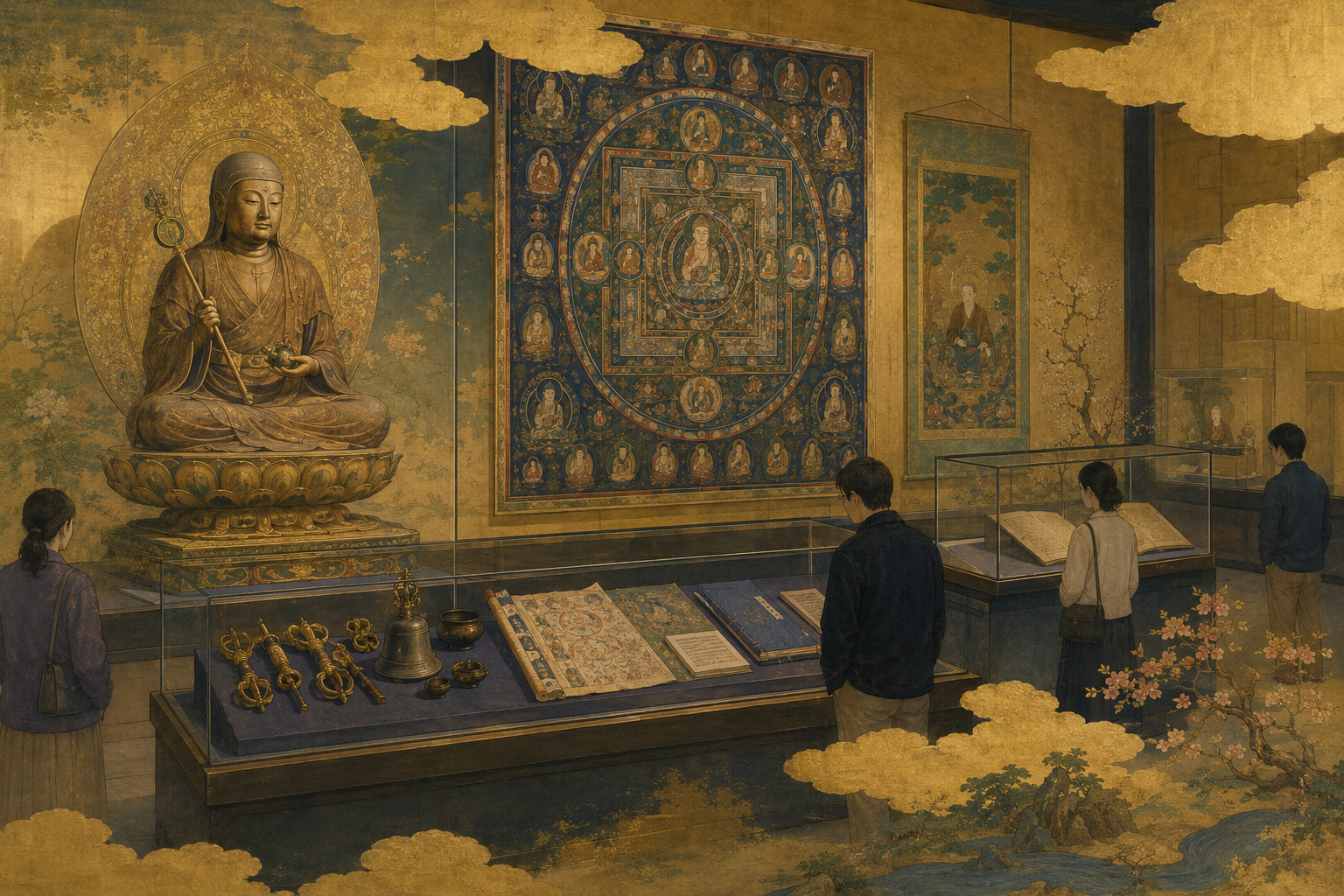
A mandala, in this exhibition, is not wallpaper behind a statue. A ritual bell is not an ornament. A Buddhist image may be a revered presence that is ordinarily hidden, not an art object waiting for a spotlight. Tokyo National Museum's summer exhibition closes by asking visitors to adjust the habits of museum looking: the beauty is inseparable from what these things were made to do.
Kūkai and the Treasures of Shingon Buddhism enters its final day Sunday in the Heiseikan galleries at Ueno Park. The official Japanese title marks the 1,250th anniversary of the birth of Kōbō Daishi: 弘法大師生誕1250年記念 特別展「空海と真言の名宝」. The anniversary itself fell in 2023; the 2026 exhibition is a belated commemoration on a scale made possible by cooperation among the 18 temples of the Association of Shingon Head Temples and related institutions.
The result is an assembly of 88 works, including 15 National Treasures and 60 Important Cultural Properties. Nine ordinarily concealed sacred images, comprising 11 figures, are specially shown. Yet the numerical prestige can obscure the larger achievement. The objects have come from institutions shaped by different lineages and long histories of division. For eight weeks in Tokyo, they have formed a temporary map of what remained shared.
From Chang'an to a Japanese visual system
Kūkai was born in 774 in Sanuki Province, in present-day Kagawa Prefecture. In 804 he sailed with a Japanese mission to Tang China and reached Chang'an. The following year, at Qinglong Temple, he received esoteric Buddhist initiations from the monk Huiguo. Kongōbuji's official chronology identifies the two great mandala traditions—the Womb Realm and Diamond Realm—and records the initiation name Henjō Kongō.
Kūkai left China in 806 with texts, painted images and ritual implements. Tōji's official history says the inventory he submitted to the court listed 216 scriptural titles in 461 fascicles, ten hanging scrolls including the paired mandalas, and implements for esoteric rites. That inventory matters because Shingon transmission did not reside in a single book. Words, images, gestures, sounds, consecration and implements belonged to one system.
Imperial patronage gave the system institutions. Kūkai received land on Mount Kōya in 816 for a center of meditation. In 823, Emperor Saga entrusted Tōji to him; Kūkai made the Kyoto temple a principal training ground for esoteric Buddhism. His activity also included education, writing and public works. The exhibition does not reduce those careers to a heroic biography. It follows what happened when a transmission attached to one extraordinary monk had to survive him.
774 — Kūkai is born in Sanuki Province.
804–806 — He travels to Tang China, studies under Huiguo and returns with texts, images and ritual instruments.
816 — The court grants Mount Kōya for a place of practice.
823 — Tōji is entrusted to Kūkai.
834–835 — The court approves the New Year esoteric rite later called Goshichinichi no Mishihō.
921 — Emperor Daigo grants the posthumous title Kōbō Daishi.
Images as a method of knowledge
The first chapter joins works associated with Kūkai to paintings, drawings and implements that articulate esoteric Buddhist thought. The paired mandalas do not simply gather many deities into elaborate diagrams. They order relationships. Mahāvairocana—Dainichi Nyorai in Japanese—is the central Buddha in the Shingon cosmos, while the Womb and Diamond realms offer complementary visualizations of awakening, compassion and wisdom.
This is why the exhibition's range matters. The National Treasure Sanjūjō Sasshi, or Thirty-Volume Booklets, contains manuscripts copied by Kūkai and others during his Chinese sojourn. Only volumes 22 and 24 are in the closing rotation. Nearby, ritual implements give material form to actions; iconographic drawings preserve models to be studied and transmitted; large paintings place deities in ordered fields. The archive and the image are not separate departments of the tradition.
Sculpture makes the system occupy bodily space. The Important Cultural Property pair carved by Kaikei in 1197—standing images of Shukongōjin and Jinja Daishō from Kongōbuji—turns protective force into taut posture, muscular surfaces and vigilant faces. They are not illustrations of a doctrine in the weak sense. Their scale and presence help produce the charged environment in which doctrine is encountered.
The final rotation is a distinct exhibition
Works on paper and silk cannot remain under exhibition lighting indefinitely. The museum divided numerous objects into early and late displays, with still finer two-week rotations for some paintings. The last day therefore offers neither the whole checklist at once nor a diminished remainder. It offers one historically meaningful configuration.
The final leaves of the National Treasure Twelve Devas Screens from Tōji show the earth, sun and moon deities. The National Treasure set of Twelve Devas from Saidai-ji closes with the water and wind deities. In the National Treasure Five Great Wisdom Kings from Daigoji, the late rotation shows Gundari, Daiitoku and Kongōyasha Myōō. Such substitutions reveal that “one work” in a catalogue may be a set whose internal world cannot safely be displayed in full for two months.
| Work | Date and lender | Why it matters on September 6 |
|---|---|---|
| National Treasure Sanjūjō Sasshi, volumes 22 and 24 | 9th century; Ninnaji, Kyoto | Closing-rotation manuscripts copied by Kūkai and others in China. |
| National Treasure Twelve Devas Screens: earth, sun and moon | 1191; Tōji, Kyoto | The fourth and final group in a four-part rotation. |
| National Treasure Twelve Devas: water and wind | 9th century; Saidai-ji, Nara | Late-period leaves tied to the New Year ritual section. |
| National Treasure Shigisan Engi Emaki, “Engi Kaji” scroll | 12th century; Chōgosonshi-ji, Nara | The final-period scroll from one of Japan's most celebrated narrative handscroll sets. |
| National Treasure Seated Five Wisdom Buddhas | 9th century; Anshōji, Kyoto | A complete five-figure ensemble shown throughout the run. |
| National Treasure Seated Yakushi Nyorai | 1103, by Ensei and Chōen; Ninnaji, Kyoto | A major late-Heian sculpture and one of the final chapter's sacred images. |
A closed rite brought to the edge of visibility
The second chapter is devoted to Goshichinichi no Mishihō, the esoteric New Year rite whose name refers to the “latter seven days.” According to Tōji, Kūkai submitted a petition for the rite in 834 and performed it at the imperial Shingon chapel in 835. It is now conducted from January 8 through 14 at Tōji's Kanjō-in. Shingon leaders gather to pray for the security of the state, abundant harvests and the well-being of the land.
The ritual space itself is not opened to the public. Visitors at Tōji may observe the processions entering and leaving, but not enter the consecration hall during the secret rite. That boundary gives the museum's reconstruction unusual weight. Diagrams, paintings, written manuals and the three sculptures known collectively as Niken Kannon—the bodhisattva Shō Kannon flanked by Brahmā and Indra—show how a rite is assembled without pretending that a display case can reproduce its efficacy.
This section also explains why 18 head temples appear together. Shingon developed into more than 50 sects and branches, according to the museum, but the head-temple association sustains shared undertakings, above all the annual rite at Tōji. The exhibition's temporary reunion thus reflects a permanent form of coordination. Institutional plurality did not erase a common ritual inheritance.
Five Buddhas, one constellation
The National Treasure Seated Five Wisdom Buddhas from Anshōji is an apt emblem for the exhibition. Five sculptures are experienced as one ensemble: Dainichi Nyorai at the center, accompanied by Buddhas associated with the four directions and five forms of wisdom. The set converts a diagrammed cosmos into an assembly sharing the visitor's space.
The figures also carry a more fragile history. Wooden sculpture survives through repair, relocation, changed buildings, altered rituals and generations of custody. A designation such as National Treasure identifies exceptional cultural value under modern law, but the objects' earlier lives were shaped by temples, worship and lineage. The museum classification is one chapter of their biography, not its beginning.
That point is sharper in the final chapter, where sculpture and hibutsu—images normally withheld from public view—stand together. Concealment is not neglect. It may be a disciplined form of access, opening an image only on specified occasions or preserving a sacred relationship within a temple. Special display gives the public a rare encounter, but it should not be confused with making the object permanently available.
A disciplined way to look
- Read the lender: each work comes from a living institution with its own history.
- Check the display dates: the closing rotation differs materially from opening week.
- Look across media: paintings, manuscripts, sculpture and implements form one ritual vocabulary.
- Notice groupings: a mandala or sculpture set organizes relationships, not isolated icons.
- Follow photography symbols: only part of the fourth chapter permits still photography; video, flash and tripods are prohibited.
From temple treasure to public cultural property
The exhibition also exposes a modern chain of responsibility. Temples preserved works for centuries under religious conditions; curators and conservators now manage transport, lighting, temperature and rotation; cultural-property law assigns national significance; admission revenue enters an economy of further preservation. Tokyo National Museum says part of the exhibition's proceeds will support cultural-property conservation through the Tsumugu Project.
There is no contradiction in admiring the precision of a line or the controlled violence of a guardian while understanding that aesthetic judgment is not the whole encounter. Museum display makes comparison possible on a scale few temples could offer. At the same time, it detaches objects temporarily from altar, procession, sound, smoke, recitation and restricted access. The gain in visibility comes with a change in context.
The best response is not to choose between “art” and “religion.” It is to see how craftsmanship carried religious knowledge and how ritual demand drove technical invention. A manuscript survives because someone copied a teaching. A bell takes its form because a hand must sound it in a prescribed act. A multi-figure ensemble is composed because relationships among deities need to be made visible.
What closes, and what continues
The exhibition ends at 5 p.m. Sunday. The 18 head temples will not cease to be connected; Goshichinichi no Mishihō will return in January; paintings and sculptures will resume lives governed by the institutions that lent them. The closing is significant precisely because the tradition is not ending.
Kūkai's posthumous name, Kōbō Daishi, was conferred by Emperor Daigo in 921, 86 years after the monk's death as counted by the traditional narrative. By then, remembrance had already begun to change biography into enduring presence. Twelve centuries later, that presence is carried not by a single relic or unbroken building but by a network: manuscripts copied and recopied, iconographies transmitted, ceremonies restaged, statues repaired, temples rebuilt and lineages organized.
For one last day in Ueno, the network becomes visible at museum scale. What appears to be a room full of masterpieces is also an argument about continuity. Shingon survived not because time left it untouched, but because people repeatedly translated inheritance into action.
Primary sources and references
- Tokyo National Museum: 弘法大師生誕1250年記念 特別展「空海と真言の名宝」 — Official Japanese title, dates, hours, admission, organizers, work total, ritual terminology and visitor rules.
- Tokyo National Museum: Kūkai and the Treasures of Shingon Buddhism — Official English title, institutional history, English terminology and conservation note.
- Tokyo National Museum: official Japanese list of works — Object titles, designations, makers, lenders and precise display rotations for all 88 entries.
- Kongōbuji: 弘法大師の誕生と歴史 — Official chronology, Japanese readings, Tang initiations, Mount Kōya, Tōji and the 921 conferral of the title Kōbō Daishi.
- Tōji: 弘法大師空海 — Official account of the imported corpus, Kūkai's institutional program and the origin of the New Year rite.
- Tōji: annual observances — Present-day dates, place, purpose and access limits for Goshichinichi no Mishihō.
- Exhibition Press Office: opening release — Official exhibition figures for National Treasures, Important Cultural Properties, hidden images and the late-period rotation.
Reporting and verification note: Names, dates, titles, cultural-property designations and display periods were checked against the museum's Japanese page and official work list. Kūkai's chronology and the reading Goshichinichi no Mishihō were checked against Kongōbuji and Tōji. Statements of belief are attributed to the relevant tradition rather than presented as historical proof. No attendance figure or unverified curator quotation has been used. The Japanese edition was structured and written independently, not translated from this report.
Image rights: © 2026 Japan.co.jp. AI-assisted editorial illustration. No unauthorized reproduction or reuse. For licensing, see the contact page.