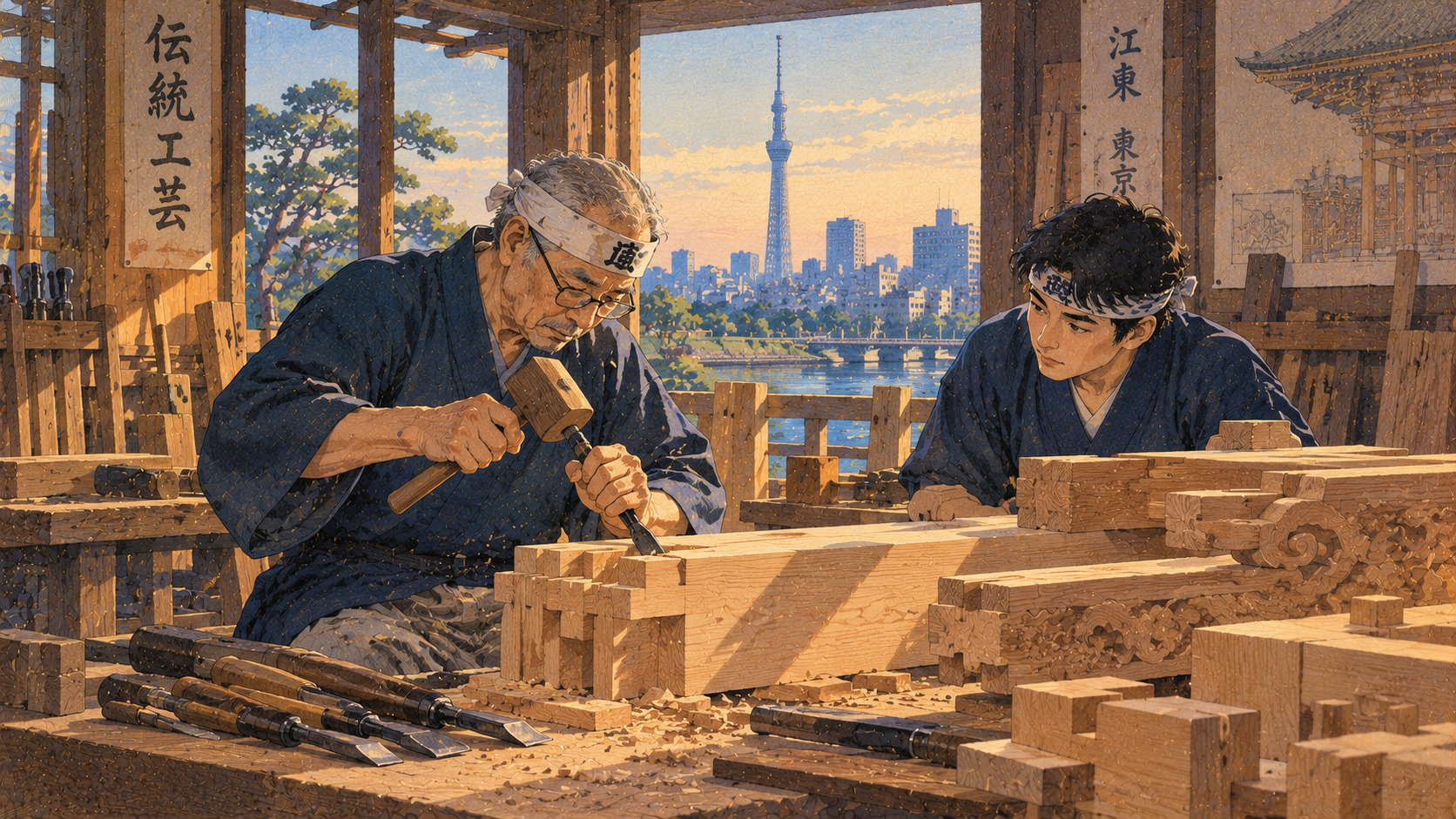
A perfectly fitted door calls no attention to itself. That invisibility is the achievement of skilled judgment.
A Door That Fits Is an Achievement
The most sophisticated object in a Japanese room may be the one its occupants barely notice: a wooden sliding panel that moves smoothly, holds its alignment and quietly survives seasonal changes in humidity. At Tokyo’s Fukagawa Edo Museum, a new exhibition asks visitors to consider the skills behind that everyday precision.
The 45th Koto Ward Traditional Crafts Exhibition runs from October 30 through November 3, 2026. This year’s featured craft is tategu, the making of fitted architectural elements such as doors and screens. The ward names artisan Saburō Tomokuni in its official program. The event includes demonstrations, displays, selected hands-on activities and craft sales.
The Difference Between Furniture and Fittings
Tategu should not be reduced to the English word “carpentry.” It concerns the components fitted into a building’s openings—doors, shoji screens and related interior elements—whose performance depends on joinery, careful measurement and the behavior of wood. Edo sashimono, the closely related tradition of fitted furniture and smaller wooden objects, serves a different purpose.
Tokyo’s industrial authority explains that Edo sashimono became especially associated with the needs of samurai households, merchants and Kabuki performers. Many pieces rely on expertly cut wooden joints rather than nails. A finely finished box or cabinet and a well-fitted door share respect for material and tolerances, but their requirements are not identical.
Why Wood Resists Simple Rules
Wood is not an inert industrial material. Grain direction, moisture and the shape of a board affect how it can be cut and how its dimensions change. A fitting too tight in one season may bind in another; removing too much material cannot always be undone. The craftsperson works with allowances and minute adjustments that are difficult to appreciate in a finished building.
A demonstration makes such judgment visible. Yet the official schedule does not establish which exact joint or tool every participant will use on every day, and Japan.co.jp has not interviewed the featured artisans. A visitor should approach the exhibition as a chance to observe craft rather than as proof of a particular technique performed.
A District Built on Water and Timber
Koto’s craft identity is inseparable from the history of Fukagawa and Kiba. As Edo grew into an enormous city, timber flowed through merchants, canals and riverside yards. The Tokyo Timber Wholesalers Cooperative traces the development of Kiba to the organization and relocation of timber businesses in response to the expanding metropolis and destructive fires.
That story is more than picturesque nostalgia. Timber had to be brought into the city, sorted, stored, measured and delivered before a carpenter could turn it into a building component. Koto’s workrooms belonged to a far larger urban supply chain. A nineteenth-century shop and today’s specialist workshop cannot be treated as identical, but both reflect the dependence of city life on materials and skilled labor.
The Work Songs of Kiba
Koto Ward preserves the history of Kiba no kiyari, calls and work songs once used by timber handlers known as kawanami to coordinate labor. The precise origin of the tradition is uncertain, as the ward itself notes. This was a human response to moving heavy wood with teamwork, timing and experience.
The song and the craft exhibition illuminate different parts of the same history. One concerns moving the wood, the other shaping it. Together they complicate the idea that traditional craft is simply an art object removed from working life.
A Specific Form of Cultural Recognition
The demonstrators are described by the municipality as holders of Koto Ward intangible cultural properties in craft techniques. This local recognition matters, but it is not the same designation as Japan’s national Important Intangible Cultural Properties or the individual holders popularly called Living National Treasures.
The ward’s official registry covers woodworking alongside cut glass, sword polishing, mounting, dyeing and other skills. A register documents recognition; it is not, by itself, a census of active apprentices, a financial assessment of workshops or evidence that succession has been secured.
What Visitors Can See
Koto’s published schedule divides demonstrations and experiences into a morning session, 10 a.m. to 12:30 p.m., and an afternoon session, 1:30 to 4 p.m. Some hands-on opportunities require payment, and visitors apply directly to the artisans at the venue. Materials may run out. The Koto Ward Traditional Crafts Preservation Association also holds sales during the exhibition.
The ward bulletin names Saburō Tomokuni for the featured fittings exhibition and lists other artisans, including Kazuhiko Yamada for tea-ceremony sashimono, in its program. Demonstrators vary by day, so the schedule should be consulted rather than assuming every trade is represented at every session.
The Longer History of Edo Woodwork
Specialist fitted woodworking developed over many centuries as elite households, warriors and tea practitioners commissioned sophisticated objects. In Edo, the demands of powerful households, merchants and theater culture encouraged styles that often prized the natural grain of mulberry, zelkova or paulownia rather than lavish surface ornament.
The Tokyo Metropolitan Government describes Edo sashimono as using little or no metal fastenings and requiring careful knowledge of joints and materials. Those descriptions speak to one tradition; they should not be applied indiscriminately to all Japanese woodworking or all historic fittings.
Preservation Is More Than Display
A crafts exhibition can preserve attention, encourage purchases and reveal how a skilled hand makes decisions. It does not automatically solve the economic problem of sustaining a workshop. The cost of labor, the demand for custom interiors, training time and the availability of suitable materials may all matter, although this exhibition announcement supplies no figures with which to measure them.
The essential question is whether customers will continue to commission objects that can be fitted, maintained and repaired. It is tempting to present hand-made woodwork as inherently greener than manufactured alternatives; without a product-by-product environmental comparison, that remains an argument to investigate, not a proven result.
Beyond the Nostalgia of Old Tokyo
Koto’s wider register includes Edo kiriko cut-glass techniques, mounting, sword polishing, textile dyeing and other practices. Its waterfront history and workroom culture make the ward an unusually concentrated place to explore the interaction between heritage and making. But the label “traditional” can obscure adaptation: materials, commissions and customers have changed over time.
For an international reader, the show offers a more concrete view of Japanese design than the shorthand of minimalism. Restraint may be an aesthetic preference, but a well-made object also embodies the practical decisions that allow it to work.
Visiting the Exhibition
The exhibition is at the Fukagawa Edo Museum, basement first-floor recreation hall, 1-3-28 Shirakawa, Koto Ward, Tokyo. It is open 10 a.m.–4 p.m. daily from October 30 through November 3, with free admission to the craft exhibition. Separate entry arrangements or fees may apply to the museum’s other displays.
For readers arriving on November 2, the program still has two dates remaining, including the final day. The exact demonstration roster should be checked against the ward bulletin. The venue directs participants to approach artisans on site for experiences, subject to fees and available materials.
What Must Survive
The exhibition’s appeal is not that Tokyo has preserved a frozen version of the Edo period. It is that the reasoning behind good work—reading a material, correcting a fit, accepting no shortcut—can still be demonstrated in public. A carpenter’s adjustment might be nearly invisible to the final user, which is precisely why it deserves attention.
There are limits to what can be concluded before field reporting. Attendance, sales, apprentice numbers and the financial position of participating workshops have not been independently established. Interviews with artisans and customers would reveal whether these recognized skills are finding sustainable places in tomorrow’s homes. For now, the exhibition gives visitors a rare chance to see the intelligence of a working hand.
Sources and verification
Based on official Koto Ward and Tokyo Metropolitan Government publications and historical material from the timber trade. No on-site interviews or attendance estimates are claimed.