- A painter of tradition in an age of change
- Born in Tatebayashi, but not yet in Gunma
- What Nanga offered Japan
- Suiun and the new exhibition system
- The remarkable rain in Gentle Spring Rain
- Gallery I: Emerald Mountain Landscape
- Gallery II: The Solitary Boat
- Gallery III: Peacock and Flowers
- What the three images can—and cannot—prove
- A public career: organizations, teaching and recognition
- Where to find documented works today
- Why Suiun belongs in Gunma’s 2026 special edition
A painter of tradition in an age of change
Green mountains swell out of mist. A quiet boat appears to suspend time. A peacock raises its head beside a flowering branch. These images invite a particular way of looking—one in which color, brushwork and untouched space share the work of storytelling. They are a useful starting point for a closer encounter with Komuro Suiun (1874–1945), a major figure in the modern Japanese Nanga tradition.
The historical story is more complicated than the familiar label “defender of tradition.” In the rapidly changing art world of Meiji, Taishō and early Shōwa Japan, Suiun argued for the continuing relevance of literati painting while using modern exhibitions and institutions to make his case. This feature pairs documented art history with a cautious visual reading of three reader-supplied images whose precise identity has not yet been established.
Born in Tatebayashi, but not yet in Gunma
Suiun was born in 1874 in Tatebayashi, a town that was administratively part of Tochigi Prefecture at the time and is now in Gunma. His birth name was Teijirō. His father was both a kimono merchant and an amateur painter, placing the young artist within a milieu where making images and appreciating classical culture could coexist with commerce.
Museum biographies connect his training to Aoki Suizan in Numata and Tazaki Sōun in Ashikaga. Accounts differ in the exact sequence of instruction, so the essential point is the network of regional artistic mentorship rather than a tidy tale of a single master. Receiving the professional name Suiun marked his entry into the lineage of Nanga practice.
What Nanga offered Japan
Nanga, sometimes called bunjinga or Japanese literati painting, developed in dialogue with Chinese scholarly painting. The painter was not merely expected to reproduce what the eye saw: poetry, calligraphy, memory, travel and temperament could enter a scene through the handling of a brush. Mountains and waters—sansui—were particularly suited to this world of cultivated imagination.
Japanese practitioners including Ike no Taiga, Yosa Buson and Uragami Gyokudō transformed the tradition during the Edo period. Under Meiji reform, however, new institutions and Western-derived ideas of observation and composition challenged older styles. The category of Nanga became contested: was its historical grammar a resource for new art, or a sign of a form that had lost vitality?
Suiun and the new exhibition system
After moving to Tokyo in the late 1890s, Suiun studied Chinese painting and established a private school in 1903. He challenged the organization of the first national Ministry of Education art exhibition in 1907, then became a participant in the exhibition world and its judging structures. It was a career of criticism from within a changing system, not permanent isolation from it.
In 1921 he helped establish the original Japan Nanga Institute, providing artists with a forum for exhibiting and sustaining their tradition. He became a member of the Imperial Art Academy in 1924 and an Imperial Household Artist in 1944. These dates locate his professional importance, but institutional prestige is only one way to judge the work itself.
The remarkable rain in Gentle Spring Rain
One securely catalogued work shows why Suiun cannot be reduced to formula. Gentle Spring Rain (Shun’u Shōshō), painted in 1920, is a pair of six-panel colored-silk screens held by the Gunma Museum of Modern Art. A literary traveler on a donkey crosses a bridge beneath willow branches, with fine rain and water lending the scene unusual immediacy.
The museum emphasizes the composition’s clear coloration, relatively shallow pictorial space and observed effects of rain. It sees a painter absorbing realist possibilities while remaining within Nanga’s poetic frame. That coexistence of convention and inquiry makes the documented work a more revealing guide to Suiun than the word “conservative” alone.
Gunma Museum of Modern Art object catalogue
Gallery I: Emerald Mountain Landscape
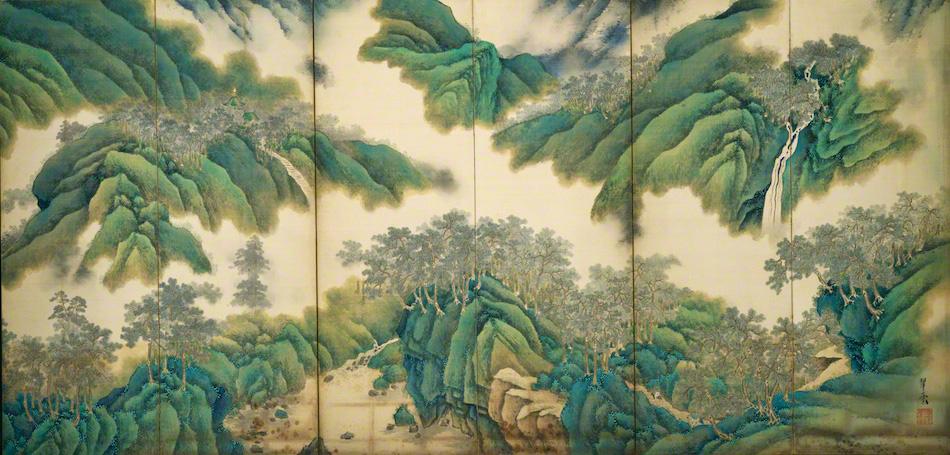
The first supplied image shows an expansive, vertically divided folding-screen-like composition. Its densely layered blue-green ridges are separated by pale passages of mist, with wooded cliffs and a thin waterfall toward the right. The eye moves from the closer rocks into increasingly distant terrain, even as the screen’s divisions interrupt a single photographic viewpoint.
That language of green mountains and atmospheric transitions is compatible with documented Suiun landscapes, including Summer and Winter Landscapes (1923), catalogued by the Gunma Prefectural Tatebayashi Museum of Art. Compatibility is not identification: the supplied image is not confirmed as that museum object or as any other recorded Suiun painting. “Emerald Mountain Landscape” is a descriptive editorial title, not an authenticated title.
Gallery II: The Solitary Boat
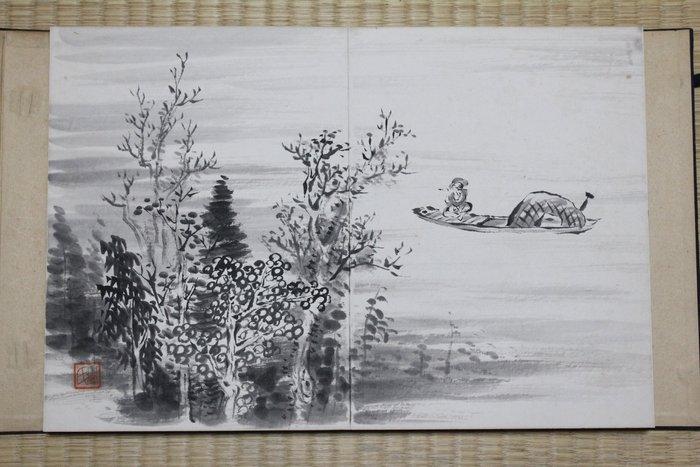
The second image is almost the inverse of the first. A stand of ink-dark trees occupies one bank, while a small craft with a figure and covered cargo seems to move across a wide field of unpainted water. The asymmetry works through restraint: darkness and detail gather in one area so that the emptiness can feel like distance, silence and slow motion.
Boats in the literati landscape tradition may suggest travel, withdrawal from public life or an encounter with nature. None of those readings establishes the subject of this particular image. Suiun’s documented Spring View with Blue Green Paint (1922) also includes a boat, but is a separate catalogued composition. We have not verified the supplied image’s inscription, date, materials, ownership or attribution.
Gallery III: Peacock and Flowers
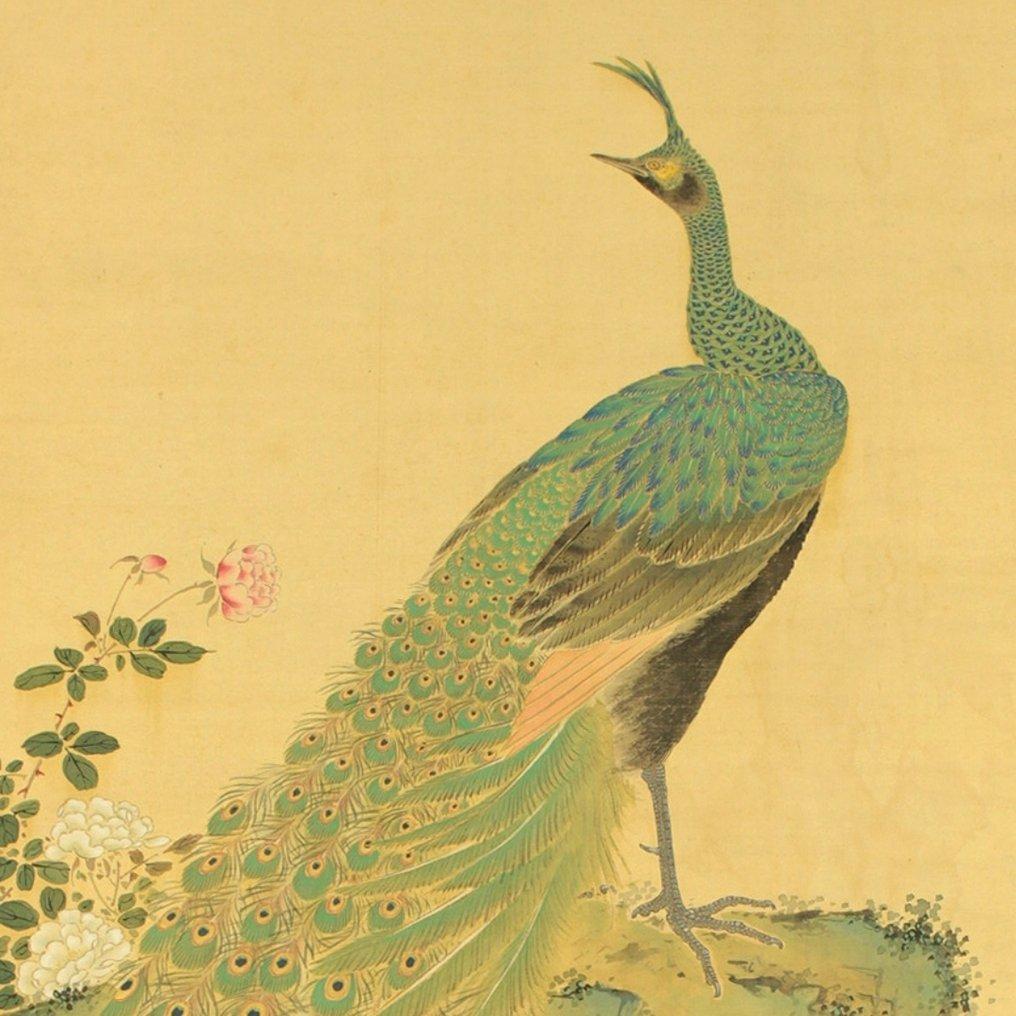
The third image centers on a green peacock, its elongated tail occupying a generous diagonal across yellow-toned ground. A flowering branch supplies a modest accent; detailed feather markings contrast with expansive unoccupied space. The bird is both a subject of natural observation and a vehicle for decorative rhythm.
Suiun’s documented output includes paintings of flowers and birds, and a National Diet Library reference record mentions a local publication reproducing an image called Peacock. But that entry is insufficient to identify this particular picture. The nearby blossoms appear rose-like; their species and the painting’s formal title remain uncertain. For now “Emerald Peacock and Roses” describes what the reader can see, not a confirmed museum attribution.
What the three images can—and cannot—prove
As a visual sequence, the proposed selection is compelling: panoramic mineral color, ink economy and closely observed feathers reveal three different possibilities within the larger Nanga and Japanese painting vocabulary. An informed viewer can compare the balance of washes, lines and negative space without pretending that the images have complete curatorial records.
Artwork authentication needs more than a resemblance in style or a visible red seal. Inscription photography, provenance, medium, dimensions, exhibition history, ownership and catalogue references are required. Until those are available, the three supplied pictures should be displayed as reader-provided images with attribution and original titles unverified—not promoted as three securely documented Suiun masterpieces.
A public career: organizations, teaching and recognition
Suiun’s importance extended beyond individual screens and scrolls. He helped form associations, taught students and worked to broaden audiences for Nanga through meetings, publications and appreciation activities. These were modern mechanisms for sustaining a tradition whose prestige had become uncertain.
The Imperial Household Artist designation in 1944 reflected official recognition near the end of his life. He died in Tokyo in 1945. Accounts of his wartime organizational involvement also belong to a difficult historical context, including transnational cultural institutions shaped by Japan’s imperial ambitions; they require attention rather than uncomplicated celebration.
Where to find documented works today
The Gunma Prefectural Tatebayashi Museum of Art catalogues Summer and Winter Landscapes (1923), Chōkō Mountain Retreat (1929) and Pine and Plum-blossom Birds (1930). The Gunma Museum of Modern Art holds Gentle Spring Rain and mounted a 150th-birth-anniversary collection display in 2024. Tokyo Fuji Art Museum also provides a catalogue entry for a large six-panel landscape screen.
These resources are an excellent place to begin because the museum records provide medium, dates and object-level descriptions—precisely the information missing from the three reader-submitted pictures. A genuine encounter with Suiun moves back and forth between seeing and checking.
Tatebayashi Museum of Art collection records
Why Suiun belongs in Gunma’s 2026 special edition
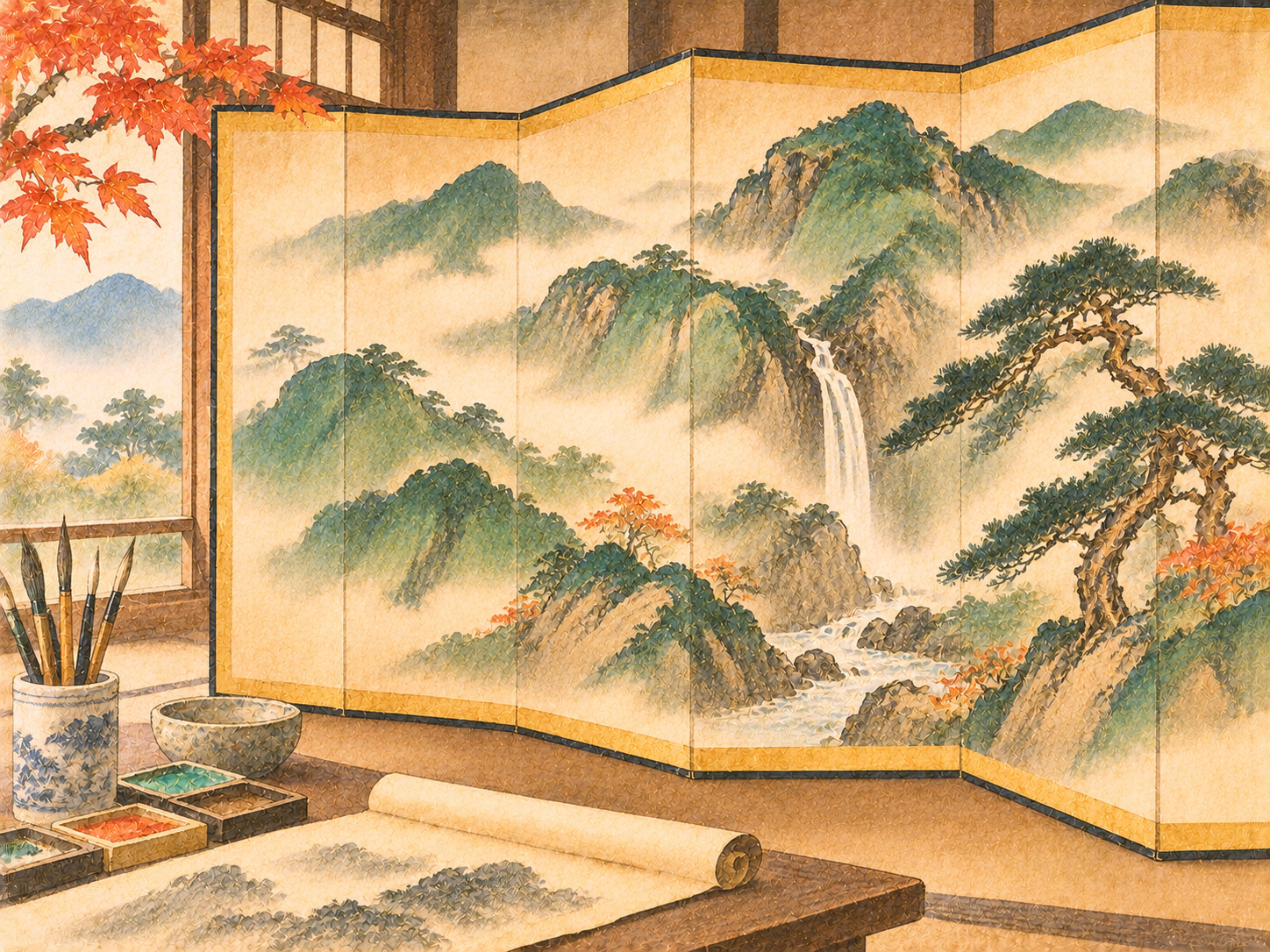
For JAPAN.co.jp’s Gunma edition, Suiun serves as a link between place, visual history and the questions facing contemporary publishing. The edition’s new AI-generated illustrations borrow broad Nanga conventions of layered mountains, carefully placed detail and open space. They are original editorial images, not historical Suiun paintings, reconstructions or evidence of past events.
Suiun helped carry a seemingly vulnerable tradition into new exhibition venues. The parallel for a modern newsroom is not to claim continuity of authorship, but to insist on clear distinctions: documented originals, reader-supplied pictures awaiting verification and contemporary visual interpretation. The more carefully those lines are maintained, the more rewarding his work becomes.
Museum records and image provenance
Publication permissions for the three images must be checked separately. An artist’s death date does not automatically settle rights in modern photographs or museum image licensing.