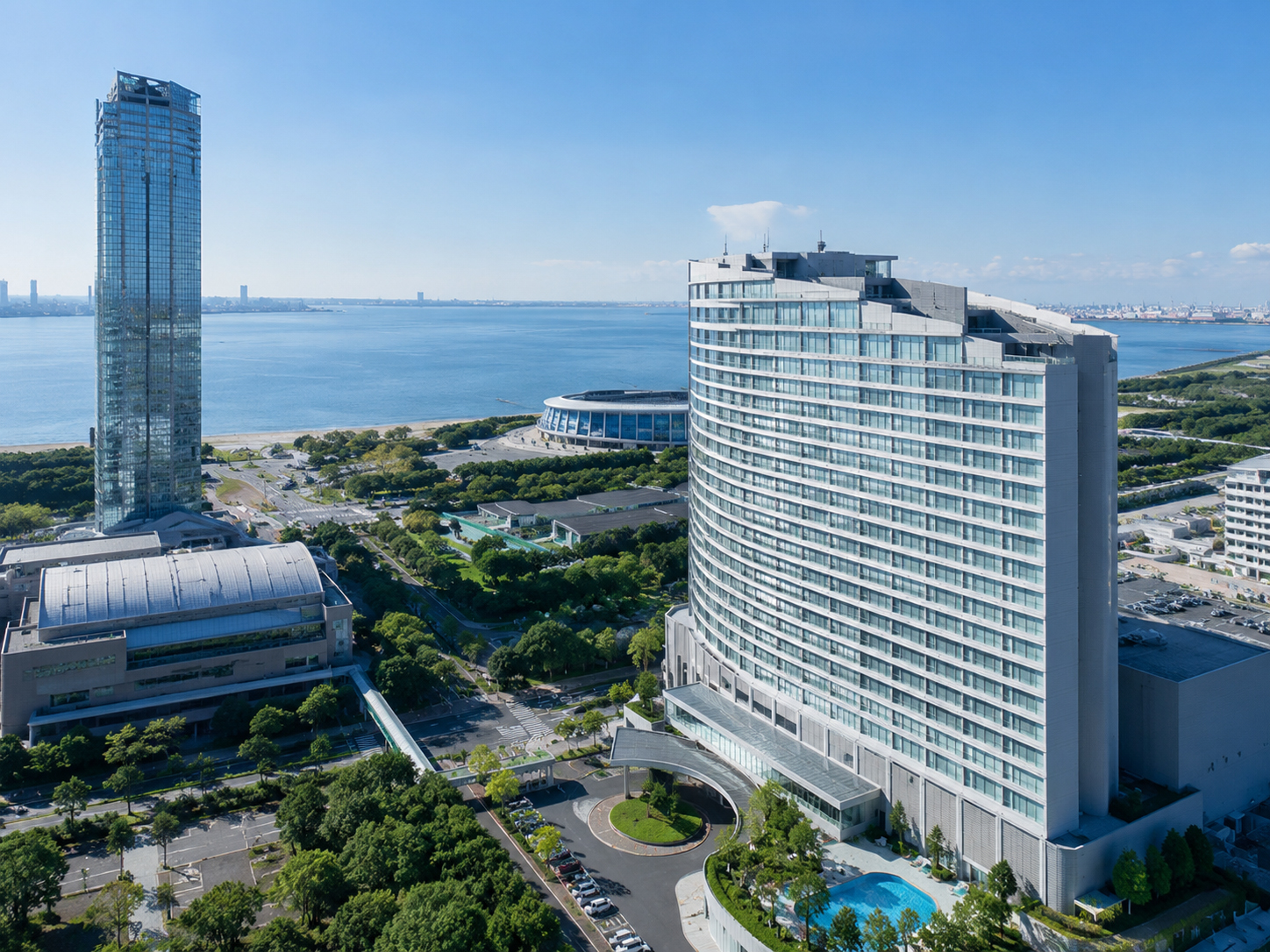
Makuhari has always felt slightly futuristic. It is Tokyo Bay air, broad sidewalks, glass offices, convention crowds, concert fans, business travelers rolling suitcases, and baseball noise drifting across a planned waterfront city. It is not central Tokyo. But it has long absorbed Tokyo’s energy from a different angle. On June 18, 2026, that bay-area story gained a new stay point: KOKO HOTEL Premier Tokyo Bay Makuhari.
The news is a hotel opening. The story is a city coming of age.
Polaris Holdings announced that KOKO HOTEL Premier Tokyo Bay Makuhari opened on June 18, 2026. The company describes the property as a new bay-area base for visitors coming to Makuhari for events, business and sightseeing, located three minutes from the south exit of JR Keiyo Line’s Kaihimmakuhari Station and one minute from the station’s park-gate south exit.
The official hotel site gives the more practical traveler’s version: the hotel is one minute from Kaihimmakuhari Station, in a lively bay area where Makuhari Messe and major commercial facilities gather. It offers more than 300 rooms, a comfortable lounge and a large public bath. That matters because this is not simply another station hotel. It is a sign that Makuhari has continued to evolve from a place people visit for events into a place where people stay, recover, work, shop and begin again the next morning.
Why Makuhari needs hotels
Makuhari is close enough for a day trip. From Tokyo Station, the Keiyo Line can carry visitors to exhibitions, concerts and baseball without making them stay overnight. That is exactly why hotel value emerges. Big trade shows begin early. Concerts end late. International conferences last multiple days. Family trips combine shopping, parks, Tokyo Disney Resort, Chiba sightseeing and airport logistics. A hotel beside the station is not just a bed. It buys time.
There are days when a basic business hotel is not enough. Exhibitors need to move before dawn. Fans arrive with merchandise, costumes and expectations. Families need a predictable route back after a long day. International visitors need a place that makes the map feel smaller. A lounge, a public bath, and a location that can be found even after a late event become part of the travel product. That is the gap KOKO HOTEL Premier is positioned to serve in Makuhari.
The heart is Makuhari Messe
No modern history of Makuhari can avoid Makuhari Messe. According to the convention center’s corporate profile, the facility opened on October 9, 1989 with International Exhibition Halls 1–8, the International Conference Hall and Makuhari Event Hall; new exhibition halls 9–11 opened on October 1, 1997. Born at the beginning of the Heisei era, Makuhari Messe became one of the stages on which Japan’s exhibition culture, game culture, auto culture, music-event culture and business-conference culture grew up.
Makuhari Messe is powerful not only because it is large, but because it can absorb different kinds of gatherings inside one urban district. Tokyo Game Show, Tokyo Auto Salon, Jump Festa, technology exhibitions, academic conferences, corporate events, concerts and fan festivals bring different clothes, different schedules and different moods. Makuhari’s wide station-front streets and planned blocks were built to handle that variation.
A future city built from Tokyo Bay
Makuhari New City did not grow like an old merchant district. It was planned. Chiba City’s overview traces the story to the immediate postwar period: in 1945, the government decided to reclaim part of the Makuhari waterfront as an emergency development project to increase food production. The purpose later changed to land creation for small and medium-size factories, and 60 hectares were completed in 1964. In 1967, the Kaihin New Town plan was announced; in 1973, reclamation work for the Makuhari district began.
Later, Makuhari was reimagined not as a simple housing district or industrial tract, but as a mixed city of work, residence, learning and leisure. Chiba Prefecture described Makuhari New City as an effort to integrate business and research functions, education, commerce, residential life, culture and recreation on land reclaimed off Chiba City’s Makuhari coast. Hotels are not a minor accessory to that concept. They are the practical connective tissue between work, play, study and movement.
The meaning of “Premier” in Makuhari
“Premier” does not have to mean excessive luxury. In Makuhari, the premium is polished convenience. The hotel is near the station, near the event district, near major retail, near the bay, and still within reach of central Tokyo and airports. It offers city function without erasing seaside openness. That is the particular attraction of a Makuhari hotel: metropolitan access with a broader sky.
The lounge and public bath described by the official site say a lot about the property’s character. The stay is not meant to end at the guestroom door. Guests can work, meet, read, plan, talk after an event, and soak away the fatigue of a long day on their feet. In Japan, a large public bath inside an urban hotel is not just an amenity. It is a rhythm-maker.
Hotels in the event era become editors of the city
Modern travel is not driven only by famous sightseeing spots. People travel for concerts, exhibitions, games, fan events, children’s competitions, corporate booths, weekend escapes and short family itineraries. Purposes have multiplied. Stays have shortened. Hotels are now asked to do more than provide rooms; they must organize a city around the traveler’s schedule.
In that sense, KOKO HOTEL Premier Tokyo Bay Makuhari is an editor of Makuhari. Makuhari Messe, the station, shopping centers, seaside parks, ZOZO Marine Stadium, Tokyo Disney Resort, central Chiba and the route toward Narita all look separate on a map. A good hotel turns those dots into a usable overnight plan. It makes the map smaller.
Choosing Tokyo Bay, not just Tokyo
From overseas, Makuhari may look like part of Tokyo. In practice, it moves at a different pace. There is water, sky, wider streets, and large-scale facilities. Where central Tokyo hotels often stack density vertically, Makuhari hotels serve a more horizontal city: one built for movement between stations, halls, malls, parks and the waterfront.
That difference changes the mood of a trip. Instead of the night view of central Tokyo, guests see Tokyo Bay light. Instead of narrow backstreets, they walk broad event boulevards after a concert. Instead of treating the hotel only as a sleep stop, they can use it as a bay-area base. KOKO HOTEL Premier Tokyo Bay Makuhari makes “staying on Tokyo Bay” easier to understand.
Makuhari as a hotel investment
Polaris Holdings’ lease material lists June 18, 2026 as the commencement of operations and describes a 20-year lease term for the property. A long operating horizon suggests confidence that demand is not merely temporary. Makuhari’s hotel demand is not just tourism, not just business, and not just events. It is the layering of all three, plus sports, shopping and family travel.
That layering matters in hospitality. A hotel must smooth the peaks and valleys between weekdays and weekends, event days and quiet days, domestic guests and overseas visitors. Makuhari has companies, schools, retail, stadiums, exhibitions, concerts and leisure trips. When one demand stream is soft, another may still be moving. The opening is therefore also a bet on Makuhari’s diversified urban demand.
How travelers can use it
| Trip purpose | Why this hotel fits |
|---|---|
| Makuhari Messe trade shows | Station and event access reduce morning stress. |
| Concerts and fan events | A shorter late-night route back keeps the experience relaxed. |
| Business travel | Lounge space, public bath and station proximity suit short stays. |
| Family trips | The hotel pairs well with shopping, parks and bay-area leisure. |
| Tokyo Bay short breaks | It offers openness without giving up metropolitan access. |
The quiet way hotels change cities
Hotels do not usually transform a city with noise. They add lights near the station. They keep people in town after events. They put travelers in cafés the next morning. They bring conference badges into lobbies and shopping bags into elevators. When overnight stays increase, restaurants, transport, retail and local attractions all feel the effect. If Makuhari is becoming more of a stay city, hotels are its quiet infrastructure.
Makuhari has the ingredients: planned blocks, Tokyo Bay air, Makuhari Messe as a heart, Kaihimmakuhari Station as a front door, and the dual identity of city and waterfront. KOKO HOTEL Premier Tokyo Bay Makuhari rearranges those ingredients for today’s traveler.
Conclusion: where discovery begins
KOKO HOTELS uses the phrase “Here Discovery Begins.” Few places suit that line better than Makuhari. This is a district that reclaimed land from the sea to imagine a future; a district that used conventions, concerts and sports to draw people; a district that has kept testing a different version of Tokyo-area travel outside central Tokyo. Now it has another reason to stay.
A hotel opening can sound small if reduced to room counts and dates. But a good hotel can change how a city is read. KOKO HOTEL Premier Tokyo Bay Makuhari nudges Makuhari from a place to go and return from into a place to stay and discover. On this edge of Tokyo Bay, the trip gains a little more room to breathe.
Sources and references
This article draws on public materials from Polaris Holdings, KOKO HOTELS, Makuhari Messe, Chiba City and Chiba Prefecture. Rates, operating details and event schedules can change; check official sites before planning travel.
- PR TIMES / Polaris Holdings: June 18, 2026 grand opening announcement for KOKO HOTEL Premier Tokyo Bay Makuhari.
- KOKO HOTELS official site: Location, room scale, lounge, public bath and basic hotel information.
- Makuhari Messe corporate profile: Facility opening in 1989 and expansion in 1997.
- Chiba City: Overview and reclamation history of Makuhari New City.
- Polaris Holdings lease announcement: Operation commencement and lease disclosure.