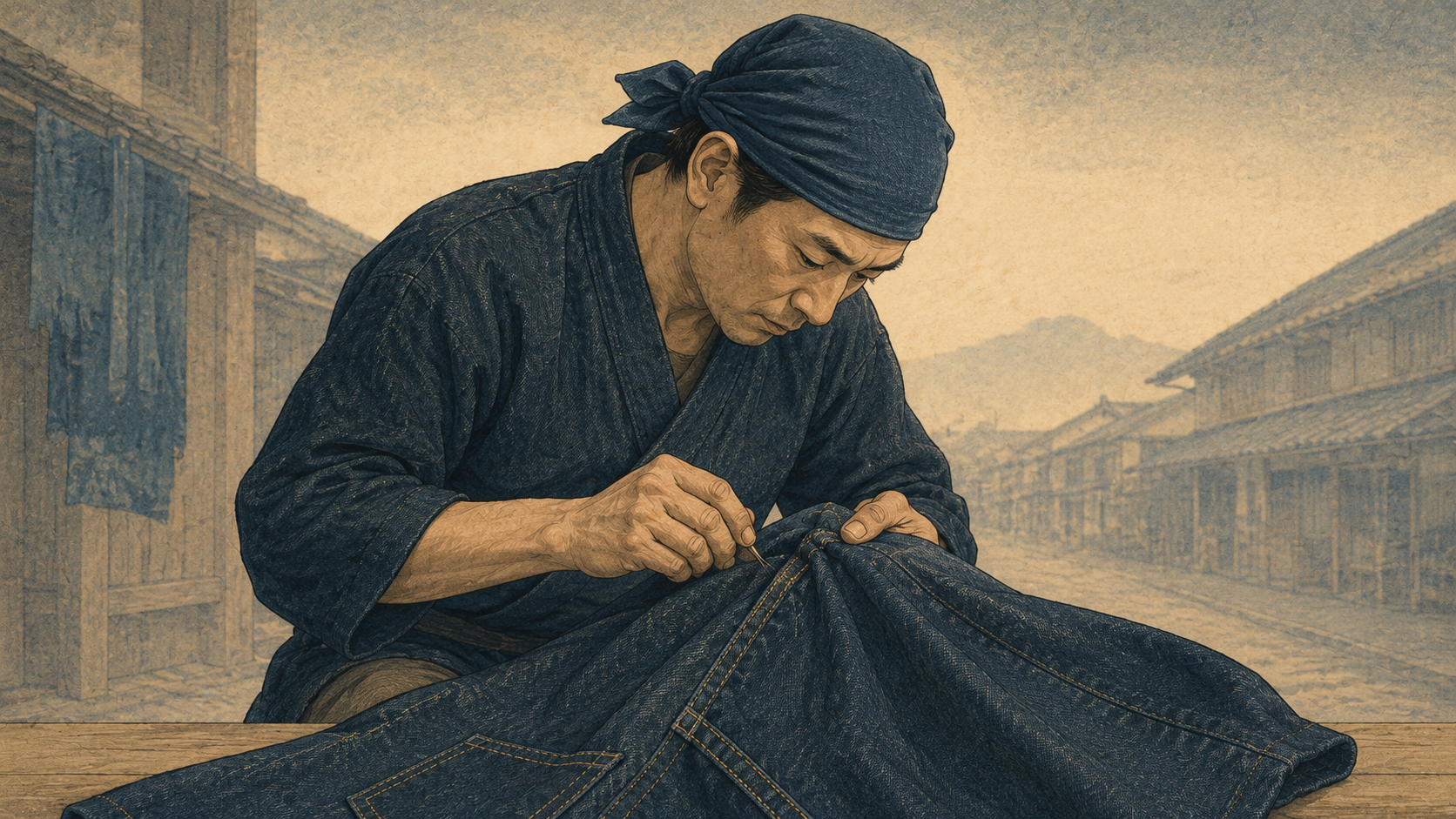
Step out of Kojima Station in Kurashiki, Okayama, and the first landmark is not a castle, a shrine or a famous garden. It is jeans. Denim wraps vending machines. Real pairs of blue jeans hang over the street like flags. Shop signs, stitching colors and indigo details turn an ordinary shopping district into a place that has given itself over to one idea: the American work pant that Japan learned to make with almost devotional precision.
Kojima Jeans Street is a roughly 400-meter walk in the Kojima Ajino district of Kurashiki, running around the old Nozaki family residence and nearby commercial streets. Okayama’s official tourism organization describes it as a sacred place for domestically produced jeans, lined with local makers and visited by travelers from overseas. The Japan National Tourism Organization introduces it as a quirky denim district with around 30 shops, blue decorations and even denim-themed snacks.
But the deeper story is not only that Kojima sells jeans. The deeper story is that Kojima made a destination out of an industrial memory. Before premium denim, the district made school uniforms, workwear, tatami edging, heavy cloth and practical clothing. It had sewing machines, dyeing know-how, wash houses, inspection skills and people used to making tough fabric behave. Japanese denim did not appear from nowhere. It grew out of a town that already knew how to work with cloth.
A textile town before it was a denim town
To understand Kojima, you have to start before jeans. This part of Okayama faces the Seto Inland Sea, where reclaimed land, salt fields, cotton, weaving and sewing shaped local work. The district was not simply rural and not quite urban. It was a maritime industrial community, tied to practical cloth and the demands of everyday life.
After World War II, Kojima became known for school uniforms and workwear. That background mattered. Heavy fabric is not easy to cut, stitch, shrink, wash or finish. The skills needed to make durable uniforms and work clothes became the foundation for a new postwar product: jeans. When American culture arrived as an aspiration, Kojima already had the hands capable of turning that aspiration into a garment.
1965 and the birth of Japan-made jeans
No history of Kojima denim can ignore Big John. Its roots go back to Kotaro Ozaki’s postwar sewing business, which made school uniforms, work clothes and military-style pants before moving toward jeans. In 1965, Kojima became associated with the birth of domestically made Japanese jeans, a turning point that gave the town a new identity.
At first, Japanese makers relied on imported denim fabric, but the ambition grew: make the whole thing in Japan, from fabric to sewing to finishing. That effort eventually produced the idea of “Japan denim,” not simply as a copy of an American garment, but as a Japanese interpretation of it. Consumers saw jeans as youth culture and freedom. Kojima’s makers saw a more concrete puzzle: shrinkage, seams, rivets, indigo, durability, fit and fading.
When an American garment became Japanese craft
Jeans began as workwear in the American West and became a global symbol of casual life. In Japan, their meaning changed again. They became something to study. Selvedge edges, deep indigo, old shuttle looms, chain stitching, hidden rivets, unsanforized shrink, wash recipes and the slow drama of fading turned jeans into a collector’s object.
The Associated Press has described Kojima as home to about 40 denim manufacturers and stores, drawing around 100,000 visitors a year. Some jeans cost tens of thousands of yen, while special pieces can climb far higher. Yet the price is part of the point. Visitors are not just buying pants. They are visiting the place where the pants make sense. They are buying a story they can wear for years.
The street as an act of editing
Kojima Jeans Street did not become a destination by accident. It is an edited landscape: an old shopping street, local manufacturers, direct-to-consumer brands, denim decorations, cafes, souvenirs and civic pride arranged around one powerful theme. A destination needs a reason to walk. Kojima made that reason blue.
Each shop offers a slightly different version of the story. Some are purist and technical. Some lean into workwear. Some appeal to global denim fans. Others make the street easier for families and casual travelers. The jeans overhead, the blue vending machines and the denim-colored soft serve may look playful, but they serve an important function: they make an industrial district photographable, memorable and legible to visitors who may not know the first thing about shuttle looms.
Kurashiki beyond the white walls
For many travelers, Kurashiki means the Bikan Historical Quarter: white-walled storehouses, willow trees, the Kurashiki River and the Ohara Museum of Art. Kojima adds a second face to the city. It is less polished, more industrial and closer to the Seto Inland Sea. That contrast is the appeal. Kurashiki is not only a place to look at old merchant culture. It is also a place to see how things are made.
For international travelers, Kojima offers a quieter but powerful kind of Japan. Not temples, skyscrapers or theme parks, but workshops, small shops, railway stations, dye stains and conversations about fabric. Some of Japan’s strongest cultural exports come from this scale: precise, local, hands-on and slightly obsessive.
Manufacturing becomes tourism
Across Japan, local industries are trying to turn production into experience: knives, pottery, lacquer, paper, sake, soy sauce, furniture and textiles. Kojima’s advantage is that denim is already a global language. Everyone knows jeans. That makes it easier to invite visitors into the deeper layers: cotton, thread, dyeing, sewing, washing, repair and aging.
The lesson for regional Japan is clear. Do not hide the factory. Make the process visible. Do not abandon the old shopping street. Give it a theme. Do not simply say “buy this.” Explain why this place makes it differently. Kojima is a case study in how a niche industrial cluster can become a tourism brand for the age of specialty travel.
Slow clothing in an era of fast fashion
The global fashion industry is full of cheap, disposable clothing. Kojima denim moves in the opposite direction. It asks the wearer to break in the cloth, live with stiffness, watch the color fade, repair the garment and accept that age can be beauty. Long before sustainability became a marketing term, denim enthusiasts and makers were practicing a kind of slow clothing culture.
That does not mean Kojima denim is for everyone. It can be expensive. It can be stiff. It can require care. The street itself is not a glamorous fashion capital. It is a modest commercial district with deep expertise. But that modesty is part of the charm. Kojima is not a place to consume fashion quickly. It is a place to think about what a garment is worth when it is made to last.
How to read the trip
A good visit to Kojima should not be rushed. Walk from the station. Enter shops slowly. Try different fits. Ask about fabric, fading and repairs. If you are pairing Kojima with Kurashiki’s Bikan district, the contrast works beautifully: white walls and river in the morning, indigo workshops and denim shops in the afternoon.
Store hours, holidays, hemming services, tax-free shopping, card acceptance and shipping options vary from shop to shop. This is not a single managed attraction. It is a living commercial street. That means the best experience often comes from patience, curiosity and conversation.
Japan.co.jp’s view
Kojima Jeans Street shows where Japanese tourism is going. The future is not only mega-cities, famous shrines and bucket-list sights. It is also regional craft, industrial identity and places where visitors can understand why something is made there and not somewhere else.
What makes Kojima beautiful is that it did not erase its past. It took the unglamorous history of uniforms, work clothes, heavy stitching and practical fabric and translated it into a global language. Every pair of jeans hanging above the street is more than decoration. It is the town raising its own past into the sky.
Travel becomes richer when a place explains itself. In Kojima, the explanation is blue. An American garment came to Japan, passed through Okayama hands and became something travelers now cross oceans to find. That is not just a shopping story. It is a story about how a small manufacturing town learned to wear its history proudly.
| Theme | What it means |
|---|---|
| Place | Kojima is the seaside textile and sewing district of Kurashiki, Okayama. |
| History | School uniforms, workwear and heavy cloth production laid the foundation for denim. |
| Tourism | Jeans Street turns buying denim into walking through a manufacturing story. |
| Appeal | Deep indigo, selvedge, fading, repair and long-term wear give the product meaning. |
| Practical note | Check individual store hours and services before visiting. |
Sources and references
This article draws on public information from JNTO, Okayama Prefecture Tourism, The Japan Times, Associated Press and denim-specialty sources. Store details and opening hours can change; travelers should confirm current information before visiting.
- JNTO / Japan Travel: introduces Kojima Jeans Street as a district with around 30 denim shops and denim-themed decorations.
- Okayama Prefecture Tourism: describes Kojima Jeans Street, its approximate 400-meter walk and its identity as a sacred place for domestic jeans.
- Japan Travel Magazine: presents Kojima as a mecca for premium Japanese denim.
- The Japan Times: reports on Kojima denim tourism and the local production ecosystem in 2026.
- Associated Press: reports on Kojima’s manufacturers, annual visitors, monozukuri ethos, price ranges and international reputation.
- Heddels: summarizes the history of Big John and the birth of Japan-made jeans.