- A memorial that needs a funding model
- How the lights became part of Kobe’s identity
- Why the crowdfunding announcement is not a first
- What a ¥550,000 gift package actually contains
- The 2027 festival and its three public spaces
- The difficult balance between free access and paid entry
- Making the art costs money—and so does protecting the crowd
- What ¥15 million can—and cannot—prove
- Can the memory outlive the generation that witnessed it?
A memorial that needs a funding model
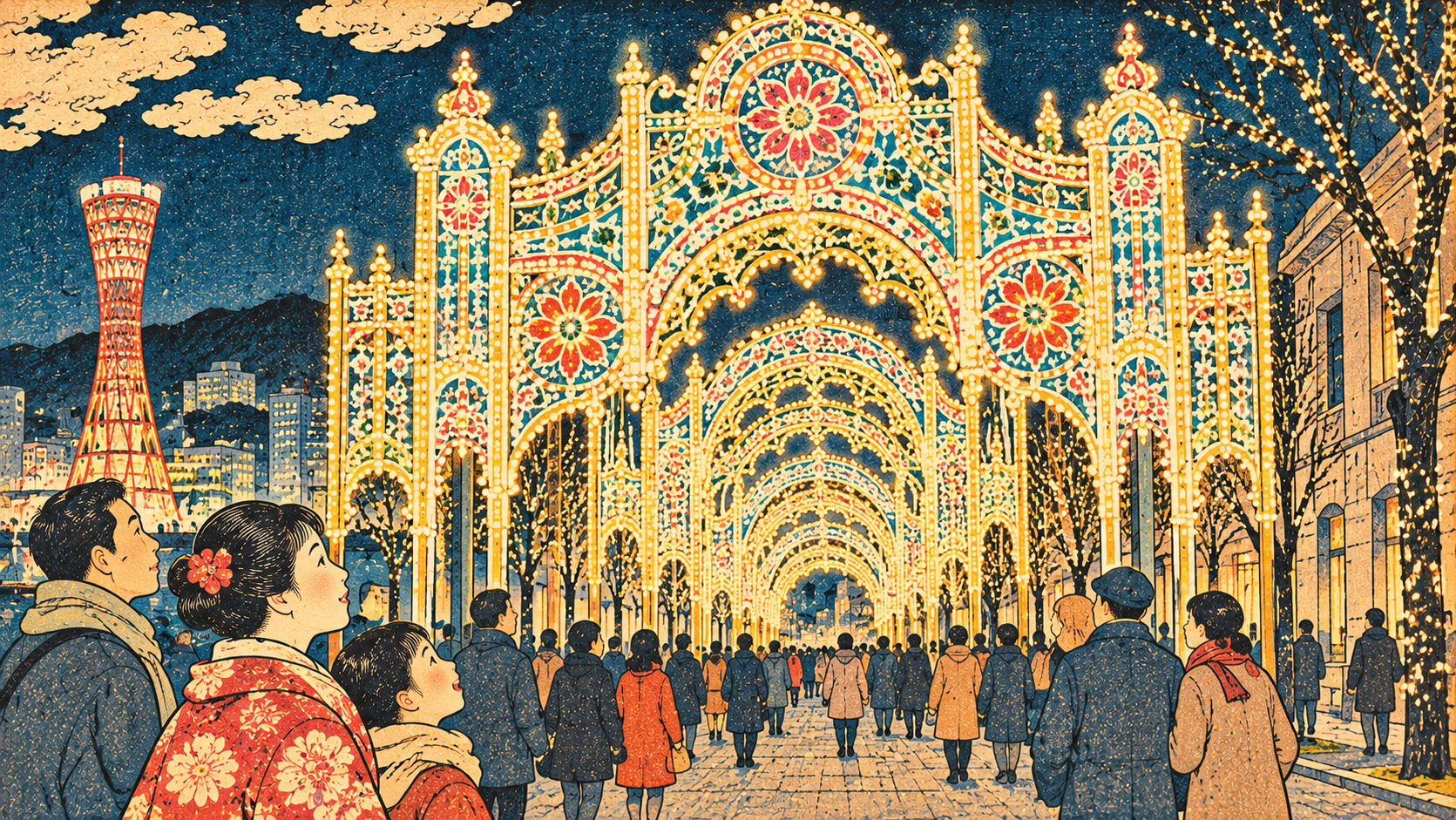
The illuminated arches of Kobe Luminarie are visually spectacular, but their origin is solemn. The festival began in December 1995, less than a year after the earthquake that devastated Kobe and surrounding communities. A work of light became a public space for mourning and for imagining a city rebuilt. Three decades later, the people who remember that catastrophe firsthand are passing those memories to younger generations.
On November 20, 2026, Kobe City and the Kobe Luminarie organizing committee announced a new round of government crowdfunding for the 32nd festival. The campaign actually opened on November 11, and the first specially designed Luminarie experience packages became available on November 16. The target is ¥15 million, with proceeds intended for artwork production and event security.
This is not the city’s first crowdfunding drive for Luminarie: an earlier campaign operated in late 2025. The innovation this time is a collection of original festival-specific thank-you experiences, including exclusive access and a premium hotel stay. What may look like a fundraising detail is part of a much larger question: how can a city protect a civic memorial without pretending that light, crowds and safety are free?
How the lights became part of Kobe’s identity
The Great Hanshin-Awaji Earthquake struck on January 17, 1995. Later that year, Kobe staged the first Luminarie as a tribute to those who died and an expression of recovery. The display gradually became one of the city’s most recognizable winter traditions, drawing residents and visitors into streets filled with large-scale illuminated structures.
Its role was always more complicated than tourism. Visitors gathered to remember absent family members, to recognize neighbors’ perseverance and to see something beautiful in a city still rebuilding. The art could travel through photographs, but the significance depended on a specific place and historical experience.
The original December format lasted for years. After pandemic disruptions prevented full-scale events from 2020 through 2022, Luminarie returned in January 2024. Organizers changed the calendar and spread installations across several sites rather than concentrating the experience in one crowded corridor. A paid area at Meriken Park formed part of a new attempt to make the event financially and operationally sustainable.
Why the crowdfunding announcement is not a first
The 2026 drive runs from November 11 to a planned February 8, 2027 close, on the Furusato Choice platform. It seeks ¥15 million for production and security. Government crowdfunding in Japan uses the furusato nozei hometown-tax donation framework, allowing eligible donors to support a named public initiative while potentially receiving tax deductions or credits under applicable rules.
Kobe had already used that approach in 2025. The city announced a target of ¥20 million for a campaign running from November 2025 into February 2026; in a December 15 update, it said donations had reached roughly 12% of target as of December 11. That was a mid-campaign snapshot—not an audited final result, and not a measurement of the current drive.
The genuinely new element in the latest press release is a set of return gifts made expressly for Luminarie. A policy distinction matters here: municipal residents and nonresident donors do not necessarily have identical eligibility for thank-you gifts, and a donor’s tax treatment depends on individual circumstances. This is a civic fundraising vehicle, not an ordinary ticketing company or a guaranteed investment return.
What a ¥550,000 gift package actually contains
The headline offer calls for a ¥550,000 donation. Kobe lists admission to the paid display, a guided behind-the-scenes daytime visit with artwork production director Daniel Monteverde, an overnight stay for two at Hotel Okura Kobe, breakfast and dinner, and ¥40,000 in local K-coupons. The hotel package specifies a high-floor south-facing room overlooking Luminarie and an in-room full-course dinner.
The price invites two readings. Supporters who want an unusual, immersive experience can help sustain an event they value. But premium rewards also raise an accounting question: how much of a large nominal donation remains available for the memorial after accommodations, hospitality, administration and any platform-related expenses have been covered?
The November release does not establish a net contribution per premium package. It would therefore be misleading to assume that ¥550,000 goes directly into artwork or security. Nor should the expensive option obscure the ordinary ways people can support or visit the festival. The featured package is a particular fundraising device within a much wider civic project.
The 2027 festival and its three public spaces
The 32nd Kobe Luminarie is scheduled for January 29–February 7, 2027, with displays at Meriken Park, Higashi Yuenchi and the former foreign settlement district. The overall theme is “A Thousand Harmonies Illuminating the Port,” a translation of 港に灯る、千のしらべ. Lighting is planned from dusk until 9:30 p.m., subject to change.
City materials describe Eternal Sunshine at Meriken Park, a Tower of Peace at Higashi Yuenchi, and a music-box-themed installation in the old settlement, connecting the artworks to remembrance and to the song “Shiawase Hakoberu Yō ni,” associated with Kobe’s post-disaster recovery. These are announced plans, not exhibitions already underway as of the November 23 edition.
Organizers are also encouraging people to explore other neighborhoods, including Motomachi, Nankinmachi and Harborland, through related lighting and visitor programs. That geographical spread matters: organizers hope the event can circulate people through the city while preserving a space for reflection at the installations themselves.
The difficult balance between free access and paid entry
Official visitor guidance says that Higashi Yuenchi and the former foreign settlement are free to enter, while the main installations at Meriken Park include a ticketed area. Published advance prices are ¥500 on weekdays and ¥750 on weekends, with same-day admission listed at ¥1,000 and ¥1,500 respectively. People planning a visit should check the latest conditions and available times before traveling.
Ticketing offers practical advantages: scheduled entry can manage queues, reduce dangerous concentrations of people and recover a portion of operating costs. It also creates an uncomfortable question. If a festival exists partly to honor the dead, what should remain accessible to everyone, regardless of ability to pay?
The current multi-site arrangement is one response, rather than a complete answer. Free spaces remain central to the event, while premium experiences and paid admission help sustain major installations. The test is whether the public purpose remains legible even as the funding mechanisms become more elaborate.
Making the art costs money—and so does protecting the crowd
Large illuminated structures demand substantial creative and technical work. Fabrication, transportation, assembly, electrical systems, maintenance, dismantling and the movement of crowds all require professionals. Kobe’s November 20 announcement expressly identifies production and security as uses of the new donations.
The organizer already draws on multiple sources of support. Kobe municipal records describe city and prefectural subsidies, corporate sponsorship, individual donations and a portion of lottery proceeds from sales at the venue. Crowdfunding is an additional component, not a replacement for the entire funding system.
For perspective, the Kobe Tourism Bureau’s reporting on the January 2025 event recorded approximately 2.448 million visitors, including around 149,300 in the paid area. These are reported attendance figures, not a profit-and-loss statement; it would be incorrect to infer event income simply by multiplying those totals by ticket prices. The crowd itself creates a significant safety obligation.
What ¥15 million can—and cannot—prove
A clear fundraising target provides a visible test of support, but it does not establish whether an annual festival is sustainably financed. To answer that, the public would need the total event budget, costs of creating and delivering reward packages, security spending, municipal funding, sponsorship and the actual balance after all expenses.
As a tax-linked contribution system, government crowdfunding also carries conditions that differ from a conventional commercial transaction. Residents, overseas supporters and visitors cannot assume they will receive identical rewards or Japanese tax relief. Clear instructions and transparent reporting are particularly important for a festival with an international audience.
Kobe’s bigger accountability challenge is to show both financial and civic results: what was raised, what was spent, whether crowd safety improved, whether free access was preserved and whether visitors encountered the earthquake memorial meaning behind the spectacle. A successful campaign is a useful step, not the end of the question.
Can the memory outlive the generation that witnessed it?
January 1995 is receding from living memory for many of Kobe’s younger residents. Luminarie is a rare recurring event in which a physical urban landscape makes a historical loss visible through an experience shared by strangers. Parents and grandparents can tell stories to children beneath the lights; visitors can learn why a festival that looks celebratory began as an act of mourning.
Fundraising based on exclusive experiences may help bring fresh resources and attention. The risk is that the commercial packaging becomes more memorable than the lives being honored. Kobe’s strategy has to make space for tourism and local economic activity without subordinating remembrance to them.
When the announced installations glow in January 2027, the city will be staging more than a winter attraction. It will be asking whether the people who inherit a shared history will also accept a share of the practical work required to preserve it. The enduring value of Kobe Luminarie lies in holding those two obligations—memory and maintenance—together.
Sources, method and reporting limitations
This analysis draws on Kobe City and organizer releases of October and November 2026, official visitor information, the previous year’s crowdfunding disclosures and historic operational reports. We have not independently interviewed organizers, audited package costs, verified final donation results or observed a future 2027 event. Figures are attributed to their original sources.