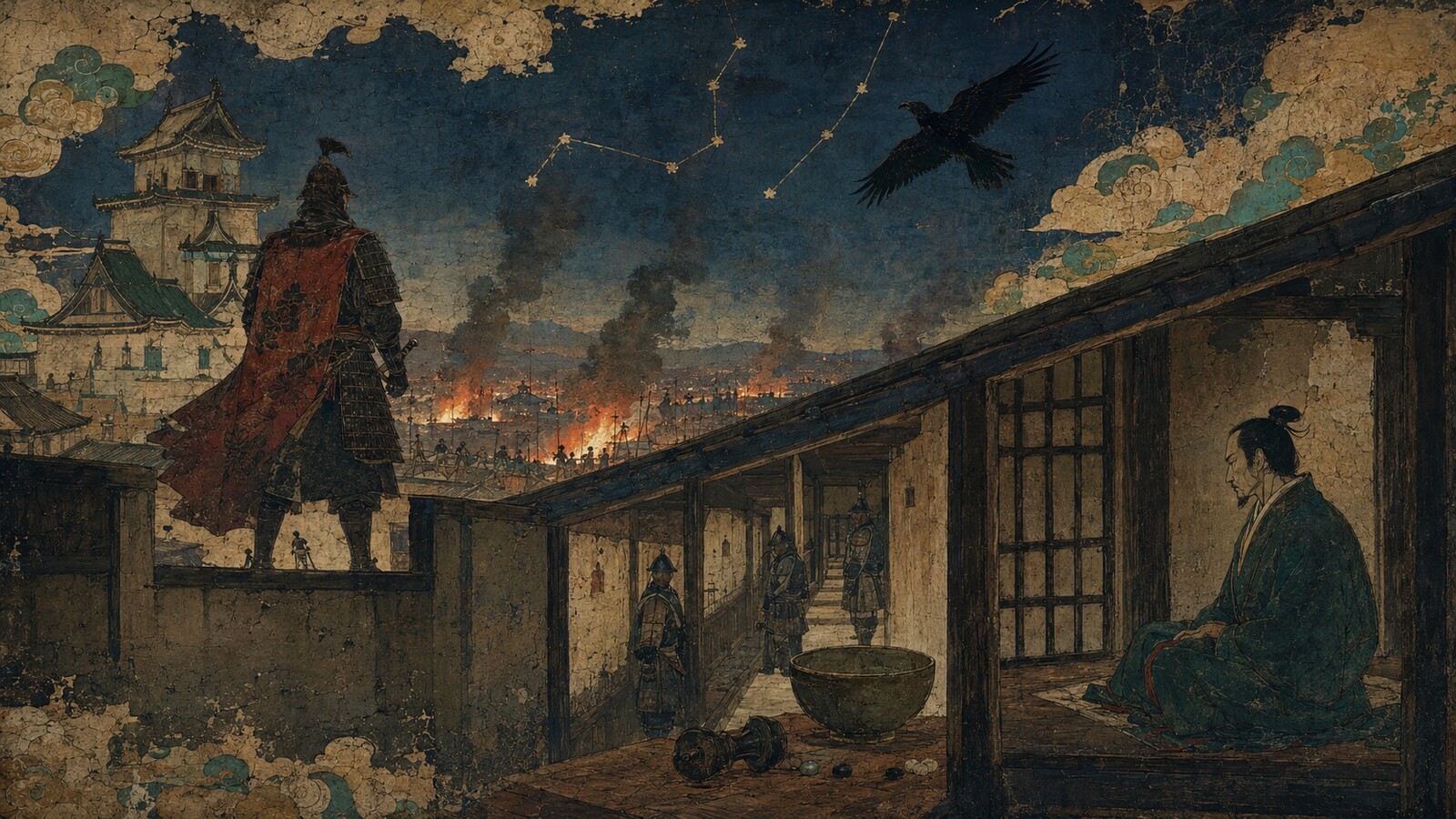
A castle under siege should be the safest place to understand. The enemy is outside. The walls are thick. The gates are watched. Every person within has sworn allegiance to the same lord. Then a child dies in a locked room, fear moves faster than any invading army, and certainty becomes the first casualty.
That is the threshold Kiyoshi Kurosawa crosses in The Samurai and the Prisoner, known in Japan as Kokurōjō—literally, “Black Prison Castle.” It is his first samurai film and his first full venture into jidaigeki, the broad Japanese tradition of period drama. Yet the new genre feels less like a detour than a homecoming. Kurosawa’s cinema has always distrusted doors, corridors and the confidence that a room contains only what can be seen.
Here, the room is a fortress. The year is 1578. Araki Murashige, once a powerful retainer of Oda Nobunaga, has rebelled against his lord and barricaded himself in Arioka Castle. Outside, Nobunaga’s forces tighten the siege. Inside, unexplained crimes fracture the household. Murashige, played by Masahiro Motoki, turns for help to the sharpest mind available: Kuroda Kanbei, the strategist he has thrown into a dungeon, played by Masaki Suda.
The premise sounds invented for cinema, but its central relationship is lodged in recorded history. Murashige did revolt. Kanbei did enter Arioka as an envoy and was imprisoned there for roughly a year. The mysteries are Honobu Yonezawa’s fiction. The prison, siege and political disaster around them are not. Kurosawa’s achievement is to make the join between fact and invention feel like a crack in the same stone wall.
A whodunit with an army at the door
The film’s dramatic engine is brutally simple. Murashige must solve crimes inside his domain while preserving the belief that he remains capable of ruling it. A murder is therefore never just a murder. It can look like divine judgment, enemy sabotage, a warning from a traitor or proof that the castle’s social order has already collapsed.
Kanbei hears the cases from below ground. He is physically powerless but intellectually dangerous. Instead of handing Murashige neat solutions, the prisoner provides clues and questions, forcing his captor to return upstairs and test them against a court filled with frightened relatives, armed retainers, monks and opportunists. Every consultation reverses their official positions: the lord depends upon the captive, and the captive gains reach without leaving his cell.
Motoki’s Murashige carries command as a bodily burden. Suda’s Kanbei, dirty and confined, can dominate a scene with stillness and language. Yuriko Yoshitaka plays Chiyoho, Murashige’s wife and moral anchor; Munetaka Aoki is the loyal Araki Kyuzaemon. Ryota Miyadate, Tasuku Emoto, Joe Odagiri and a large ensemble populate a court in which rank clarifies where people sit but not what they believe.
This is not a sword-fight delivery system. Blades matter because everyone knows they can be drawn; much of the violence occurs first in argument, ritual and implication. The film proceeds through investigations and accumulating pressure. Viewers expecting constant combat may find its 147 minutes austere. Viewers willing to watch loyalties alter in the space between two sentences may find it unusually tense.
The history beneath the mystery
Arioka Castle stood in present-day Itami, Hyogo Prefecture, just northwest of Osaka. Murashige captured the older Itami Castle in 1574, renamed it and rebuilt it as a formidable sōgamae stronghold: not only a central keep, but a fortified town enclosed by earthworks and moats. Japan’s Agency for Cultural Affairs describes the compound as approximately 0.8 kilometers east to west and 1.7 kilometers north to south. A Portuguese missionary who visited in 1577 praised its scale and appearance.
Murashige had risen under Nobunaga and was entrusted with control of Settsu Province. Then, in October 1578, he abruptly turned against him, aligning with forces opposed to Nobunaga, including the Ishiyama Hongan-ji network and the Mōri. His reasons remain debated. Later narratives often reduce the decision to treachery or cowardice, but the political map was volatile, alliances were coercive and Nobunaga’s unification campaigns could be pitiless.
Nobunaga sent prominent figures to reverse the rebellion. Kuroda Kanbei—then known as Kuroda Yoshitaka—arrived to persuade Murashige on behalf of his own lord and Hashiba Hideyoshi’s camp. Murashige detained him. According to the Kuroda kafu family chronicle summarized in Itami’s archaeological records, Kanbei remained imprisoned until Arioka fell in 1579 and was rescued by his retainer Kuriyama Zensuke.
Murashige left Arioka for Amagasaki before the final collapse, hoping to secure aid and continue the fight. That flight hardened his reputation. Nobunaga’s reprisals were catastrophic. An Itami City chronology, drawing on the Shinchōki, records that roughly 700 members of Murashige’s family and household were executed in Kyoto and at Nanatsumatsu near Amagasaki. Exact totals in wartime chronicles deserve caution; the mass killing itself is central to the historical memory of the siege.
The strangest epilogue complicates the label “coward.” Murashige survived, took the name Dōkun and reappeared in tea records in 1583, serving in the cultural orbit of Hideyoshi. Itami City notes that a surviving letter from Kanbei to Dōkun indicates the former prisoner and former jailer later worked under the same ruler. Murashige is said to have died in Sakai in 1586. The man who abandoned a doomed castle did not disappear from history; he changed identities and entered another system of power.
| Element | Historical record | Novel and film |
|---|---|---|
| Murashige’s revolt | He rebelled against Oda Nobunaga in 1578 and held Arioka for almost a year. | His political and moral crisis becomes the pressure chamber for the story. |
| Kanbei’s captivity | The envoy was detained at Arioka and freed after the castle fell in 1579. | He becomes a prison-bound consulting detective and psychological adversary. |
| Crimes inside the castle | No evidence establishes the four linked mystery cases as historical events. | Yonezawa invents them to expose fear, belief and divided loyalty under siege. |
| Murashige’s later life | He survived, used the name Dōkun and reappeared as a tea practitioner. | The known outcome gives every decision a tragic tension, even without spoilers. |
The traitor whom history could not finish
Popular history rewards a clean moral line. Nobunaga marches toward national unification; those who resist appear as obstacles. A samurai who leaves his castle while his household dies seems to violate the most durable legend of the class: that honor is proven by choosing death.
Yonezawa and Kurosawa are interested in the person trapped behind that legend. What if refusal to die is not the absence of principle but a different principle? What if preserving life in a culture organized by spectacular punishment causes unforeseen deaths elsewhere? What if a merciful choice is impossible to separate from political calculation?
The film does not conduct a modern trial of sixteenth-century behavior. It dramatizes the instability of judgment itself. Murashige wants to distinguish his rule from Nobunaga’s cruelty, yet every choice is made inside war. Mercy can be read as weakness. Ritual can hide strategy. Religious language can offer consolation or become a weapon. A leader’s inner conscience matters, but so does what hundreds of people think they saw him do.
That makes Murashige an ideal Kurosawa protagonist. In Cure, ordinary people commit violence after influence they cannot explain. In Pulse, connection becomes isolation and empty Tokyo rooms seem infected by absence. In Cloud, commerce, resentment and digital distance turn into pursuit. The recurrent terror is not simply an attacker. It is the moment a social mechanism continues to work after nobody can say who controls it.
From four impossible crimes to nine literary honors
Honobu Yonezawa published Kokurōjō in Japan in June 2021. The novel places four mysteries within the siege and sets Murashige and Kanbei into a double-detective structure: one man can move through the castle, the other can see patterns from confinement. It blends the documentary gravity of historical fiction with the fair-play pleasures of a puzzle.
The book became an exceptional awards phenomenon. It won the 166th Naoki Prize, the 12th Yamada Futaro Prize and the 22nd Honkaku Mystery Grand Prize. It also became the first work to rank first in four major annual Japanese mystery lists in the same cycle. KADOKAWA ultimately promoted it as a nine-honor achievement.
An English translation by Giuseppe di Martino appeared from Yen On in July 2023 as The Samurai and the Prisoner. That title follows the relationship most readily legible to an international reader. The Japanese title is darker and more architectural: Kokurōjō, the black prison castle. One names the two men. The other names the machine that contains them.
Kurosawa wrote the screenplay himself. On the official Japanese site, he acknowledged that both period drama and mystery were new challenges for him. The adaptation necessarily compresses a 448-page Japanese hardcover and an episodic investigation into a feature, but it preserves the governing idea: facts do not restore order unless people can still agree what facts mean.
Kurosawa’s horror was always architectural
Kiyoshi Kurosawa began directing commercially in the 1980s and worked across low-budget genre cinema and direct-to-video production before Cure brought international attention in 1997. Pulse in 2001 made digital loneliness feel apocalyptic. Tokyo Sonata, a family drama about unemployment and secrecy, won the Un Certain Regard Jury Prize at Cannes in 2008. Journey to the Shore won directing honors in the same Cannes section in 2015, and Wife of a Spy earned him the Silver Lion for directing at Venice in 2020.
The genres change, but the grammar persists. Kurosawa often favors a wide, steady view over rapid cutting. He lets a doorway divide the frame and allows empty space to acquire moral weight. Sound arrives from beyond the visible room. A person crosses a background and the entire scene changes meaning. The fear comes from waiting long enough to notice that the world is no longer behaving as expected.
Arioka offers that grammar in wood, plaster, stone and rank. The castle is a series of thresholds: lord and vassal, family and state, sacred and profane, above ground and dungeon. The long shot can show hierarchy as distance. A pillar can separate two men who appear to share a room. Off-screen space can contain a spy, an army or merely the possibility that somebody heard the wrong sentence.
In a July interview with The Associated Press, Kurosawa said the transition became natural once the sets, costumes, props, wigs and makeup placed the actors inside the other world of the period. He retained the long takes and compressed dialogue scenes associated with his modern films. The result looks recognizably classical while moving according to his private clock: dread accumulates; it does not report for duty every five minutes.
Entering Japan’s oldest movie house
Period films were not a niche at the birth of Japanese narrative cinema. The British Film Institute notes that jidaigeki dominated early fiction production. Shozo Makino’s one-reel sword pictures helped establish chanbara, a word imitating the clash of blades. In the late 1920s, dynamic editing and dramatic lighting moved the form beyond photographed stage action and toward psychological cinema.
Allied occupation policy restricted films that promoted feudal values after 1945. When those restrictions ended, the 1950s became a golden age. Samurai films accounted for more than a third of an industry producing roughly 500 titles a year. Akira Kurosawa, Kenji Mizoguchi and Hiroshi Inagaki carried the form to international festivals; studio filmmakers supplied a huge domestic popular tradition that Western distribution only partly revealed.
Akira Kurosawa’s Seven Samurai, Throne of Blood, Yojimbo, Kagemusha and Ran created such a vast international image of samurai cinema that the surname itself can cause confusion. Kiyoshi Kurosawa is not related to Akira. The new film’s armored figures on ridgelines inevitably recall the older director’s late epics, but its center of gravity is closer to an interrogation room than a battlefield.
That distinction places The Samurai and the Prisoner inside another samurai lineage: films that question the codes they display. Masaki Kobayashi’s Harakiri and Samurai Rebellion exposed the cruelty beneath institutional honor. Hideo Gosha and the rebel-samurai cycles turned feudal order into a site of corruption and resistance. Kurosawa’s contribution is to make interpretation itself the battleground. The decisive weapon may be a story someone persuades a room to believe.
Five castles, one impossible fortress
The historical Arioka is now an archaeological site beside JR Itami Station. Its surviving foundations cannot serve as a complete film set. Kurosawa’s castle was assembled from the material memory of other places and the controlled world of a studio.
Shochiku’s production report identifies Kyoto’s historic Uzumasa studio and location work at Himeji, Akashi, Sasayama, Iga Ueno and Hikone castles. Several are National Treasures or Important Cultural Properties. The dungeon set was built with real earth underfoot. Yasuyuki Sasaki’s cinematography, Tetsuo Harada’s production design, Koichi Takahashi’s editing, Mikisuke Shimadzu’s sound and Yoshihiro Hanno’s score bind those fragments into one enclosure.
The method is appropriate. No camera can recover Arioka in 1578. Historical filmmaking always constructs the visible past from surviving buildings, scholarship, craft and invention. Here, the seams support the theme: a castle called Arioka is distributed among five other castles, just as the historical Murashige is distributed among chronicles, local memory, moral legend and fiction.
Japan’s release also produced a revealing experiment. Shochiku began screening a special monochrome version in three Japanese theaters on July 10, without changing the edit. Kurosawa said the conversion made faces, eyes and costume patterns newly visible to him. Color provides the period world; black and white exposes its geometry. Both versions underline how much of the drama lives in looking.
From Cannes to a breakthrough at home
The Samurai and the Prisoner premiered on May 19 in the Cannes Premiere section of the 79th Cannes Film Festival. Shochiku reported a five-minute standing ovation from the roughly 1,000-person audience. Festival enthusiasm does not guarantee a domestic audience, especially for a long historical mystery, but the Japanese opening on June 19 found one.
Through July 20, the distributor reported 755,848 admissions and ¥1,035,468,780 in box office revenue. It was the first Kurosawa-directed film to cross ¥1 billion in Japan, passing the ¥630 million Shochiku gives for Creepy. The figure matters less as a contest among unlike films than as evidence that an austere director, a prestige cast and a literary mystery reached beyond a specialist art-house public.
Critical response has not been uniform. Admirers see a precise, unsettling fusion of procedural mystery and historical epic; skeptics find the chaptered investigation and restrained staging too deliberate. That disagreement is useful. Kurosawa has not hidden a conventional action film inside an art-house package. He has made a patient work whose suspense depends on attention, and the 147-minute running time makes the bargain explicit.
What the American release means
Janus Films acquired U.S. rights before Cannes and is opening the film in New York and Los Angeles on July 31 before expanding through August. IFC Center scheduled Kurosawa appearances for opening weekend, while Film at Lincoln Center listed multiple director Q&As on August 1 and 2. In Los Angeles, the Japan Foundation joined the Landmark Nuart and Janus as a community partner for the July 31–August 6 engagement.
Janus is an unusually resonant distributor for this crossing. Its catalog helped build American art-house knowledge of Japanese cinema, including the work of Akira Kurosawa. Now it is presenting an unrelated Kurosawa entering the genre most international viewers associate with that name. The coincidence is marketable, but it can also clarify the difference.
Akira often made action legible through movement across landscape. Kiyoshi makes danger legible through the possibility that a landscape—or a room—has been misunderstood. He does not deny the pleasures of banners, armor and massed troops. He asks what happens after they establish the image of power and before anybody knows whether that power will hold.
- Title: The Samurai and the Prisoner; Japanese title Kokurōjō (黒牢城).
- Director and screenwriter: Kiyoshi Kurosawa.
- Running time: 147 minutes; Japanese with English subtitles; DCP at listed New York venues.
- Opening: July 31 in New York and Los Angeles, then major U.S. cities through August.
- Approach: A spoiler-light expectation is best: historical siege, chamber drama, four-part mystery and bursts of violence—not continuous swordplay.
- Historical caution: Murashige, Kanbei, the revolt and imprisonment are historical; the linked crimes and detective partnership are fiction.
The prisoner above, the prisoner below
The film’s English title suggests a simple distinction. Murashige is the samurai; Kanbei is the prisoner. The castle gradually makes that grammar unstable. Kanbei is confined by earth and timber. Murashige is confined by command, by reputation, by the gaze of his retainers and by a future history that will call him traitor before it hears his reasons.
This is why Kurosawa’s first samurai film feels so inevitable. He has not traveled backward merely to dress his anxieties in armor. The Sengoku world gives those anxieties a visible hierarchy and places a sword beside every interpretation. Power moves downward, rumor sideways, fear everywhere.
Nearly 450 years after Arioka fell, the ruins survive at the edge of a modern railway station. The warrior written as a coward became a tea man. The captive became one of the best-known strategists of the unification era. A celebrated mystery writer placed them in conversation, and a horror master listened long enough to hear a new kind of ghost—not a spirit in the dungeon, but the story history tells when everyone who could contradict it has left the room.
Reporting Notes and Sources
Film, venue and box-office information was checked through July 30, 2026, at 10:12 a.m. JST. Ticket availability and theater schedules may change. Japanese box-office totals are distributor-reported. Historical chronicles are indispensable but not neutral transcripts; disputed motives, retrospective moral labels and casualty totals are identified cautiously. Plot discussion avoids the solutions to the film’s mysteries.
- Associated Press: Kiyoshi Kurosawa’s first samurai film arrives in U.S. theaters
- Shochiku: official Japanese film site, story, cast and director comments
- Shochiku: June 19 Japanese release and principal credits
- Shochiku: admissions and ¥1 billion box-office announcement through July 20
- Shochiku: Kyoto studio production and castle-location report
- Shochiku: special monochrome edition and director’s statement
- Festival de Cannes: official film entry, 147-minute runtime, cast and production credits
- Festival de Cannes: 2026 Official Selection and Cannes Premiere placement
- Film at Lincoln Center: New York engagement, synopsis, format and director Q&As
- IFC Center: July 31 opening, showtimes, format and Kurosawa appearances
- Japan Foundation Los Angeles: Landmark Nuart engagement, July 31–August 6
- Screen Daily: Janus Films acquires U.S. rights before the Cannes premiere
- KADOKAWA: 166th Naoki Prize and four annual mystery-list No. 1 rankings
- KADOKAWA: 22nd Honkaku Mystery Grand Prize and Japanese publication record
- KADOKAWA: official Kokurōjō hardcover page
- Yen Press: English edition of Honobu Yonezawa’s novel
- Itami City: Murashige’s revolt and the year-long defense of Arioka
- Itami City Board of Education: Arioka archaeology, chronology, Kanbei’s imprisonment and the castle’s fall
- Agency for Cultural Affairs, Japan Heritage: Arioka’s fortified town, scale and year-long siege
- Cultural Heritage Online: official history and national designation of the Arioka Castle Site
- Itami City: Murashige as Dōkun, his later tea life and the Kanbei letter
- British Film Institute: Kurosawa’s career, recurring motifs and major films
- British Film Institute: history of jidaigeki, chanbara and postwar samurai cinema