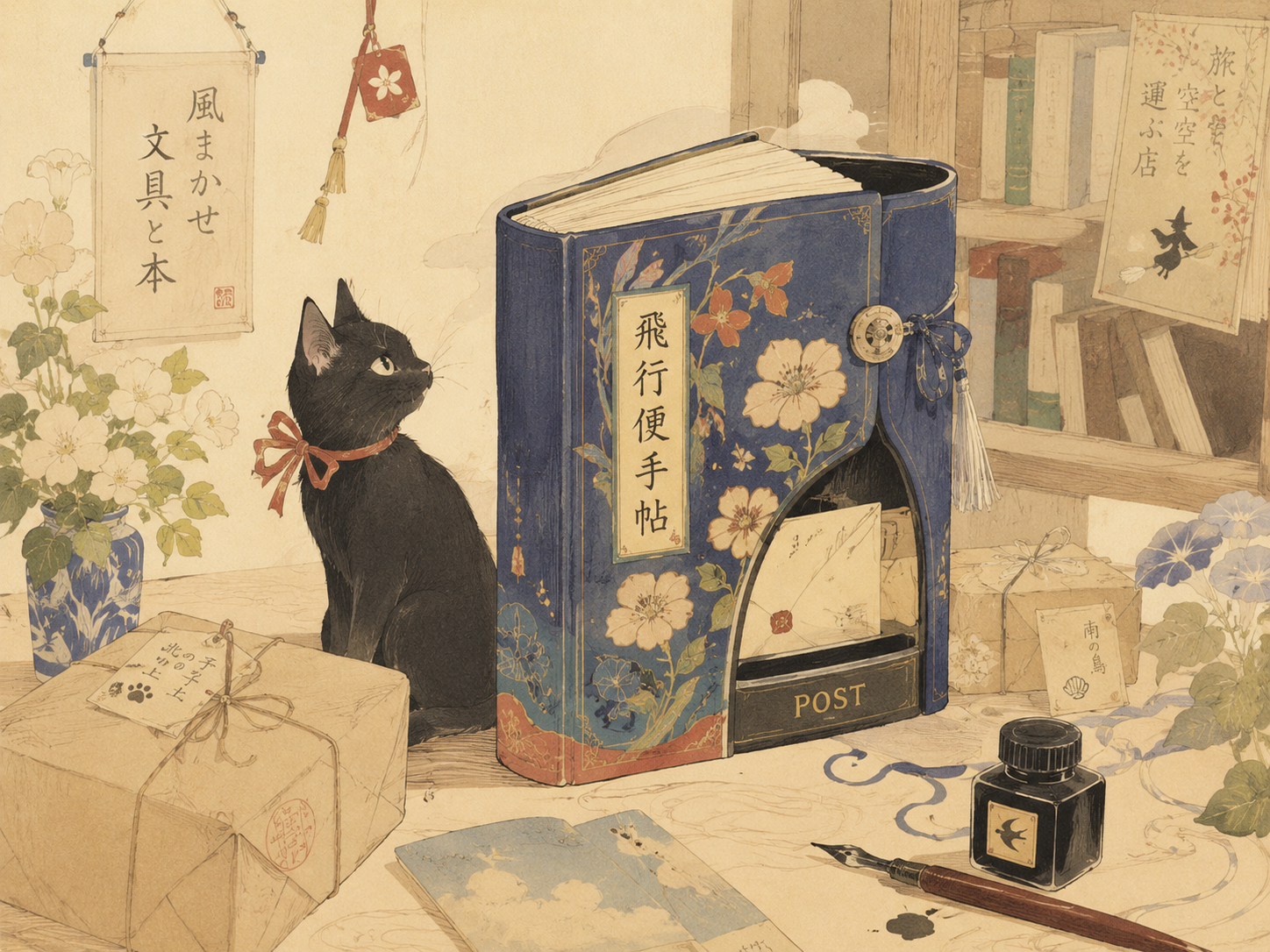
The object looks like a book. It sits upright like a book, wears a cover like a book, and borrows the quiet authority of a bookshop shelf. But the new Kiki’s Delivery Service item that has been making the rounds in Japan is not actually a book at all. It is a piece of Studio Ghibli pseudo-literature: a designed object that turns reading culture into room décor, fandom into furniture, and a beloved story about work, independence and growing up into something fans can place on a shelf even when there is nothing to read inside.
That small trick is why the item is more interesting than ordinary merchandise. Japan already knows how to turn a character into a lunch box, a mug, a key holder or a hand towel. But a fake book does something stranger. It asks the fan to treat the world of the story as if it had left behind an artifact. Kiki is not merely printed on a product. Her fictional world is turned into an object with a little physical dignity.
The product comes at a moment when Kiki is unusually present again. Eiko Kadono, the author of the original 1985 children’s novel, is in the news at 91, still writing and still defending the magic of books. The Ghibli film has returned to theaters in prestige formats. A new live-action international television adaptation has been announced. And Japan’s Ghibli retail universe keeps finding ways to make the imaginary feel touchable.
A book that performs bookness
The July 2026 SoraNews24 report described the item as a Kiki’s Delivery Service book that is not meant to be read. That phrase is the key. It is not a counterfeit book, and it is not a failed notebook. It is an object that borrows the emotional vocabulary of a book: spine, cover, shelf, secrecy, discovery, nostalgia. The pleasure is not turning pages. The pleasure is placing a fragment of Koriko, Kiki’s seaside city, into the ordinary room.
This is an old Ghibli retail move. Donguri Kyowakoku and the wider Ghibli goods ecosystem do not only sell characters. They sell traces of worlds: bakery signs, music boxes, teacups, postcards, bags, miniature kitchens, forest spirits, delivery parcels, letter sets and objects that feel as if they might have been found inside a film. The best Ghibli merchandise is not loud. It whispers, “This could have existed.”
That whisper matters for Kiki in particular. Unlike many fantasy stories, Kiki’s magic is domestic and practical. She does not save a kingdom. She delivers parcels, cleans rooms, eats pancakes, feels lonely, loses confidence, recovers confidence and learns how to work. A fake book fits that world because Kiki’s story has always been about the everyday object touched by a little magic.
Before the film, there was Kadono’s book
For many global fans, Kiki’s Delivery Service begins with Hayao Miyazaki’s 1989 Studio Ghibli film. In Japan, however, the story began four years earlier as Majo no Takkyūbin, a children’s novel by Eiko Kadono, illustrated by Akiko Hayashi and published by Fukuinkan Shoten in 1985. The novel follows a 13-year-old witch who leaves home for a year of independence, arrives in a town by the sea and starts a delivery service with her black cat Jiji.
The premise is simple, but it has unusual durability. Kiki is not chosen by prophecy. She is sent out because growing up requires practice. Her broom is not a weapon; it is transportation. Her magic is not conquest; it is labor. Kadono’s story treats work, self-doubt, friendship and service as the real adventure.
The book won major recognition in Japan and grew into a longer literary series. Over decades, Kadono expanded Kiki’s world beyond the first year of independence. In recent coverage, Kadono has been described as the author of around 200 books, and the Kiki series remains the work that made her internationally famous. She won the Hans Christian Andersen Award in 2018, one of children’s literature’s highest honors.
Miyazaki turns apprenticeship into cinema
The 1989 film changed Kiki forever. Miyazaki kept the core of Kadono’s idea but reshaped it into a film about adolescence, creative blockage, loneliness and the pressure to become useful in a city where nobody has been waiting for you. The film’s magic is understated. The most dramatic crisis is not a battle with evil but the loss of confidence: Kiki can no longer fly, and she can no longer understand Jiji.
That quietness is the source of the film’s longevity. Kiki’s Delivery Service has become one of Ghibli’s most widely loved films because it makes independence feel both exhilarating and frightening. Kiki’s work is charming, but it is also precarious. She has to find customers, earn trust, handle mistakes, and discover who she is when her gift no longer works automatically.
The film is also a masterpiece of object memory. The bakery sign, Osono’s counter, Tombo’s bicycle, Ursula’s painting, Kiki’s red bow, the radio, the broom, the parcels, the attic room: all of them are remembered almost like household belongings. That is why Ghibli merchandise can feel emotionally powerful. The object is never just an object. It is an index to a scene.
The black cat, the delivery company and the Japanese pun
Kiki’s Japanese title, Majo no Takkyūbin, has its own commercial history. Takkyūbin is associated with Yamato Transport’s parcel delivery service, whose famous logo shows a black cat carrying a kitten. The overlap between a witch’s black cat and Japan’s best-known delivery company gave the film an accidental modern fairy-tale realism. Kiki’s magic became legible through the language of real Japanese logistics.
That is one reason the story works so well in Japan. It is fantasy, but it is fantasy integrated into an ordinary service economy. Kiki does not open a castle gate. She makes deliveries. She performs an occupation that every city understands. In a country where trains, convenience stores, courier services and neighborhood shops are part of daily order, Kiki’s broom feels like one more small transport network.
The new not-a-book object belongs to that same tradition. It turns a beloved fictional service into a believable collectible. It is not enough that fans remember Kiki. The object lets them imagine that Kiki’s world had publishers, shelves, packages and private souvenirs of its own.
Why Japan loves goods that pretend to be artifacts
Japanese character commerce often works by creating a small bridge between the fictional and the domestic. A Totoro clock is not merely a clock with a Totoro on it; it makes the room feel slightly wooded. A Kiki teacup is not merely a cup; it suggests Osono’s bakery. A fake book is part of this larger practice of artifact design.
This is different from simple branding. Branding puts a logo on an object. Artifact design makes the object feel as though it came from the story’s world. The difference is subtle but powerful. It rewards fans who do not want to wear fandom loudly. They want to live near it.
Kiki is especially suited to that mode because the film’s emotional texture is soft, domestic and transitional. The fan is not buying a battle pose. The fan is buying atmosphere: a window, a shelf, a bakery, an attic, a seaside breeze, a room where a young person is trying to become herself.
2026: the year Kiki returned to the shelf
The not-a-book item is also part of a broader 2026 Kiki revival. SoraNews24 has tracked a steady stream of Kiki goods, including notebooks, ceramic cake cases, music boxes, bags and other objects that make the film’s world collectible. Internationally, new attention has come from theatrical re-releases and the announcement of a new live-action series based on Kadono’s work.
The timing is important. Many Ghibli fans who saw Kiki as children are now adults furnishing homes, buying gifts, raising children or returning to the film for comfort. Kiki’s story grows with them. As a child, the fantasy is flying. As an adult, the fantasy is having the courage to start again after losing confidence.
That is why a book that is not a book can land so neatly. It is not for reading. It is for remembering. It lets the adult fan keep a child’s story in the language of an adult room.
Japan.co.jp view
At first glance, the story is tiny: Studio Ghibli sells another beautiful object. But the tiny story contains a large pattern. Japan has become a global master of emotional material culture. It understands how fiction leaves residue in the room. It understands that a fan may not want more content, but may want a carefully made thing that gives content a physical resting place.
Kiki’s Delivery Service is the perfect test case because it began as literature, became cinema, turned into a retail universe, and now returns as a book-shaped object that is not actually a book. That loop is almost too elegant. A story about delivery has delivered itself across forms for more than forty years: novel, film, merchandise, theater, global adaptation, and now shelf-object.
The fake book is therefore not a betrayal of literature. It is a compliment to it. It admits that books have an aura even when unread, that shelves carry memory, and that some fictional worlds become real not because we enter them, but because we make room for them at home.
Reader takeaways
| Item | Meaning |
|---|---|
| What happened | A new Kiki’s Delivery Service object in Japan looks like a book but functions as collectible décor rather than reading material. |
| Why it matters | The item shows how Ghibli merchandise often works as artifact design, making fictional worlds feel physically present. |
| Historical root | Kiki began as Eiko Kadono’s 1985 children’s novel before becoming Studio Ghibli’s 1989 film. |
| 2026 context | Kiki is enjoying renewed attention through merchandise, theatrical revival, Kadono coverage, and a planned international live-action series. |
| Japan.co.jp read | The “book that is not a book” is really about the afterlife of stories as objects. |
Sources and references
This article draws on SoraNews24 coverage of the Kiki’s Delivery Service not-a-book item, AP reporting on Eiko Kadono, Deadline reporting on the new Kiki television project, historical information on Kadono’s original novel, and recent reporting on Ghibli’s 2026 Kiki revival.
- SoraNews24: Don’t judge this Kiki’s Delivery Service book by its cover, because it’s not actually a book.
- Associated Press: Eiko Kadono still believes in the magic of books at 91.
- Deadline: Kiki’s Delivery Service series in development from BBC Studios and Kadokawa.
- SoraNews24 Kiki’s Delivery Service archive: 2026 Ghibli merchandise and theatrical revival items.
- Kiki’s Delivery Service novel reference: publication history and series background.