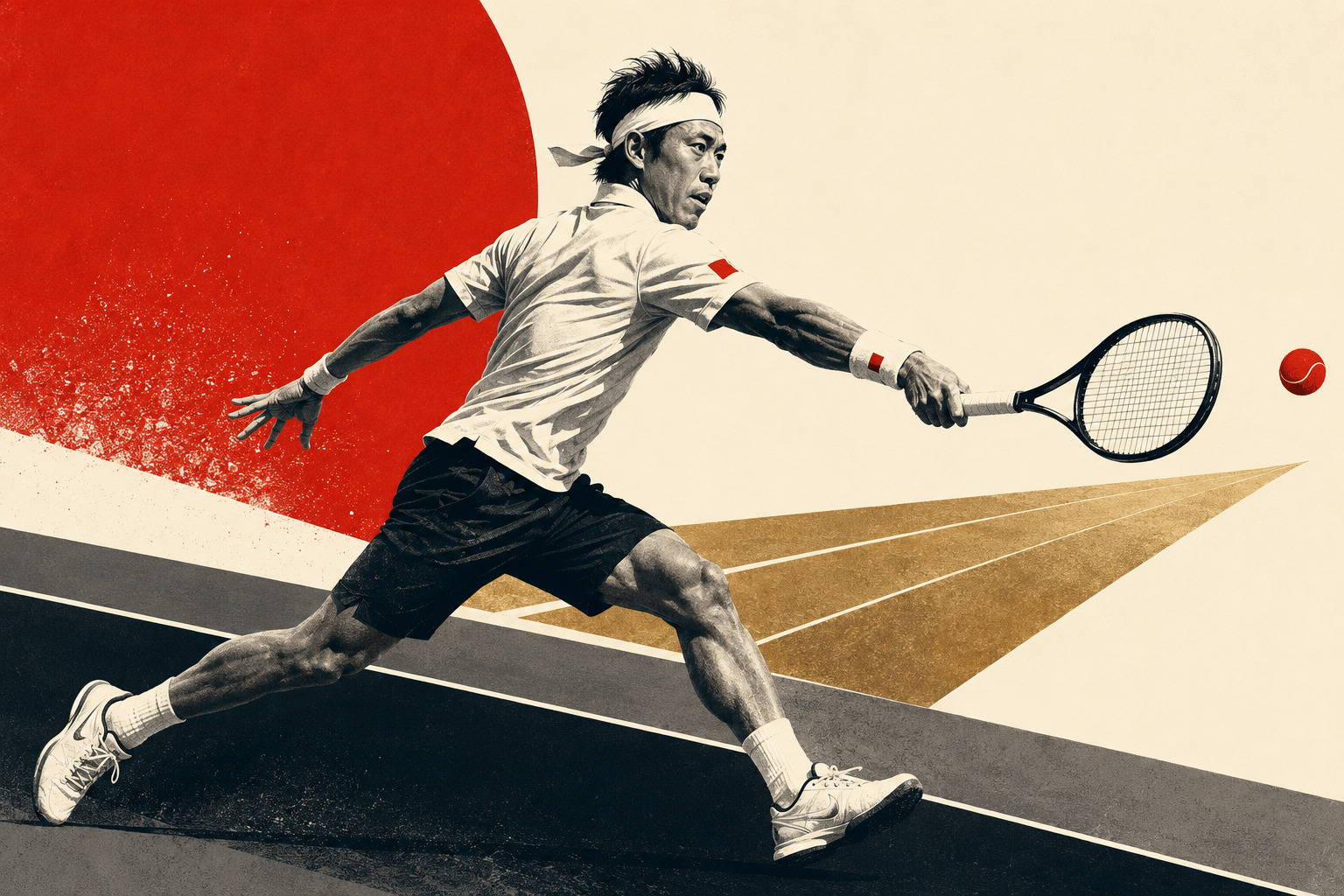
When the final ball sailed long, Kei Nishikori did not collapse onto the court. The 36-year-old stood inside the baseline, watched Shang Juncheng’s reply miss and made a small fist with his right hand. The score was 6–7(3), 6–3, 6–4. The clock read two hours, 31 minutes and 36 seconds. His first tour-level win in 14 months felt quieter than a resurrection and more truthful.
He is no longer trying to return to 2015, when he was ranked fourth in the world. On April 30, Nishikori announced that he would retire from professional tennis at the end of 2026. He admitted that part of him still wanted to continue, but the decision to reconstruct his body for another campaign had become harder than the desire to compete. Washington was his first official event since the announcement, his ninth main-draw appearance in the city and his last.
The victory over Shang therefore made no promise about the future. Nishikori felt the fatigue late in the third set and said he did not know whether he could play three or four matches in succession. Against 19-year-old Jodar two nights later, he lost in 70 minutes. Hope and limitation appeared in the same week. That is the honest shape of a farewell season: one day the past returns; the next, time resumes.
The grammar of a career remained in the comeback
Nishikori created six break chances in the first set against Shang and converted none. He lost the tie-break 7–3. Shang received two medical timeouts for his right leg, a relevant part of the match but not a complete explanation for its result. Nishikori finally broke midway through the second set, broke again in the opening game of the third and never allowed Shang a break point all night.
The service numbers described a different kind of strength from the familiar highlights. Nishikori put 70 of 97 first serves in play, a 72 percent rate. He won 73 percent of those points and 70 percent behind his second serve. He has never been the giant server who erases a problem with four aces. Yet over two and a half hours, his service was not broken, or even placed under a formal break-point threat.
The rest looked unmistakably like Nishikori. He took the ball before it fell, stepped into the court, changed the angle and made the following exchange arrive sooner. At 178 centimeters, he survived an era of tall servers and accelerating baseline power by taking time away rather than merely adding force. After losing the first set, he gradually made the match run on his clock.
Washington’s three overlapping times: 2007, 2015, 2026
The tournament at Rock Creek Park became a growth ring in Nishikori’s professional life. His first main draw came in 2007. At 17, after earning his first tour win in Indianapolis, he also won a match in Washington. At the 2026 edition, 17-year-old Cruz Hewitt recorded his first ATP win and was identified as Washington’s youngest match winner since Nishikori. With the retiring player still in the draw, someone else’s breakthrough recovered the teenager buried in his record book.
The second time is 2015. Ranked fifth and seeded second, Nishikori defeated Marin Cilic—the man who had beaten him in the previous year’s U.S. Open final—in the semifinal. John Isner took the opening set of the final, but Nishikori rallied 4–6, 6–4, 6–4. It was his third title of that season and 10th overall. The proportions were larger, but the blueprint resembled the 2026 match: fall behind an imposing opponent, find a foothold on return and make the final set his own.
The third time is 2026. His official tournament record entering the week was 18–7. Across his five most recent appearances, he had reached the 2014 quarterfinal, won in 2015, made the 2017 semifinal, reached the 2018 quarterfinal and returned to the semifinal in 2021. This time he needed a wild card at No. 721. The Shang win added a 19th Washington victory; the Jodar loss closed the record at 19–8.
The span from 2007 through 2026 contains 20 seasons. But the ATP’s official notes list Nishikori at 0–0 in 2022, the year he missed after hip surgery. The accurate statement is that the Shang result gave him a tour-level win in 19 of the past 20 seasons—not 20 consecutive seasons. A statistic that preserves the absence tells the better story of his durability.
From an 18-year-old qualifier to the New York night of 2014
Nishikori’s first ATP title came at Delray Beach in 2008. An 18-year-old qualifier ranked No. 244, he defeated then-No. 12 James Blake 3–6, 6–1, 6–4 in the final. He became the youngest tour champion since a 16-year-old Lleyton Hewitt won Adelaide in 1998 and was named ATP Newcomer of the Year. Only months after turning professional, he made the highest level of men’s tennis feel reachable from Japan.
In 2012 he defeated Milos Raonic to become the first Japanese man to win the Tokyo tournament. In 2014 he collected four titles and went 54–14, the best season of his career. Yet the event that separated that year from an ordinary list of results was the U.S. Open. His fourth-round match with Raonic lasted four hours and 19 minutes and ended at 2:26 a.m. His quarterfinal against Stan Wawrinka lasted another four hours and 15 minutes. By the time he entered the final, he had spent 16 hours and 26 minutes on court.
In the semifinal, Nishikori beat World No. 1 Novak Djokovic 6–4, 1–6, 7–6(4), 6–3. He became the first Japanese man to reach a major semifinal since Jiro Sato at the 1933 French Championships, an 81-year interval, and the first Asian-born man to contest a Grand Slam singles final. Cilic defeated him 6–3, 6–3, 6–3, but the final itself was the first major title match since the 2005 Australian Open without Roger Federer, Rafael Nadal, Djokovic or Andy Murray.
Read only from the final score, it was the day Nishikori fell short. Read as a tournament, it was the fortnight when a Japanese player without the physical profile of a dominant serve-first champion beat the world No. 1 and opened a door in the most restricted era of men’s tennis. Not holding the trophy does not erase what it took to stand beside it.
Twelve titles, four Masters finals and the mistake of “not finishing”
Nishikori won 12 ATP Tour titles, six at ATP 500 level: Tokyo twice, Barcelona twice, Washington, and Memphis in 2013 when that event carried 500 status. He kept winning in Memphis after its category changed, completing four consecutive titles from 2013 through 2016. Brisbane in 2019 became his final tour-level title. He reached four Masters 1000 finals—Madrid in 2014, Miami and Toronto in 2016, and Monte Carlo in 2018—without winning one.
It is easy to compress the absence of a major or Masters trophy into a verdict that he could not finish at the largest events. Remove the opponents and the era disappears. Nadal and Djokovic stood across the net in those Masters finals. Federer completed the generation whose control over the sport was historically severe. Nishikori climbed the same mountain, reached No. 4 in March 2015, qualified for the season-ending finals four times and advanced to its semifinals twice. Remaining in the Top 10 meant surviving that opposition every week.
A better number for understanding him is found in deciding sets. The ATP’s pre-Washington media notes placed Nishikori at 157–60 when a match reached its final set, a 72.4 percent winning rate—the best among active players and behind only Bjorn Borg and John McEnroe historically at the time of the retirement announcement. His five-set record was 29–8. The third set against Shang added one more line to that evidence.
| Year | Milestone | Why it mattered |
|---|---|---|
| 2008 | Delray Beach champion | No. 244 qualifier wins his first title at age 18 |
| 2012 | First Tokyo title | First Japanese man to win the home tournament |
| 2014 | U.S. Open finalist; four titles | First Asian-born man in a Grand Slam singles final |
| 2015 | World No. 4; Washington champion | Career peak in the rankings and on North American hard courts |
| 2016 | Rio Olympic bronze | Japan’s first Olympic tennis medal in 96 years |
| 2019 | Brisbane champion | His final ATP Tour title |
| 2023 | Challenger title on return | Wins his first event after 20 months away |
| 2026 | Retirement announcement; DC comeback | Adds a tour victory in his final season |
The body’s timeline: rebuilding feel from zero
Calling the second half of Nishikori’s career “injury-plagued” conceals the work required to return. His right elbow was operated on in 2009 and again in 2019. A torn tendon in his right wrist ended the 2017 season early. He underwent left-hip surgery in January 2022 and missed the entire year. An ankle injury suffered in practice delayed the comeback again. In June 2023, at his first event in 20 months, he won the Challenger tournament in Puerto Rico while unranked.
Hip surgery did not end when the pain was removed. Nishikori later described the mental shock of wondering whether he could move as before while rebuilding his contact with the ball and his confidence from zero. A left-knee injury stopped his momentum later in 2023. The injuries formed a chain rather than a stack of medical reports: protect one area, load another; lose match rhythm; lose ranking; lose direct access to tournaments.
There was another revival in 2025. He reached his first tour final in six years in Hong Kong. At the Australian Open, Thiago Monteiro led him by two sets and held two match points before Nishikori won in five. In April, he reached 450 career tour-level victories in Madrid. Then multiple physical problems gathered again after August. He played Challengers in early 2026, but a convincing path back into the weekly main tour did not materialize.
Nishikori said the idea of retirement first entered his mind after a tournament the previous August. He felt pain in three or four parts of his body and could not commit mentally to rebuilding the condition required to fight again. That is not a story about losing the appetite to win. It is a professional calculation about whether appetite can still pay for another full cycle of rehabilitation, travel, practice and recovery.
He changed Japanese men’s tennis from an exception into an expectation
Japanese men’s tennis had a history before Nishikori. Jiro Sato approached the top of the international game in the 1930s. Shuzo Matsuoka became Japan’s first male ATP singles champion in Seoul in 1992 and reached the Wimbledon quarterfinals in 1995. Nishikori continued that line, then changed the frequency of its milestones. The Top 10 stopped being a single astonishment and became a place he repeatedly occupied from 2014 through 2019.
His 2012 Tokyo victory gave Japan its first image of a home male champion at the national tour event. The 2014 U.S. Open demonstrated that an Asian-born man could reach a major singles final. In Rio in 2016, he beat Nadal 6–2, 6–7(1), 6–3 for bronze. It was Japan’s first Olympic tennis medal since Antwerp in 1920, a 96-year wait.
Influence is not measured only by finding a successor with an identical résumé. Nishikori changed whether a junior considered moving abroad, whether a company invested in a male player for the long term and whether Japanese viewers expected one of their players to remain in the second week of a major. Naomi Osaka, also in the Washington field, said Japanese players naturally grew up admiring someone who represented the country at the highest level for so long. Osaka’s four major titles made a different history, but seeing both of them at one tournament revealed how much wider the map had become.
Jodar, 19, showed how time moves
Rafael Jodar was eight years old when Nishikori won Washington in 2015. By 2026, the Spaniard was 19, ranked No. 24, a first-time tour champion in Marrakech and a French Open quarterfinalist. Nishikori earned a break point in the opening game of their second-round match but could not convert it. Jodar took his one opening-set chance in the sixth game and won it 6–3. An immediate break in the second set placed Nishikori behind again; Jodar closed it 6–2.
The ATP’s analysis noted that Jodar served into Nishikori’s forehand and drew errors from that wing in baseline exchanges. Early in the second set, the teenager won a 21-shot rally after repeatedly recovering from deep behind the baseline. The 36-year-old had spent two and a half hours against Shang; the 19-year-old had accelerated into the world’s Top 24. The answer was less cruel than clear. The “new generation” Nishikori wanted to test himself against was present in both speed and staying power.
“Passing the torch” is too neat. No ceremonial object changed hands. Jodar expressed respect, then attacked a legend’s forehand without mercy because he was there to win. Nishikori entered as a competitor, not an honoree. The deepest respect the younger player could offer was to treat the veteran not as a historical figure but as the current opponent who had to be beaten.
What remains: New York with Osaka, then Tokyo
The Washington loss was not scheduled to be Nishikori’s last match. The initial entry list for the U.S. Open mixed doubles includes a pairing of Nishikori and Osaka. The competition is set for August 24–26. Six teams will qualify for the 16-team main draw by combined ranking, eight will receive wild cards and two will advance from qualifying, so appearing on the initial list is not the same as a confirmed main-draw place. Still, the prospect has special weight: Nishikori opened the men’s door in New York in 2014; Osaka later won the U.S. Open twice.
The confirmed homecoming is Tokyo. The Kinoshita Group Japan Open will run September 30 through October 6, and the tournament has announced it as Nishikori’s final appearance there. His record is 24–9, with titles in 2012 and 2014 and a runner-up finish in 2018. A player who began traveling the world in 2007 will return to the court where he became the first Japanese men’s champion.
His complete route to retirement remains subject to his body and entry status. Counting an exact number of matches is therefore less useful than seeing each one that occurs. There may be a day like the Shang match, when he loses the first set and finds the correction. There may be another like the Jodar match, when a younger player’s pace closes the court. Both belong to the same ending.
The final ball will not grade 20 years
We want a great career to receive a proportionate conclusion: a trophy, a full stadium at home, doubles with an old companion, a long speech. Competition does not accept that script. The final match may be a first round. The body may stop first. The score may be one-sided.
Nishikori’s value will not be determined by his last point. It lives in the No. 244 qualifier winning Delray Beach at 18; the first Japanese man lifting the Tokyo trophy; the player trading blows with Raonic until 2:26 a.m., surviving another four hours and 15 minutes against Wawrinka, then defeating World No. 1 Djokovic. It lives in placing an Asian-born man in a major singles final for the first time, reaching No. 4 and returning Japan to the Olympic tennis podium after 96 years. It lives in returning after the wrist, the elbow, the hip, the knee and the ankle interrupted him.
The Washington victory compressed that career. He lost the first set. His early chances disappeared. The opponent’s time appeared longer. Nishikori kept holding serve, altered the next exchange and eventually finished with his own tennis. Losing two days later does not make the victory smaller. It clarifies what it meant to return while knowing there were not many returns left.
Kei Nishikori’s final season is not a reenactment of his prime. It is the act of carrying the past into a present point and trying to win it. In Washington, he did that one more time.
Reporting Notes and Sources
Information was checked through July 31, 2026, at 2:05 p.m. Japan Standard Time. Rankings, the pre-event Washington record and deciding-set percentages use the ATP’s official pre-tournament media notes. The 19–8 final Washington record adds the documented win and loss. Initial entry and confirmed main-draw admission are treated separately.
- ATP Tour: Shang result, match duration and Nishikori’s reaction
- ATP Tour: Official Nishikori–Shang score
- ATP Tour: Jodar result and tactical account
- ATP Tour: Official 2026 Washington media notes
- Mubadala DC Open: Retirement decision, final season and Washington memories
- ATP Tour: Nishikori’s end-of-2026 retirement announcement
- ATP Tour: Official biography, titles, surgeries and comeback record
- ATP Tour: 2014 U.S. Open final and total court time
- ATP Tour: Raonic rivalry, Tokyo titles and the 2014 U.S. Open marathon
- Olympics.com: Rio 2016 bronze and Japan’s 96-year medal interval
- ATP Tour: Nishikori on hip surgery and rebuilding his game
- ATP Tour: 2023 title in his comeback tournament
- ATP Tour: Nishikori’s final Tokyo appearance in 2026
- Reuters: U.S. Open mixed-doubles initial entries and selection process