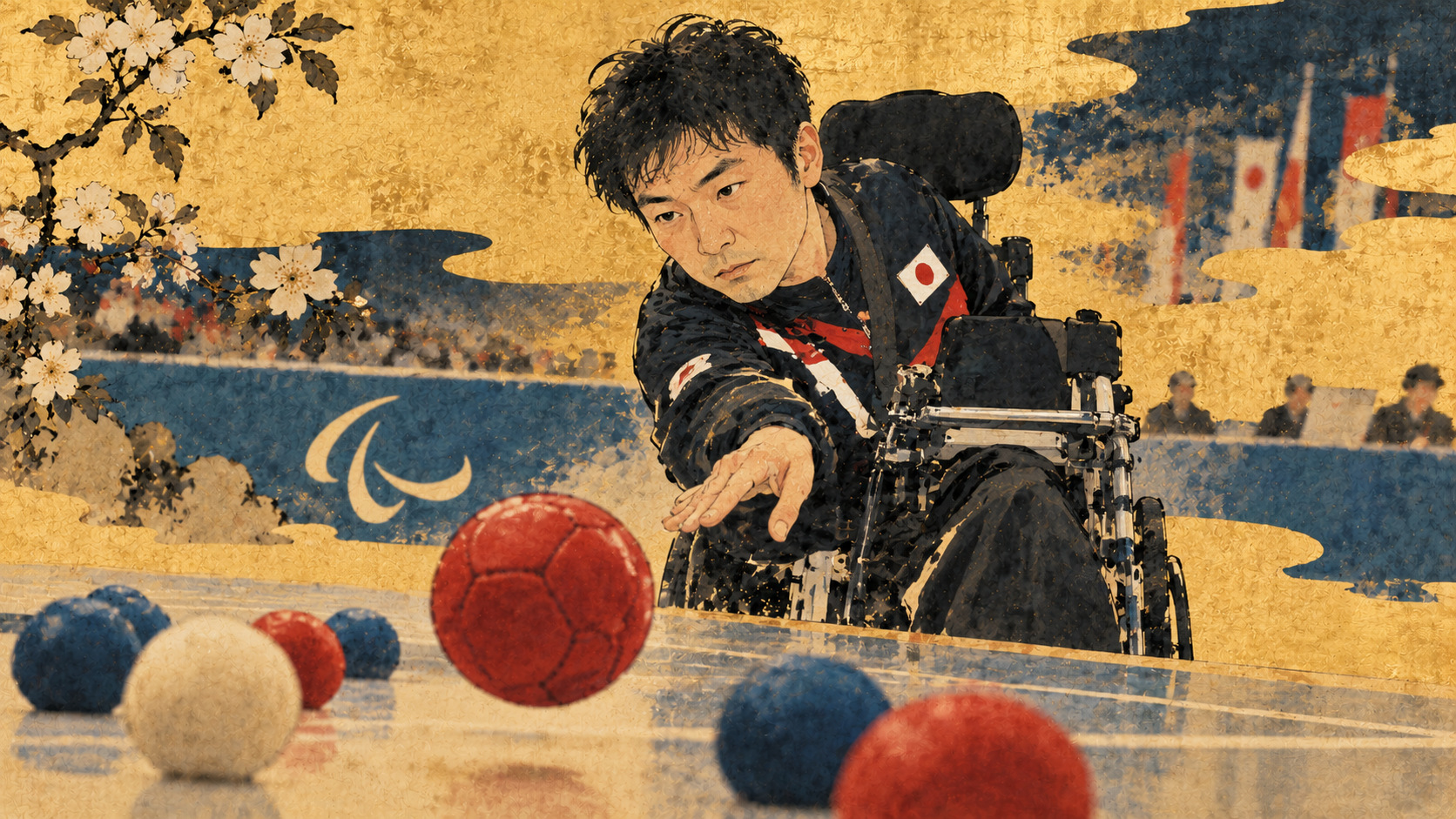
The anniversary made the story extraordinary. Precision, adaptation and competitive judgment won the medal.
A medal at the place where his life changed
The decisive action took place quietly: a ball rolled down a ramp, approached the white jack, and changed the mathematics of a match. On October 21, Kazuki Takahashi of Japan defeated South Korea’s Jeong Howon 5–1 in the men’s BC3 individual bronze-medal match at the Aichi-Nagoya Asian Para Games.
Jeong was the Paris 2024 Paralympic champion. Takahashi had also defeated him in preliminary play. But the contest carried another significance for the Japanese athlete: according to the Japan Boccia Association and his post-match remarks, he had sustained a spinal cord injury while competing in judo at the same venue approximately 30 years earlier.
That coincidence could overwhelm the reporting. It should not. A thirty-year biography does not score five points. Takahashi earned them through precise decisions under pressure, working with ramp operator Yutaka Hoshi.
How the bronze match was won
Takahashi went unbeaten in three preliminary matches. Thailand’s Withun Chanthakhat then defeated him in the semifinal with a final-end comeback, leaving him to prepare for an exceptionally difficult bronze contest against a reigning Paralympic gold medalist.
In the first end of the bronze match, Takahashi scored three points. He added one in the second, conceded one in the third, and scored once more in the fourth to prevail 5–1. The opening three-point lead changed the tactical obligations of both players: Jeong now needed to create scoring opportunities while Takahashi could defend an advantage without losing control of the jack.
Takahashi told the Japan Boccia Association that he viewed the semifinal loss as a question of small inaccuracies rather than a fundamental tactical failure. His response was not merely motivational. It was technical and immediate.
Inside BC3: the strategy belongs to the athlete
Boccia is a precision sport in which opponents propel colored balls toward a white target known as the jack. Players can score through placement, but also through controlled collisions that displace the jack or opposing balls. Every end becomes a problem in geometry, probability and nerve.
In BC3, competitors use a ramp to deliver the ball. The ramp operator adjusts equipment under the athlete’s direction, while rules prevent that operator from seeing the playing area during an end. The athlete, not the operator, owns the decisions about aim, distance and tactical sequence. World Boccia’s current rules spell out those responsibilities.
For Takahashi, Hoshi was the ramp operator. Their work should not be described as an athlete passively receiving assistance: it is a regulated collaboration in which communication, trust and technical precision are indispensable.
Hoshi’s contribution and the cost of a near miss
In the association’s post-match account, Hoshi explained that he regarded creating a supportive atmosphere as part of his contribution. He and the coach worked to draw out Takahashi’s smile. Takahashi, meanwhile, spoke of wanting to achieve a result together with Hoshi before family members and supporters in the home crowd.
He was clear that bronze was not his ultimate ambition. He had wanted the best-colored medal. That dissatisfaction is evidence of a world-class competitor measuring his performance by sporting goals, not only by the poignancy of the occasion.
Japan’s national team uses the name Hinotama Japan. The association reported that Takahashi was the only individual team member to progress to the knockout stage in the competitions covered by its October 21 announcement.
What it means to return—without reducing a life to an injury
The Japan Boccia Association reported that Takahashi’s spinal cord injury occurred during a judo match in this same sports venue around 30 years ago. His reflections after the medal ceremony concerned much more than that injury. He said that his younger self could not have pictured a future in which he would be supported by so many people and able to experience such happiness.
There is a risk in treating disabled athletes as inspirational symbols rather than competitors, especially when an injury supplies a compelling narrative arc. Takahashi’s story deserves a wider frame: a life lived in a wheelchair, years of training, relationships built through sport, painful defeats, hard-earned expertise and an ongoing desire to win.
Japan.co.jp has not independently obtained medical or contemporary venue records documenting the original accident. The historical account is attributed to the athlete’s statements as published by the national governing body.
The long road through Rio and Tokyo
The Japanese Paralympic Committee lists Takahashi, born February 3, 1980, as a BC3 competitor who placed 12th individually at the Rio 2016 Paralympics. His résumé extends well beyond one emotional return to Nagoya.
At the Tokyo 2020 Paralympics—held in 2021—he won silver in the mixed BC3 pairs competition. At a Tokyo Metropolitan Government reception that autumn, he acknowledged the happiness of a silver medal while speaking candidly about falling short of gold. A bronze medal five years later fits into the history of an elite athlete who has never confused participation with satisfaction.
Boccia entered the Paralympic programme in 1984, with 19 competitors from five countries. Over four decades, it became a sophisticated international sport, and Asian contenders, including South Korea and Japan, emerged as leading forces.
Twice past a champion from South Korea
The Asian Paralympic Committee’s account of October 19 records Takahashi defeating Jeong in a tiebreak after a 3–3 score. Jeong, one of the game’s most decorated stars, entered the tournament as Paris 2024 BC3 champion.
Meeting again on October 21, Takahashi won far more decisively. South Korean outlet News1 also reported the 5–1 score and Jeong’s exit without an individual medal. This was not an anonymous upset: two athletes with deep international experience met twice, and Takahashi won both matches.
That record deserves to be understood in tactical terms rather than reduced to an uncomplicated national rivalry.
A history that began long before this podium
The origins of target-ball games extend across many cultures, but the modern Paralympic discipline is comparatively young. Boccia debuted at the 1984 Games and expanded its classification and competitive systems in subsequent decades. In the BC3 class, equipment design and athlete–operator communication have become central to the sport’s technical sophistication.
Japan’s Tokyo 2020 Paralympics helped make boccia more visible domestically. Yet athletes train for years between major televised tournaments. National records, sponsor support and an active competition circuit matter when a hometown medal becomes possible.
Takahashi competes for Forval Corporation, according to the Japanese association’s 2026 announcement. His achievement is thus also a story about the sporting infrastructure behind Japanese para-athletes, although no independent assessment of his funding or training arrangements was conducted for this article.
The next end
After the individual event, Takahashi was named for BC3 pairs competition alongside Hoshi, with Japanese teammate Ayaka Sekine and ramp operator Katsuo Nakamura. Those were the announced plans as of October 21, not a claim about matches not yet verified in this report.
The Los Angeles 2028 Paralympics are on the horizon, but neither another selection nor another medal follows automatically from a 2026 bronze. Every competition begins afresh.
The enduring image from Nagoya is not simply an athlete coming back to a building. It is a player who studied a narrow semifinal defeat, made adjustments and beat a Paralympic champion. Thirty years matter, but so does the final ball.
Reporting sources and further reading
Based principally on official October 21 results and interviews published by the Japan Boccia Association. The original injury records were not independently obtained. No exclusive interviews or rights to event photographs are claimed.
- Japan Boccia Association: October 21 match and athlete interviews
- Asian Paralympic Committee: Jeong’s opening match
- Japanese Paralympic Committee: Tokyo 2020 roster
- Tokyo Metropolitan Government: 2021 medalist reception
- World Boccia: Rules 2025–2028
- International Paralympic Committee: Boccia history
- South Korean News1: bronze match reporting