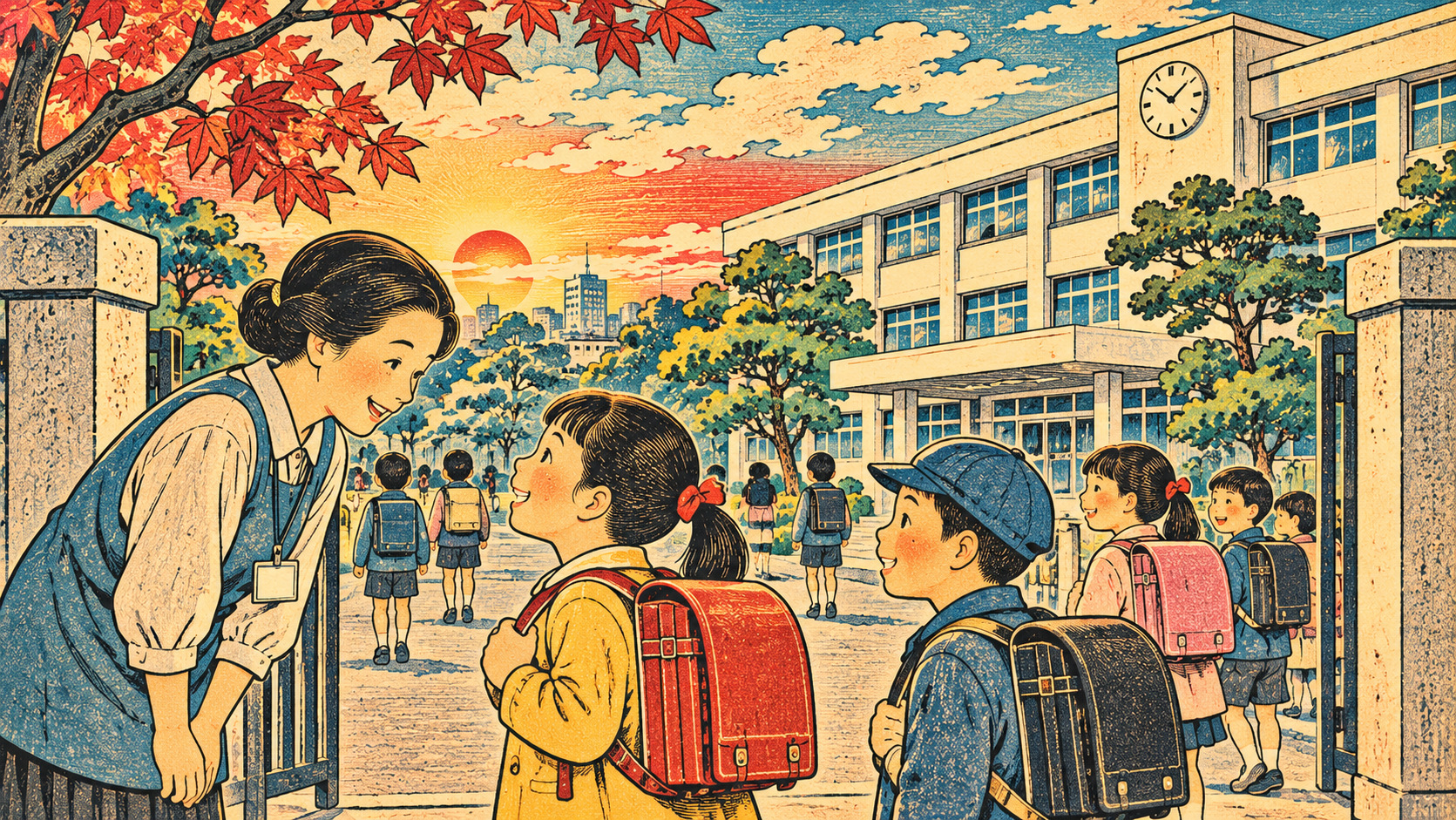
- The overlooked gap between the commute and the school bell
- From three schools to seven wards—and an eighth site
- What a child actually does before class
- Why after-school care never answered the morning question
- Community groups, not another routine for classroom teachers
- The practical meaning of safety before the doors open
- What 113 opening-day users can—and cannot—tell us
- The economics of expanding from eight schools to 115
- A forty-minute experiment with larger implications
The overlooked gap between the commute and the school bell
Consider the timetable of an ordinary working morning. A parent must leave home early enough to catch a train; an elementary-school child may not be allowed into the building until well afterward. The difference can be only half an hour, but it creates a genuine choice about supervision, safety and whether a child must wait outside. Japan has spent decades building after-school support. Before-school provision is a more awkward piece of the daily schedule.
On November 19, Kawasaki City announced that Minamikase Elementary School in Saiwai Ward will begin a pilot early-morning school-space program on December 7. It would be the eighth municipal elementary school participating in a project the city calls 朝の居場所づくり, literally “creating a place to be in the morning.”
The idea is not elaborate: make designated school space available before classes, with community-based adults supervising. The policy significance lies in its possible scale. Kawasaki has 115 municipal elementary schools and hopes eventually to provide such spaces throughout the system. That ambition is still a goal, not a completed or fully costed citywide service.
From three schools to seven wards—and an eighth site
Kawasaki began with three schools on July 6, 2026: Shin-Ogura Elementary in Saiwai Ward, Hisamoto Elementary in Takatsu Ward, and Inukura Elementary in Miyamae Ward. According to the city, 113 children used the spaces on the opening day, with attendance of 43, 41 and 29 respectively.
The next schools came in stages. Shimokodanaka Elementary in Nakahara Ward and Yurigaoka Elementary in Asao Ward joined on September 14. Noborito Elementary in Tama Ward began on October 28, and Kawasaki Elementary in Kawasaki Ward on November 16. That established a presence in each of the city’s seven administrative wards.
The newly announced Minamikase site would be a second location in Saiwai Ward, bringing the total to eight on December 7 if it opens as planned. As of the November 23 publication date, that start is in the future. It is important not to convert a scheduled opening into a report of an already operating service.
What a child actually does before class
At the original pilot schools, spaces were available on school days from approximately 7:30 a.m. until 8:10 a.m., using facilities such as libraries and a media center. Children could read, study or talk with the adults on duty. Kawasaki’s published pilot instructions specified free access without advance registration and the use of a participation card.
This is not a substitute for a full childcare day, an extended kindergarten program, or the after-school clubs that families know as gakudō. It addresses a narrow window just before lessons, when a safe indoor setting may be more useful than a larger activity schedule. Weekends, holidays and longer school breaks were excluded from the original pilot arrangements.
Crucially, those details are established for the first three schools. Staffing, precise entry routes and individual arrangements at Minamikase should be confirmed through the school and municipal guidance rather than inferred from the earlier pilot. The citywide program is still being adapted to different school premises.
Why after-school care never answered the morning question
Japan’s after-school child programs developed around the idea that children need a protected place when classes end and parents have not returned from work. That structure helped make employment and schooling compatible for many families. But it created no automatic answer to the opposite end of the day: when parental work starts before the school opens.
Kawasaki’s own 2026 policy statement identifies parental reassurance and pupil safety as central objectives. The city proposed one pilot school in each ward and an expansion dependent on local readiness. Its approach treats the morning gap as a specific public-policy problem rather than simply asking teachers to extend their working day.
The need does not belong to one type of household. Parents raising children alone, shift workers, commuters with long trips and families juggling a younger sibling’s nursery drop-off may all face different forms of the same scheduling conflict. A durable system will have to accommodate those differences without assuming that every family needs the service every day.
Community groups, not another routine for classroom teachers
Kawasaki’s initial operating model enlisted organizations already active in local community life. Shin-Ogura’s program was operated by NPO Hatarakurasu, Hisamoto’s by the Takatsu Ward community sports-club NPO SELF, and Inukura’s by the Inukura children’s book group. The diversity of these operators is not incidental; it is a central feature of the city’s attempt to draw on local people.
The Inukura group had already been opening a morning library space with volunteers during the previous school year, according to city materials. That experience illustrates a possible advantage of community partnerships: adults who know the neighborhood and can create a welcoming environment rather than merely supervising an empty room.
But the same model has a scalability problem. Being reliable every school morning requires recruitment, training, accountability, substitute coverage and clear arrangements with school administrators. An enthusiastic local group is a strong foundation, not a guaranteed workforce for a permanent network of 115 sites.
The practical meaning of safety before the doors open
Kawasaki’s planning documents say opening times for school gates and building entrances vary, and some pupils have traditionally waited in outdoor spaces until their buildings opened. On cold, rainy or dangerously hot mornings, that wait can become stressful. A designated indoor space could reduce exposure and uncertainty.
Yet opening a room early also creates new obligations. Schools and community operators must define who checks arrivals, handles illness or a missed pickup, contacts parents, manages emergencies and supervises access to the building. These are operational requirements, not details that can be solved by the simple existence of a spare classroom.
Claims of educational gains also deserve scrutiny. A quiet place to read may be valuable in its own right, but the city has not published evidence that this program increases test scores or eliminates tardiness. A credible evaluation would track safety incidents, families’ reported relief, children’s experience and any additional burden transferred to school staff.
What 113 opening-day users can—and cannot—tell us
The first three pilot schools recorded 113 participating children on July 6. That demonstrates that families were willing to use the opportunity immediately. It does not establish the percentage of all pupils who need morning support, the number who would use it regularly, or its effect on parents’ employment.
Kawasaki publicized anecdotes from the first day: a child appreciated having time to finish homework, while a parent described needing to leave early for work before taking a younger child to nursery care. These accounts are useful illustrations of need, but they are not a representative satisfaction survey.
The more revealing figures would come over a full school term: daily demand, no-show patterns, age distribution, operating costs, parent satisfaction, staffing stability and the experience of families who cannot use the service. Schools that report low attendance may have inadequate access rather than no underlying demand.
The economics of expanding from eight schools to 115
Kawasaki’s 2026 fiscal planning materials identified ¥22.264 million in new funding for promoting morning school spaces. That is a budget line for the initial policy effort. It should not be divided by 115 and described as the proven annual operating cost per school; the program had not been deployed across all 115 campuses.
Citywide expansion would entail more than wages for morning supervisors. Recruiting local partners, coordinating building access, maintaining safeguarding procedures, setting up emergency communications and evaluating results all have costs. Some sites may already have community groups or suitable rooms; others may require different staffing and arrangements.
The city explicitly says it intends to expand as individual schools become ready. That cautious phrasing is sensible. It also means neither a completion date nor comprehensive funding for every campus can be established from the November announcement alone. A meaningful public debate should ask for per-site costs, equitable access and durable financing as the rollout progresses.
A forty-minute experiment with larger implications
Kawasaki is not proposing to reinvent the Japanese school curriculum. It is offering approximately 40 minutes of structured, supervised time before lessons begin. The apparent modesty of the intervention is precisely why it merits attention: household and public-service timetables rarely align perfectly, yet small gaps can produce disproportionate stress.
The new school announced for December will test whether the approach can expand beyond a single model site in each ward. If it works, other cities may examine the lessons, but Kawasaki has not established a national template or proved that one delivery model fits every municipality.
The measure of success will not be a map showing 115 colored dots. It will be whether children reliably begin their days safely and calmly, whether parents can organize their mornings with less anxiety, and whether communities and schools can keep the arrangement going. The city is trying to turn a vulnerable interval into an ordinary, dependable part of the school day.
Primary sources, reporting method and unresolved questions
This report analyzes Kawasaki City Education Board announcements from July through November 2026, municipal policy materials, and the city’s published program guidance. We did not visit participating schools, interview children or families, independently audit outcomes, or verify Minamikase’s school-specific operating instructions. Such details should not be assumed from earlier pilot sites.