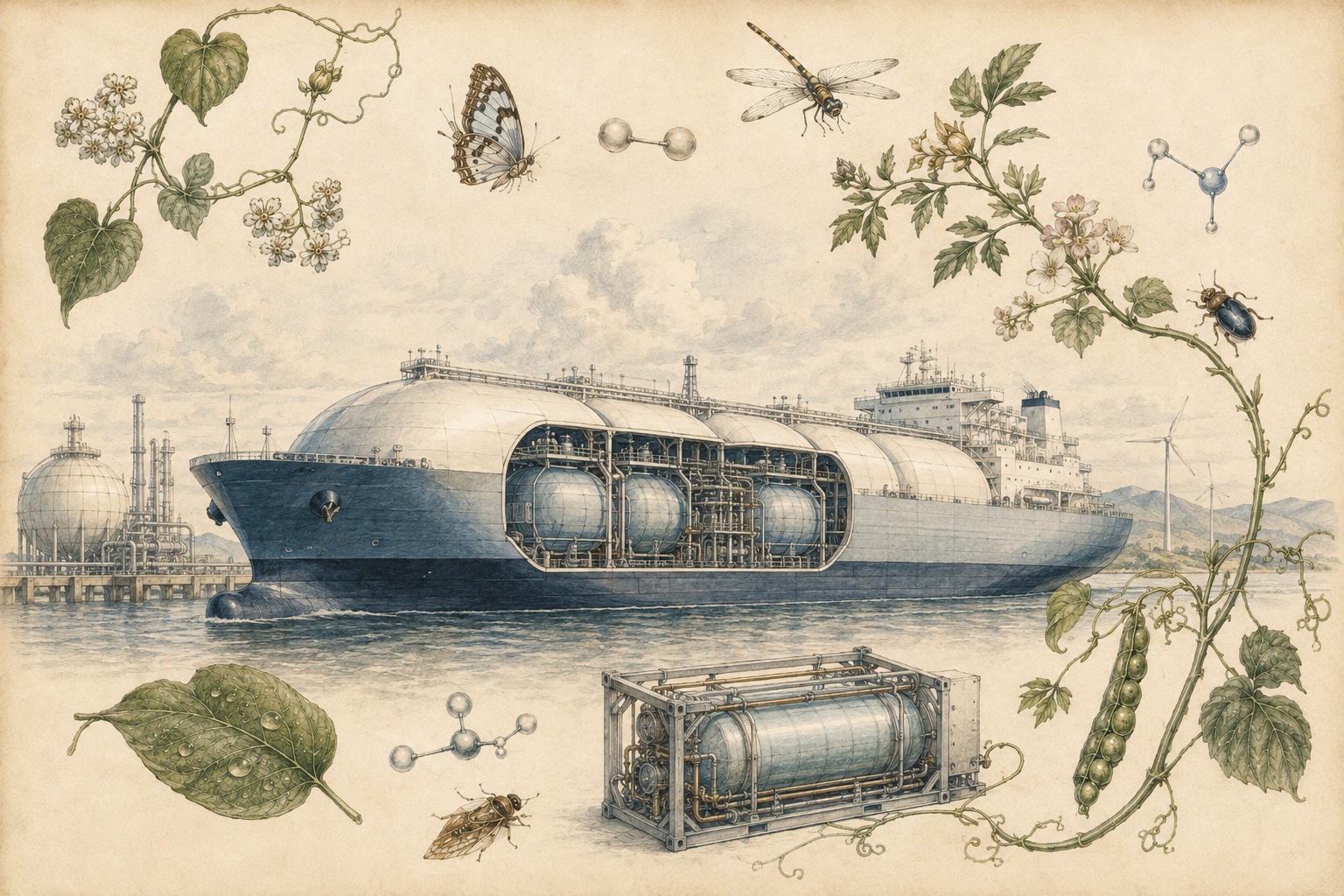
Scaling a ship by a factor of 32 is not the same thing as enlarging a drawing by 32. When the 1,250 m³ Suiso Frontier returned from Australia in 2022, Japan had demonstrated something no country had previously completed as an integrated pilot: load liquid hydrogen onto a purpose-built carrier, move it across an ocean and unload it into a receiving system. Four years later, the next contracted vessel is being asked to carry approximately 40,000 m³. By cargo volume alone, that is a 32-fold jump.
On January 6, 2026, Kawasaki Heavy Industries and Japan Suiso Energy announced the shipbuilding contract. The planned vessel is approximately 250 meters long, 35 meters wide and 20 meters deep, with a summer full-load draft of 8.5 meters and a sea speed of about 18 knots. It will be Japanese-flagged and classed by Nippon Kaiji Kyokai, or ClassNK. Its propulsion architecture is diesel/hydrogen-fueled electric propulsion, combining a hydrogen/oil dual-fuel generator engine with a conventional oil-fueled generator.
Yet the most important specifications are not dimensions. They are the systems that make minus-253°C hydrogen behave like commercial cargo: insulation that limits boil-off, equipment that turns unavoidable boil-off gas into ship fuel, high-volume cargo handling, and double-wall vacuum-jacketed transfer piping. Suiso Frontier proved that marine liquid-hydrogen logistics could be done. The 40,000 m³ vessel is intended to test whether they can be done at the volume, speed and reliability that a business requires.
Why liquefy hydrogen at all?
Hydrogen is the lightest element. That gives it excellent energy content by mass, but at ordinary temperature and pressure it occupies so much volume that bulk ocean transport becomes impractical. Liquefaction changes the logistics.
Cool hydrogen to roughly minus 253°C and it becomes a liquid. Kawasaki says its volume falls to about one eight-hundredth of the gaseous state. That makes ship-scale transport possible, but it creates a demanding cryogenic problem. The hydrogen has to be liquefied, the cargo containment system has to resist heat ingress, and any heat that does enter causes some of the liquid to evaporate.
That natural evaporation is boil-off gas, or BOG. No practical tank is perfectly insulated. A commercial design therefore has two jobs: reduce the amount of heat entering the tank, then make useful work from the hydrogen that inevitably boils off.
The new ship uses high-performance insulation to limit BOG. When gas is produced, a hydrogen fuel-supply system with compression and heat-exchange equipment can route it to the generators. What would otherwise be a cargo-management burden becomes part of the ship’s propulsion energy.
Tanegashima, LNG and hydrogen: half a century of cryogenic engineering
Kawasaki did not arrive at liquid hydrogen from nowhere. The company presents its hydrogen work as the latest chapter in roughly half a century of cryogenic engineering.
One major branch came from LNG. After the 1973 oil shock, Japan accelerated efforts to diversify imported energy. In 1981 Kawasaki’s Sakaide Works completed the 129,000 m³ Golar Spirit. Kawasaki’s corporate history identifies it as the first LNG carrier built in Japan and the first large LNG carrier built outside Europe and the United States.
LNG carriers taught Japanese shipbuilders how to put enormous cryogenic tanks inside a moving hull: manage thermal contraction, ship motion, structural loads, insulation, loading systems and gas generated by heat ingress. Liquid hydrogen demands an even colder environment, but the engineering culture is related.
A second branch came from spaceflight. In the 1980s Kawasaki delivered liquid-hydrogen storage tanks to the Tanegashima Space Center, then operated by NASDA, the predecessor of today’s JAXA. Rocket hydrogen was a niche market compared with energy shipping, but it gave engineers decades of direct experience with hydrogen at minus 253°C.
When Kawasaki published thermal-insulation results in 2023, it explicitly connected the vacuum-insulated double-shell tanks on Suiso Frontier and the Hy touch Kobe terminal with knowledge accumulated from the Tanegashima storage tank delivered more than 40 years earlier. The shipbuilding story is therefore also a story about technologies migrating from space systems and LNG into an entirely new energy trade.
In 2016, the international safety rulebook was still being written
The challenge was regulatory as well as technical. Ships carrying LNG and LPG are governed by the International Gas Carrier Code, but the IGC Code did not contain detailed requirements for bulk liquid-hydrogen carriage when Japan began pursuing the pilot.
In 2016 the International Maritime Organization adopted MSC.420(97), Interim Recommendations for Carriage of Liquefied Hydrogen in Bulk. IMO explained that the recommendations were needed precisely because the IGC Code did not specify the requirements for liquid hydrogen and because a pilot ship needed a framework for safe long-distance overseas transport.
In 2017 ClassNK published its own Guidelines for Liquefied Hydrogen Carriers based on those IMO recommendations. Suiso Frontier’s design review and construction survey were carried out under those rules and guidelines.
IMO adopted revised interim recommendations in 2024, and the regulatory framework continues to evolve. Liquid-hydrogen carriers are not entering a century-old mature rule set. Ship size, engineering practice and international safety rules are maturing together.
Suiso Frontier: the 116-meter ship that proved “possible”
Suiso Frontier was named and launched at Kawasaki’s Kobe Works in December 2019. It is 116 meters long and 19 meters wide, with a molded depth of 10.6 meters, gross tonnage of roughly 8,000, cargo capacity of about 1,250 m³ and a sea speed of about 13 knots. Its propulsion is diesel electric.
The vessel was built for demonstration, not for commercial economics. Under the HySTRA/NEDO program, the broader pilot chain used Australian brown coal as a resource for hydrogen production, liquefied the hydrogen and tested the overseas transport and receiving chain into Kobe.
Suiso Frontier departed Japan for Australia in December 2021. In February 2022 the partners completed the pioneering pilot of liquid-hydrogen loading, ocean transport and unloading between Australia and Japan.
The achievement was not simply that a hydrogen ship crossed an ocean without incident. Engineers acquired operating data on storage, ship-to-shore interfaces, cryogenic cargo handling and long-duration insulation.
Kawasaki’s 2023 results put numbers around that insulation performance. Suiso Frontier’s storage tank recorded a boil-off rate of 0.3 percent per day, while the Hy touch Kobe onshore tank recorded 0.06 percent per day. Kawasaki said both were better than their design targets and comparable with boil-off performance for LNG coastal vessels and storage tanks of a similar class.
| Suiso Frontier | New 40,000 m³ vessel | |
|---|---|---|
| Role | Pilot international liquid-hydrogen transport | Commercial-scale supply-chain demonstration |
| Cargo capacity | Approx. 1,250 m³ | Approx. 40,000 m³ |
| Length | 116 m | Approx. 250 m |
| Breadth | 19 m | 35 m |
| Sea speed | Approx. 13 knots | Approx. 18 knots |
| Propulsion | Diesel electric | Diesel/hydrogen-fueled electric |
| BOG strategy | Pilot storage and transport validation | Active use of boil-off hydrogen as generator fuel |
What becomes harder when cargo volume jumps 32-fold?
More cargo per voyage can lower transport cost per unit. But larger tanks amplify problems in heat transfer, structural engineering, manufacturing, inspection, cargo handling and safety.
A cryogenic hydrogen tank is more than a very large thermos bottle. Heat paths through supports and piping have to be controlled. A ship bends and twists in waves. Liquid moves inside its tanks. Metals contract under deep cryogenic temperatures. Design choices that improve insulation can conflict with structural demands.
Manufacturing also has to change. Kawasaki has discussed welding and inspection automation and modular production techniques for future large hydrogen tanks. A commercial industry cannot depend on heroic craftsmanship to make one exquisite demonstration tank. It has to manufacture multiple tanks with repeatable quality, lead time and cost.
40,000 m³ is not the end point: a 160,000 m³ design is waiting beyond it
Kawasaki’s design ambitions already extend far beyond the contracted vessel. In 2021 ClassNK granted AiP to Kawasaki’s 40,000 m³-class cargo containment system for a large liquid-hydrogen carrier. In April 2022 Kawasaki obtained AiP for a vessel using four such tanks, for 160,000 m³ total cargo capacity.
That concept is approximately 346 meters long and 57 meters wide with a 9.5-meter draft. Kawasaki said its four 40,000 m³ tanks could carry roughly 10,000 tonnes of liquid hydrogen. In scale, the concept approaches the world of major LNG shipping.
But Approval in Principle is not a shipbuilding contract. It indicates that the classification society has found no fundamental technical obstacle in the reviewed concept under the applicable rules and risk assessment. The vessel actually contracted in 2026 is the 40,000 m³ ship.
The sequence is revealing: prove the basic chain at 1,250 m³; prove commercial-scale operations at 40,000 m³; retain a technical pathway to 160,000 m³ if demand eventually justifies LNG-like scale. This lets the market mature alongside the machinery.
The ship can burn part of the cargo it is carrying
The propulsion architecture is one of the clearest signs that the new vessel is designed for a different era. Rather than driving the propeller directly with a hydrogen main engine, the vessel generates electricity onboard and uses electric propulsion. The generating plant includes a hydrogen/oil dual-fuel engine as well as a conventional oil-based generator engine.
Boil-off hydrogen from the cargo tanks can be compressed, conditioned through heat exchangers and supplied to the generator. The cargo is therefore also a potential fuel source for the ship.
That solves two problems at once: it reduces the burden of managing BOG and can lower CO₂ emissions from the voyage. But the vessel should not be described as a guaranteed zero-emission ship. Kawasaki’s published specification is “diesel/hydrogen-fueled electric propulsion,” and a conventional oil-fueled generator remains part of the design. The company has not published the future fuel split across specific voyages.
Actual shipping emissions will depend on how much boil-off is available, how the engines are operated, cargo load, route and other conditions.
Loading time may matter almost as much as sailing speed
A large ship does not earn its economics merely by being at sea. If it spends days waiting or loading in port, capital and labor costs continue while no cargo is being delivered. Cheap hydrogen shipping therefore requires faster cargo handling as well as larger tanks.
The 40,000 m³ vessel will have a cargo system designed to load and unload large volumes of liquid hydrogen. Transfer lines use double-wall vacuum-jacketed piping so the minus-253°C cargo can move safely and efficiently between shore and ship with reduced heat ingress.
Cargo handling involves far more than pumping a liquid. Piping has to be cooled down. Materials contract. Connections must remain sealed. Emergency shutdown systems have to act rapidly. Vapor has to be managed. The ship rises and falls with tide and cargo level while the shore connection remains safe.
What Suiso Frontier and Hy touch Kobe tested at pilot scale now has to happen on a commercial timetable.
The other half of the ship is on land: Kawasaki LH₂ Terminal
The new vessel’s natural partner is the Kawasaki LH₂ Terminal now under construction at Ogishima. A groundbreaking ceremony was held in November 2025. JSE manages the project, while a Kawasaki-led joint venture is responsible for major design and construction work.
The terminal is planned around a 50,000 m³ liquid-hydrogen storage tank, marine loading and unloading systems, hydrogen liquefaction equipment, gaseous-hydrogen send-out facilities and liquid-hydrogen lorry dispatch. JSE and Kawasaki describe it as the world’s first commercial-scale facility for handling liquid hydrogen.
By FY2030, the project is intended to operate the new ship and terminal and test the performance, safety, durability, reliability, economics and commercialization requirements of an international hydrogen supply chain.
The present demonstration differs from the original Australia-Japan concept. JSE says that in FY2024 the plan changed from procuring hydrogen overseas for the demonstration to procuring hydrogen gas produced in Japan. That gas will be sent by pipeline to the Kawasaki terminal and liquefied there. The new vessel will conduct ship-to-base cargo handling and trials under ocean-going conditions. Importing liquid hydrogen from overseas is the post-2030 commercial objective.
Does a bigger ship really make hydrogen cheap?
Japan’s policy target is explicit. NEDO’s Green Innovation Fund project for large-scale hydrogen supply chains aims for hydrogen supply costs of 30 yen per normal cubic meter in 2030 and 20 yen or less by 2050. Large liquid-hydrogen and MCH supply chains are intended to reduce cost through scale while large end users create demand.
Ship size is central to that logic. A vessel carrying 32 times the cargo does not need 32 bridges, 32 crews or 32 port entries for one equivalent quantity of hydrogen. Capital cost, crew, insurance, propulsion and port fees can potentially be spread over more product.
But “bigger is cheaper” only works if the vessel is full and moving. If the ship sails partly empty, scale economics evaporate. If a liquefier stops, the ship waits. If the receiving market cannot absorb cargo, storage fills and the vessel has nowhere productive to go.
The hidden variable in hydrogen shipping is utilization.
- Hydrogen production cost: the price before liquefaction begins.
- Liquefaction energy: the electricity required to reach minus 253°C.
- Boil-off rate: how much cargo vaporizes during storage and voyage.
- Ship load factor: whether voyages leave close to full.
- Voyages per year: how little time is lost to waiting, maintenance and turnaround.
- Cargo-handling time: how quickly large volumes can be transferred safely.
- Demand utilization: whether power plants and industrial users consume arriving hydrogen continuously.
LNG gives hydrogen both a hopeful precedent and a warning
LNG is the closest historical precedent. Natural gas was once difficult to move economically across oceans. Liquefaction plants, insulated tanks, large carriers, receiving terminals, pipelines and long-term contracts turned it into a global commodity.
Kawasaki’s Sakaide Works helped build that Japanese history. Since Golar Spirit in 1981, the company has accumulated decades of LNG and LPG shipbuilding experience. Building the 40,000 m³ hydrogen carrier at the same Sakaide yard makes the industrial lineage unusually visible.
But hydrogen cannot simply inherit LNG’s economics. It has lower volumetric energy density, requires much colder storage, and consumes energy in liquefaction. Natural gas is an extracted primary energy resource; hydrogen usually has to be manufactured first from electricity or another feedstock, then conditioned for transport.
That means liquid hydrogen has to earn its role. Converting electricity into hydrogen and shipping it across an ocean will not always beat direct electrification. The strongest cases may be where Japan needs imported low-carbon molecules for steel, chemicals, long-duration energy storage, power balancing or other hard-to-electrify demand.
A cargo called hydrogen is not automatically low-carbon
The early Suiso Frontier pilot included hydrogen produced from Australian brown coal. The intended concept was to use an abundant resource while preventing associated carbon dioxide from entering the atmosphere through carbon capture and storage. The climate value of that hydrogen depended on upstream emissions management.
The current commercialization demonstration has shifted to domestically produced hydrogen, but “domestic” is not itself a carbon standard. The electricity or feedstock used to make the hydrogen still matters. Future imported hydrogen will likewise have to be judged by production emissions, capture performance where relevant, electricity source, liquefaction energy and shipping emissions.
The ship’s own emissions matter too. Using hydrogen BOG can lower CO₂, but the ship retains oil-fueled generation. The terminal, liquefier, compressors and vaporization systems all consume energy.
The meaningful metric is therefore not cubic meters transported. It is lifecycle carbon dioxide avoided when delivered hydrogen displaces a fossil alternative.
Marine safety: managing an invisible gas at cryogenic temperature
Hydrogen has a wide flammability range, low ignition energy and high buoyancy after leakage. Liquid hydrogen also introduces severe cryogenic hazards. Ship design has to address material behavior, leaks, ventilation, ignition sources, fire, collision, grounding and cargo-transfer accidents as one integrated safety system.
Kawasaki says the hydrogen fuel system, fuel-supply system and liquid/gaseous hydrogen cargo systems on the new vessel are subject to risk assessment, with measures designed to protect crew, the environment and the ship’s structural integrity. ClassNK rules and guidelines, IMO interim recommendations and the IGC Code framework underpin the design process.
Safety is also an economic issue. Insurance, port acceptance, inspection intervals, crew training and equipment redundancy all feed into cost. A design that is unnecessarily cumbersome can undermine economics; a design that is not sufficiently robust can destroy public acceptance. Commercial demonstration has to find the workable balance.
The day a 40,000 m³ hydrogen ship becomes boring
When Suiso Frontier was launched in 2019, the giant “LH₂” lettering on its side announced that this was something the world had never seen. A demonstration ship is supposed to attract attention.
Successful commercial shipping is almost the opposite. Oil tankers and LNG carriers became important precisely because ports learned to treat them as routine. Cargo windows are scheduled. Crews follow established procedures. Industrial customers assume next month’s delivery will arrive.
If the 40,000 m³ carrier succeeds, its descendants may become less newsworthy. Sakaide may build more of them. Ogishima may receive hydrogen on schedule. Pipelines may send it to plants that do not organize ceremonies every time the molecule arrives.
Suiso Frontier answered the question: Can liquid hydrogen be transported across the sea?
The 40,000 m³ vessel is being asked a much harder question:
Can liquid hydrogen be transported across the sea safely, repeatedly, cheaply and as a business?
That is what the 32-fold scale-up is really about.
1973 The first oil shock accelerates Japan’s diversification of energy imports and the expansion of LNG.
1981 Kawasaki’s Sakaide Works completes Golar Spirit, the first LNG carrier built in Japan.
1980s Kawasaki supplies liquid-hydrogen storage tanks to the Tanegashima Space Center, accumulating deep-cryogenic hydrogen experience.
2016 HySTRA is established; IMO adopts MSC.420(97), interim recommendations for bulk liquid-hydrogen carriage.
2017 ClassNK publishes Guidelines for Liquefied Hydrogen Carriers.
December 2019 Suiso Frontier is named and launched at Kobe.
2021 Kawasaki receives ClassNK AiP for a 40,000 m³-class liquid-hydrogen cargo containment system.
December 2021 Suiso Frontier departs Japan for Australia.
February 2022 The Australia-Japan pilot completes liquid-hydrogen loading, transport and unloading.
April 2022 Kawasaki receives ClassNK AiP for a 160,000 m³ liquid-hydrogen carrier design.
December 2023 Kawasaki publishes Suiso Frontier tank boil-off performance of 0.3% per day.
FY2024 JSE changes the commercialization-demonstration plan from overseas hydrogen procurement to domestically produced hydrogen.
November 2025 Groundbreaking for Kawasaki LH₂ Terminal, including a 50,000 m³ storage tank.
January 6, 2026 JSE and Kawasaki announce the shipbuilding contract for the 40,000 m³ carrier.
Through FY2030 The vessel and Kawasaki terminal are scheduled for cargo-handling, ocean-condition, safety, durability, reliability and economic demonstrations.
After 2030 The partners aim to establish a commercial international supply chain importing liquid hydrogen into Japan.
Reporting notes and principal sources
This article uses public information checked through August 9, 2026, 12:50 a.m. JST. The vessel’s delivery date, contract value, specific demonstration route, future hydrogen/oil fuel split and design boil-off rate have not been publicly disclosed and are not inferred. “World’s largest” follows the January 6, 2026 Kawasaki/JSE announcement for the vessel under shipbuilding contract; it does not imply that Kawasaki’s separate 160,000 m³ AiP design has been constructed.
- Japan Suiso Energy / Kawasaki Heavy Industries: Contract for world’s largest 40,000 m³ liquefied-hydrogen carrier, January 6, 2026
- Kawasaki: Naming and launch of Suiso Frontier, December 11, 2019
- Kawasaki: Thermal-insulation performance of Suiso Frontier and Hy touch Kobe, December 11, 2023
- Kawasaki: ClassNK AiP for 160,000 m³ liquid-hydrogen carrier design, April 22, 2022
- Kawasaki: AiP for 40,000 m³-class liquid-hydrogen cargo containment system, May 6, 2021
- JSE / Kawasaki: Groundbreaking for Kawasaki LH₂ Terminal, November 27, 2025
- Japan Suiso Energy: commercialization demonstration and FY2024 project change
- NEDO Green Innovation Fund: Large-scale Hydrogen Supply Chain Establishment
- NEDO: commercialization demonstration and 30 yen/Nm³ 2030 target
- IMO: MSC 97 and interim recommendations for bulk liquid-hydrogen carriage
- ClassNK: Guidelines for Liquefied Hydrogen Carriers, March 29, 2017
- Kawasaki: shipbuilding history and Golar Spirit, 1981
- Kawasaki: 50 Years History of Cryogenic Engineering