A painting that makes darkness the subject
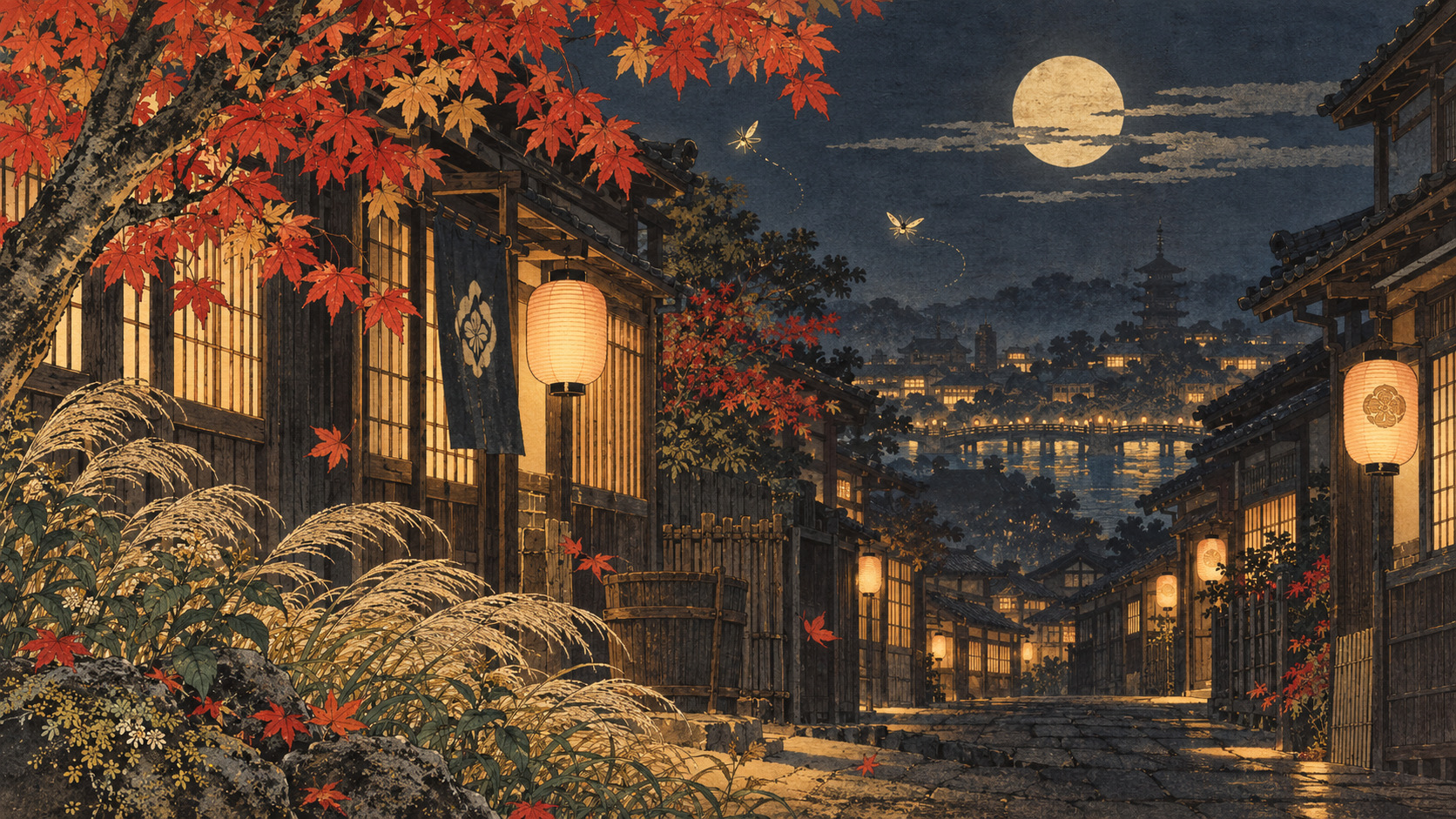
A street in Edo's Yoshiwara pleasure quarter is almost swallowed by the night. Behind wooden latticework, light reveals figures and patterned surfaces; outside, other people emerge as silhouettes. The extraordinary thing about Katsushika Ōi's hand-painted Night Scene in the Yoshiwara is not simply that it depicts artificial light. It makes the difference between illumination and obscurity the organizing principle of the picture. The Ota Memorial Museum of Art in Tokyo has placed this rare painting at the center of an exhibition, Katsushika Oi “Night Scene in the Yoshiwara” — The Lineage of Nightscapes, running from October 6 through December 6, 2026. According to the museum, this is the first public showing of the work in three years; it remains on view throughout the exhibition.
An artist who deserves more than a famous surname
Ōi was the daughter of Katsushika Hokusai, among the most internationally recognized Japanese artists. That relationship is useful context but inadequate as a description of her achievement. Her birth and death dates remain uncertain, and the museum says only about a dozen of her hand-painted works are known. Such a small surviving corpus invites extravagant stories about her life. It is better to begin with what can be seen and documented: in this painting, a remarkable intelligence for arranging several intensities of light across a complicated human scene. Her father's international celebrity should not flatten her into an assistant or curiosity. Equally, we should not invent a complete biography to compensate for the archive's silences.
The social architecture of the lattice
Yoshiwara was the officially licensed pleasure quarter of Edo, the city now called Tokyo. The lattice in Ōi's painting was part of the architecture of display and commerce. It separated people inside from observers outside, framing women as subjects of an economy and a public gaze. The work's beauty needs to be understood alongside that history. The quarter helped sustain networks of fashion, performance, publishing and art, but the women who worked there operated within systems of debt, restrictive status and coercion. To admire how Ōi painted the women and their spectators without acknowledging those conditions would produce an incomplete picture. The canvas captures a structure of looking; it does not, by itself, tell us what each of its subjects experienced.
Why the medium matters
Ukiyo-e is often associated internationally with multicolor woodblock prints, which require designs to be carved and printed from successive blocks. Ōi's masterpiece is different: it is a nikuhitsu-ga, a painting made directly by hand. That gives the artist another way to calibrate the transition from bright interiors to obscured faces and dark passages. Light is never simply a white patch against black. It has an apparent source and falls unevenly; figures can become visible by being surrounded by deeper shadow. The effect may remind a modern viewer of stage or cinematic lighting, but an analogy should not become a false historical claim. Ōi did not “invent film noir.” Her accomplishment belongs to the possibilities and experiments of Edo painting.
Other Japanese painters of the night
The new exhibition deliberately places her work in a lineage. The museum's selection includes Suzuki Harunobu, Torii Kiyonaga, Utagawa Hiroshige, Tsukioka Yoshitoshi, Kobayashi Kiyochika and others. Hiroshige's One Hundred Famous Views of Edo: Night View of Saruwaka-machi, on display in the first exhibition term, uses the geometry of streets and the depth of a night sky to establish atmosphere. Prussian blue, known in Japanese printmaking as bero-ai, became an especially evocative pigment for blue skies and water. A later perspective emerges in Kiyochika's View of Ryōgoku Bridge in Enlightened Tokyo, scheduled for the second term. As Japan's cities transformed in the Meiji era, bridges, lighting and streets changed the experiences available to artists. These works are not points on a single line of inevitable progress; they reveal changing choices about what the night could mean.
The night scenes made for export
The museum's most unexpected historical argument concerns images produced for buyers outside Japan from the late Meiji period onward. Japanese woodblock print culture had changed at home, but overseas markets continued to value images of moonlit bridges, dark streets and luminous water. The exhibition introduces night scenes that copied or responded to celebrated artists, and highlights the commercial work of publishers such as Hasegawa Takejirō and Watanabe Shōzaburō. Some have received little exhibition attention. Their presence raises a useful question for global readers: how much of what later generations picture as “traditional Japan” was shaped by the expectations of overseas collectors? Art traveled, and the market influenced what was made to travel.
The women we cannot hear
There is another reason not to view Ōi simply as an early modern master of illumination. She was a woman working in an artistic world whose surviving record heavily favors men. Yet a woman artist's representation of other women is not direct testimony from the women represented. The individuals visible through the lattice did not leave their voices in the pigment. Their labor, constraints and personal histories require other forms of evidence. The Ota museum has separately announced a 2027 exhibition examining the art history of pleasure quarters and the realities that glittering pictures could conceal. That forthcoming approach reinforces a useful discipline for this show: appreciate artistic invention, but make room for the histories left outside the frame.
What visitors can actually see
The exhibition runs in two terms: October 6–November 3 and November 7–December 6. Ōi's Night Scene in the Yoshiwara remains on display in both, but all other artworks rotate between the two terms. Hiroshige's Saruwaka-machi night scene is listed for the first; Kiyochika's Ryōgoku Bridge image for the second. The museum, at 1-10-10 Jingūmae in Shibuya, opens 10:30 a.m. to 5:30 p.m., with last admission at 5 p.m. Admission is ¥1,200 for adults, ¥800 for university and high school students, and free for children of junior high school age and below. The museum advises that it accepts cash only. Dates, works and visitor arrangements should be checked on the museum's official website before traveling.
What remains visible after the lanterns fade
A nocturnal picture can do more than preserve an attractive old city. It can show how the act of looking is organized: who is lit, who is shadowed, who is displayed and who is watching. Ōi's unusually rare painting gives international audiences a reason to look past Hokusai's reputation and ask what was distinctive about her own eye. The surrounding exhibition widens the question across centuries of Japanese printmaking and across the ocean to the business of selling a Japanese image abroad. The lasting encounter is not with light alone. It is with the darkness the artist chose not to erase.
Sources and Further Reading
- 太田記念美術館:展覧会公式案内 / Ota Memorial Museum official exhibition page
- 太田記念美術館:公式英語案内 / Museum English overview
- 太田記念美術館:2023年の作品展 / Museum previous exhibition, 2023
- 太田記念美術館:2026年展覧会一覧 / Museum exhibition calendar
- MY Bunkamura:展覧会情報 / Exhibition listing
- 太田記念美術館:年間展覧会予定 / Annual schedule
Research checked October 13, 2026. The exhibition opened October 6.