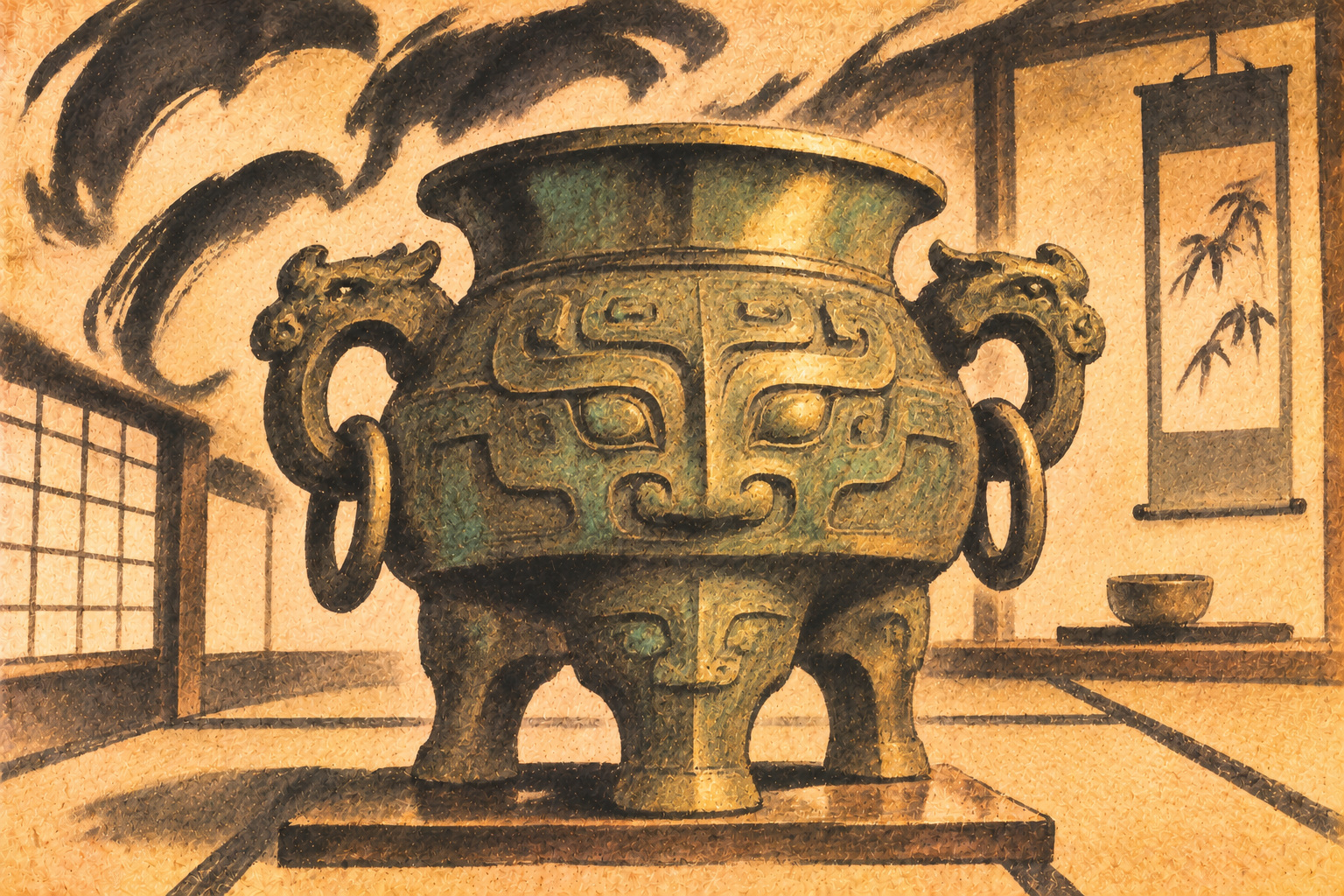
- The journey from an ancient ritual vessel to the tea room
- Karamono is a Japanese judgment, not a simple customs label
- Before tea, bronze was a language of ritual and power
- The vase that makes a casting experiment newsworthy
- Forms migrate across materials, not only countries
- Tea was imported; chanoyu became something else
- Who decides what deserves to be called a treasure?
- A museum founded on the very bronzes it investigates
- The exhibition changes halfway through
- Japan’s aesthetic originality lies partly in its openness
The journey from an ancient ritual vessel to the tea room
A bronze vessel in a Japanese tea room appears almost motionless: dark metal, a restrained arrangement of flowers, a space in which a small change of light matters. But the object carries an unexpectedly long journey. Its shapes have precedents in ancient Chinese ritual vessels, in later scholars’ reinterpretations of antiquity and in the choices Japanese collectors and tea practitioners made centuries afterward. A vase may tell a history of international exchange more eloquently than a map.
The Birth of Karamono: Exploring the Origins of Chanoyu Designs, at SEN-OKU HAKUKOKAN MUSEUM TOKYO in Roppongi, runs from November 3 to December 13, 2026. This November 13 report is a historical examination of the exhibition, not a newly announced opening. The curators propose a three-thousand-year perspective on Japanese tea aesthetics, with cast bronze flower vessels as a particularly revealing route through that history.
Karamono is a Japanese judgment, not a simple customs label
The term karamono, often translated as Chinese imports, developed within Japanese cultural practice. It was not limited to objects made in the Tang dynasty, despite the kanji for Tang in the word. In medieval and early modern contexts it could describe prized objects arriving from the continent and entering Japan’s world of collecting, display and tea. That makes the category a question of taste as much as origin.
An object does not become a celebrated tea utensil merely by crossing a border. It must be noticed, interpreted, sometimes renamed and placed within new rituals of use. Its previous function may be transformed. The exhibition asks how artworks and furnishings came to be designated meibutsu—renowned or treasured objects—and why certain shapes retained their prestige long after their first makers disappeared.
Before tea, bronze was a language of ritual and power
The museum’s substantial holdings of ancient Chinese bronzes ground the show in a history well before Japan’s tea ceremony. One listed object, the bronze zun known as Ding Fuji Zun (鼎父己尊), is dated to the late Shang period, around the eleventh century BCE. Such vessels belonged to a world in which cast metal could communicate ritual authority, rank and memory. They were not created as modern Japanese flower holders.
That distinction is essential. A straight line from a Shang sacrificial vessel to Sen no Rikyū would be misleading. Between those periods lies the Chinese revival of antiquarian scholarship, particularly during the Song dynasty, when collectors studied earlier bronzes and artisans adapted admired forms for new practical settings. Those revivals helped make a shared repertoire of shapes available to later East Asian craft traditions.
Primary source: 泉屋博古館|中国中近世の青銅芸術
The vase that makes a casting experiment newsworthy
The exhibition’s investigative centerpiece is kodō, bronze or bronze-like flower vessels prized in Japanese tea settings. Among the displayed examples is a fifteenth-century Ming vessel titled Kodo Momojiri Hanaire (胡銅桃尻花入). Its proportions and surface belong to a history in which age, casting character and association with earlier objects became aesthetic assets.
Crucially, the museum is not content merely to display these vessels. Working with the Tea Ceremony Research Center and Ashiyagama no Sato, it has organized casting experiments to investigate objects whose places of production and manufacturing processes remain incompletely understood. Experimental reconstruction can reveal how an alloy behaves in a mold or how walls and decorative features might be formed. It cannot, by itself, establish the provenance of every historical vessel; those conclusions require converging documentary, stylistic and materials evidence.
Primary source: 泉屋博古館東京|特別展「唐物誕生」公式案内
Forms migrate across materials, not only countries
The show crosses the boundaries between bronze, ceramics, lacquer, painting and calligraphy. A Southern Song celadon vase shaped like a cong—a form associated with much earlier Chinese jade—demonstrates that the migration of a silhouette can matter as much as the transport of an individual object. A tea caddy with the name Wakakusa demonstrates how a named vessel can acquire a distinct Japanese biography.
It also includes a sixteenth-century Korean tea bowl, Ko-Ido Chawan Rokujizō. That is an important complication in the usual shorthand of “Chinese influence”: Japanese tea aesthetics developed within a wider East Asian network, and some objects later prized in Japan were made on the Korean peninsula. Treating all imported prestige as one national tradition obscures the multiple histories that made the tea room possible.
Tea was imported; chanoyu became something else
The Urasenke school’s official history locates the early arrival of tea-drinking customs in exchanges with China involving Buddhist monks, and credits the medieval monk Eisai with transmitting Song-style powdered tea practices. By the Muromachi period, appreciation of imported Chinese art had become an important part of elite tea culture.
But the later evolution of chanoyu was not simply a quest for more expensive imports. Murata Jukō (1422–1502) looked to Japanese-made tools and the aesthetic possibilities of imperfection and restraint; Takeno Jōō (1502–1555) and Sen no Rikyū (1522–1591) developed the practice further. The celebrated tension between karamono prestige and wabi restraint helps explain how imported objects could be admired while new values emerged around humble, local ceramics.
Primary source: 裏千家|茶の歴史
Who decides what deserves to be called a treasure?
The afterlife of a tea utensil was shaped by networks of trade, religious institutions, powerful patrons, collectors and tea masters. Provenance—who had owned the object, where it had appeared and what stories accompanied it—could change its standing. The tradition of naming a tea bowl or caddy placed an object into a social and historical narrative that extended beyond its original workshop.
There is a politics to this beauty. Imported works could signify cultivated taste but also wealth and authority. The popular image of a perfectly modest tea room should not erase the material hierarchies that shaped elite collecting. A good exhibition can acknowledge both sides: the intensity of looking at a beautiful object and the social machinery that made that object famous.
A museum founded on the very bronzes it investigates
The setting is not incidental. SEN-OKU HAKUKOKAN was established as a foundation in 1960 after donations from the Sumitomo family that included more than five hundred Chinese bronzes and mirrors. The museum explains that the collection reflected both an interest in sencha, or steeped-leaf tea, and the family’s longstanding association with copper production.
The institution’s name combines Sen-oku, the Sumitomo family’s old trading name, with hakuko, a reference to the Song-period cataloguing of antiquities. Its bronze collection developed from private collecting into public scholarship and exhibitions in Kyoto and Tokyo. A museum whose identity grew from the study of Chinese metalwork is therefore especially suited to question how those works were reinterpreted in Japanese artistic life.
Primary source: 泉屋博古館|住友コレクションの歴史
The exhibition changes halfway through
The exhibition has an important two-part schedule. The first phase runs from November 3 through November 23; the second from November 25 through December 13, with the museum closed November 24. Among the objects scheduled for the first phase are the National Treasure Autumn Landscape traditionally attributed to Emperor Huizong, and a National Treasure tenmoku bowl with floral decoration. A related Winter Landscape and a celadon bowl called Bako Han are listed for the later phase.
Here “traditionally attributed” matters: it conveys an art-historical identification without pretending authorship is undisputed. Visitors planning a trip for a particular work should use the museum’s exhibit list rather than assume that every advertised masterpiece remains on view throughout the run. The November 27 casting-related lecture and November 29 symposium offer opportunities to follow the technical and historical questions further, subject to the museum’s reservation procedures.
Japan’s aesthetic originality lies partly in its openness
The museum is open from 11 a.m. to 6 p.m., with Friday evening hours until 7 p.m.; last admission is thirty minutes before closing. General admission is ¥1,500, students ¥800 and visitors under eighteen enter free under the published conditions. Those practical details make the historical proposition accessible: it can be tested by standing in front of the vessels, comparing surfaces and examining the differences between periods.
The larger lesson is not that Japanese tea culture was borrowed whole from China. Nor is it that imported works lost their original histories once they arrived. It is that creative cultures emerge through acts of selection and reinterpretation. Forms born in ancient ritual, revived in later workshops and valued in another country became something new in the tea room. The achievement of chanoyu is inseparable from that centuries-long conversation across borders.
Sources and reporting limitations
Research based on the museum and historical institutions. Traditional attributions, unresolved origins and reconstruction hypotheses are not treated as established certainties.