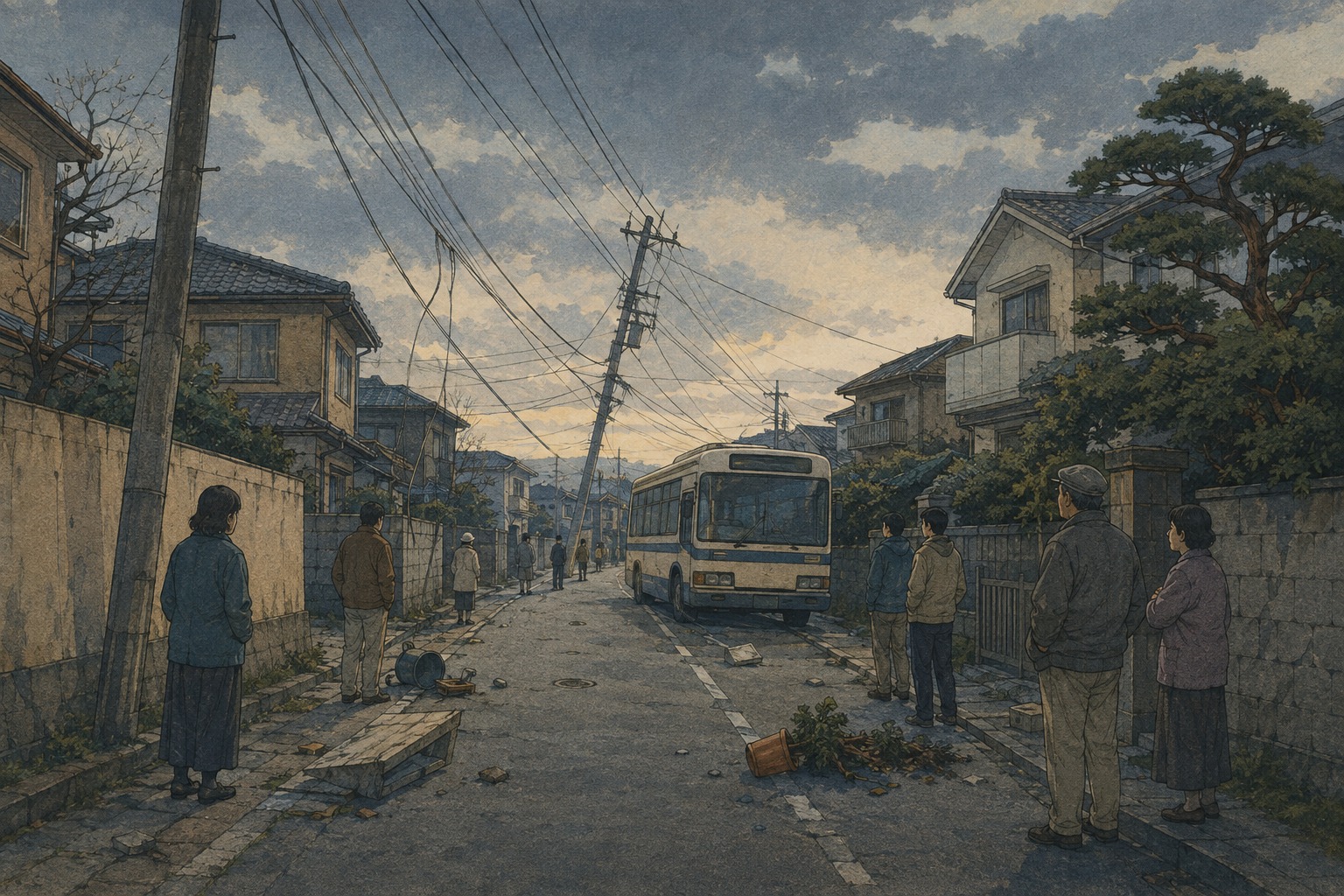
At 2:00 a.m., when most of the Tokyo region was asleep, strong shaking spread across the Kanto plain. Seventeen municipalities in Ibaraki, Saitama, Chiba and Tokyo registered lower 5 on the Japan Meteorological Agency’s seismic-intensity scale. The earthquake did not produce catastrophic structural failure, but it exposed a more ordinary urban danger: people falling in dark rooms, objects shifting, pipes breaking and transport systems stopping for inspection.
A deep earthquake beneath a densely populated plain
The Japan Meteorological Agency located the hypocenter in southern Ibaraki Prefecture at a provisional depth of 68 kilometers. Its provisional magnitude was 5.9. The focal mechanism was reverse faulting under east–west compression, and the agency’s initial analysis placed the rupture on the boundary between the descending Pacific plate and the Philippine Sea plate above it. There was no tsunami threat.
Lower 5 intensity was measured in Koga, Ryugasaki, Shimotsuma, Joso, Toride, Ushiku, Tsukuba, Chikusei, Tsukubamirai and Omitama in Ibaraki; Kawaguchi, Warabi, Toda and Miyashiro in Saitama; Urayasu and Inzai in Chiba; and Tokyo’s Adachi Ward. Shaking from intensity 4 down to 1 was observed over a much wider area stretching from Tohoku to Kinki.
Magnitude describes the energy released by the earthquake. Intensity describes the shaking at a particular location. At lower 5, the JMA says many people feel frightened and want to hold onto something; unsecured furniture may move, and unstable objects may fall. That distinction helps explain why a moderate-magnitude but deep earthquake could injure people across several prefectures without producing widespread building collapse.
The injury count is not one clean number
| Area | FDMA fifth report | Reporting note |
|---|---|---|
| Ibaraki | 1 minor injury | Epicentral prefecture |
| Saitama | 9 minor injuries | One home partly damaged |
| Chiba | 4 minor injuries | Lower 5 in Urayasu and Inzai |
| Kanagawa | 1 serious, 7 minor | Maximum intensity 4 |
| Tokyo | 15 minor injuries | Listed separately as Tokyo Fire Department information |
The four-prefecture table totals 22 injured: one seriously and 21 slightly. Kyodo News reported that a woman in her 80s in Yokohama was seriously hurt after waking abruptly and falling from her bed. Another woman in her 80s injured her face at home in Toride. Those details come from local emergency-service reporting carried by Kyodo; the national table itself does not identify patients or describe each injury.
Tokyo’s 15 minor injuries appear in a separate line rather than in the table. Early disaster totals often combine reports prepared at different times and under different definitions. Ambulance transport, treatment and confirmed injury are not always counted simultaneously. The responsible approach is to show the accounting, timestamp it and update it—not to choose the largest available total without explanation.
Why trains stop even when tracks are intact
A broken water pipe flooded a road in Tokyo’s Koto Ward, and a temporary power outage was reported in Meguro. Rail operators suspended service on some sections while inspecting tracks and equipment. A post-earthquake stop does not necessarily mean that damage has been found. It is also an automatic safety response while rails, overhead power, signals, bridges and other structures are checked.
As of 10:00 a.m., the Ministry of Land, Infrastructure, Transport and Tourism reported no expressway closures. Inspections of major national roads—including routes 4, 6, 17, 50, 298 and 357—found no abnormalities. TEPCO said it had found no impact on its principal power facilities. No new earthquake-related abnormalities were reported at the Tokai No. 2, Fukushima Daiichi or Fukushima Daini nuclear plants.
The slow sway above the city
Southern Saitama, northwestern Chiba and Tokyo’s 23 wards recorded long-period ground-motion class 2. This is a separate four-level JMA measure designed for the slow oscillations that can resonate with tall buildings. Two places with the same conventional seismic intensity can feel very different on high floors because a building’s height, structure and natural period shape its response.
At class 2, people may feel a strong swaying motion and want to hold onto something. Furniture or office equipment on casters can move, and objects can fall from shelves. The observation matters in a metropolitan skyline filled with towers: ground-level intensity alone does not fully describe what residents experience dozens of floors above the street.
Kanto’s three-layered tectonic problem
The geology beneath Kanto is unusually crowded. The Philippine Sea plate descends from the south beneath the continental plate, while the Pacific plate dives from the east beneath both. The August 23 rupture occurred about 68 kilometers down at the Pacific–Philippine Sea boundary, not on a shallow surface fault.
Japan’s Headquarters for Earthquake Research Promotion describes southern and southwestern Ibaraki as persistently active at depths of roughly 30–50 and 50–70 kilometers. Magnitude 5 to 6 earthquakes occur every few years and have sometimes caused localized damage. “Southern Ibaraki” is therefore a geographic reporting name, not proof that every earthquake there repeats on one identical fault.
A history written below Ibaraki
1895: A magnitude 7.2 earthquake near Lake Kasumigaura killed four people in Ibaraki.
1921: A magnitude 7.0 earthquake near Ryugasaki damaged earthen storehouses and cracked roads.
1983: A magnitude 6.0 southern Ibaraki earthquake occurred at a depth of 72 kilometers.
2005: A magnitude 6.0 earthquake beneath northwestern Chiba produced upper 5 shaking, injured 38 people, partly damaged 12 homes and trapped people in 47 elevators.
April 1, 2026: A magnitude 5.0 southern Ibaraki earthquake produced lower 5 shaking.
August 23, 2026: Magnitude 5.9, 68 kilometers deep, with maximum lower 5 intensity.
This history does not make the August earthquake a scientifically established precursor to a magnitude 7 event. Seismology cannot infer the time and size of the next major rupture from one shock. The history matters for a different reason: it shows that damaging deep earthquakes are a recurring part of life beneath the capital region and are already embedded in government hazard planning.
What “watch for a week” actually means
The JMA advised people in strongly shaken areas to remain alert for about a week for an earthquake capable of producing lower 5 shaking, with particular attention during the first two or three days. In past cases, an earthquake of a similar size has followed a major shock roughly 10% to 20% of the time. That is not a prediction that another earthquake will occur, nor is the inverse probability an all-clear.
Strong shaking can loosen furniture anchors, weaken walls and slopes, and leave glass where people may not see it at night. Residents should keep shoes, a flashlight, glasses, essential medicine and a charged phone within reach. They should stay away from leaning walls or damaged slopes and report gas odors, leaking water or structural damage to the appropriate local authority or utility.
The most useful lesson from this earthquake is not an image of ruined cities. It is whether a person can move safely through a dark bedroom, whether a cabinet is secured, and whether a family has agreed what to do when mobile networks are congested. Lower 5 shaking can leave most of a metropolis standing while still causing an injury that permanently changes one life.
- Japan Meteorological Agency: August 23 southern Ibaraki earthquake
- Fire and Disaster Management Agency: fifth damage report
- Ministry of Land, Infrastructure, Transport and Tourism: second infrastructure report
- Headquarters for Earthquake Research Promotion: Ibaraki seismicity
- JMA: long-period ground-motion scale
- Mito Local Meteorological Office: Ibaraki earthquake history
Update note: Casualty and infrastructure information is current through 10:00 a.m. JST on August 23, 2026. Preliminary totals may change. Japan.co.jp did not directly interview injured residents, emergency services, municipalities or transport and water operators. Individual injury circumstances and some localized urban effects are attributed to wire-service reporting and kept distinct from government totals.