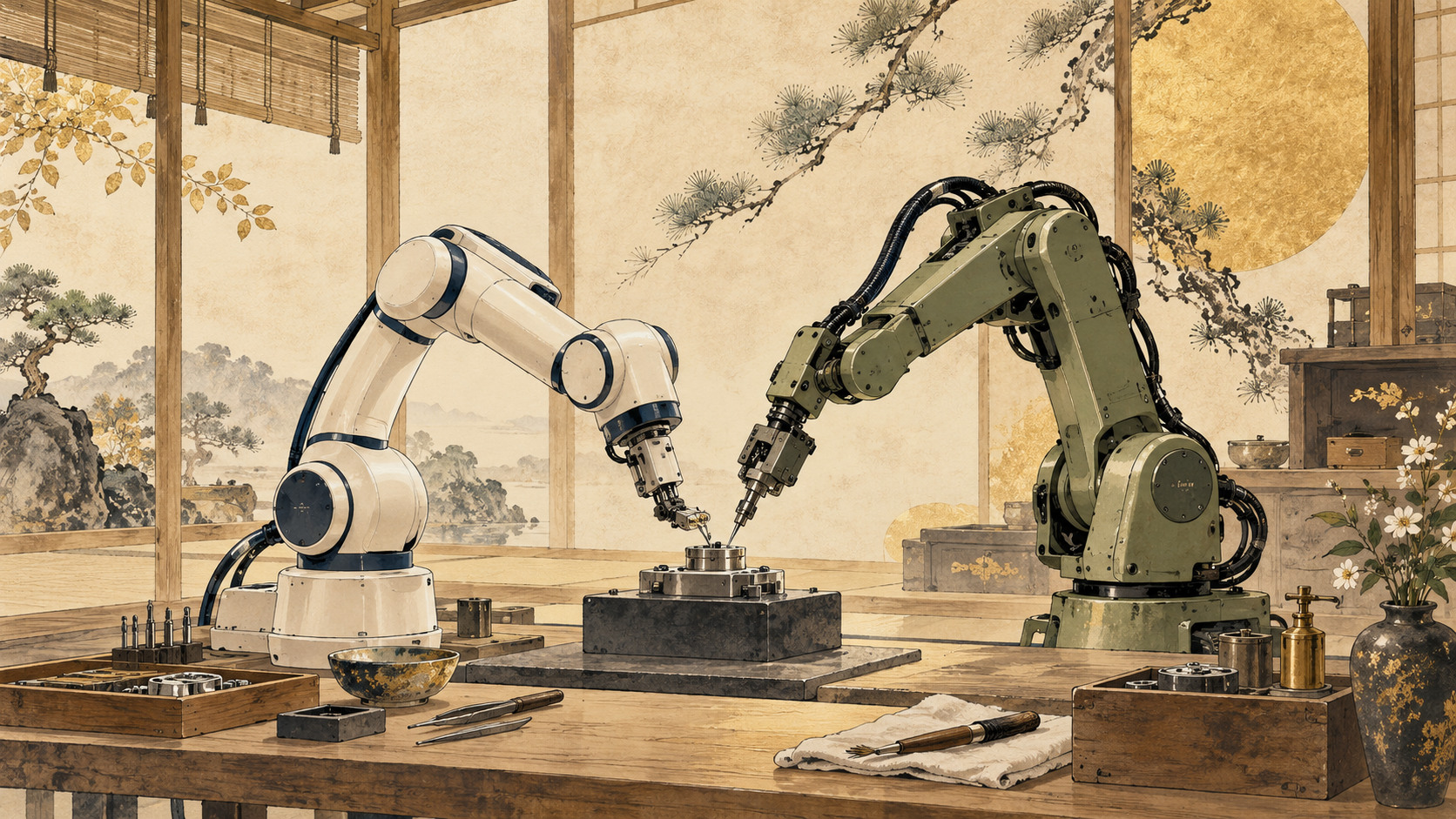
An investment confirms a commitment—not that the software has passed a factory-floor test.
The factory that needs an interpreter
Imagine an industrial line staffed by machines from five suppliers. A camera detects the part, an arm picks it up, another robot inspects it, and a mobile vehicle moves it away. Each machine may perform its own task well. Making the whole line work together can require painstaking integration. That is the problem behind a $2 million bet by Japanese industrial technology distributor Kanaden.
On October 19, 2026, Kanaden announced that it had made a strategic investment in California-based RSYNQ Corporation. The companies say they will pursue Japanese commercialization of RSYNQ’s Semantic Intent Protocol, or SIP, software meant to coordinate artificial intelligence systems and different kinds of machines. The investment is confirmed by the companies’ disclosure; whether SIP improves live operations at commercial scale remains an open question.
Why a 119-year-old company would back California software
Kanaden began life in 1907 as Kanagawa Denki, selling electrical machinery and undertaking electrical contracting. Its official history records the sale of Mitsubishi fans through Mitsubishi Corporation in 1922, a Mitsubishi Electric agency agreement in 1962, its current name in 1990, and a transition to the Tokyo Stock Exchange Prime Market in 2022. Its present portfolio reaches factory automation, electronic devices, building systems and other industrial markets.
This heritage matters more than the investment’s dollar amount. Industrial distributors occupy the difficult territory between a manufacturer’s specification and the reality of a customer’s production floor. If integration shifts from extensive custom programming to reusable software, some familiar engineering costs could fall and new software, monitoring and support businesses could emerge. Those are possibilities, however, not revenue figures Kanaden has promised or demonstrated.
The proposed layer between intention and motion
RSYNQ describes SIP as a middleware and orchestration layer. Its advertised function is to convert a high-level objective from an AI agent or business application into coordinated actions by robots, sensors and other equipment. The release calls this a shared semantic framework: devices would collaborate around the meaning of a task, rather than simply exchange isolated messages.
For illustration, a logistics supervisor might ask a system to inspect an incoming pallet and deliver it to a designated bay. That could involve a camera, lifting machinery and a mobile robot. The example explains the ambition; it is not a documented RSYNQ customer deployment. The hard problem is not expressing an intention in plain language. It is translating the instruction into permissible, observable actions amid moving humans, changing inventory, mechanical limits and communications failures.
A protocol is not automatically a universal standard
Robotics already has substantial software infrastructure. ROS 2, an established open robotics framework, uses different middleware options including DDS and Zenoh. Its own documentation cautions that communication between different DDS implementations is not always guaranteed. Industrial facilities also rely on controllers and other interfaces developed for specific machines and safety requirements.
SIP appears, from its developers’ account, to target a different layer: coordinating tasks across devices rather than merely transporting messages. It would be incorrect to claim that it replaces ROS 2 or existing industrial control protocols. Nor has the supplied announcement established that SIP is an independently governed open standard. Public technical specifications, compatibility matrices and performance comparisons would allow prospective customers to distinguish the proposed innovation from existing integration products.
Japan is a proving ground, not an automatic winner
The International Federation of Robotics reports that Japan installed 36,219 industrial robots in 2025, a decline of 19% from the previous year. It ranked third globally in annual installations, behind China and the United States. A single year’s investment cycle does not erase Japan’s historic role in manufacturing robots and automation equipment, but it shows why market conditions cannot be taken for granted.
The economic prize may increasingly lie in managing fleets of machines from multiple countries and generations. Japanese manufacturers have long excelled in physical equipment. Whether they can capture the software that directs heterogeneous equipment is another question. For Kanaden, access to Japanese factories and established customer relationships may be at least as important to the partnership as writing a check.
What a convincing demonstration would look like
An independent evaluation would start with a baseline. How many vendors and device types were connected? How many engineer-hours did the job take before and after SIP? What happened to throughput, error rates, latency and recovery time? Could engineers audit each action after a fault? Were safety boundaries retained when an AI-generated request conflicted with machine constraints?
A polished demonstration can show that a coordinated sequence is possible. It cannot, by itself, prove that the software will remain reliable for months under industrial loads. Customers also need to know who updates adapters when an equipment manufacturer changes firmware, who responds during an outage and which party is liable for failures. These questions are not minor implementation details: they determine much of an industrial platform’s total cost.
Physical AI comes with physical consequences
It is tempting to imagine factory AI as a chatbot equipped with mechanical arms. The analogy breaks down at the moment an erroneous instruction moves a heavy object. A mistaken paragraph can be edited. A mistaken robot path may endanger people or equipment. Safe industrial automation therefore needs defined operating envelopes, risk assessments and independent mechanisms for stopping unsafe actions.
The partners say SIP tracks system state, dependencies and execution in real time. That claim should be tested separately from compliance with machine-safety standards, cybersecurity expectations and industrial certification. A high-level orchestration layer must never be assumed to substitute for properly engineered machine controls or emergency protection.
The markets they are targeting are not interchangeable
Kanaden and RSYNQ identify manufacturing, logistics, agriculture, mobility, hospitality, healthcare and infrastructure as potential areas of use. All involve coordination, but the environments are sharply different. A warehouse needs predictable movement through aisles. A farm faces mud, weather and uncertain objects. Healthcare-related equipment operates under a much stricter safety and accountability regime.
Listing several applications is a roadmap, not proof of an addressable market. Commercial traction will depend on customers accepting a specific cost, retrofit plan, maintenance obligation and security architecture. Early pilots with measured results would provide substantially better evidence than another broad list of potential uses.
What the $2 million does—and does not—tell investors
The disclosed investment amount is US$2 million. The announcement does not establish RSYNQ’s valuation, Kanaden’s percentage ownership, other financing sources, revenue, customer count or path to profitability. It would be speculative to calculate an implied enterprise value without the size and terms of the stake.
The partners say they intend to expand joint business activity in Japan during the fourth quarter of 2026. That does not mean customer rollouts have already occurred. The more useful investor questions concern distribution economics, who owns resulting customer relationships, intellectual-property rights, and whether equipment makers will support the required integrations.
A story about the invisible work between machines
Japan’s aging workforce creates pressure to automate more tasks, but buying additional robots is not enough if every new device adds another custom integration project. In mature factories, equipment installed years apart must often work as a coherent system. That unglamorous problem may be a bigger business opportunity than humanoid publicity images suggest.
Kanaden’s journey from electrical equipment seller to investor in a California orchestration startup reflects an industrial transformation still in progress. The companies have disclosed a real transaction and an ambitious plan. The decisive evidence is yet to come: whether machines that previously needed extensive custom programming can work together more safely, reliably and economically. That is what will determine if this $2 million is a useful investment—or simply an evocative headline.
Sources and documentation
Company statements are attributed as such. Technical and market context comes from ROS 2 and IFR primary sources. Independent customer performance data was not located.