The metals that make AI possible do not disappear after one use
The modern semiconductor industry is built on substances most users never see. Copper carries signals through intricate circuitry. Tantalum, titanium, tungsten and cobalt serve specialized functions in thin-film processes. And long before a chip reaches a data center, a manufacturer must secure materials clean enough to withstand the extreme demands of fabrication. Two October announcements from JX Advanced Metals point toward a different way of protecting those supplies: recovering valuable material from manufacturing and turning discarded copper into high-performance electronics products. One is an investment decision. The other is a product already entering commercial sales. Understanding that distinction is essential to understanding the news.
Two October decisions, two very different manufacturing processes
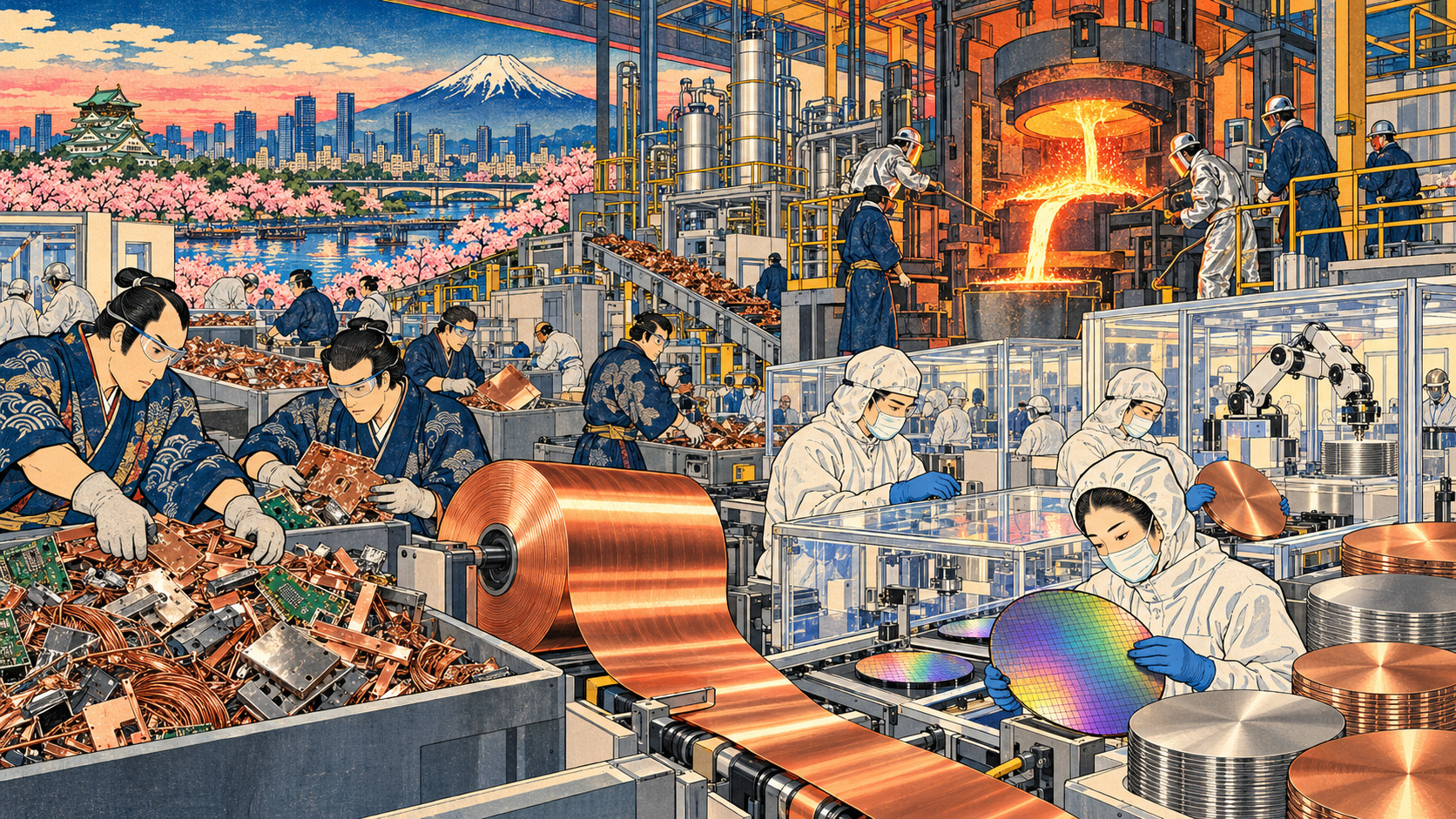
On October 28, JX Advanced Metals said its group company JX Advanced Metals Coil Center would install new equipment at its Tatebayashi facility in Gunma Prefecture and Nasu facility in Tochigi Prefecture. The machines will help cut and clean used sputtering targets for recycling. The release did not disclose the investment amount, the equipment's planned startup date or a processing-capacity figure. On October 26, the company announced that it had begun full-scale sales in October of rolled copper foil made entirely from recycled copper raw material, part of its Cu again product family. That was not an announcement of a newly completed target-recycling refinery. It was a separate commercial product based on a different metallurgical process. Together, the disclosures demonstrate how the word recycling can describe multiple stages of a complex industrial supply chain.
Why sputtering targets matter to chips
Inside a semiconductor fabrication plant, some metal layers are deposited by a technique called sputtering. In a vacuum chamber, energetic ions strike a highly controlled piece of solid material—the target—and knock atoms from its surface. Those atoms settle as a thin film on a wafer. Such films can form components of interconnect structures, barriers and other layers essential to integrated circuits. Copper is widely associated with electrical interconnects; tantalum and other materials serve different thin-film roles. JX says its product range includes copper, tantalum, titanium, tungsten and cobalt targets, and that its materials are used in advanced logic and memory production. The company describes its positions in those target categories as world-leading. These are supplier assertions, not independently verified market rankings in this report.
A used target is not necessarily exhausted metal
Sputtering targets do not always wear down uniformly. A target may be retired while valuable metal remains, because physical erosion patterns and the plant's process requirements make further use impractical. That creates a material-recovery opportunity, but not a shortcut to semiconductor-grade manufacturing. The spent target must be collected with traceability, separated from fixtures or incompatible materials, and prepared for processing. Cutting and cleaning are meaningful steps in that chain. They do not themselves prove that the resulting feedstock meets the chemical and microstructural requirements of a new target. Depending on the material and product, further refining, melting, forming, inspection and customer qualification may be necessary.
The extraordinary difficulty of making “pure enough” metal
In ordinary recycling, the central question can be whether a recovered metal meets the requirements of a structural or general-purpose industrial application. In advanced semiconductor manufacturing, an exceedingly small concentration of the wrong impurity may affect device reliability or wafer yield. Trace metallic contaminants, particles, dissolved gases, surface residues and lot-to-lot variability all matter according to specific process requirements. A recovery line must preserve more than the identity of the metal; it must preserve confidence in a carefully controlled material specification. JX's release says it already works with customers to collect and recycle used targets and wants to reinforce its vertically integrated supply chain. It provides no target-by-target recovery percentage, volume or certified reuse rate. Those omissions do not invalidate the investment, but they limit what can be quantified today.
A second test: copper foil that can bend
The copper-foil announcement concerns another demanding application: flexible printed circuits used in smartphones, wearables and mobility electronics. Rolled copper foil must combine electrical performance with repeatable mechanical behavior as devices flex. Copper cleanliness matters, but so do material processing and crystalline structure. JX says its proprietary structure-control technology supports flexibility and durability, and that exceptionally low impurities are important for fine-pitch circuits. For the new product, group companies collect recycled feedstock, and JX uses refining that includes a dedicated smelting furnace introduced in 2025. According to the company, melting recycled raw materials alone enables the 100%-recycled-copper-feedstock designation while preserving quality equivalent to its conventional foil. This is a company-reported product-quality result, not a side-by-side independent laboratory comparison conducted by Japan.co.jp.
What “100% recycled” does—and does not—mean
The crucial qualifier is raw material. JX says the copper input comes entirely from recycled sources. That does not say the electricity, chemicals, water or logistics used to manufacture the foil are carbon-free. Nor does it mean every atom of the finished electronic device is recycled. There can also be an important distinction between recycled material recovered from manufacturing scrap and material recovered from products after consumers discard them. The announcement describes collected recycled feedstock but does not provide a complete public breakdown of those categories or a product-level environmental life-cycle assessment. The company says it plans to apply UL certification, rather than presenting such certification as already completed. Its reported approximately 80% worldwide share of rolled copper foil for flexible printed circuits is likewise a company-supplied market estimate.
A history that begins in a copper mine—and includes pollution
The development belongs to a history spanning more than a century. In 1905, entrepreneur Fusanosuke Kuhara established the Hitachi Mine in what is now Ibaraki Prefecture. The business expanded Japan's copper production and gradually developed a broader smelting and materials industry. But metal production also had consequences for communities around the mine. Sulfurous emissions harmed forests and agriculture. A giant stack built in 1914 became a conspicuous response to the smoke-damage problem, although dispersing emissions and preventing pollution are not the same thing. JX's corporate chronology records a dedicated recycling furnace at its Hitachi smelter in 1978 and the opening of Isohara Works in 1985 as the group moved deeper into electronic materials. The new recycling investments are not a sudden break with copper history: they are part of a long—and sometimes environmentally difficult—industrial transition.
Can recycling reduce Japan’s dependence on imported resources?
Recovering material can strengthen supply security by adding more pathways through which metal is obtained. That is a meaningful advantage for a country with limited domestic mineral resources, but it would be a mistake to equate recycling with self-sufficiency. Global demand continues to expand; metals may remain embedded in products for years; production losses occur; and some recovered material can originate outside Japan. Supply risks also differ among copper, tantalum, tungsten and other elements. Even a highly effective recycling system can supplement rather than replace primary mining and international trade. The strategic question is whether the company can reliably collect, separate and refine enough suitable feedstock to make supply more resilient during disruptions. No October disclosure quantified how much imported metal the new equipment would displace.
The customer is part of the loop
Unlike collecting mixed household scrap, target recycling can depend on close relationships with advanced chipmakers. Fabrication facilities must identify the spent material, maintain records, segregate contaminated or incompatible lots, and return usable targets to a supply partner. The supplier then needs a route from preparation and refining through controlled fabrication and qualification. The value of an integrated materials business may lie in these customer relationships as much as in its metallurgy. JX calls its approach a vertically integrated supply chain. Yet whether the new investment improves cost, lead times or dependence on primary raw materials is an empirical question requiring operational results, not just a statement of intent.
Environmental gains must be measured, not presumed
Recycling often saves the need for some new extraction, but the climate and pollution benefits of any specific product depend on the full manufacturing system. Scrap collection, transportation, separation, high-temperature refining, power consumption, chemical use and manufacturing yield all affect the balance. A meaningful comparison would use consistent boundaries and report greenhouse-gas emissions per unit of qualified product. The two October releases did not provide product-specific emissions savings, a complete life-cycle assessment or externally audited recovery volumes. Consequently, describing the new systems as an environmental breakthrough measured in tons of avoided CO₂ would go beyond the evidence.
Five figures worth watching next
There are clear tests of this program's future significance: the capital cost and operational start of the two target-processing installations; annual weight of used targets processed; recovery and reintegration rates by metal; independent quality and durability data for the recycled-input foil; and environmental measures that compare products on a consistent basis. These metrics would turn an industrial strategy into an assessment of industrial performance. They would also help determine whether higher recovery translates into greater security of supply for electronics manufacturers or just a modest supplementary source of metal.
The next competitive advantage may be the return journey
Japan's semiconductor position is often discussed in terms of lithography equipment, manufacturing subsidies and chip architectures. But the less visible business of preparing and recovering pure metals can also determine whether fabrication plants operate reliably. The most consequential feature of JX Advanced Metals' announcements may be the effort to make return flows part of an advanced-materials business model: production, use, collection, preparation and potential re-entry into manufacturing. The new target equipment remains a planned investment, and the foil's environmental impact still requires independent measurement. The longer-term proposition is nevertheless important. Materials companies may compete not only on the purity of what they ship, but on their ability to recover it and prove what happens next.
Sources and reporting note
This is a document-based analysis of company primary releases and corporate history. Japan.co.jp did not visit the facilities, conduct independent material tests or interview management. Product-quality and market-share claims are explicitly attributed to the company.
- October 28: JX target recycling investment
- October 26: JX recycled copper foil
- JX target-recycling release (English)
- JX recycled copper foil release (English)
- JX Advanced Metals corporate history
- JX Advanced Metals: businesses and market shares
- JX press release archive: October 19 cooperation
- JX Advanced Metals: corporate history (English)