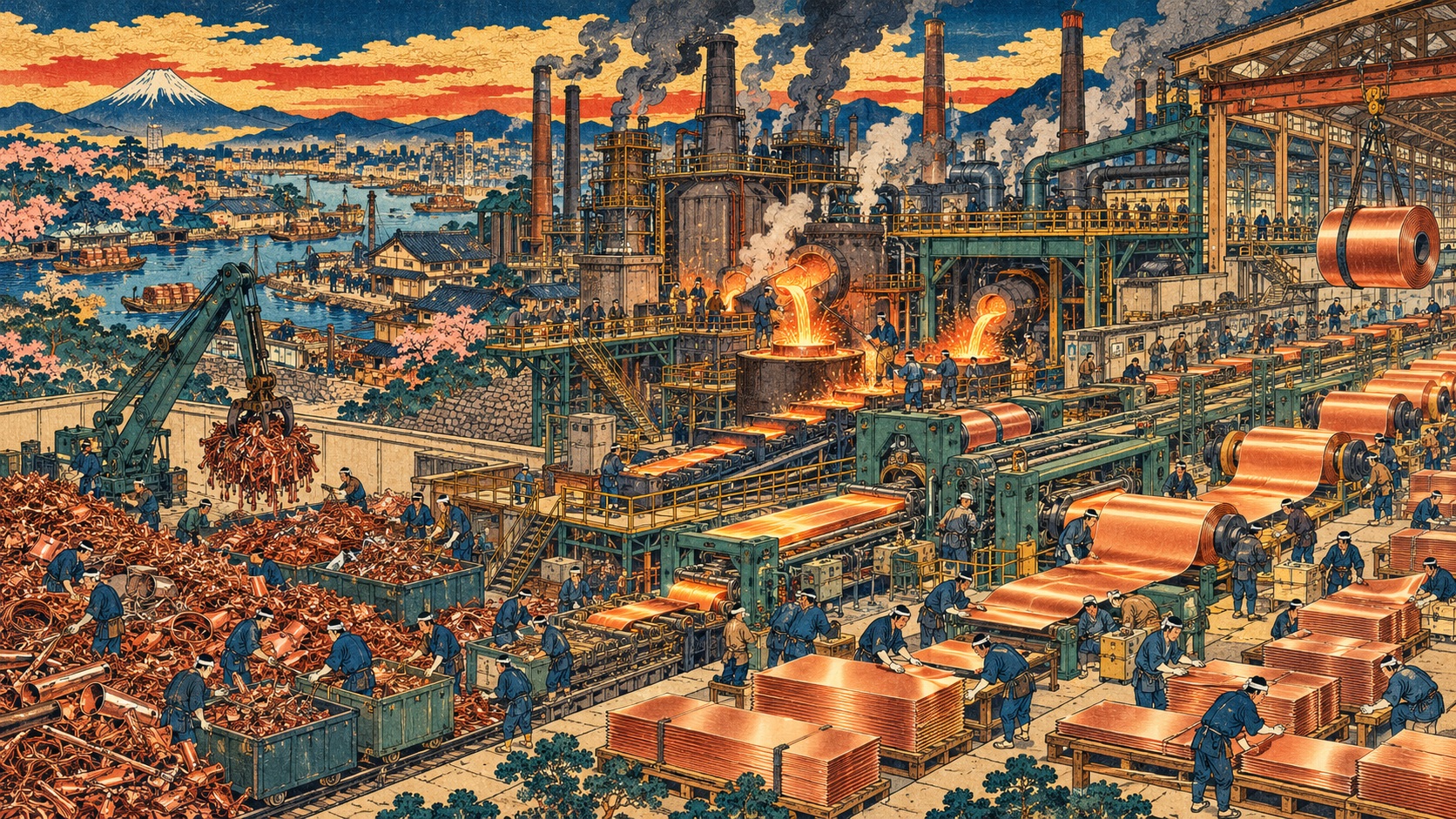
A second life for the metal inside moving electronics
Inside a folding handset or a smartwatch, a ribbon of copper may have to flex repeatedly while maintaining a precise electrical connection. JX Advanced Metals says it can now produce a specialized version of that material from entirely recycled copper feedstock. On October 26, the Japanese supplier announced that full-scale sales of the rolled foil had begun during the month. The achievement it describes is not simply melting down scrap: it is recovering a sufficiently clean metal to satisfy demanding electronic-circuit specifications.
What the company actually announced
According to JX, group companies collect the recycled input and a refining system that includes a dedicated melting furnace installed in 2025 processes it. The firm says only recycled materials are melted for the new product and that consistent quality comparable to its conventional foil has been achieved. It also says it plans to pursue applicable UL certification. That is a plan, not an announcement that certification has been obtained. No sales-volume figure, named customer adoption or independently verified emissions comparison accompanies the October 26 release.
Why rolled foil is different from ordinary copper sheet
Rolled copper foil is a precision electronic material, notably used in flexible printed circuits that route signals through tight or moving spaces. Rolling metal into thin foil is distinct from the electrodeposition process used for other kinds of copper foil. JX attributes its material’s bend performance and durability partly to proprietary control of crystal structure. Its technology materials describe a range that includes foil as thin as six micrometers; that statement about the broader portfolio should not be mistaken for a thickness specification for every new recycled variant.
Recycling must survive a purity test
Scrap from discarded products or industrial processes can contain various metallic contaminants. The thinner and finer the conductor, the more consequential defects and impurities may become. JX says its flexible-circuit applications require exceptionally low-impurity copper, and credits its separation technology and production know-how with making recycled-feedstock production commercially stable. Quality is the real gatekeeper: a lower-impact origin has little practical value to device manufacturers if the material cannot repeatedly bend, conduct and survive mass production.
An influential niche—but mind the market-share claim
The company estimates that it holds approximately 80% of the global market for rolled copper foil for the stated flexible-circuit applications. That is a company estimate, not an independently established figure in the October 26 materials. It does not mean JX controls 80% of all copper foil worldwide or that the recycled product has already captured 80% of a market. Still, the claim helps explain why materials choices by a specialist Japanese supplier might ripple through electronics supply chains.
A four-year circular-copper strategy
In 2022, JX set out its Sustainable Copper Vision. Its Cu again program subsequently introduced an approach to 100%-recycled electrolytic copper in January 2024 and expanded into high-performance copper alloys in January 2025. The October 2026 rolled-foil release marks another product category. In a separate report, JX said its group’s fiscal-2024 recycled-content ratio for electrolytic copper was 24.6%, representing roughly 100,000 metric tons of recycled copper. A 100%-recycled product is not evidence that the company’s entire copper output comes from scrap.
One crucial accounting distinction
An earlier JX program for recycled electrolytic copper uses mass-balance accounting. In such systems, recycled and mined inputs may be mixed physically, while audited input quantities are attributed to an equivalent quantity of output. This can support credible chain-of-custody claims without physically isolating each atom. By contrast, the October release says the new rolled foil is produced by melting recycled raw materials exclusively. The wording describes a different manufacturing claim, though the full traceability rules, product boundaries and verification documents for this line still warrant scrutiny.
Why resource security matters to Japan
Copper conducts electricity through everything from power grids and EVs to servers and telecommunication infrastructure. Japan depends on imports for much of its mineral supply, leaving manufacturers exposed to transport, mining and geopolitical risk. Recycling cannot create copper from nothing, nor can it immediately replace all primary mining: it needs a continuing pool of recoverable products and manufacturing scrap. But turning collected metal back into high-grade electronics material can diversify supply and retain more economic value in a circular industrial chain.
The AI and robotics connection is a forecast, not an order book
JX expects demand associated with smaller, more capable electronics, wearable devices, electromagnetic shielding for AI servers, industrial equipment and robotics. Those uses are plausible growth areas; they are not evidence that a particular leading smartphone, AI-server or robot maker has contracted for this recycled foil. A buyer still has to evaluate conductivity, mechanical fatigue, process yields, production consistency, procurement cost and reliable delivery before using it in a commercial design.
What “100% recycled” does not tell us
Feedstock composition and carbon footprint answer different questions. Recycling can avoid some impacts of virgin extraction, but collecting, transporting, refining and rolling scrap still consume energy and resources. The company release does not quantify a product-level reduction in greenhouse-gas emissions against its conventional foil, describe a full life-cycle assessment, or supply independent carbon-footprint verification for this specific product. It would be misleading to translate 100% recycled inputs into a claim of 100% lower emissions or zero environmental impact.
The industrial test ahead
For manufacturers, a meaningful recycled-material offering must deliver repeatable specifications at a competitive price and scale. For investors and environmental auditors, the questions extend to certification, traceable inputs, energy use, product-level emissions and actual customer uptake. JX has made a material and commercial announcement with potentially wide relevance because high-performance copper is embedded in everyday technology. Whether it becomes a turning point will depend on those future disclosures and purchases—not on a green label alone.
Sources and verification
Cross-checked Japanese and English company releases, process documentation and independent industry reporting. Company-reported performance and market share have not been independently tested for this article.