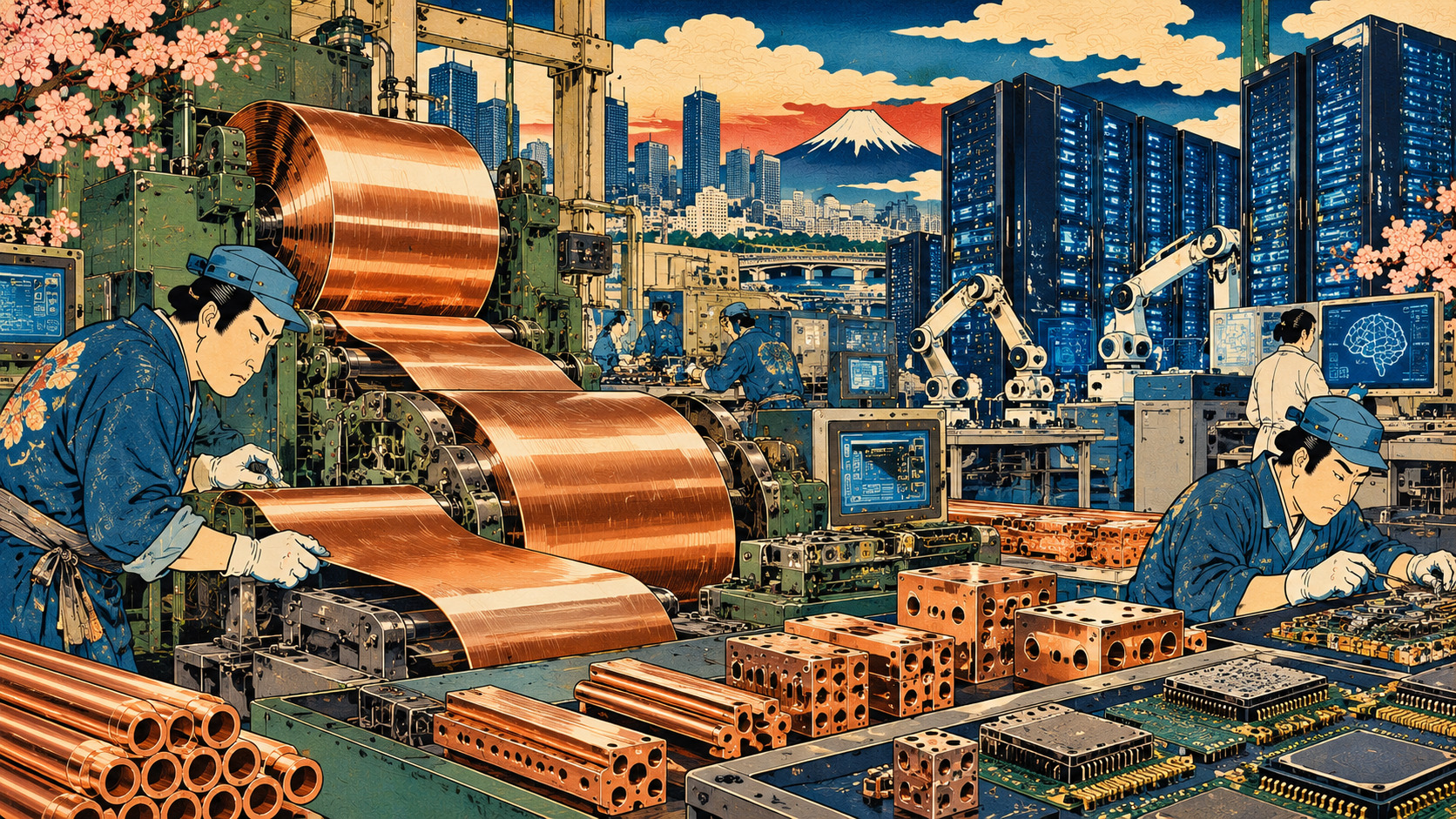
An AI server is only as reliable as its smallest connections
Artificial intelligence is usually discussed through the biggest numbers: accelerator shipments, data-center megawatts, model parameters and billions of dollars in capital spending. Yet a server's reliability also depends on small spring-like metallic contacts that make electrical connections inside electronic assemblies. The more powerful and densely packed the hardware, the less forgiving its thermal and mechanical environment can become. This is where an old branch of metallurgy enters a new technology story. On October 22, JX Advanced Metals announced that it would enlarge its copper-titanium alloy production capacity by 50% by fiscal 2029 compared with fiscal 2026, citing growing demand from AI-related applications. The investment is not about making artificial intelligence software; it is about producing materials that help hardware operate reliably.
Two plants, two distinct constraints
The plan stretches across Japan. In Samukawa, Kanagawa Prefecture, the company's Kurami Works will install additional heat-treatment equipment. In Muroran, Hokkaido, Muroran Copper Alloy Co., Ltd.—a joint venture of JX Advanced Metals and The Japan Steel Works—will add melting and casting equipment. These are not interchangeable investments. Casting establishes the metal stock and its basic composition; the downstream processing and heat-treatment sequence helps establish the final mechanical characteristics. JX says heat treatment at Kurami had become a bottleneck as demand increased. The company also presents the Muroran expansion as important to business-continuity planning. A larger factory alone would not necessarily address the problem if a critical stage remained capacity constrained.
The size of the bet—and the distinction between disclosure and reporting
The primary company release specifies the goal of 50% more overall copper-titanium alloy capacity in fiscal 2029 than fiscal 2026. It does not disclose annual tonnage or the project's yen investment amount. The Japan Metal Daily, a trade publication, reported roughly ¥5 billion for heat-treatment equipment at Kurami and another roughly ¥5 billion for Muroran casting equipment, totaling approximately ¥10 billion. That publication also reported a plan to double Muroran's ingot capacity by the end of fiscal 2028. These monetary and plant-specific details should be understood as independently reported figures, not numbers given in the company's October 22 statement. A 50% increase in capacity is not a promise of 50% more sales, profits or AI-server orders.
Why pure copper is not always enough
Copper is an excellent electrical conductor, but the metal's softness is a disadvantage when a tiny component must push against another surface repeatedly and retain its shape at elevated temperatures. Introducing titanium into copper and controlling the alloy through metallurgical processing changes that balance. Copper-titanium alloys can offer high strength, formability and resistance to stress relaxation. The latter property matters because a contact subjected to constant load and heat can gradually lose some of the force that keeps two conducting surfaces firmly together. Excessively weak contact pressure can increase the risk of unreliable connections. Material choice therefore involves far more than maximum conductivity: engineers also evaluate contact force, fatigue, thermal behavior, corrosion, formability and production cost.
An unusually revealing datasheet
JX's NKT322 product illustrates the tradeoff. The company describes it as a copper-titanium alloy containing approximately 3.2% titanium and 0.2% iron by weight, classified as UNS C19910. Its posted technical figures give an electrical conductivity of 12% IACS at 20°C, and representative tensile strengths from about 950 to 1,070 megapascals for several processing tempers. IACS compares conductivity with a reference standard for annealed copper. The number should not be mistaken for an efficiency rating of an electronic device. JX cautions that its technical values are representative, not blanket product guarantees. Crucially, the October expansion release does not say that every tonne of the planned new capacity will be this specific NKT322 grade.
Heat, stress, density and the connector problem
Modern AI infrastructure combines processors, memory, power-distribution hardware and networking systems in increasingly demanding configurations. Connections must be fabricated to fine tolerances, then survive assembly, transport, thermal cycling and operating stress. More power and higher device density can aggravate thermal challenges, but applications differ considerably and are governed by detailed component specifications. JX says its alloy is already adopted for connectors inside AI servers and that demand has expanded rapidly. The October release does not identify customers, exact connector models, contract values or shipment volumes. Claims about adoption by any named accelerator vendor would therefore be speculation. The industrial significance is more modest and more defensible: a materials supplier sees a bottleneck in a product it says is becoming more important to high-density computing.
A stronger contact is not always a better conductor
High-strength alloys can sacrifice conductivity relative to pure copper. That is why seemingly small materials improvements matter. JX lists an experimental variant, NKT322 (HC), that uses the same basic composition as conventional NKT322 while modifying its production process. Its published figures show conductivity of 20% IACS, versus 12% for the conventional alloy, while maintaining high strength; the company describes that improvement as approximately 70%. But its website identifies the HC material as being at a trial stage while mass-producibility is being confirmed. The October 22 expansion is not proof that this prototype is in volume production. Proper journalism keeps an existing commercial alloy, a prototype and an announced factory-capacity target separate.
From the Hitachi Mine to the age of computing
JX Advanced Metals traces its origins to Fusanosuke Kuhara's opening of the Hitachi Mine in 1905. Mining and smelting were central to Japan's industrialization, and they carried serious environmental costs. The company acknowledges that smoke pollution became a major issue around the mine. It built its famous giant stack in 1914, part of an effort to address that pollution, although dispersing emissions is not identical to eliminating them. The Hitachi Mine closed in 1981 after its deposits were depleted. The group moved further into advanced electronic materials, with Isohara Works beginning operations in 1985. The evolution from extracting ore to engineering exacting alloys offers a useful perspective on what advanced manufacturing actually means: competitiveness increasingly resides in processing know-how and quality control, not simply ownership of mineral deposits.
An industrial opportunity with geographic exposure
The announcement links a high-value materials market with two established manufacturing areas, Hokkaido and Kanagawa. Upstream casting and downstream heat treatment depend on utilities, skilled personnel, equipment commissioning, stable feedstocks and transport between facilities. Muroran's capacity expansion may provide flexibility, as JX says, but geographically separated equipment does not remove every supply disruption. Qualification by demanding electronics customers can also take time, and rising costs can affect margins even when orders are strong. Japan's competitive advantage in this segment may lie in consistent metallurgy, reliability testing, process control and long customer relationships. The releases do not provide sufficient data to rank JX against all international copper-titanium suppliers or to calculate its future market share.
The sustainability claim deserves its own test
JX also says it is promoting copper-titanium alloys using 100% recycled raw materials, relying on impurity-separation and contamination-control methods to preserve conventional performance and quality. The company began discussing such high-performance recycled alloys publicly in January 2025. The distinction matters: using entirely recycled raw-material input is not the same as manufacturing with zero emissions. Material collection, refinement, casting, heat treatment and transportation still consume resources. The October release does not give independently audited product-by-product carbon savings or life-cycle emissions. This subject overlaps with JX's separate late-October announcements on target recycling and recycled copper foil, but this feature's central question is how the company can scale a specialized connector alloy for electronics.
Beyond data centers: a forecast, not an order book
JX points to physical AI—the application of intelligent systems in robotics and mobility—as another possible source of demand. It is a plausible technical connection: robotic equipment and vehicles contain many connectors that have to remain dependable under vibration, varying temperatures and repeated mechanical stress. However, those applications are subject to distinct standards and qualification cycles. The company's projection does not establish that orders from robotics or automotive customers have already materialized at the scale implied by an eventual market boom. Competing materials and evolving hardware designs could also reshape demand. An investor should treat the projected market as an opportunity, not a guaranteed return on the new capital expenditures.
What will prove the investment worked?
By fiscal 2029, the most persuasive evidence will not be the capacity target alone. It will be the achieved output, yield, utilization, product mix, customer qualifications, profitability, energy intensity and whether quality remains consistent as volume rises. JX's October announcement is consequential because it specifies exactly where two real manufacturing constraints are being addressed. The bigger lesson reaches beyond copper-titanium alloys. As AI hardware becomes more powerful, the industrial ecosystem required to make it dependable is growing more specialized. In that ecosystem, Japan's competitive strength may be found in a metal contact so small that the people using the resulting intelligence will never see it.
Sources and reporting methodology
This article uses JX primary disclosures, technical product specifications, financial filings and Japanese industry-press reporting. No original executive interviews, factory visit or third-party alloy tests were conducted. Unpublished customer and volume details are not inferred.
- JX Advanced Metals October 22 primary announcement
- JX October 22 English announcement
- Japan Metal Daily: reported investment breakdown
- Sangyo Shimbun industry coverage
- JX NKT322 technical specification
- JX high-conductivity NKT322 (HC) prototype
- JX 2025 recycling reference and release archive
- JX corporate history
- JX FY2026 financial presentation (JPX)
- JX October 9 data-center leak-detection investment