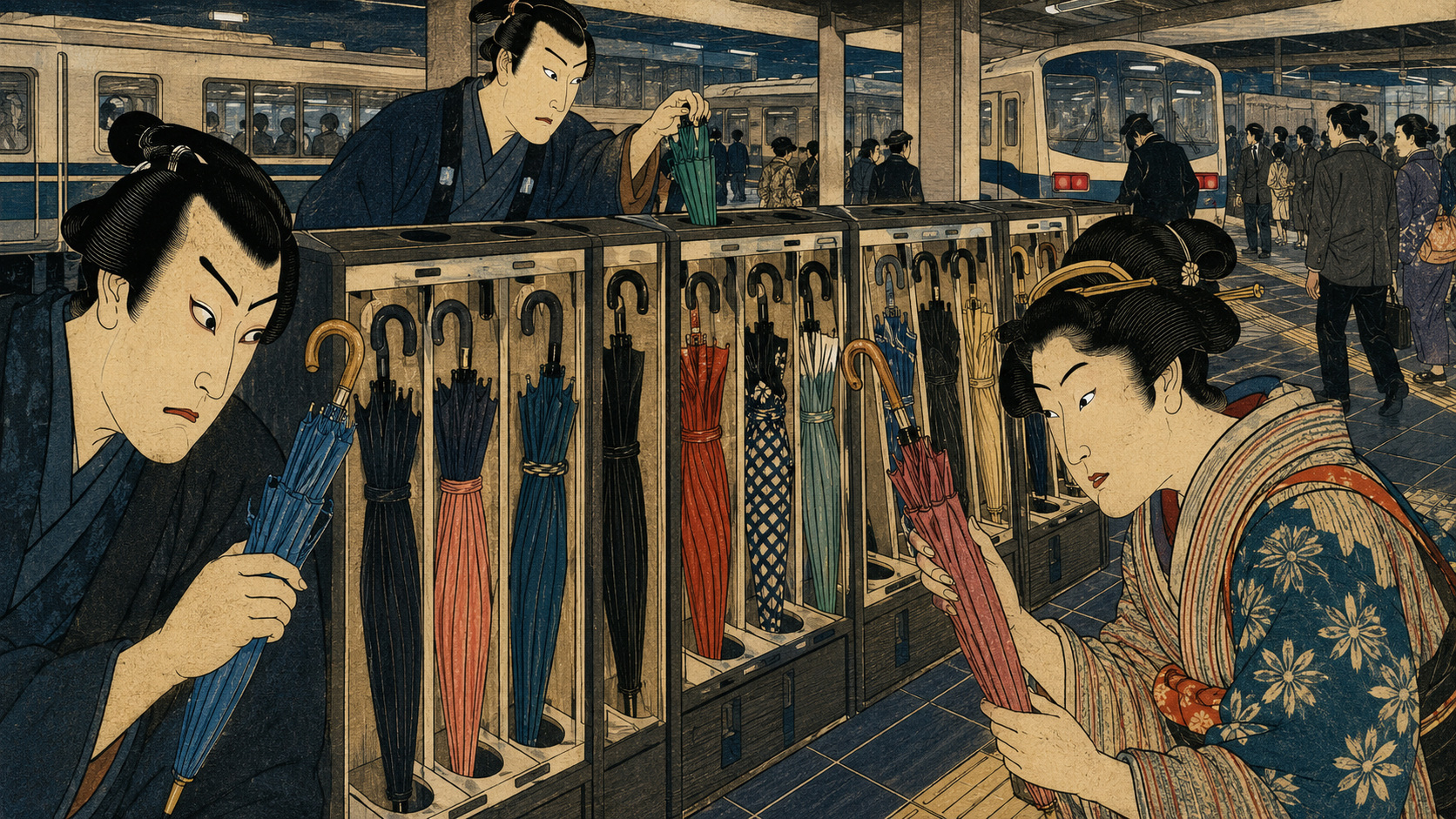
An umbrella is easiest to forget when the rain has stopped. The passenger steps off the train, clears the gate and puts a telephone or bag back into each hand. The transparent object that had been indispensable at breakfast remains on a rail, under a seat or beside a station umbrella stand. To its owner it was “my umbrella.” To the member of staff who finds it, unmarked and undamaged, it may be one of hundreds wearing the same face.
A Himeji experiment is attempting to divert that object from the final straight line to disposal. On July 22, JR West announced a trial in which umbrellas found at railway facilities, unclaimed through the applicable legal retention period and otherwise scheduled to be thrown away are offered from unattended racks at service facilities in the city. The experiment had begun on June 9 and is scheduled to run through November 30.
The stock includes rain umbrellas, rain-and-sun parasols and some branded models. JR West says every item is inspected and its handle disinfected. Prices range from ¥199 to ¥1,999 including tax, depending on type and condition. A customer chooses a physical umbrella, follows a QR code and pays online with PayPay or a credit card. At the time of the announcement, nine participating sites included Himeji Post Office, Himeji Shogunbashi Post Office, the Himeji branches of Resona Bank and Minato Bank, Richmond Hotel Himeji, Himeji Information System College and the Miki Museum of Art.
Exactly What Is “Japan’s First”?
JR West describes the experiment as the first of its kind nationwide. That phrase requires a narrow reading. The resale of legally processed railway lost property is not new, nor is the reuse or recycling of unclaimed umbrellas. “Dig-out” markets have long offered ownerless railway articles after the required process, while Bookoff and Tokyu have reused or recycled unclaimed rail and bus property since 2021.
The company’s novelty claim concerns this particular combination: unclaimed umbrellas originating at railway facilities, displayed at largely unattended racks in everyday city facilities and purchased by customers through online self-service payment. It is not the first sale of lost property in Japan. Stating the boundary does not diminish the project; it identifies what the trial is actually designed to test.
The release also corrects an easy visual assumption. These are not described simply as shops inside stations. The named racks stand in post offices, banks, a hotel, a college and a museum around Himeji. Placing an existing umbrella at a place people already visit when weather changes—the city’s ordinary nodes—is the central operational idea.
The First Duty Is to Return, Not Resell
An umbrella does not become JR West merchandise when it is picked up. Japan’s Lost Property Act establishes the reporting, storage, public notice and rights surrounding found objects. The present system comes from a 2006 law, effective in December 2007, that comprehensively replaced the 1899 act. It reduced the general holding and public-notice period from six months to three and created a special-facility-occupier system for railway companies and other operators that process extraordinary volumes of lost property.
National Police Agency guidance explains that high-volume articles expensive to store, including umbrellas and clothing, may in defined circumstances be sold or disposed of if their owner remains unknown two weeks after public notice. This is not permission to abandon the search immediately. Reporting and publication duties apply; when an item is sold, the proceeds stand in for it while the statutory rights process continues. JR West says this trial draws from umbrellas that have completed the applicable holding period and reached the stage at which they would otherwise be disposed of.
Return must therefore remain the top rung of the circular ladder. JR West handles about 1.3 million lost-property cases a year and is rolling out “Lost Property Cloud find” in summer 2026. Staff photograph an object; AI reads visible features to assist registration. Passengers can search through multilingual chat, while participating businesses can compare records across organizational boundaries. Getting an object back to the person who already owns it preserves its full use value and avoids replacement through the shortest possible loop.
Why an Umbrella Can Be Found Yet Remain Lost
Japan’s lost-and-found system is often celebrated as a symbol of a society in which property comes home. A strong system still needs strong identifying information. Tokyo Metro warns that generic umbrellas, gloves and scarves can be too difficult to identify by telephone or email and may require an in-person inspection. A clear plastic umbrella offers almost none of the usual clues: color, pattern, brand, wear or a written name.
Another railway supplies a sense of scale. Sotetsu reported 81,176 lost articles in fiscal 2025; umbrellas ranked first at 15,042, or 18.5 percent—an average of 41 a day. JR West has said about 9,000 umbrellas are forgotten each month on trains and at stations in Kinki, that more than 80 percent cannot be matched to owners and that over 100,000 a year in the region remain ownerless.
Weather changes the relationship between a person and an object. An umbrella is purchased urgently as rain begins, then turns into extra baggage as skies clear. Closed and set against a train wall, it slips out of the field of vision. A cheap transparent replacement may cost less—in time as well as money—than a trip back to collect the old one. Convenience weakens the memory of ownership; low price weakens the incentive to recover it.
From Bamboo and Washi to the Transparent City
Japan’s umbrella was not always an anonymous disposable. A wagasa made from bamboo ribs, washi and oil carried the materials of a region, the skill of a craftsperson and the evidence of repair. Local industries grew around models such as the Awa bangasa of Mima in Tokushima and the Yodoe umbrella of Tottori. Regional histories date production in Yodoe to 1821; by the Taisho era, 71 makers reportedly produced 170,000 umbrellas a year. Western umbrellas and mass manufacture eventually prevailed, all local manufacturers had closed by 1984, and preservation groups now carry the technique.
The Western umbrella became a distinctive instrument of the Japanese city through vinyl. Tokyo manufacturer White Rose dates its development of a vinyl-covered umbrella to 1958. The first material was milky rather than transparent. A connection with an American buyer around the 1964 Tokyo Olympics opened another market, and later clear versions offered a practical advantage: a walker could see traffic and other people through the canopy.
The transparent umbrella’s problem grew from its success. A rational, safe object for a crowded wet city became something available everywhere and replaceable at a moment’s notice. Where a craft umbrella bore an individual maker and material biography, the convenience-store umbrella largely erased distinction. JR West’s racks are therefore doing more than selling used goods. Pricing by condition and type attempts to make each mass-made object an individual again.
80 Million—or 130 Million? A Fog of Big Numbers
National umbrella figures are repeated more confidently than they are defined. JR West’s release says roughly 80 million umbrellas are discarded annually in Japan but does not publish a source or method. A Ministry of the Environment Plastics Smart case page uses approximately 80 million for umbrellas “consumed.” A Tokyo government feature published in 2026 says about 130 million are sold annually. Umbrella company Amvel, analyzing 2025 customs data, counted 52.23 million imported long umbrellas and estimated 31 million to 39 million of those were plastic, arguing that the familiar 80 million figure may be outdated.
Sales, imports, consumption and disposal are different measures. Totals change depending on whether folding umbrellas and domestic production are included and how inventories or re-exports are treated. It is unsafe to present one number as a settled annual waste count. For this project, JR West’s direct operational measures—about 9,000 forgotten each month and more than 100,000 ownerless each year in Kinki—are the more useful starting point.
The company also estimates that reusing one umbrella avoids about 692 grams of carbon dioxide, equivalent, it says, to about 23 large plastic shopping bags. The public release does not disclose the compared umbrella, material assumptions, transport, cleaning, rack, payment, product lifetime or end-of-life boundary. It should be treated as a company estimate, not an audited emissions result.
Take an Umbrella Apart and Circularity Gets Hard
An umbrella is a compact composite product. Ribs and shaft may contain steel, aluminum or glass fiber. Canopy material may be polyester or polyethylene. The handle can be resin or wood; springs, runners, fasteners and thread hold the assembly together. Recycling a broken unit requires checking wetness, dirt and corrosion, manually dismantling it and separating incompatible materials. The lower the new retail price, the harder it becomes to pay for that labor.
A functional umbrella therefore usually retains more manufacturing value through direct reuse than through material recovery. Safety remains essential: bent ribs or a failing lock can injure the user. JR West says all stock is inspected and the handles disinfected, but its public announcement does not detail grading standards, remaining strength, returns, warranty or the fate of unsold units. A larger program will need condition labels people can understand and a clear allocation of responsibility for defects.
Umbrellas too worn for reuse have another route. In 2025, JR West, JR West Trading, Okamoto and Hirabayashi Metal began collecting 4,000 to 5,000 disposal-bound plastic umbrellas each month, separating metal and sheet and pelletizing the latter in an “umbrella-to-umbrella” recycling program. The project targets about 90 percent material recovery by weight and plans to use regenerated umbrellas as loaners at JR West Via Inn hotels. Since 2023 the group has also supported “Umbrella Leaf,” which turns discarded canopy fabric into flowers.
Return, Reuse, Recover: Four Destinations
| Stage | The decisive question | Value and limitation |
|---|---|---|
| Return to owner | Can photograph, time, train and identifying features reconnect object and person? | The shortest loop, preserving use and ownership. Generic umbrellas are difficult to match. |
| Reuse or resale | Is it safe, and does it actually replace one new purchase? | Preserves embedded material and manufacturing value. Requires inspection, hygiene, liability and demand. |
| Repair, parts or material recovery | How much can be recovered when direct use is no longer safe? | Better than disposal, but composite construction costs labor and energy to separate. |
| Proper disposal | Can the residue be handled safely in the correct waste stream? | The final outlet. More racks cannot make unsold and irreparable units disappear. |
If this order is reversed, “circularity” can disguise a weakening of the effort to find owners. Better AI matching should return what can be returned; safe articles can then be sold; broken ones can be harvested for material. JR West’s separate programs can be understood as early attempts to connect these rungs into one ladder.
An Unattended Rack Tests Trust—and Payment Access
Self-service retail suppresses staffing cost and may make a very low-value product viable across many locations. For a hotel guest or bank customer caught by a sudden shower, a ¥199 used umbrella nearby can avoid adding another new convenience-store umbrella to circulation. Post offices, schools and museums extend the opportunity beyond rail passengers.
The model also depends on trust. With no clerk, a customer judges condition, follows the QR payment process and removes one object. The public release does not explain anti-fraud or inventory controls. Payment through PayPay or a credit card may also exclude a person who uses cash, has no supported application or card, or is a visitor with incompatible services. If circular benefit is to be widely shared, access should be measured alongside low price.
A ¥199 floor carries a paradox. A strong discount can persuade a shopper to choose reuse over new manufacture. Yet if even a reused umbrella is priced as something not worth remembering, the psychology of disposability survives. A rack can do more than tell the story of a lost object. It can state condition and durability, offer care guidance and explain where the article goes after its second life.
From Student Posters to “TETSUKASA”
Students at Himeji Information System College helped design the experiment’s posters. Three entries were selected from 12 and edited for display at every site. It is a small recognition that circularity is not only an engineering system; it is a problem of language and design. Whether a used umbrella appears to be dirty lost property or a tool waiting for its next rain affects whether anyone will choose it.
JR West’s proposed next steps include the “re:bon” project with O Ltd.; “TETSUKASA,” an art contest that applies train-inspired images to reused umbrellas; and bulk rain-and-heat loan sets for hotels and other businesses. The company says it aims for roughly 3,000 sales and rental locations nationwide by fiscal 2030. The concept grew from an internal employee idea-solicitation program.
Three thousand installations would not by itself be an environmental achievement. Empty racks, unsold stock and long-distance logistics could dilute the case. The more revealing question is whether an umbrella can be found, inspected and used again in the same region, then directed to repair or material recovery without another unnecessary journey. Scale should be measured in pathways, not fixtures.
Eight Numbers Needed After November 30
- Units stocked and sold at each site, sell-through rate and time to sale.
- Owner-return rate during the search period and elapsed time before resale eligibility.
- Reasons articles failed inspection; numbers repaired, recycled and finally disposed of.
- Share of purchases that displaced a new umbrella and share still in use after six and 12 months.
- Measured transport, cleaning, rack and payment burdens, plus the boundary behind the 692-gram estimate.
- Defects, returns, injuries, theft, unpaid removals and unsold inventory.
- Collection, storage, inspection and logistics cost per unit; revenue and its destination.
- Cases in which cashless-only payment prevented an intended purchase.
The most important result is not merely how many umbrellas are sold. A reused item must displace a new one and remain in service long enough to create the claimed benefit. A novelty purchase by someone who had no intention of buying a new umbrella lifts the sales figure without necessarily avoiding production. Any lifecycle claim requires this displacement rate.
The owner-return rate belongs in the same report. More resale inventory is not automatically success. If AI search, staff registration and passenger guidance improve until fewer umbrellas become legally ownerless, a shrinking rack could be the better social outcome.
Giving the Next Rain a Name
A craft umbrella carried the memory of maker and place. The transparent plastic umbrella preserved visibility in a crowded city and rescued millions of people from sudden weather. Anonymity and affordability are not merely failures; they are the reverse face of an extraordinary public convenience. The failure lies in paying for convenience only by treating the object as immediately disposable.
The Himeji rack reverses that relationship by a small degree. A forgotten mass product becomes an individual article with a condition and price. Another person selects it, pays and carries it into a second rain. To make that promise real requires a diligent legal search for the owner, rigorous inspection, intelligible grading, inclusive payment, a route for unsold stock and environmental data another analyst can reproduce.
Someone will forget an umbrella again when the sky clears. A circular economy is not a spell that eliminates ordinary human inattention. It strengthens the search, transfers what cannot be returned, and recovers material when use is no longer safe. The lasting possibility in JR West’s experiment is not that one umbrella can live forever. It is that the moment of forgetting need not also be the moment it becomes waste.
Sources and references
Dates, prices, payment, sites, inspection, umbrella volumes, the carbon estimate and the fiscal 2030 target reflect JR West’s July 2026 releases. “Japan’s first,” “about 692 grams” and “about 80 million annually” are identified as company wording or estimates and are not presented as independently verified national statistics or audited reductions. Legal explanations draw on the National Police Agency, the official e-Gov statute and public police guidance.
- JR West: unattended resale trial for unclaimed umbrellas, July 22, 2026
- JR West: detailed trial release (PDF)
- JR West: racks, student posters, TETSUKASA and expansion target
- JR West: plastic umbrella-to-umbrella material recycling
- JR West: “Umbrella Leaf” upcycling
- JR West: Lost Property Cloud find and approximately 1.3 million annual cases
- JR West: lost-item inquiry guidance
- e-Gov Law Search: Lost Property Act
- National Police Agency: property lost at a facility
- National Police Agency: property found at a facility
- Tokyo Metropolitan Police: revision of the Lost Property Act
- Ishikawa Prefectural Police: special facility occupiers
- Tokyo Metro: identifying generic umbrellas and other lost property
- Sotetsu: fiscal 2025 lost-property figures, umbrellas ranked first
- TV Asahi: markets for legally processed unclaimed railway property
- Bookoff Group: Tokyu unclaimed-property reuse and recycling
- White Rose: history of Japan’s vinyl umbrella
- Yonago City Tourist Information: history of Yodoe umbrellas
- Tourism Shikoku: Mima wagasa and Awa bangasa
- Ministry of the Environment Plastics Smart: i-kasa umbrella sharing
- Tokyo Updates: plastic umbrellas designed to be repaired and kept
- Amvel: 2025 customs data and the disputed 80-million umbrella figure
- O Ltd.: “re:bon” circular umbrella project