The crucial question is not whether a robot looks human, but whether a maintenance worker can stay out of danger.
The work passengers never see
After the last train clears a section of track, another railway operation begins. Crews inspect overhead equipment, handle heavy components and cut back vegetation that can interfere with safe service. Much of that work must fit into narrow overnight windows and sometimes takes place near live electrical systems or high above the ground. Japan’s railway reliability depends on the people who do it.
Two new machines, two different jobs
On October 16, West Japan Railway Company, commonly known as JR West, announced two additions to its multifunctional railway maintenance machinery: a heavy-duty single-arm robot and an improved production-model humanoid. The first is scheduled to enter use on operating railway lines in October 2026; the second is due to begin in November. The announcement is a deployment plan with two separate start dates, not evidence that both machines are already operating everywhere.
An arm with a 120-kilogram grip
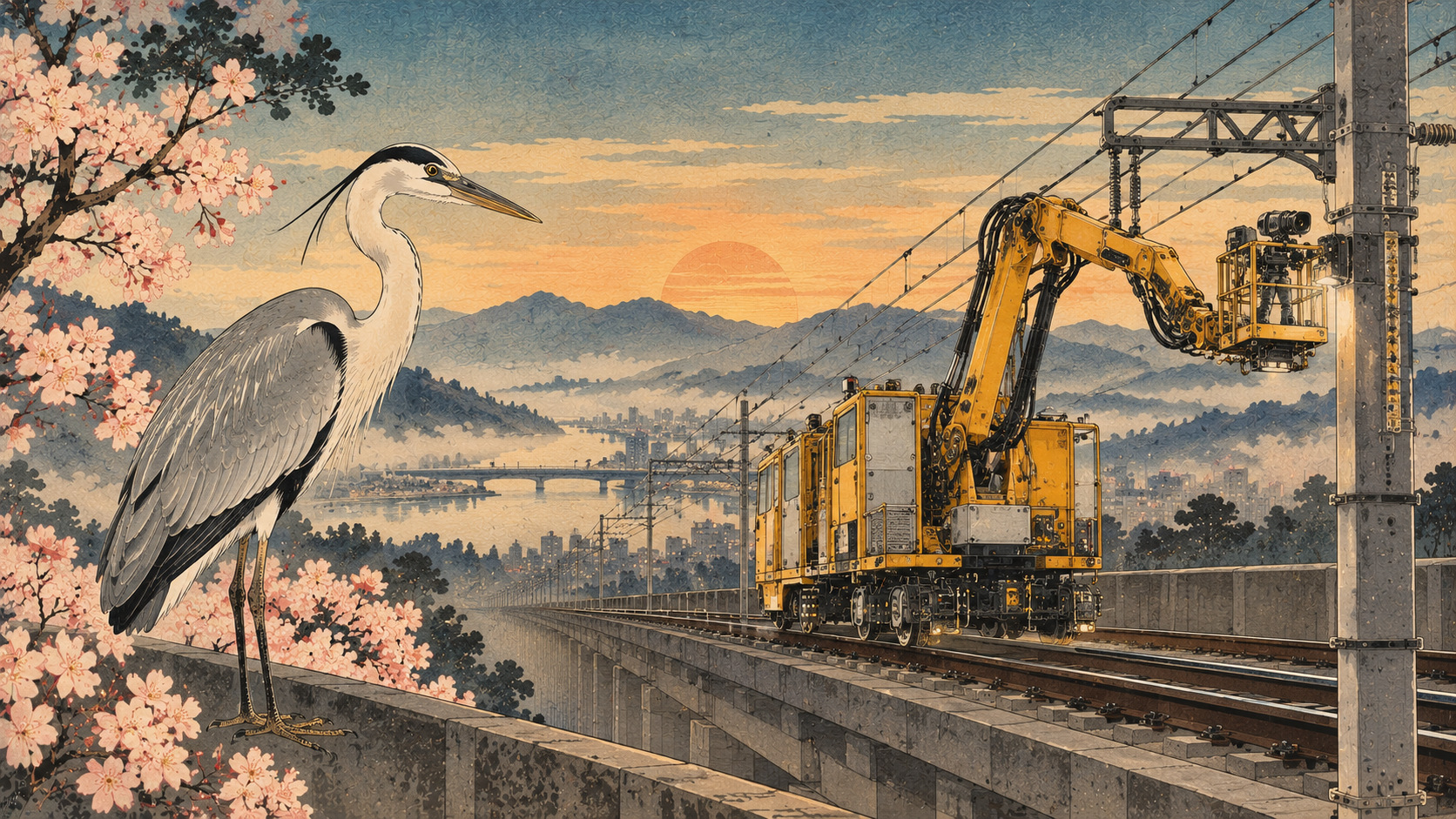
The single-arm machine mounts on the deck of an elevated work vehicle and can grip loads weighing up to 120 kilograms, according to JR West. Its purpose is to assist people with difficult lifting tasks rather than replace every task a skilled maintainer performs. The rated gripping capacity is not a claim that the machine can safely move that load in every position or circumstance. Site conditions, procedures and the manufacturer’s limits still matter.
A humanoid rebuilt for trackside trees
The production humanoid is smaller and lighter than the earlier model, with changes that include a longer boom. JR West says it will initially focus on clearing trees that could interfere with railway operations. Tree growth is an apparently mundane threat with serious consequences: branches near overhead wires and trees falling toward tracks can disrupt trains and endanger workers responding to the problem.
The history began before this October
The newest machines grow out of a program that JR West and engineering partners began developing in 2020. In July 2024, group company Nishinihon Electric System began using a multifunctional railway maintenance machine on commercial lines. The technology later gained the name ZIZAI. It evolved from prototypes associated with robotics developer Man-Machine Synergy Effectors and was commercialized in cooperation with Nippon Signal and other industry partners.
A robot body does not mean an autonomous mind
A humanoid silhouette can make the machine seem like a self-directed artificial intelligence. That would misstate what the public documentation establishes. Japan’s Ministry of Land, Infrastructure, Transport and Tourism described the earlier system as a robot operated remotely by a worker from a cab at the base of a maintenance vehicle. The operator supplies judgment and commands while the machine provides reach and force. The October announcement does not establish that these robots independently diagnose faults, plan repairs or work without human supervision.
Safety is the first return on investment
JR West identifies fall and electric-shock prevention as major reasons to mechanize elevated maintenance work. Relocating human effort away from hazardous positions could matter even where the labor saving is modest. The company also targets a reduction of roughly 30% in the personnel needed for certain work. That is an announced goal, not an independently measured productivity improvement across the railway network.
Why Japanese railway operators need another workforce model
The industry confronts an aging society, competition for technically skilled workers and a continuing obligation to keep critical transport infrastructure running. Work performed in extreme weather or overnight presents a difficult recruitment proposition. For JR West, a machine that lets experienced employees perform physically demanding work from a safer position may make maintenance careers more sustainable and open more roles to workers with different physical capabilities.
From an engineering prototype to a maintenance tool
The underlying research is not simply a robotics spectacle. Japan’s transport ministry discussed the partnership in its 2023 white paper, describing potential tasks including inspections, replacing components, handling heavy items, painting and vegetation clearance. A research prototype is not the same thing as an operational product: manufacturing, controls, training and integration into railway safety systems must come together before a machine can do dependable night work.
The technology is already crossing company lines
East Japan Railway Company says that a multifunctional railway maintenance machine developed through cooperation with JR West entered use in its electrical maintenance division in March 2026. Its initial application is vegetation clearing, with broader deployment under consideration. This does not mean the new October JR West models were already introduced by JR East; they are distinct developments in the same technology family.
Could the same machines maintain other infrastructure?
Power utilities, bridges and other public works also require hazardous high-level maintenance. JR West wants to broaden the range of jobs through new tools and eventually contribute to infrastructure maintenance beyond rail. But the business case remains incomplete without comparable data on machine costs, setup time, uptime, repair rates, training and the total crew hours saved. The public announcement does not provide a comprehensive independent evaluation.
The next test happens after the cameras leave
A compelling photograph of an industrial humanoid may attract attention. The more consequential story will unfold on actual maintenance shifts: can workers avoid dangerous climbs, complete work in the available window and document safer results over time? The October single-arm introduction and the scheduled November humanoid rollout give JR West new ways to test that question. Success will be measured by the trains that run safely the next morning, not by the robot’s resemblance to a person.
Sources and documentation
Based on official railway and government disclosures. Technical specifications and labor targets are attributed to their issuers; no independent field validation or new interview is claimed.