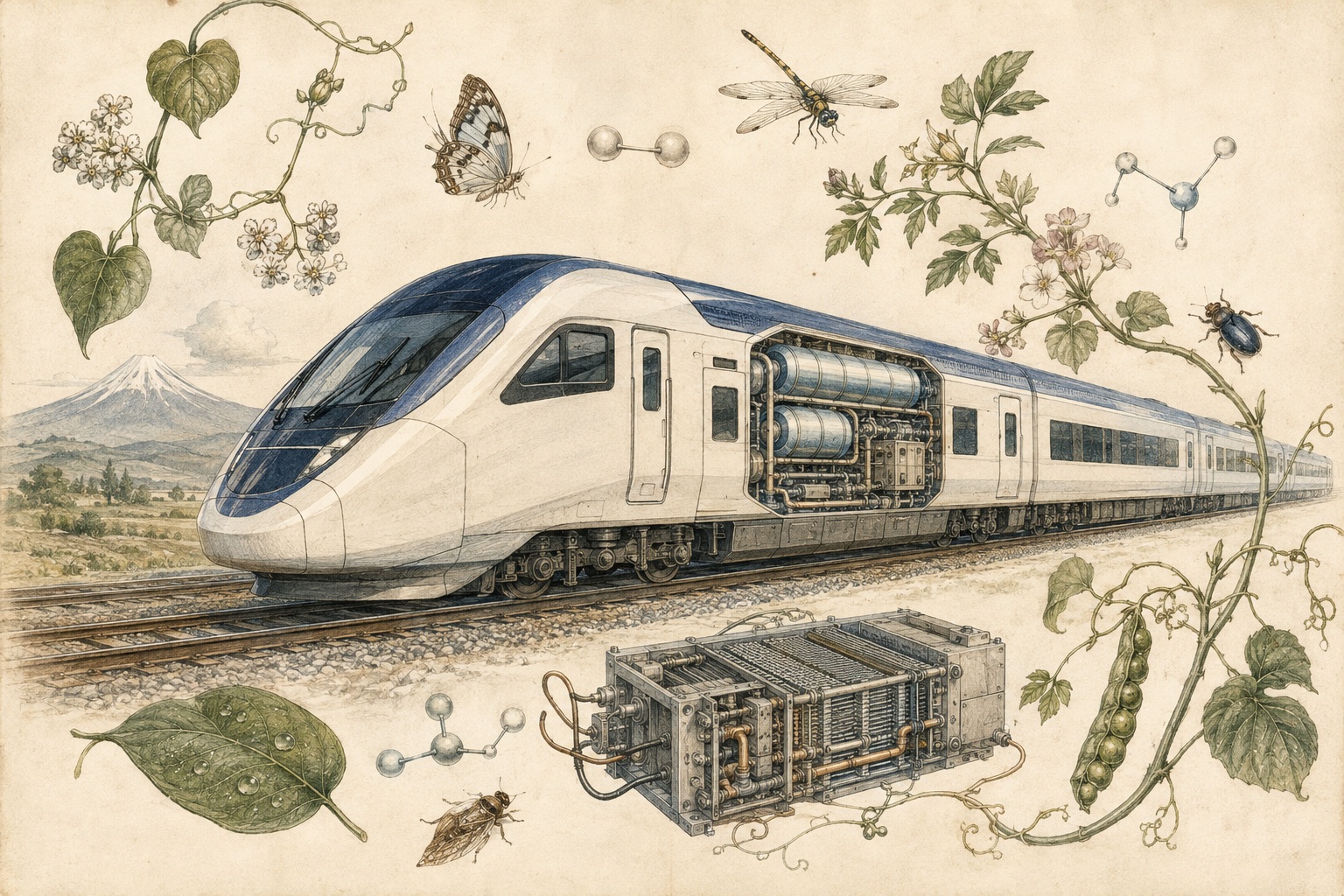
“Hydrogen train” still sounds like a phrase from a technology exhibition. The significance of the announcement made by JR East and Iwatani on August 7, 2026, is that Japan is trying to move beyond the exhibition stage. The difficult questions are no longer simply whether a fuel cell can turn hydrogen into electricity or whether a train can move under its own hydrogen power. The questions are operational: Can a railway refill several trains safely and quickly every night? Can the trains climb long grades, accelerate repeatedly, recover braking energy, meet a morning timetable and return to service the next day with the reliability passengers expect from an ordinary railway?
That is why the division of work in the new NEDO project matters. JR East will focus on the train itself—hybrid controls and a new hydrogen-storage unit. Iwatani will focus on what happens when the train is standing still: rapidly filling a large hydrogen vessel while controlling pressure, flow and temperature safely. Parts of the rolling-stock development will also involve Hitachi and Kawasaki Railcar.
A hydrogen railway is not just a vehicle. It is a vehicle, a depot, a filling installation, a fuel supply chain, maintenance procedures, safety rules and a timetable assembled into one system. For years, the public story of hydrogen rail has been dominated by the attractive part: a train that produces no carbon dioxide at the point of use. Social implementation is governed by less glamorous questions—where the hydrogen comes from, how it is transported, how long refueling takes, how many trainsets can be processed in succession and what happens to service when the supply chain is interrupted.
Japan now has two hydrogen-train programs moving at once
JR East’s 2026 hydrogen strategy is easier to understand if its two programs are separated. The first is the existing FV-E991 series test train, HYBARI, which has spent years gathering data and is now slated to be converted into Japan’s first hydrogen-powered train for regular commercial passenger service. JR East says that operation is targeted for around the end of FY2027 on the Tsurumi Line and the Nambu Line branch between Shitte and Hama-Kawasaki.
For that first commercial step, hydrogen is planned to be filled at the Kamakura Rolling Stock Base (Nakahara) at 35 MPa. JR East’s July 2026 announcement put the operating distance at roughly 70 kilometers per fill. This is deliberately a limited operating environment: a place to turn experimental technology into railway practice, to learn what refueling, maintenance, dispatching and fault recovery look like when passengers—not engineers—are waiting for the train.
The second program is the next-generation train supported by the new NEDO project. JR East says it intends to use 70 MPa high-pressure hydrogen, seek a range comparable with a diesel railcar, and develop performance suitable for routes with sustained gradients. Commercial operation is targeted around the end of FY2030. HYBARI therefore asks, “Can hydrogen become a normal passenger railway service?” The next-generation project asks the larger question: “Can hydrogen become a practical replacement option across a meaningful share of Japan’s non-electrified railway network?”
The story began twenty years ago with the NE Train
Japan’s hydrogen-rail story did not suddenly begin in the 2020s. In April 2006, JR East announced development of what it then described as the world’s first fuel-cell hybrid railcar. The vehicle was based on its New Energy Train, or NE Train, which had been developed as a diesel-engine hybrid and designed from the outset so it could later be converted to fuel-cell operation.
The concept already contained the architecture that remains central today. The experimental vehicle used two polymer-electrolyte fuel-cell units totaling 130 kW, lithium-ion batteries and approximately 270 liters of hydrogen storage at 35 MPa. During acceleration, electricity could come from both the fuel cells and batteries; during braking, regenerative energy could be captured and returned to the battery.
A 2007 JR East sustainability report records that the company was conducting running tests while studying matters that sound remarkably current two decades later: the safety of installing high-pressure hydrogen tanks on railway vehicles, hydrogen filling facilities and filling methods. The latest NEDO project, in other words, is not reopening an old question. It is trying to solve at commercial scale one of the questions engineers identified almost at the beginning.
HYBARI married automotive fuel cells to railway engineering
The next major step came in October 2020, when JR East, Hitachi and Toyota announced the joint development of the FV-E991 series. Each partner contributed a different engineering lineage: JR East brought rolling-stock design and railway operations; Hitachi brought hybrid railway-drive technology developed with JR East; Toyota brought fuel-cell expertise accumulated through vehicles including the Mirai and SORA.
A train is not simply a very large fuel-cell car. Railway vehicles are much heavier, demand enormous power during acceleration, brake frequently and must survive relentless duty cycles. The hybrid architecture lets the fuel cells work as part of a broader energy-management system rather than forcing them to meet every instantaneous demand alone. The battery can assist during acceleration and climbing, while regenerative braking recovers energy that would otherwise be dissipated as heat.
HYBARI’s name expands to “HYdrogen-HYBrid Advanced Rail vehicle for Innovation.” The specifications published in 2020 called for a two-car set, a maximum speed of 100 km/h, four 60-kW polymer-electrolyte fuel-cell units and two 120-kWh lithium-ion main-circuit batteries. Demonstration testing began in March 2022 on the Tsurumi and Nambu lines and other sections, giving JR East years of data on vehicle performance and system stability.
| Generation | Role | Key idea |
|---|---|---|
| 2006 fuel-cell NE Train | Basic technology validation | 35 MPa hydrogen, fuel cell + battery, regenerative braking |
| HYBARI from 2022 | Real-line demonstration | JR East, Hitachi and Toyota technologies combined |
| Commercial HYBARI, target end FY2027 | Japan’s first passenger operation | Tsurumi/Nambu branch, 35 MPa, about 70 km per fill |
| Next generation, target end FY2030 | Broader non-electrified routes | 70 MPa, rapid refueling, longer range and sustained-grade capability |
Why Iwatani matters: making hydrogen obey a railway clock
Iwatani’s role is more consequential than the phrase “hydrogen supplier” suggests. According to the company’s history, it began handling hydrogen in 1941 and in 1978 started hydrogen-business operations at Japan’s first large-scale commercial liquid-hydrogen production plant. Over decades it has accumulated experience in producing, transporting, storing and dispensing hydrogen for industrial, space and mobility applications.
Railways need fuel in large quantities and on predictable schedules. A passenger car can be refueled one vehicle at a time. A depot may need several trainsets prepared inside a narrow overnight maintenance window. Rapidly compressing hydrogen into a large tank raises its temperature. Refueling therefore becomes a control problem involving pressure, temperature and flow: put hydrogen in too slowly and the timetable suffers; push too aggressively and the thermal and safety margins disappear.
This is why the wording of the August 7 announcement deserves attention. Iwatani is explicitly responsible for “rapid filling and filling-control technology for large-capacity hydrogen vessels.” That is social-implementation engineering in its purest form. The objective is to transform hydrogen from a laboratory fuel into something railway staff can replenish as routinely and predictably as today’s diesel operations.
Hydrogen is an energy carrier, not a magic energy source
Point-of-use emissions are only one part of the climate calculation. A fuel cell combines hydrogen with oxygen to generate electricity, with water and heat as the immediate byproducts. But hydrogen itself must first be produced. When it is made from fossil fuels without effective carbon management, significant emissions can occur upstream. When it is produced by electrolysis using low-carbon or renewable electricity, the lifecycle carbon burden can be much lower.
That distinction means “hydrogen train” cannot automatically be translated as “zero-carbon train.” The relevant questions are how the hydrogen was produced, what electricity powered that production, how much energy was used to compress or liquefy it, how far it traveled, and how efficiently the full chain turns primary energy into motion at the wheel.
JR East has acknowledged this supply-side issue. In describing its next-generation train, the company said it would consider hydrogen manufactured overseas and imported into Japan as well as hydrogen produced in Japanese regions rich in renewable energy. If hydrogen rail expands, procurement quality will matter almost as much as rolling-stock technology.
- Origin: Was the hydrogen produced with renewable or low-carbon energy, or from unabated fossil fuel?
- Refueling: Can a depot process multiple trainsets quickly enough to protect the timetable?
- Range: Can one fill replace a diesel duty cycle without operational compromises?
- Grades and climate: Can the system maintain required power on sustained slopes and in difficult weather?
- Alternatives: On the specific route, is hydrogen better on lifecycle cost and emissions than electrification, batteries, or other low-carbon fuels?
The value of having an answer besides “build more catenary”
One obvious way to decarbonize a diesel railway is to electrify it. But catenary, substations, transmission equipment and their maintenance are expensive, especially on long rural routes with relatively few passengers. Battery trains offer another powerful option, particularly where non-electrified sections are short enough to bridge between charging opportunities. Neither technology, however, is automatically optimal for every route.
Hydrogen becomes interesting when it creates a third option between full electrification and continued diesel operation: an electric-traction train capable of covering longer unelectrified distances without installing continuous overhead wiring. Railways also have an infrastructure advantage over private automobiles. Trains return to known depots on predictable schedules, so fueling infrastructure can be concentrated rather than scattered across thousands of roadside locations.
That advantage is conditional. A route with convenient charging points may favor batteries. A dense line may justify conventional electrification. Hydrogen must earn its place route by route, not by being more futuristic. Its total lifecycle cost, maintenance burden, operational flexibility and actual greenhouse-gas reduction must outperform the alternatives under the conditions where it is deployed.
Europe reached passenger service first—but Japan’s path is still significant
Japan is not the first country to put hydrogen fuel-cell passenger trains into commercial use. In September 2018, Alstom’s Coradia iLint entered scheduled passenger service in Lower Saxony, Germany. The train converts hydrogen and oxygen into electricity through fuel cells and was designed specifically to replace diesel trains on non-electrified regional lines. Alstom later moved to a fleet of 14 series trains in Germany and has demonstrated ranges on the order of 1,000 kilometers.
So the important Japanese claim is not “the world’s first hydrogen train.” Japan’s significance lies in the engineering pathway it has chosen. JR East has spent two decades developing fuel-cell hybrid rail technology, then combined automotive fuel-cell know-how, railway regenerative controls, high-pressure gas engineering and Japanese railway operating practice. Its next-generation program now aims to take 70 MPa high-pressure hydrogen and rapid refueling into real railway operations, with overseas deployment also under consideration.
The hydrogen “backbone” turns a train into an anchor customer
The August 7 NEDO announcement explicitly links the railway project to Japan’s emerging “hydrogen backbone” concept: an effort to connect hydrogen production, transport and use by creating concentrated demand along major transport corridors. Hydrogen infrastructure faces a familiar chicken-and-egg problem. Suppliers hesitate to build expensive facilities without dependable demand; users hesitate to buy hydrogen equipment when supply is thin.
A railway can become an anchor customer because its demand is unusually predictable. Trainsets run to schedules, consume fuel in repeatable patterns and return to the same depots. If a railway depot becomes part of a regional hydrogen hub, infrastructure might eventually be shared with buses, trucks, stationary generation or industrial users. If, on the other hand, an expensive supply chain has to be built solely for a handful of trains, the economics become much harder.
JR East is already exploring hydrogen outside rolling stock: hydrogen use at its Kawasaki power plant, a hydrogen station concept in Karuizawa, and fuel-cell trucks and refuse vehicles around Takanawa Gateway City. The strategic question is therefore larger than whether a hydrogen train works. It is whether railway demand can be integrated with power, logistics and urban demand so that several users share the same hydrogen ecosystem.
The unresolved issues: safety, cost, efficiency and carbon intensity
Hydrogen is extraordinarily light. That is useful by mass, but awkward by volume, which is why transportation applications generally require compression or liquefaction. On a railway, high-pressure storage must be designed around collision, derailment and fire scenarios, with leak detection, ventilation, isolation and emergency procedures. Filling facilities bring their own long-term engineering questions: fatigue, seals, piping inspection, thermal management and staff training.
Economics remain equally important. Producing hydrogen, compressing it, transporting it and converting it back into electricity through a fuel cell introduce energy losses. In situations where renewable electricity can be fed directly into a battery train, hydrogen may be less energy-efficient. Hydrogen has to compensate through advantages such as range, rapid replenishment, centralized infrastructure, cold-weather or gradient performance and compatibility with existing diesel-style operating patterns.
Above all, the carbon intensity of the fuel must remain visible. A train that emits no CO₂ from its own propulsion system can still be part of a high-carbon energy chain. If Japan imports hydrogen, meaningful accounting will have to consider the electricity and feedstock used in the producing country, any carbon capture, conversion or liquefaction energy, and maritime transport.
From “test train” to just “the train”
The history of railway technology has a strange rule: the most successful innovations eventually stop looking innovative. Regenerative braking, automatic ticket gates and modern power electronics were once special technologies. When they work, passengers forget about them.
That may be the real destination for HYBARI. Around the end of FY2027, a passenger may board a hydrogen train on the Tsurumi Line or Nambu branch not for a demonstration but to commute, shop or visit family. At that moment, hydrogen rail crosses a cultural boundary as important as the technical one—from research project to public transportation.
If the next-generation train follows around the end of FY2030 and proves capable of longer non-electrified routes and sustained gradients, Japan could gain another practical tool for regional railway decarbonization. The success metric will not be a spectacular speed record. It will be whether the train wakes up on the same cold morning as a diesel railcar, keeps the same timetable, climbs the same hill, returns to the same depot, refuels within the maintenance window and does it again the next day.
The NEDO decision announced on August 7 gives funding and a defined division of labor to that unglamorous but decisive work. A question that began with one experimental NE Train twenty years ago has expanded to include depots, hydrogen supply networks, regional energy systems and railway economics. Whether Japan’s hydrogen train is truly the future will not be answered by a blue logo or a plume of water vapor. It will be answered on an ordinary platform on an ordinary morning in the 2030s.
1941 Iwatani begins handling hydrogen.
1978 Iwatani begins hydrogen-business operations at Japan’s first large-scale commercial liquid-hydrogen production plant.
2006 JR East develops a fuel-cell hybrid railcar based on the NE Train and moves toward running tests.
2007 JR East continues real-line testing and research into high-pressure tanks and hydrogen filling.
2018 Alstom’s Coradia iLint begins scheduled hydrogen fuel-cell passenger service in Germany.
October 2020 JR East, Hitachi and Toyota announce joint development of the FV-E991 series HYBARI.
March 2022 HYBARI demonstration testing begins on the Tsurumi and Nambu lines and other sections.
July 14, 2026 JR East announces commercial HYBARI service targeted for the end of FY2027 and development of a next-generation train.
August 7, 2026 JR East and Iwatani announce NEDO selection of their next-generation hydrogen fuel-cell railway project.
Target: end FY2027 Commercial HYBARI operation on the Tsurumi Line and Nambu branch.
Target: end FY2030 Commercial operation of the next-generation 70 MPa-class hydrogen hybrid train.
Reporting notes and principal sources
This article uses public information checked through August 9, 2026, 12:50 a.m. JST. Commercial-service dates, specifications and operating sections remain subject to change. “No CO₂ at the point of use” is not treated here as synonymous with zero lifecycle carbon emissions.
- JR East: NEDO selection for next-generation hydrogen fuel-cell railway development, August 7, 2026
- JR East: Accelerating zero-carbon initiatives and hydrogen LX, July 14, 2026
- JR East: Development of the World's First Fuel Cell Hybrid Railcar, April 11, 2006
- JR East, Hitachi and Toyota: HYBARI development announcement, October 6, 2020
- JR East Sustainability Report 2007: real-line testing, tank safety and hydrogen filling research
- Hitachi: FV-E991 system and principal specifications
- Iwatani: Our History
- Alstom: Coradia iLint enters passenger service, 2018
- Alstom: Coradia iLint hydrogen train overview