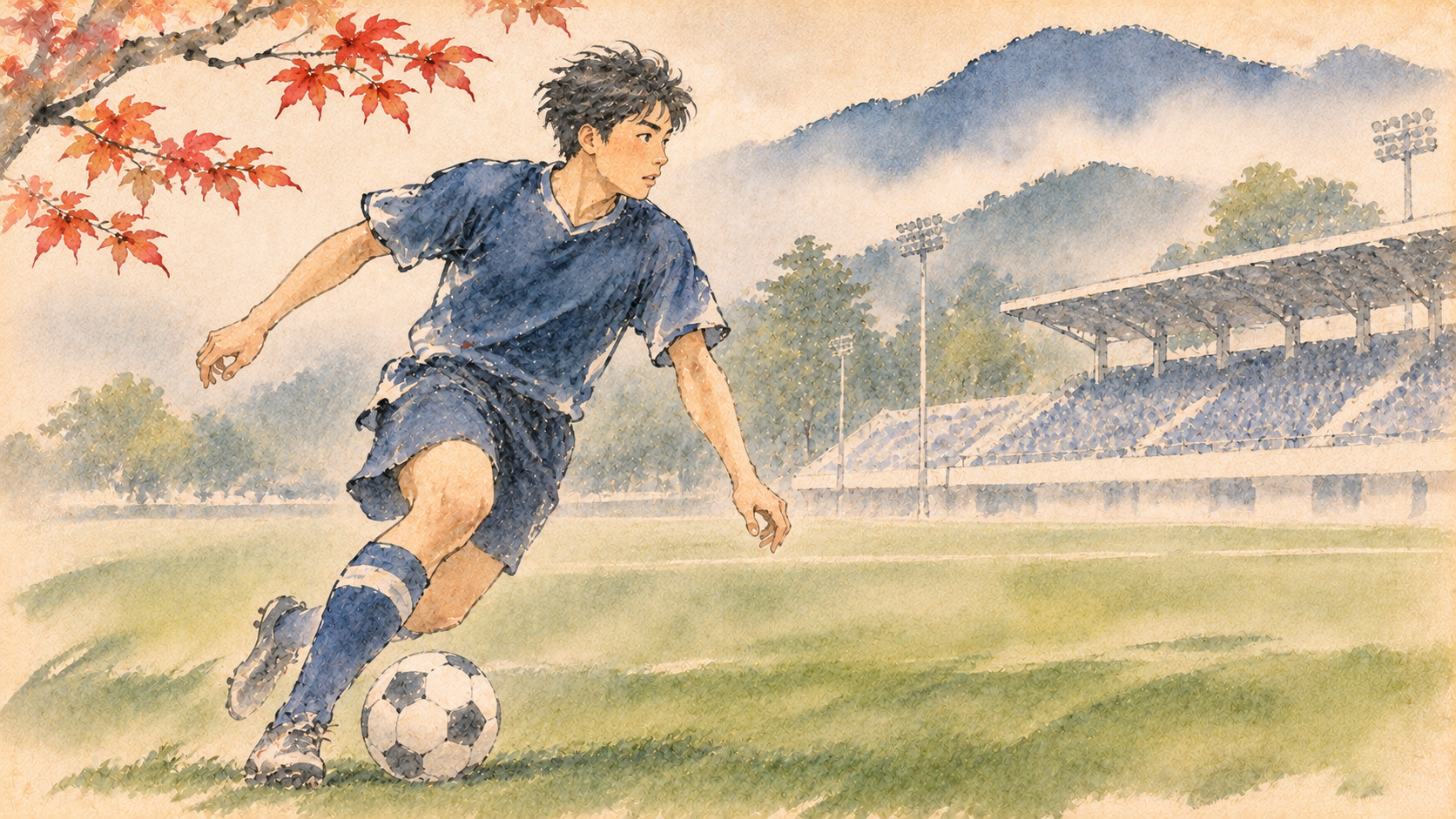
- A small tournament with an unusually wide horizon
- First, a clarification: U-18 teams in a U-17 competition
- Six teams and two distinctly international groups
- The fixture list: five venues, nine scheduled matches
- Why Japan built an academy system in the first place
- The defending champion and the new arrivals
- What an unfamiliar opponent can reveal
- Tochigi as a football classroom
- The outcome that matters after the final whistle
A small tournament with an unusually wide horizon
On the morning of December 15, a Kawasaki Frontale academy side is scheduled to meet ASEC Mimosas of Côte d’Ivoire in Tochigi. Later that day, Shonan Bellmare will play South Korea’s Ulsan HD. Flamengo from Brazil and Benfica from Portugal complete a six-team lineup announced by the J.League on November 19. The event, the eighth J.League International Youth Cup, will unfold across five stadiums in Tochigi Prefecture from December 15 through 19.
For young Japanese players, the attraction is more than meeting celebrated overseas club names. The opportunity is to learn whether decisions that feel comfortable at home still work against an opponent trained in a different football culture. The significance of a short competition rests less in its final table than in the unfamiliar problems it forces teenagers to solve.
First, a clarification: U-18 teams in a U-17 competition
Kawasaki Frontale U-18 and Shonan Bellmare U-18 are the Japanese entrants. Those are their academy team names, but this particular competition is designated U-17: eligible players must have been born on or after January 1, 2009. The two domestic clubs qualified as the champion and runner-up, respectively, of the 2026 J.Youth Cup, the 32nd J.League Youth Championship.
That distinction matters for fans interpreting lineups and comparing age groups. An U-18 team name does not mean that every player in the organization’s usual squad can compete. The November announcement does not provide a definitive roster or confirm the participation of any individual footballer.
Six teams and two distinctly international groups
Group A contains Kawasaki Frontale U-18, ASEC Mimosas and CR Flamengo. Group B comprises Shonan Bellmare U-18, SL Benfica and Ulsan HD FC. Each club meets the other two teams in its group once. After those games, teams finishing at the same position in their respective groups meet for the championship, third place or fifth place.
Matches last 70 minutes, with 35-minute halves; ties are resolved by penalty kicks under the published format. Because every team plays only two group matches, a single missed chance or defensive mistake can radically change the standings. The winner of such a competition has earned a tournament title, not a scientifically valid ranking of countries’ development systems.
The fixture list: five venues, nine scheduled matches
The group stage opens on December 15 at CITY FOOTBALL STATION in Tochigi City: Kawasaki versus ASEC Mimosas at 11 a.m., followed by Shonan versus Ulsan at 2 p.m. On December 16 at Sakura Stadium in Sakura City, Flamengo plays Kawasaki at 11 a.m. and Ulsan plays Benfica at 2 p.m. December 17 brings Flamengo against ASEC at 11 a.m. and Shonan against Benfica at 2 p.m. at Kawachi Athletic Stadium in Utsunomiya.
The fifth-place match is scheduled for 10 a.m. on December 19 and the third-place match for 1 p.m., both at Omatsuyama Athletic Stadium in Shimotsuke. The 3 p.m. final is planned for Kanseki Stadium Tochigi in Utsunomiya. The league also plans showcase matches during the group phase and a cultural-exchange day for players and staff on December 18. Admission to all games is free, with free live coverage planned on the league’s official YouTube channel.
Why Japan built an academy system in the first place
Youth football was not a decorative afterthought when Japan’s professional league began in 1993. From the beginning, the J.League required member clubs to maintain development teams and launched the J.Youth Cup that year. In the early 2000s the league consolidated the language of “J.League Academy” around club youth structures and increasingly emphasized coaches, player development and the environments in which young athletes learn.
The international youth event started in 2015 and was staged annually through 2019. After an interruption, it returned in 2024 and continued in 2025. The 2026 edition is the eighth. Inviting overseas academies to Japan gives domestic players access to unfamiliar opponents without requiring every family or club to fund a long international tour. That is a structural part of the tournament’s value, even if lasting effects must be assessed over years.
The defending champion and the new arrivals
Flamengo arrives as the defending champion. In the 2025 final, the Brazilian club defeated Right to Dream of Ghana; the J.League named João Vitor Couto as both leading scorer, with four goals, and tournament MVP. Its return adds continuity to an otherwise changing roster of invited academies.
ASEC Mimosas and Benfica are participating for the first time, according to the 2026 announcement. Ulsan HD returns for the first time since 2018; the organizers also identify Ulsan as a recipient of the 2025 K League Best Youth Development Club award. These institutional credentials offer background, but they do not tell us the relative ability of the specific squads to appear in Tochigi.
What an unfamiliar opponent can reveal
A defender accustomed to one tempo can discover that a different team presses immediately after losing possession. A midfielder may find passing angles closed faster than expected. Coaches can watch how their players adjust under pressure and whether a tactical instruction survives contact with a game that unfolds differently from training. These are possible development benefits, not measured outcomes from a tournament that has yet to begin.
One event also cannot determine whether an academy produces more professional players. To answer that, researchers would need to track minutes played, injuries, selection patterns, player progression, education and later opportunities. The J.League announcement defines improving academy players’ football level and promoting international exchange as the tournament’s purposes; it does not quantify their eventual success.
Tochigi as a football classroom
Staging matches across Tochigi City, Sakura City, Utsunomiya and Shimotsuke opens international youth football to communities beyond the typical major-city spotlight. A local teenager can watch opposing players with different styles from the touchline. The free-admission policy lowers one barrier; planned online streams offer another means of access.
But no attendance forecast, economic-impact estimate or evidence of an increase in youth participation accompanies the release. Transport, school calendars and stadium operations will shape how many people actually engage. Visitors should consult the J.League’s official tournament page near the event for potential updates to times, venues and attendance arrangements.
The outcome that matters after the final whistle
A champion is scheduled to be crowned on December 19. Yet the tournament’s longest-lasting effect could be almost invisible on that afternoon: how players review their mistakes, which habits coaches change, and whether a short international encounter informs the next training cycle.
As of the November 19 announcement, no 2026 results, spectator figures, streaming audiences or player-specific achievements exist to report. The meaningful story for now is a verified investment in competitive international experience—and an open question about how Japanese academy football will use it.
Official fixture schedule (Japan time)
| Date / time | Fixture | Venue |
|---|---|---|
| 12/15 11:00 | Kawasaki Frontale U-18 — ASEC Mimosas | CITY FOOTBALL STATION |
| 12/15 14:00 | Shonan Bellmare U-18 — Ulsan HD FC | CITY FOOTBALL STATION |
| 12/16 11:00 | CR Flamengo — Kawasaki Frontale U-18 | Sakura Stadium |
| 12/16 14:00 | Ulsan HD FC — SL Benfica | Sakura Stadium |
| 12/17 11:00 | CR Flamengo — ASEC Mimosas | Kawachi Athletic Stadium |
| 12/17 14:00 | Shonan Bellmare U-18 — SL Benfica | Kawachi Athletic Stadium |
| 12/19 10:00 | 5th-place match | Omatsuyama Athletic Stadium |
| 12/19 13:00 | 3rd-place match | Omatsuyama Athletic Stadium |
| 12/19 15:00 | Final | Kanseki Stadium Tochigi |
Sources and reporting limitations
Reporting note: This account draws on the J.League’s official November 19 announcement, JFA terminology and J.League academy history. JAPAN.co.jp did not interview participants or independently verify any future roster, tactical performance, attendance count or streaming audience. Dates, fixtures and broadcasts were announced plans at the research cutoff.
- J.League primary Japanese announcement, 19 November 2026
- J.League official Japanese news and fixture list
- J.League English tournament announcement
- 2026 tournament special site
- J.League academy history and player-development mission
- JFA football terminology and competition definitions
- 2025 tournament official results
- 2025 competition history and previous champions
- 2026/27 J Youth Cup framework