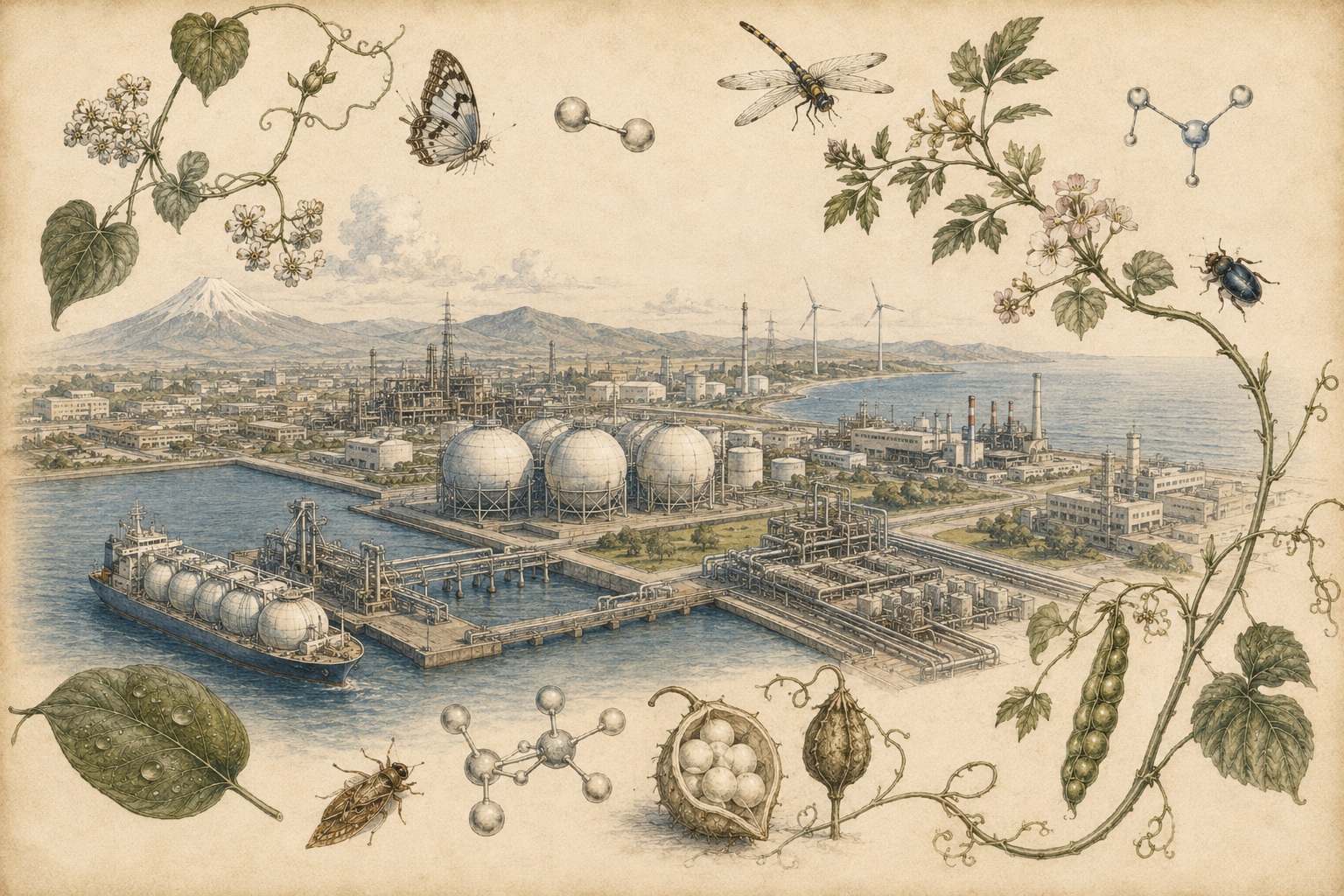
A hydrogen market does not exist simply because one large company can buy a subsidized fuel. Imagine every steelworks building its own tank, every glass factory constructing another unloading system and every parts manufacturer paying for another dedicated logistics chain. In an early market with small volumes, the fixed cost of delivery can overwhelm the cost of the molecule itself.
Japan’s answer is the hydrogen hub. Concentrate storage, unloading, pipelines, truck loading and other infrastructure around a port or anchor customer. Let several industrial users share the equipment. If oil complexes and city-gas systems became economical by aggregating demand, hydrogen and ammonia may need to follow the same infrastructure logic.
On March 27, 2026, JERA’s Hekinan plan became one of the first projects certified for this new hub support. Hekinan Thermal Power Station in Aichi Prefecture provides the anchor: an enormous fuel consumer capable of creating base demand. Low-carbon ammonia from the Blue Point project in Louisiana will serve the power station, while part of the supply is intended for manufacturing customers across Central Japan.
The policy distinction is fundamental. Price-gap support helps the fuel price compete. Hub-development support helps the fuel physically reach multiple customers without forcing each one to build a private import chain. It marks Japan’s attempt to move hydrogen policy from scattered dots on a map toward regional industrial networks.
“The fuel is expensive” and “delivery infrastructure is expensive” are two different problems
Japan’s hydrogen support system can look confusing because it contains several mechanisms. Break down the delivered cost and the distinction becomes logical.
Low-carbon ammonia is produced overseas. It is loaded onto a ship, transported to Japan, unloaded, stored, transferred to road transport or pipeline, delivered to a factory and finally consumed in a boiler or furnace. The user’s real price contains all of those steps.
Price-gap support focuses on the difference between a certified base price required for low-carbon supply and the reference economics of the conventional fuel or feedstock being replaced.
Hub-development support addresses a different piece: common storage and transport infrastructure between production or import and the point of use, where several users share the equipment. Government documents use common tanks and common pipelines as representative examples.
For Hekinan, JERA specifically identifies lorry-loading facilities needed to distribute ammonia to other companies. If all ammonia remained inside JERA’s own power station, that outward-facing infrastructure would not be necessary. Once the site becomes a supplier to factories, the receiving terminal needs an exit door.
The government wanted to avoid a “one company, one tank” hydrogen economy
In policy work dating back to 2022, METI warned that if individual companies developed separate hydrogen and ammonia infrastructure without aggregation around large demand, supply chains could become inefficient and fail to scale.
The resulting hub concept set a guideline of roughly three large hubs centered on major metropolitan and industrial areas and about five medium-sized regional hubs over roughly the following decade.
That does not mean Japan intends to limit hydrogen to eight places. It means concentrating the first expensive shared infrastructure where demand density can support high utilization, then extending spokes toward surrounding users.
Oil and LNG did not become national energy systems because every customer chartered its own import vessel. Large receiving points emerged first, followed by pipelines, trucks and secondary terminals. Hydrogen and ammonia are entering that same infrastructure phase.
FS, FEED, EPC: a “hub” is becoming a construction schedule
The government has approached hub development in three stages. First comes feasibility study, or FS: identify demand, fuel volume, transport mode, land and commercial logic.
Next is FEED, front-end engineering and design. Tank size, piping, loading equipment, safety distances, road access and future expansion become engineering decisions.
Then comes EPC—the actual engineering, procurement and construction of infrastructure. Japan supported FS work during FY2024; from FY2025 onward, FEED and infrastructure investment moved under the Hydrogen Society Promotion Act’s hub-development framework.
Program documentation requires plans seeking hub support to show extended supply after supported facilities are acquired, and the low-carbon supply business is generally expected to begin by FY2030.
That is a significant transition. Hydrogen hubs have moved from regional vision documents toward questions such as when a tank is ordered, where the truck gate sits and who will use the facility for the next decade.
Why Hekinan? Start with 4.1 gigawatts of anchor demand
The most valuable asset in a hydrogen hub is not a tank. It is a customer large enough to keep the tank busy.
Hekinan Thermal Power Station has maximum output of 4,100 MW. JERA describes it as Japan’s largest coal-fired thermal power station and among the largest in the world.
That scale can support infrastructure economics that a smaller industrial customer could never justify alone. A major power station absorbs large quantities of fuel; smaller manufacturing customers can then take a fraction of the same imported supply.
That is the economics of clustering. A factory needing only a few thousand tonnes per year cannot reasonably build a trans-Pacific ammonia supply chain. If a nearby anchor consumes hundreds of thousands of tonnes, the factory may only need the incremental logistics needed to connect to the shared hub.
Hekinan already tested 20% ammonia at one gigawatt
Hekinan is not merely a promising location on a planning map. It has already handled ammonia at a scale relevant to utility operations.
In April 2024 JERA and IHI began a demonstration substituting ammonia for 20% of heat input at Unit 4. On April 10, the unit achieved 20% substitution while operating at its rated 1 GW output.
JERA later reported that NOx remained no higher than during coal-only operation, SOx fell by about 20%, and N₂O—a potent greenhouse gas—was below the detection threshold during the test.
Those findings do not make the lifecycle emissions of the fuel zero. Upstream natural-gas emissions, carbon capture and storage performance, shipping and other steps still matter.
But the test gave JERA something extremely useful for a hub: real experience receiving, storing, vaporizing, piping and combusting large quantities of ammonia at a commercial power station.
From power station to regional fuel wholesaler
JERA’s certified price-gap supply plan names industrial-furnace customers including Toyota Industries, AGC, NGK Insulators and Aisin Fukui alongside Hekinan.
This is where hub-development support becomes tangible. Those factories do not need to charter ammonia carriers. They do not each need a marine import terminal. Fuel can be received in bulk at Hekinan and loaded into road tankers through shared facilities.
Road distribution is flexible at the beginning. When customers number only a few and are dispersed, it can be cheaper than constructing permanent pipelines to every site. If demand later concentrates, some high-volume routes could justify larger storage nodes or pipelines.
A hub therefore does not have to build the final network on day one. It needs to create an expandable center from which demand can grow.
| Mechanism | Price-gap support | Hub-development support |
|---|---|---|
| Problem addressed | Low-carbon fuel is more expensive than incumbent fuel | Initial shared transport and storage infrastructure is expensive |
| What is supported | The certified price difference | Shared transport/storage assets used by multiple customers |
| Hekinan example | Economics of Blue Point low-carbon ammonia supply | Lorry-loading equipment and related shared distribution infrastructure |
| Market goal | Make the molecule commercially buyable | Aggregate demand and raise infrastructure utilization |
Central Japan started organizing a shared market four years before certification
Hekinan’s certification did not emerge from nowhere. On February 21, 2022, governments, industry groups and companies in Central Japan established a regional organization to accelerate hydrogen and ammonia deployment. In October 2022 it took its current name, the Central Japan Hydrogen and Ammonia Association.
Its stated work includes planning infrastructure for the import, storage, supply and utilization of hydrogen and ammonia.
Central Japan has a strong reason to pursue this model: dense manufacturing. Automotive, glass, ceramics, steel, machinery and aerospace industries create numerous heat-intensive demand points around ports and inland industrial areas.
Individually those users are smaller than a power station. Collectively they form a large potential market.
A hydrogen or ammonia hub is therefore industrial infrastructure as much as energy infrastructure. If shared supply becomes accessible, even companies too small to finance a private import chain may eventually buy low-carbon fuel.
The other end of Hekinan is in Louisiana
Looking only at Aichi misses half the hub. The upstream anchor is Blue Point in Ascension Parish, Louisiana.
CF Industries, JERA and Mitsui reached final investment decision in April 2025. The project will produce low-carbon ammonia from natural gas, capture and compress carbon dioxide from the production process and send it for permanent geological storage. Nameplate ammonia capacity is approximately 1.4 million tonnes per year.
Ownership is CF Industries 40%, JERA 35% and Mitsui 25%. CF Industries estimated the ammonia production facility at roughly $4 billion. The project is designed to capture more than 95% of CO₂ generated by ammonia production and to transport and permanently store approximately 2.3 million tonnes of CO₂ annually.
JERA will offtake ammonia associated with its investment and supply Hekinan and manufacturing customers in the Chubu region. Commercial production is expected around 2029.
The Japanese “hub,” in other words, is not merely a domestic tank. It is the Japanese node in a long contractual network linking U.S. natural gas, carbon capture and storage, ammonia production, ocean shipping, power generation and manufacturing.
Four ammonia carriers: shared infrastructure also exists at sea
In June 2026 JERA signed time-charter agreements with the NYK Group and Mitsui O.S.K. Lines for four ammonia carriers intended to transport low-carbon ammonia from Blue Point.
The economics mirror the hub. A demonstration can work with an occasional vessel. A commercial chain supplying hundreds of thousands of tonnes every year needs a shipping schedule, dry-dock coverage, redundancy for weather and delays, and enough vessels to keep terminal inventory stable.
Shared tanks on land, common loading systems, road distribution—and a contracted fleet at sea. These are the signs that hydrogen-derived fuel is moving from “project” toward “logistics industry.”
Why ammonia? Sometimes the easiest way to transport hydrogen is not to transport hydrogen
Ammonia, NH₃, is a hydrogen-containing molecule. It liquefies at around minus 33°C near atmospheric pressure, dramatically warmer than liquid hydrogen’s roughly minus 253°C. The fertilizer and chemical industries have transported ammonia globally for decades.
Japan therefore treats ammonia both as a hydrogen carrier and as a fuel or feedstock that can sometimes be used without cracking it back into pure hydrogen.
At Hekinan it can go directly to the boiler. Industrial furnaces can also use ammonia as fuel. In other applications, future cracking systems could recover hydrogen.
The tradeoff is safety. Ammonia is toxic and pungent. Existing chemical-industry experience is valuable, but energy use could increase volumes through ports and roads enormously. Safety systems and community acceptance have to expand with the market.
A hub is only as valuable as its utilization rate
A shared tank does not reduce cost merely by existing. It has to be used.
If one company bears the full fixed cost of a facility, every tonne carries that burden. If five users keep the same facility busy, the fixed cost can be distributed across much more throughput.
The opposite is also true. If industrial customers delay switching fuel, a large tank can sit underused. If lorry-loading bays process only a handful of vehicles, unit logistics cost stays high.
Hub policy is therefore a demand-aggregation policy disguised as an infrastructure policy. The government is not merely betting that companies can construct assets. It is betting that enough customers will actually use them.
The strength—and danger—of having JERA as an enormous anchor
A 4.1 GW power station is nearly ideal for creating first-wave demand. It can justify ships, tanks and port systems before smaller industrial customers are ready.
But that creates a second risk: if JERA’s own power-generation demand dominates overwhelmingly, the “shared hub” may function in practice as a JERA terminal with a small external-sales arm.
The real test is growth beyond the anchor. Do Toyota Industries, AGC, NGK Insulators and Aisin Fukui increase their consumption? Do more manufacturers sign contracts? Does the share of ammonia moving through common loading equipment to third parties grow?
Hub performance should therefore be measured not only in total tonnes, but in tonnes supplied outside the anchor customer and in the number of independent users.
Road tankers are not the final network; they are a way to discover it
For the first industrial customers, road tankers offer flexibility. They can reach factories that are not on a dedicated pipeline and adapt as customer geography changes.
At much larger scale, trucking has limits. Driver availability, traffic, loading time, safety controls and distance all raise cost.
If demand later becomes concentrated along a corridor, a dedicated pipeline or secondary terminal may become cheaper. Japan’s hub-and-spoke policy framework is designed to allow that type of evolution.
Supporting truck-loading equipment now is therefore not necessarily a commitment to truck ammonia forever. It can be a low-capital method for learning where demand is strong enough to justify more permanent infrastructure later.
Will Japan actually build the planned three large and five medium hubs?
Government policy has used a guideline of around three large metropolitan/industrial hubs and five medium regional hubs over about a decade.
On March 27, 2026, the first certifications went to Hekinan and Tomakomai in Hokkaido. The Tomakomai plan similarly links imported low-carbon ammonia with power generation and industrial uses around a major port and energy cluster.
Japan has therefore begun implementation with two large ammonia-centered import clusters. What follows—pure hydrogen import hubs, domestic hydrogen production clusters and other regional architectures—will show how broad the model becomes.
The “three plus five” figures should remain a planning guideline, not a quota. Building an empty hub to satisfy a national map would defeat the purpose of demand aggregation.
Safety changes when ammonia becomes an energy commodity
Ammonia is a mature industrial chemical, not a benign one. It is toxic and harmful when released, and the scale of energy-market handling could eventually exceed traditional local chemical uses.
For the 2024 Hekinan demonstration, JERA built dedicated ammonia tanks, vaporizers, piping and burners and established operational and safety systems.
External distribution moves the challenge outside the power-station fence: road transport, loading and unloading, customer storage, industrial furnaces, emergency response and coordination with local authorities.
Shared infrastructure creates economies of scale, but it also creates shared failure modes. One terminal outage can affect several customers. Redundant inventory, alternate delivery and emergency planning are therefore part of hub economics.
How low-carbon is low-carbon ammonia?
Blue Point plans to use natural gas as feedstock and capture more than 95% of the CO₂ generated during ammonia production, with roughly 2.3 million tonnes per year expected to be transported and permanently stored.
That can substantially reduce emissions relative to conventional ammonia production. Lifecycle performance also depends on factors such as upstream methane emissions, electricity, actual capture performance, CO₂ storage and shipping.
No CO₂ at the point of ammonia combustion is not the same thing as zero lifecycle emissions.
Power-sector use is also debated because 20% substitution still leaves 80% of the heat input from coal. Its cost per tonne of CO₂ avoided should be compared with renewable energy, grids, storage and other options.
One argument for the hub approach is that infrastructure does not have to stop with power generation. If the same low-carbon fuel can serve industrial furnaces, chemicals, maritime fuel and other hard-to-electrify uses, a single import node can support a broader decarbonization market.
Manufacturing competitiveness: share the fuel infrastructure for low-carbon products
Central Japan manufacturers are not adopting low-carbon fuel merely to help an electricity company fulfill a strategy. They face pressure to reduce Scope 1 emissions embedded in products sold into global supply chains.
Automotive components, glass and ceramics compete internationally. If each company pays for private hydrogen or ammonia infrastructure, decarbonization can raise Japanese production cost enough to weaken competitiveness.
Shared infrastructure is therefore environmental infrastructure and industrial policy at the same time.
If the hub eventually reaches smaller manufacturers, it could also reduce the risk of a two-tier economy in which only giant corporations can afford lower-carbon industrial heat.
How to know whether Hekinan is really becoming a hub
- Annual supply to non-JERA users: Has the project become a genuine multi-user hub?
- Shared-infrastructure utilization: How busy are tanks, loading bays and handling systems?
- Customer count: Does the initial manufacturing group expand?
- Delivered cost: Is the factory-gate fuel cost actually falling, not just the import price?
- Safety performance: Can high-volume loading and distribution operate without serious incidents?
- Lifecycle carbon intensity: What is the verified CI from Blue Point through Japanese delivery?
- Public cost per tonne avoided: Combine price-gap and infrastructure support when judging policy efficiency.
- Unsubsidized follow-on investment: Do new customers and assets appear without equivalent public support?
A hydrogen hub is an energy railway station
A railway network is valuable because lines meet at stations where passengers and freight can change direction. One isolated track is not a network.
Hydrogen and ammonia need similar junctions. Overseas production alone is not a market. A giant power station alone is not a market. Ships, tanks, trucks, factories and contracts need a place where the flows can split and reconnect.
Hekinan’s purpose is therefore larger than burning Blue Point ammonia inside JERA’s own boiler. The strategic value lies in dividing the imported flow and giving other industries an entry point into the same fuel market.
If it works, the next factory will not have to recreate an import terminal from zero. It can connect to an existing hub. More users raise utilization; higher utilization lowers unit cost; lower cost attracts more users.
That positive feedback loop is what the policy is trying to purchase.
The failure case is a giant subsidized private terminal
There is an opposite outcome. Hekinan could consume nearly all the fuel, industrial sales could remain marginal, the external-loading facilities could be lightly used and ammonia could remain too expensive to attract new customers.
In that case the government would face a legitimate criticism: hub support did not create a regional market; it subsidized an enlarged supply system for one dominant user.
That is why “shared use” is central to the statutory support definition.
The March 2026 certification is only an entry ticket. The real evaluation begins when Blue Point operates, the carrier fleet sails, commercial ammonia reaches Hekinan and independent factories begin buying meaningful volumes.
Can Japan become good at distributing hydrogen, not only inventing hydrogen technology?
Japan has spent decades developing fuel cells, electrolyzers, turbines, boilers and hydrogen carriers. Market formation introduces a less glamorous discipline: logistics.
Which port receives the fuel? Whose tank holds inventory? When does the truck leave? How much reserve supply is required? What happens when a ship is delayed? Who carries insurance? Who trains operators? How does a new factory sign on?
Those questions belong as much to ports, warehouses, trading companies and industrial-gas distributors as to hydrogen laboratories.
What JERA is testing at Hekinan is therefore not simply the combustion of low-carbon ammonia.
It is whether one giant anchor customer can pull an entire industrial region into the same low-carbon fuel market.
Price-gap support changes hydrogen’s price tag. Hub-development support tries to change hydrogen’s map.
If Japan’s hydrogen market eventually becomes real, that map will not show isolated demonstration machines. It will show thick lines between shared hubs and ordinary industrial customers.
December 2017 Japan publishes its Basic Hydrogen Strategy.
July 2021 JERA and IHI begin the large-scale fuel-ammonia substitution development project at Hekinan.
February 21, 2022 Central Japan establishes a public-private organization to accelerate hydrogen and ammonia implementation.
October 17, 2022 The organization adopts its current name, the Central Japan Hydrogen and Ammonia Association.
2022–2023 Japan develops the hub policy and sets a guideline of roughly three large and five medium hubs over about a decade.
April 2024 Hekinan Unit 4 begins 20% heat-input ammonia substitution testing and reaches 20% at rated 1 GW output.
May 2024 Hydrogen Society Promotion Act is enacted.
FY2024 Government supports feasibility studies for prospective hydrogen and ammonia hubs.
April 2025 JERA, CF Industries and Mitsui reach FID on the Blue Point low-carbon ammonia project.
December 19, 2025 JERA’s Blue Point-to-Hekinan and Central Japan supply plan receives price-gap certification.
February 16, 2026 JOGMEC decides to grant price-gap subsidies to JERA.
March 27, 2026 Hekinan and Tomakomai become the first projects certified under hub-development support.
June 2026 JERA signs time-charter agreements covering four ammonia carriers with NYK Group and MOL.
Around 2029 Blue Point commercial production is expected to begin.
FY2029 JERA targets commercial large-volume ammonia substitution at Hekinan Unit 4.
2030s The true test is whether Hekinan grows from a power-station fuel terminal into a shared low-carbon fuel hub serving multiple industries.
Reporting notes and principal sources
This article uses public information checked through August 9, 2026, 12:50 a.m. JST. JERA has not publicly disclosed the project-specific hub subsidy amount, total supported capital cost, lorry-loading capacity, shared-tank capacity or a future pipeline specification, and none is inferred. Hub-development support is treated separately from price-gap support and focuses on transport and storage infrastructure jointly used by multiple low-carbon hydrogen or derivative customers.
- JERA: certification under the Hydrogen Society Promotion Act hub-development support program, March 27, 2026
- Agency for Natural Resources and Energy: Hydrogen Society Promotion Act certification and support framework
- Agency for Natural Resources and Energy: hub-development application guidance
- JERA: price-gap certification for Blue Point low-carbon ammonia, December 19, 2025
- JOGMEC: price-gap grant to JERA and supply to Hekinan, Toyota Industries, AGC, NGK Insulators and Aisin Fukui
- JERA: Blue Point Low-Carbon Ammonia Production Project
- CF Industries: Blue Point FID, 1.4 Mt/y capacity and CCS plan
- JERA: start of 20% fuel-ammonia substitution demonstration at Hekinan, April 2024
- JERA: results of Hekinan 20% ammonia demonstration, June 2024
- JERA: Hekinan Thermal Power Station basic information
- JERA: time-charter agreements for four ammonia carriers with NYK Group and MOL, June 2026
- Central Japan Hydrogen and Ammonia Association: establishment and objectives
- METI: hydrogen hub policy and guideline for roughly three large and five medium hubs
- Hokkaido: certification of the Tomakomai low-carbon ammonia supply hub, March 27, 2026