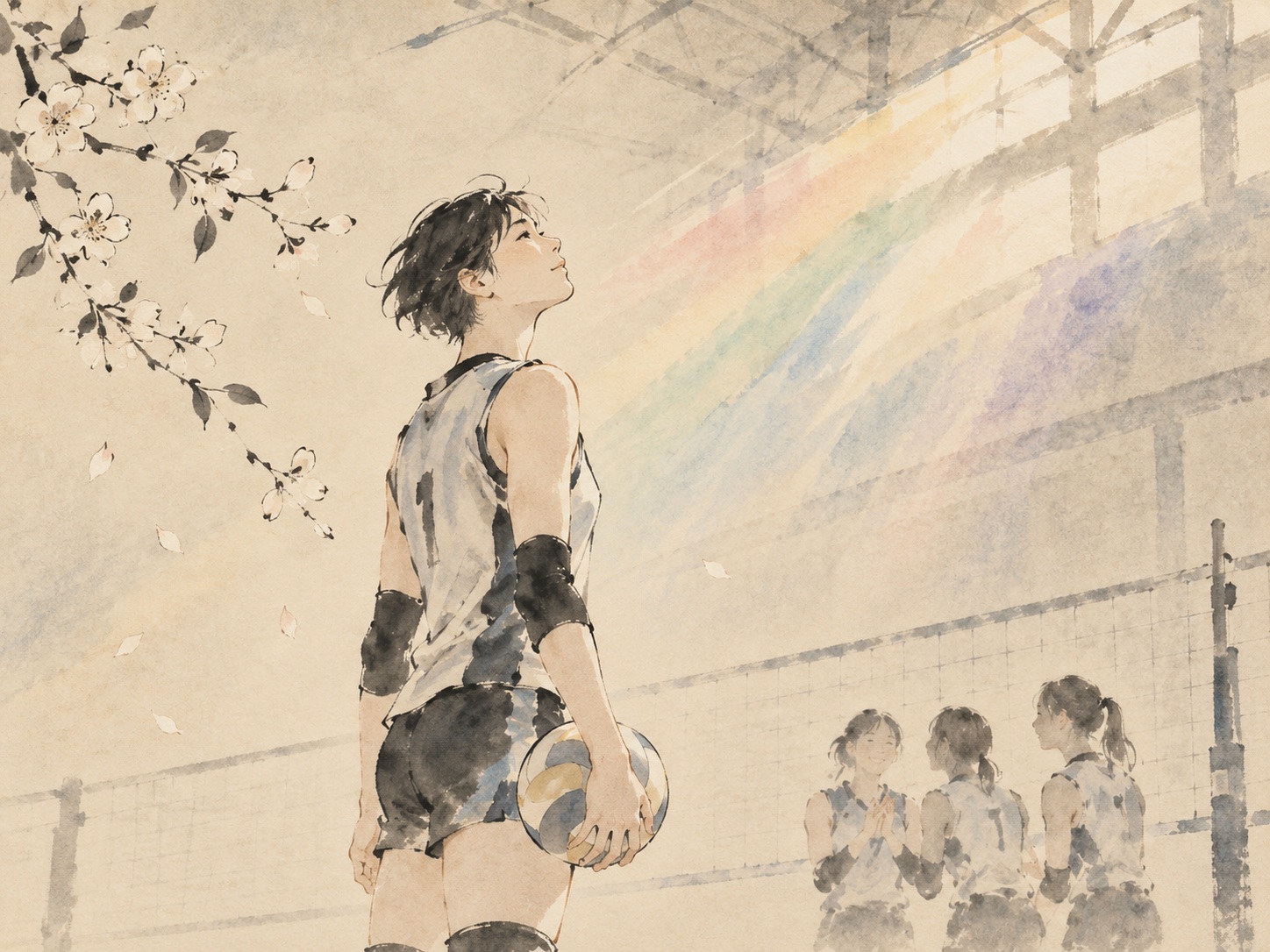
Rui Takahashi, a 26-year-old outside hitter for Suntory Sunbirds Osaka in Japan’s top men’s volleyball league, publicly said on September 29 that he is gay and “one of the sexual minorities.” He did so not after retirement, but while under contract, wearing No. 21 and preparing for another SV.League season.[1][2]
Takahashi wrote that he had feared and denied part of himself since childhood. A major turning point, he said, came during roughly two seasons spent on the same club as his younger brother, Japan national-team star Ran Takahashi. Talking with Ran helped him accept himself for the first time.[1]
A coming-out statement centered on self-acceptance
Takahashi did not frame his announcement as a heroic act or a change in career identity. He thanked family, teammates, staff and others who had supported him, told fans he wanted them to hear the news in his own words before the new season, and said his commitment to volleyball and personal growth would not change.
He also broadened the purpose beyond sexuality. He said he hoped that facing himself and speaking openly might become a small catalyst for people who struggle to accept themselves for many different reasons. The message was less “look at me” than “it is possible to stop denying yourself.”[1]
The player behind the announcement
Suntory’s official profile lists Takahashi as a Kyoto City native who attended Higashiyama High School and Nihon University before joining the Sunbirds in the 2022 season. He is an outside hitter, with a listed reach of 330 centimeters and a playing background that includes third-place finishes at the Inter-High, National Sports Festival and All-Japan University Championship.[3]
SV.League statistics show him appearing in 47 matches and 99 sets in 2025-26. His role leaned heavily toward serving: he delivered 147 serves and recorded 11 aces. He is not primarily a high-volume scoring star; he is a rotational contributor trusted to change particular phases of a match.[4]
Suntory announced in May that Takahashi’s contract had been renewed for 2026-27, and the June roster release again listed him as No. 21. His public statement therefore belongs to an ongoing professional career, not a retrospective after leaving the sport.[2][5]
Two seasons beside Ran
Ran Takahashi is one of Japan’s most prominent volleyball players, an outside hitter who represented Japan at both the Tokyo and Paris Olympics. He joined Suntory for the 2024 season, putting the brothers on the same club for the 2024-25 and 2025-26 seasons. Ran’s official Suntory profile says he began playing volleyball because his older brother played.[6]
Rui said those two seasons were central to accepting himself. Conversations with Ran turned a private fear into something he could put into words.
Sports teams often discuss trust only in competitive terms: communication, chemistry, accountability. Takahashi’s account shows another dimension. A team environment can also determine whether an athlete feels safe enough to understand and describe his own life.
Why openly gay men remain rare in professional sport
The absence of visible gay athletes does not mean they are absent from sport. Sexual orientation is not visible in a box score or player profile. Visibility depends on disclosure, and disclosure depends on whether the perceived benefits outweigh risks to employment, teammates, sponsorship, privacy, family and public treatment.
Japan’s Olympic Committee addressed that invisibility directly at a 2021 sports-journalist seminar featuring former national-team fencer and transgender advocate Fumino Sugiyama. The session focused on diversity in sport from an LGBT perspective and on the difficulty created when sexuality and gender identity are not visible unless someone chooses to disclose them.[7]
In men’s professional sport, additional pressures can come from traditional ideas about masculinity, locker-room culture and fear of fan or sponsor reaction. Japan has had so few openly gay active male professionals that Takahashi’s announcement immediately became national and international news.
Women’s soccer offered earlier examples of visibility
Japan has seen more public LGBTQ+ visibility in women’s football. Shiho Shimoyamada, who played in Japan and Germany, publicly identified as lesbian while continuing her playing career around 2019; Japan Football Association competition records show her as an active player with Sfida Setagaya during that period.[8]
Former Japan international Kumi Yokoyama later publicly discussed his gender identity. JFA records document Yokoyama’s national-team career. Sexual orientation and gender identity are different, and these stories should not be collapsed into one category, but together they show that LGBTQ+ visibility in Japanese sport has grown unevenly across different competitions and genders.[9]
Fumino Sugiyama moved from athlete to governance
Fumino Sugiyama now serves on the board of the Japanese Olympic Committee; the JOC’s 2025-26 officer list includes him among its directors. That matters because LGBTQ+ representation is not only about which athletes are visible on the field. It also concerns who has a voice in the institutions setting policy, education and safeguarding standards.[10]
But governance representation and daily locker-room safety are different things. A league can endorse diversity while an individual player still worries about jokes, outing, social-media abuse or sponsor reaction. Institutional language matters only if it reaches the everyday culture in which athletes work.
The right not to come out is part of inclusion
Japanese coverage of Takahashi’s announcement noted an important public response: people emphasized that coming out or not coming out should remain the individual’s choice, and both decisions deserve respect.[11]
That is a necessary corrective to celebratory coverage. Praising one athlete’s openness should not create a new demand that other LGBTQ+ athletes explain themselves. Disclosure is a right, not a duty.
What clubs can do without turning inclusion into branding
The most useful measures are often ordinary organizational practices: anti-harassment rules that explicitly include sexual orientation and gender identity, confidential reporting channels, careful handling of personal information, inclusive family benefits, sensible travel and accommodation procedures, and clear responses to discriminatory conduct.
Takahashi said teammates, staff and others around him helped him reach the point where he could face himself. That is meaningful testimony about his personal experience. It should not be stretched into an unverified claim that every part of the club’s institutional culture is perfectly inclusive. As of the reporting cutoff, Japan.co.jp did not identify a detailed club policy statement issued specifically in response to his announcement.
Japan’s national policy has also shifted
Japan enacted the Act on Promotion of Public Understanding of Diversity in Sexual Orientation and Gender Identity in 2023. In 2026, the government was discussing and explaining the basic plan required under that law. The legislation is an understanding-promotion framework rather than a comprehensive anti-discrimination statute, but it places diversity of sexual orientation and gender identity on the national policy agenda.[12]
Professional sports organizations sit at the intersection of employment, entertainment, education and community influence. As leagues commercialize, the treatment of athletes becomes both a rights issue and a governance issue.
Rui should not disappear behind Ran’s fame
Much coverage inevitably foregrounds the relationship with Ran, one of Japan’s biggest volleyball stars. Rui himself made those conversations an important part of his announcement. But the older brother’s coming out should not be rewritten as a story whose main character is the famous younger brother.
Rui lived the fear, made the decision and chose the timing. Ran’s support matters because Rui says it mattered. The subject of the story remains Rui Takahashi.
The meaning comes from continuing to play
Perhaps the most consequential part of Takahashi’s announcement is what did not happen: he did not announce retirement. He had already renewed his contract for 2026-27 and spoke just before another season.[2]
When his serve lands in, it will be a point. When it misses, it will be an error. Coaches will make volleyball decisions, and supporters will evaluate volleyball. The ordinary continuation of that process after his sexuality is public is what meaningful inclusion ultimately looks like.
It may be impossible to prove whether Takahashi is the first openly gay active male professional athlete in Japanese history. It is not difficult to establish that such public examples are exceptionally rare, and that an active top-league player choosing to speak while continuing his career is significant.
Takahashi said he hoped his words could become a small catalyst for someone else. That impact cannot be measured in a stat sheet. What can be observed is whether, when the new season begins, Rui Takahashi is allowed to remain exactly what he says he intends to be: himself, and a volleyball player.
Sources and references
- Rui Takahashi, official Instagram account, September 29, 2026 statement; wording corroborated by Jiji Press and Japanese sports reporting.
- Suntory Sunbirds Osaka, 2026-27 contract renewal announcement, May 1, 2026.
- Suntory Sunbirds Osaka, official Rui Takahashi player profile.
- SV.League, official Rui Takahashi player statistics.
- Suntory Sunbirds Osaka, 2026-27 roster announcement, June 17, 2026.
- Suntory Sunbirds Osaka, official Ran Takahashi player profile.
- Japanese Olympic Committee, 2021 sports-journalist seminar on diversity in sport from an LGBT perspective.
- Japan Football Association, 2019 Empress’s Cup roster including Shiho Shimoyamada.
- Japan Football Association, Kumi Yokoyama playing record and overseas-player program.
- Japanese Olympic Committee, 2025-26 board list including Fumino Sugiyama.
- Nikkan Sports, public reaction emphasizing respect for both disclosure and privacy, September 29, 2026.
- Government of Japan, June 16, 2026 briefing on the basic plan under the LGBT understanding-promotion law.
Reporting cutoff: October 4, 2026. No authoritative registry establishes Takahashi as definitively the first openly gay active male professional athlete in Japan, so this article does not make that claim. Japan.co.jp also did not identify a detailed post-announcement club statement specifically setting out Suntory’s LGBTQ+ policies by the cutoff.