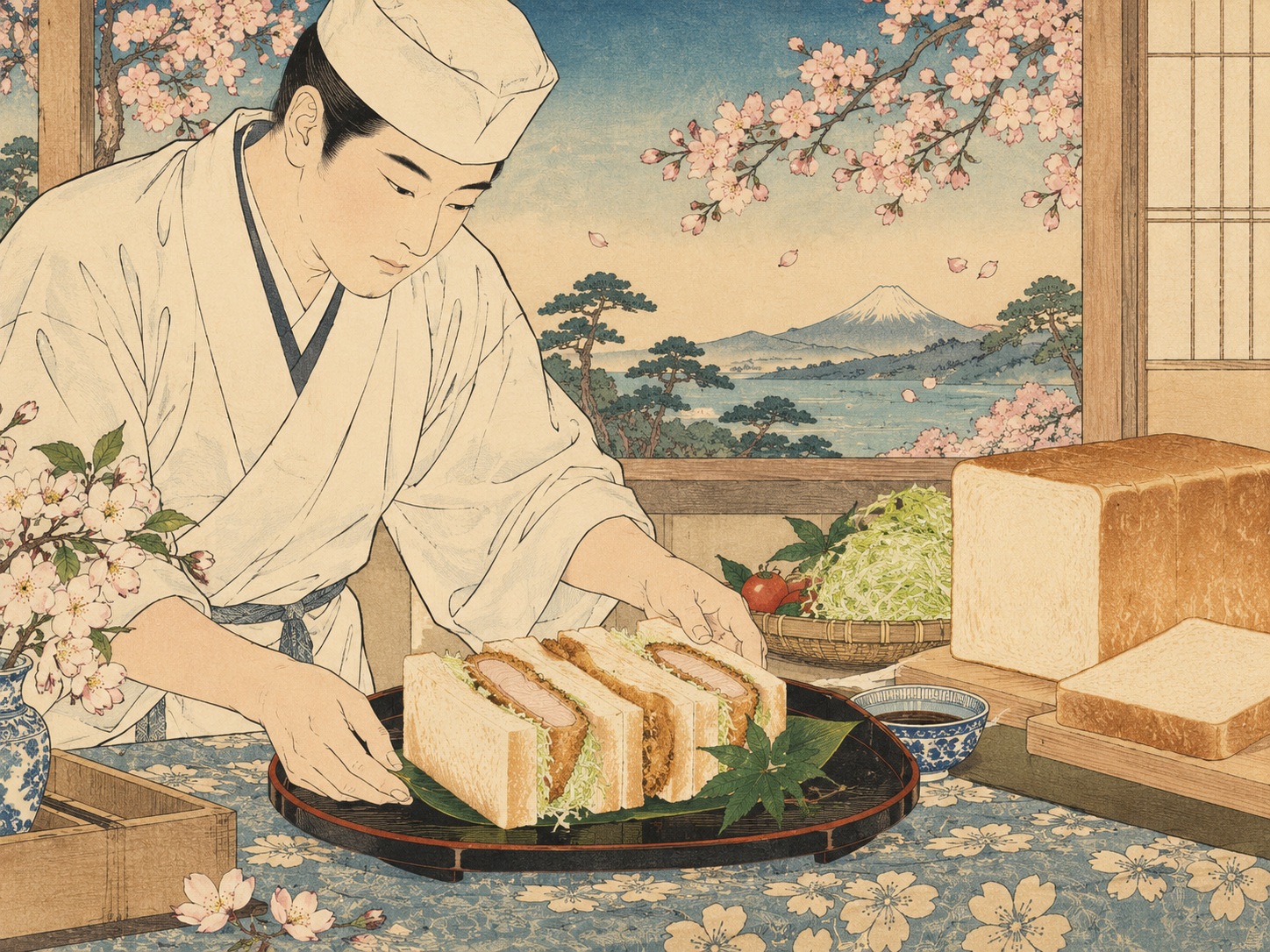
The Japanese sando is almost too ordinary to notice.
Egg sandwiches from convenience stores, katsu sandwiches at stations and airports, mixed sandwiches in kissaten cafes: soft bread wrapped around carefully portioned fillings has long been part of everyday eating in Japan.
Paris-based chef Walter Ishizuka has taken that familiar structure and treated it with the precision of fine dining.
From cheap comfort food to a serious culinary format
The Japan Times traces Yabai Sando to 2022, when Ishizuka opened the shop in Paris’s Odéon district after the disruptions of the pandemic.
During lockdown, he became frustrated with the quality of simple street food and delivery options around him and began thinking about whether inexpensive, casual food could carry the same care as fine dining.
The Japanese sandwich became the vehicle.
Chicken katsu, egg, tuna tataki and wagyu cutlets arrive between soft crustless shokupan, but the sauces move beyond simple reproduction: yuzu aioli, black sesame, ginger and wasabi appear beside techniques shaped by years in French kitchens.
“Sando” is borrowed language that became its own thing
The Japanese word “sando” is a shortened form of the English “sandwich.”
What matters is what happened after the borrowing.
Japanese sandwiches developed a recognizable grammar: soft shokupan, carefully distributed filling, neat cross-sections, modest thickness and portability.
Tamago sando, fruit sando and katsu sando became categories of their own.
As those forms spread internationally, “sando” began functioning in English not simply as a translation of sandwich, but as a label for a specifically Japanese style.
The bread is not background
One of the most important ingredients in Ishizuka’s work is shokupan.
Tuttle includes Ishizuka’s own shokupan recipe and describes the bread as essential to an authentic sando.
Unlike a crusty baguette that asserts itself against the filling, shokupan is soft, fine-textured and structurally supportive.
The relationship is delicate. A crust that is too hard overwhelms it. Too much sauce collapses it. Dry egg filling exposes its softness instead of complementing it.
The apparent simplicity leaves little place to hide.
Katsu sando belongs to Japan’s longer yoshoku story
Katsu sando also sits inside a wider history of yoshoku—Western-derived dishes adapted into Japanese eating culture.
Tonkatsu itself evolved from European-style cutlets into a Japanese dish built around panko crust, shredded cabbage and thick sauce.
Putting the cutlet between slices of bread made it portable.
Today, katsu sandwiches are sold in department stores, station shops, airports, convenience stores and specialist restaurants.
Ishizuka keeps that form recognizable while moving its culinary context upward with wagyu, ginger-wasabi sauces and fine-dining balance.

The wagyu sando captures the whole idea
One of the signature recipes is the wagyu beef sando.
Tuttle describes a wagyu cutlet paired with wasabi-sriracha mayonnaise and sweet-tart pickled red onions.
That combination puts Japanese beef, Japanese condiment logic, Southeast Asian-American hot-sauce culture and French-trained sauce construction inside the same sandwich.
The result is not simply Japanese food exported unchanged. It is a Japanese format used to reorganize international flavors.
Lobster and truffle fit because the structure is so simple
The book moves well beyond the classic convenience-store repertoire.
A truffle grilled cheese combines cheddar with truffle mayonnaise. A lobster sando uses citrus, mint and ginger mayonnaise. Smoked salmon and wakame appear on charcoal shokupan. There is also a chocolate-hazelnut dessert version.
The sandwiches remain visually legible as Japanese sandos even as the fillings travel across cuisines.
Fine dining and portability are not opposites
Fine dining is often associated with tasting menus, elaborate plating and long service rituals.
Ishizuka compresses those decisions into something held in two hands.
Acid, fat, heat, crunch, bread moisture, temperature and cutting precision all have to be resolved before the sandwich is closed.
The appearance stays familiar while the internal construction becomes more exacting.
Japan’s convenience-store culture helped prepare the global audience
The international rise of tamago, fruit and katsu sandos cannot be separated from tourism and Japan’s convenience-store culture.
For many visitors, Japanese convenience stores became showcases for quality control, packaging, seasonality and accessible prepared food.
Sandwiches were part of that discovery.
Soft bread, carefully centered fillings and clean packaging made even a low-cost snack feel culturally distinct.
That helped “sando” travel abroad as a recognizable idea rather than just another sandwich.
Ishizuka’s career was built in French kitchens
Tuttle’s author biography describes more than two decades of work in elite European restaurants and hotels.
His résumé includes Paul Bocuse’s restaurant near Lyon, The Ritz in Paris and The Connaught in London. He later became head chef of Rivié at The Hoxton Paris.
Viewed conventionally, opening a sandwich shop after that career could look like a move down the culinary hierarchy.
In practice, it became a test of whether high-level technique can be translated into a form anyone understands instantly.
The cookbook sends restaurant technique back into the home
The new book completes an interesting circle.
Ishizuka took an everyday Japanese format into a Paris restaurant, refined it with fine-dining methods, and now breaks those methods down for home cooks.
The 45 recipes are accompanied by instructions for shokupan, tempura, miso soup, pickles and multiple sauces.
The point is not simply to admire a restaurant sandwich. It is to understand how it was built.
Is the sando actually “Japanese food”?
The answer depends on what counts as Japanese cuisine.
Bread and sandwiches are not indigenous to Japan. Mayonnaise, cutlets, ham and cheese entered through foreign influence.
But Japan recombined those ingredients into a distinct format: shokupan, egg salad, fruit and cream, tonkatsu, immaculate cuts and carefully managed softness.
Japanese food history repeatedly works this way—absorbing outside techniques, then transforming them until the adaptation becomes culturally specific.
Why the word itself matters overseas
When a restaurant in Paris, London or New York calls something a “sando” rather than a Japanese sandwich, the word is doing cultural work.
It signals that the form has become recognizable enough to carry its Japanese name.
“Sando” is nowhere near as globally universal as sushi, ramen or tempura. But the direction is similar.
Wagyu katsu sando, tamago sando and fruit sando now appear on international menus under Japanese terminology.
There is also a risk in making humble food luxurious
The transformation is not automatically positive.
A food that began as an accessible snack can become expensive once it is paired with wagyu, lobster and truffle and placed inside an upscale restaurant context.
Luxury ingredients alone do not demonstrate understanding of Japanese sandwich culture.
What makes Ishizuka’s approach more interesting is his attention to the form itself: the softness of the bread, thickness of the filling, balance of sauce and the fact that the whole thing still needs to work as something held and eaten by hand.
Global Japanese food has never depended on purity
Debates about Japanese food overseas often turn quickly toward “authentic” versus “inauthentic.”
The sando makes that distinction awkward.
It is already an adaptation of a Western sandwich.
Now that Japanese adaptation has moved to Paris, absorbed French culinary technique and returned to the world in another form.
That circular movement may be a better model for modern Japanese food culture than a one-way idea of export.
An international cuisine inside a square of bread
The 45 recipes in “Sando” share a remarkably simple architecture.
Two pieces of bread. Filling in the middle.
Inside that structure can sit tonkatsu, wagyu, lobster, wakame, truffle or yuzu.
That is the strength of the form.
The simpler the structure, the more cultural variation it can absorb.
Walter Ishizuka has not merely made Japanese sandwiches more expensive. His work shows how a small, familiar Japanese food format can become a language for combining cuisines without losing its basic identity.
Sources and references
- Tuttle Publishing — “Sando: The Art of the Japanese Sandwich,” Walter Ishizuka, published September 22, 2026.
- Google Books — “Sando: The Art of the Japanese Sandwich,” bibliographic record.
- The Japan Times — “‘Sando: The Art of the Japanese Sandwich’ elevates the humble bite,” October 4, 2026.
- Hachette Pratique / Google Books — French edition of Walter Ishizuka’s “Sando,” 2024.
Reporting cutoff: October 6, 2026, 8:05 a.m. JST. Publication date, 128-page length, 45 recipes, author biography and recipe examples are verified through Tuttle Publishing. Yabai Sando’s 2022 opening and culinary framing are supported by The Japan Times. Because secondary histories differ on the exact inventor and date of katsu sando, this article avoids presenting a single origin claim as settled fact.
Why it matters
Ishizuka applies fine-dining technique to one of Japan’s most familiar casual-food formats rather than abandoning the format itself.
The book
Forty-five recipes move from tonkatsu and wagyu to lobster, truffle, wakame and dessert sandos.
The larger story
The overseas use of the word “sando” shows Japanese food culture spreading through adaptation, not cultural purity.