- A biological problem in an ocean of water
- What the researchers actually published
- The unusual route sperm must travel
- Why dead specimens gave only part of the answer
- The flower-bud arrangement
- The viscous layer with sperm inside
- A line of inquiry stretching back years
- Why this matters beyond a single squid
- Observation, hypothesis and the missing experiment
- The case for looking at living animals
A biological problem in an ocean of water
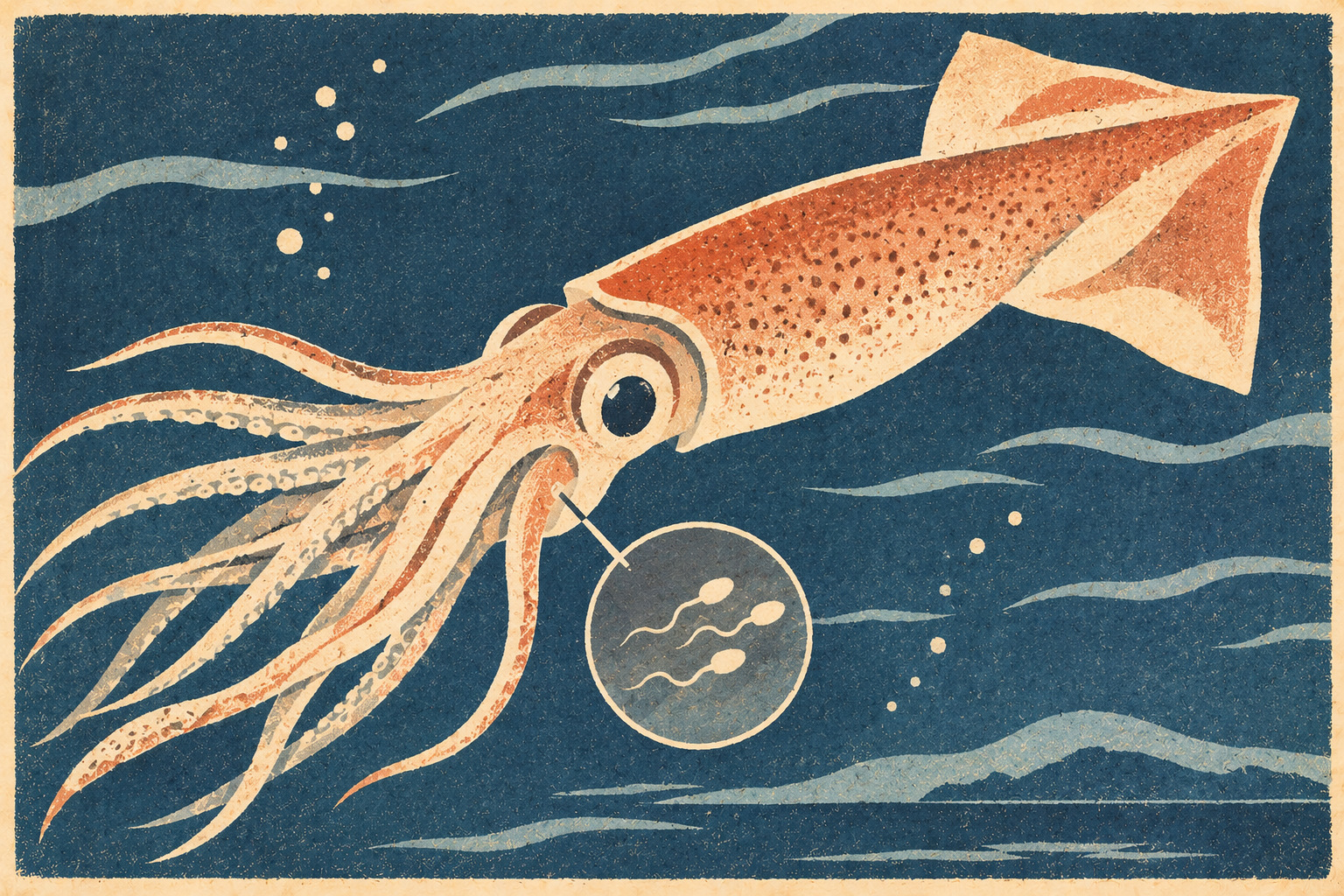
A squid releases sperm into a world built to wash small things away. Seawater moves, dilutes, and disperses. Yet sperm delivered by a male Japanese flying squid must find its way to storage organs around the female’s mouth and remain available until spawning. How that transfer works without losing much of the sperm has been a surprisingly persistent question.
A Hokkaido University team has now identified two anatomical features that may help solve it: a flexible membrane that closes like a flower bud around the mouth, and a transparent, sticky layer containing numerous sperm. The findings are unusually tangible. They also come with a crucial qualification: the researchers have proposed a mechanism, not yet measured exactly how much sperm the mechanism saves.
What the researchers actually published
The paper appeared online in the peer-reviewed journal Marine Biology on September 11, 2026, as article 191 in volume 173. Hokkaido University announced it on November 6. The authors are Jun Yamamoto, John R. Bower, Hajime Matsui, Mitsuhiro Nakaya and Kento Suzuki. Yamamoto is an assistant professor at the university’s Field Science Center for Northern Biosphere; Bower is an associate professor in its Faculty of Fisheries Sciences.
Even the paper’s title is deliberately cautious: “Functional morphology of the buccal membrane suggests a mechanism limiting sperm dispersal in the Japanese flying squid Todarodes pacificus.” The word “suggests” matters. The anatomy and the sticky layer were observed; the protective role is an inference that invites further testing.
The unusual route sperm must travel
In Japanese flying squid, mating involves packets of sperm placed around the female’s mouth. A male’s spermatophores produce structures called spermatangia that attach near her lips and release sperm. The sperm must then reach small storage organs called seminal receptacles in the buccal membrane—the flexible tissue surrounding the mouth.
These names are easy to confuse. Spermatangia are a source of sperm after mating; seminal receptacles are the structures that store it. Neither is simply an ordinary human-like reproductive tract. The steps between deposition, movement, storage and eventual fertilization have been studied unevenly, especially because the relevant tissues are delicate.
Why dead specimens gave only part of the answer
Much anatomical knowledge begins with a preserved or dissected specimen. But a squid’s soft tissue can change shape after death. In particular, the tissue surrounding the mouth may lose the three-dimensional configuration that it has in a living animal. A flat, open-looking membrane on a specimen cannot necessarily tell a scientist how water moves around it in the sea.
The team studied females that had already mated, observing the mouth area underwater while the animals were alive. They also examined excised tissue. That combination makes this more than a new image of familiar anatomy: the researchers could compare the living configuration with structural details that are difficult to see in moving animals.
The flower-bud arrangement
The team found that the buccal membrane closed around the lips in a form the university compared to a flower bud. The arrangement created a narrow space and brought the openings of the sperm-delivering spermatangia close to the sperm-storing seminal receptacles.
Distance matters here. If sperm can travel within a constrained space instead of moving directly through freely circulating seawater, there may be fewer opportunities for them to drift away. It is a plausible physical explanation, not a claim that the investigators have mapped every water current around a wild squid.
The viscous layer with sperm inside
A second observation strengthens the hypothesis. The inner surface of the membrane contains lengthwise folds. Across those folds the scientists found a clear, viscous layer holding many sperm. Gentle movements of the surrounding water did not easily remove it.
The membrane’s shape might restrict water exchange, while the viscous material may hold sperm near their destination. The precise composition of that material, its response to stronger flows, and its contribution to actual fertilization success remain questions. The paper’s observations should not be mistaken for an engineering recipe or a quantified conservation intervention.
A line of inquiry stretching back years
The latest work builds on earlier research into the squid’s spawning process. A 2019 study in Scientific Reports documented close-up observations of spawning in a captive Japanese flying squid and described the anatomical route involving spermatangia and seminal receptacles. It also made clear how many parts of sperm movement and fertilization remained unknown.
Earlier scientists had proposed that female squid might position the buccal membrane so sperm could reach the receptacles. The living anatomy described in 2026 supplies a more detailed structural picture. It does not mean that every step—from sperm release to the precise instant of egg fertilization—has now been directly observed.
Why this matters beyond a single squid
Japanese flying squid are familiar in Japanese fisheries and on restaurant menus, but familiarity is not the same as biological understanding. The species occurs widely in waters around Japan, with seasonally distinct groups and complicated migrations. Fisheries Research and Education Agency material describes major autumn- and winter-spawning groups and an approximately annual life cycle.
For a short-lived species, successful reproduction is fundamental to the next generation. But explaining a microscopic reproductive mechanism is not the same as explaining a stock decline. Ocean conditions, fishing pressure and changes in distribution can all complicate fishery outcomes. This study did not test stock-recovery measures or demonstrate a change in catches.
Observation, hypothesis and the missing experiment
There is an important difference between seeing sperm persist in a viscous layer and proving that a particular arrangement raises fertilization rates by a measurable amount. A definitive functional test might compare dispersal under different water flows or altered membrane conditions. The November 6 announcement explicitly says further experimental verification is needed to determine how strongly the structure limits dispersal.
That makes the research no less valuable. Many discoveries in functional morphology begin by identifying an overlooked structure and proposing what it could do. Here the result is a carefully bounded explanation for a problem that conventional dissection could not settle.
The case for looking at living animals
The most compelling lesson is methodological. A flexible membrane may seem unremarkable when examined after an animal has died. In a living squid, surrounded by water, its folded shape becomes part of a possible reproductive system: an enclosed channel and a sticky surface working together.
The researchers have opened a new chapter rather than written the final one. Their study offers a physical reason sperm might remain near the female’s storage organs in an enormous ocean. For a familiar Japanese species, that is a substantial advance—and a reminder that some of the most consequential marine adaptations are almost invisible until someone finds a new way to look.
Sources and reporting method
Reporting method: A document-based review of the peer-reviewed paper’s publicly accessible abstract, Hokkaido University’s Japanese announcement, earlier research and fisheries-resource material. No independent researcher interviews were conducted.
- 北海道大学、2026年11月6日研究発表 / Hokkaido University, November 6 release
- Yamamoto et al., Marine Biology 173, article 191 (2026), abstract and bibliographic record
- Yamamoto et al., Close-up observations on spawning behavior, Scientific Reports (2019)
- 水産研究・教育機構、令和7年度 国際漁業資源の現況 / Fisheries Research and Education Agency, resource review
- 水産研究・教育機構、スルメイカ秋季発生系群の資源評価(2025年12月公表)