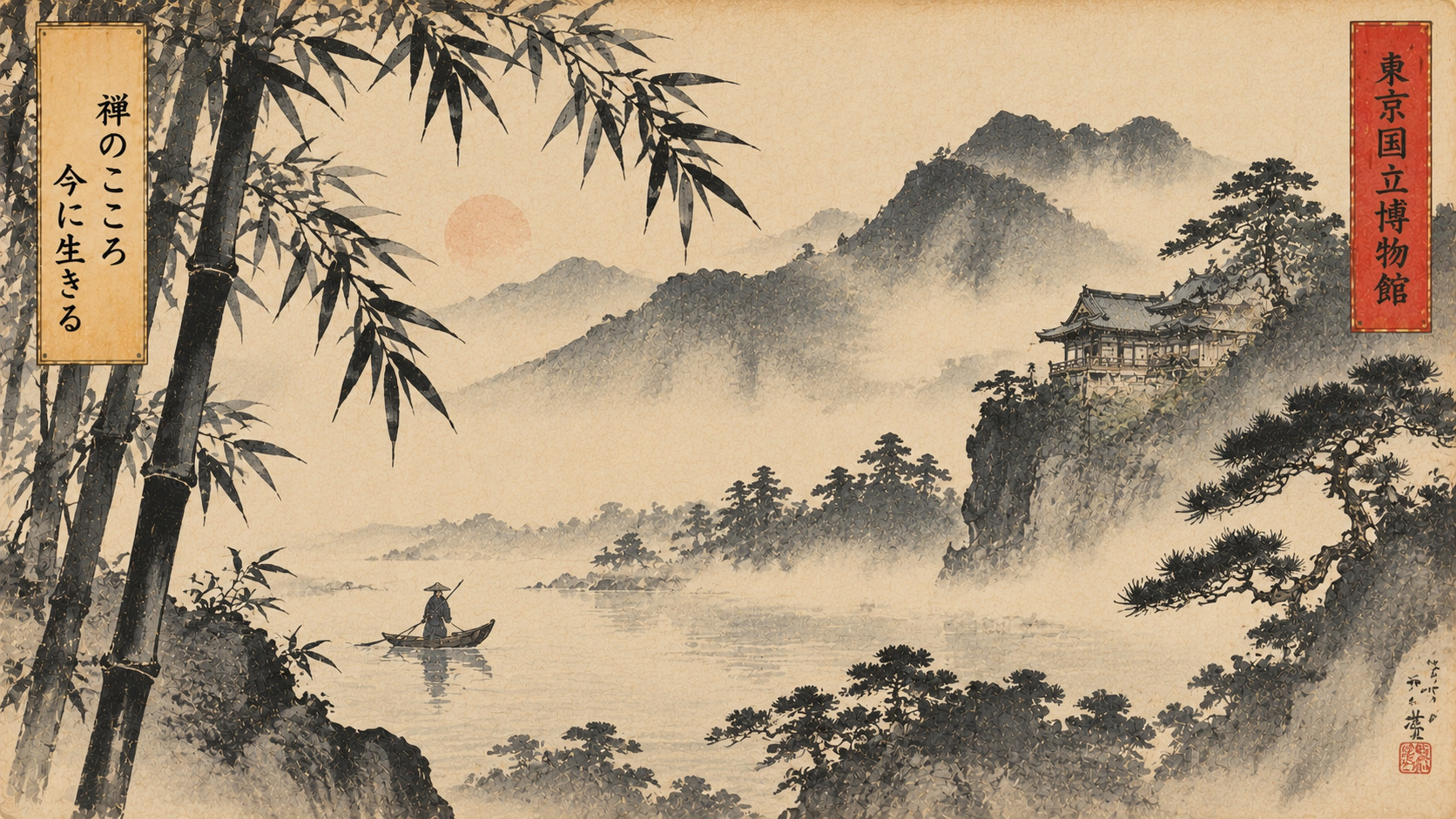
A painting does not need color to occupy a room
A few strokes of black ink can suggest a hillside, a face, even the air between two objects. Yet the most rewarding question is not whether Japanese ink painting looks serene. It is how works of ink and calligraphy became embedded in a network of Zen monasteries, patrons and working artists that still shapes how Japan sees its past. Tokyo National Museum has given visitors an unusually direct route into that history.
Its Honkan Gallery Room 13 opened a new display, “Zen and Ink Painting | 13th–16th century,” on October 20, running to December 6. The selection is coordinated with the much larger Daitokuji 700th-anniversary exhibition at the museum’s Heiseikan, which opened October 14. Together they invite comparison between the compact encounter with an object and the historical institution that preserved it.
Six objects, not an imaginary survey
The museum’s October 20 checklist contains six entries. Among them is a grape painting dated 1491 by Botsurin Shōtō, a portrait of Ikkyū Sōjun, writings by Ikkyū and by the Daitokuji founder Shūhō Myōchō, and two groups of paintings formerly installed in the abbot’s quarters at Daisen-in.
The last two are designated Important Cultural Properties and are attributed to Kanō Motonobu: “The Studious Woodcutter Zhu Maichen” and “Fruit.” The Japanese checklist says *den*—traditionally attributed to—not a conclusively proven signature. That distinction matters. An art-historical claim should not become more certain merely because a headline needs to be short.
Ink was part of an international exchange
Japanese ink painting did not spring spontaneously from a national preference for minimalism. The full establishment of Zen Buddhist institutions from the Kamakura period brought direct engagement with Chinese Song- and Yuan-period pictures, writing practices and elite aesthetic culture. The techniques were adapted, contested and broadened in Japan over successive generations.
Monks traveled, books and paintings circulated, and religious establishments became repositories of cultural knowledge. At the same time, professional painters and military elites developed their own uses for ink painting. Calling every ink picture “Zen art” can obscure those patrons and the practical settings in which the objects were made.
What a painter leaves out
Much of ink painting’s expressive range lies in its apparent economy. Water controls how black becomes gray; the absorbency of the support changes an edge; an abrupt brush movement can register energy that a carefully modeled contour cannot. An unpainted space may evoke fog, sky, distance or the viewer’s own perception.
But blank space is not a certificate of spiritual profundity. Composition also answers to Chinese models, workshop conventions, religious requirements and the architecture of the building. To understand a picture, it is necessary to ask who saw it, where it hung and what it was expected to do.
The room itself was once part of the picture
Daisen-in’s former sliding-door and wall paintings are especially revealing. They were components of a lived architectural environment, not autonomous framed rectangles. Panels divided interiors; a viewer moved through them; paper surfaces took on different visual force as daylight shifted.
The museum identifies the works as former *hōjō shōhekiga*, paintings from the abbot’s quarters. That provenance is not a picturesque footnote. It changes the object of inquiry from a beautiful image to an organized room—and from an isolated masterpiece to the collective work of patrons, artists and craftspeople.
Writing as a trace of a person
The display also offers the chance to look at *bokuseki*, calligraphy associated with Zen monks. The characters carry linguistic meaning, but each stroke also records a bodily action: pressure, speed, pause and recovery. The space between signs is just as deliberate as the shape of the ink itself.
A writing by Shūhō Myōchō addressed to Kakudōjin and another by Ikkyū Sōjun concerning the founder’s sermon are listed for this display. Shūhō, honored as Daitō Kokushi, founded Daitokuji. The objects connect the history of the monastery to the physical marks made by figures associated with its tradition.
Daitokuji’s seven centuries
Daitokuji dates its founding to 1326. Located in Kyoto’s Murasakino district, it flourished with imperial patronage and later established connections among warriors, monks and practitioners of tea. The anniversary exhibition marks that 700-year span, bringing works from Daitokuji and its subtemples into Tokyo.
The museum describes this as the first such large presentation in Tokyo and notes a long interval since a comparable gathering of treasures usually kept from public view. The associated Room 13 display makes the historical question approachable through a tightly focused selection of paintings and inscriptions rather than through scale alone.
Tea, power and painting
Later Daitokuji history involves the political world of the warlords and the development of tea culture, including Sen no Rikyū. These ties explain why painting, calligraphy, gardens and ceramics are so often encountered together in discussions of Japanese aesthetics. They also explain why the survival of an artwork is entangled with the fortunes of an institution.
The temptation is to tell a seamless story in which Zen automatically produced every admired Japanese design principle. The historical record is more complex. Courtly, mercantile, Chinese and professional artistic traditions also contributed—and their interactions varied by century and by patron.
Beyond the familiar name of Sesshū
International introductions to Japanese ink painting often rely heavily on Sesshū Tōyō, deservedly a central figure. Yet the October 20 checklist does not list a work by Sesshū. Advertising this as a Sesshū show would be a straightforward factual error.
The attraction here is different: works and attributions that make visible a community of monks, painters and patrons. The 1491 grape painting, the inscriptions and the Daisen-in panels are not interchangeable illustrations of “Zen simplicity.” Each has a specific date, material history and place in the museum’s account.
Why the historical method matters now
Contemporary graphic design, architecture and publishing frequently celebrate negative space and restraint. It is easy to describe that resemblance as Zen influence; proving a direct line of transmission requires far more evidence. The museum’s objects reward a less promotional kind of looking: attending to what survives, what was moved and what is still uncertain.
That approach offers a surprisingly modern lesson. A convincing visual story can emerge from delicate evidence and careful attribution, not from a sweeping claim about an entire civilization.
Planning a visit—and knowing the limits
“Zen and Ink Painting | 13th–16th century” is listed for October 20–December 6 in Honkan Room 13. The related anniversary special exhibition, “Daitokuji: The Unrivaled Zen Monastery of Japan,” is listed for October 14–December 6 in the Heiseikan. Tickets and viewing conditions may differ; consult the museum before traveling.
This article draws on the museum’s published checklist and exhibition descriptions, not on a visit, independent conservation analysis or interviews with curators. Object changes and any revised schedule should be checked against the museum’s current listings.
Sources and documentation
Based on official museum collection and exhibition documentation; no curator interview or in-person verification.